Kling 4.0 + GPT Image 2.6 - 8 lighting styles on one clip, one per second
Relight one phone clip into 8 lighting styles that switch exactly once per second
 Tested by Nouamane Benbrahim
Disclaimer: This is an independent creative test made with AI, for demonstration only. It isn't an ad for any brand shown or named, and isn't affiliated with, sponsored or endorsed by them. All trademarks belong to their owners
This is the video I posted on Instagram, here's the link if you want to watch it with sound.
In this post you'll learn how to:
- Relight one phone clip into 8 different lighting styles
- Copy the look of someone else's video without copying their room or their face
- Make the look switch exactly once per second, right on the beat
- Keep your real typing and movement the same across every look
I saw a reel where a guy sits in an armchair on his laptop and the lighting changes every second. Directional light, silhouette, golden hour, neon, all on the same shot. I wanted to do the same thing on my own clip, but without buying a single lamp.
So I filmed myself doing basically the same thing, typing on my laptop in an armchair, and relit it 8 times with AI.
Here's my exact process.
1. Film the clip and pick the 8 seconds
I filmed about 20 seconds of myself typing, on my phone, locked off. Then I skipped the first 2 seconds, because I keep those untouched as the opener where the title shows up, and cut the next 8 seconds out. That's one second per look.
2. Grab a frame of each look you want to copy
Then I went through the reel I was copying and pulled one frame from the middle of each look I wanted: directional light, silhouette, golden hour, rim backlight, screen glow, teal and orange, neon and projector lamp.
I only use these for the vibe, meaning the light, the color and the patterns on the wall. I don't take the guy, his chair, his room or the text on screen.
3. Pull a frame of yourself on each exact second
Now I pulled a frame of my own clip exactly on each second: 0, 1, 2, all the way to 7. Right on the second, because that's the exact frame where each look starts in the final cut.
4. Relight each frame into its look
Then I made one relit still per look. Each one gets two references: my frame for that second first, and the frame from the reel second.
In the prompt I tell it the first image is the whole photo, me, my clothes, the chair, the wall, the framing. The second image is the lighting style only, take nothing else from it. I also lock my head to the same size as in my frame and ask for a real photo, not an illustration.
And I never let it add lamps. The projector look gets a big orange circle on the wall, but no projector anywhere in the shot. Same thing for neon, colored light on the wall and on me, but no neon tubes.
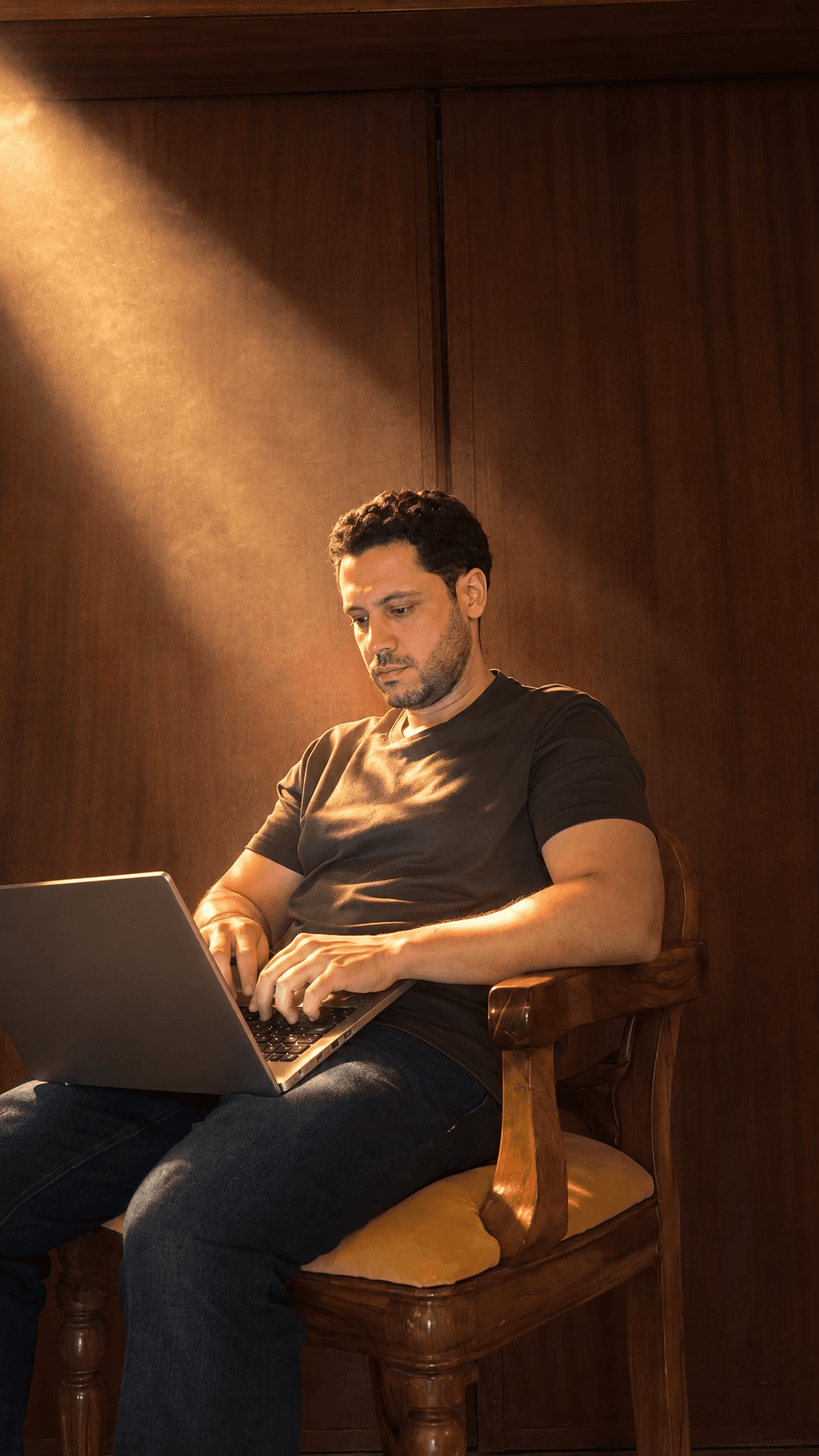
Exact prompt
Keep the first reference exactly: the same camera, framing, crop, place, pose, expression and clothes. Change only the light, color and finish, to the lighting style of the second reference: DIRECTIONAL LIGHT. THE VIBE: A real iPhone photo of a man working on his laptop in a quiet room, now lit by one dramatic shaft of warm sunlight cutting through the dark. Moody, cinematic, still. IDENTITY LOCK: The man from the first reference, preserved exactly: his face, short dark hair, beard and build, no aging. The first reference sets his head size, head shape, body and proportions, never larger. REFERENCE ROLES: The first reference is the whole photo: the man, his dark grey t-shirt and blue jeans, the silver laptop, the carved wooden armchair with the yellow cushion, the reddish wood-panelled wall, and the framing. The second reference is the lighting style only: its single diagonal sunbeam through haze. Take NOTHING else from it: not the other man, his beanie, sweater or beard, not his armchair, room, plant, sofa or picture frames, and none of its white text. No text anywhere in the image. THE SUBJECT: Same seated pose as the first reference, typing on the laptop on his lap, eyes down on the screen. THE SETTING: The same wood-panelled wall and carved armchair as the first reference. No new lamps, windows, fixtures or objects in frame: only the light changes. THE LIGHT: KEY: one hard shaft of warm golden-white sunlight angles down steeply from the upper left of frame, a clearly visible diagonal beam through light haze, landing on his face, shoulder, arms and hands. FIELD: everything outside the beam falls three to four stops under, the wood wall a deep dim brown, with one bright warm patch where the beam hits the wall. No fill. GRADE: warm amber highlights, deep brown-black shadows, rich contrast. THE MOOD: quiet focus, cinematic. THE COMPOSITION: identical to the first reference, his head the same size and in the same spot, same crop from the top of the wall panels to his knees and the chair legs, no zoom. THE CAMERA: the same vertical phone shot as the first reference. THE AFTER EFFECT: visible dust and haze inside the beam, soft fine film grain. A real photo of a real person in real light, not an illustration, painting or render.
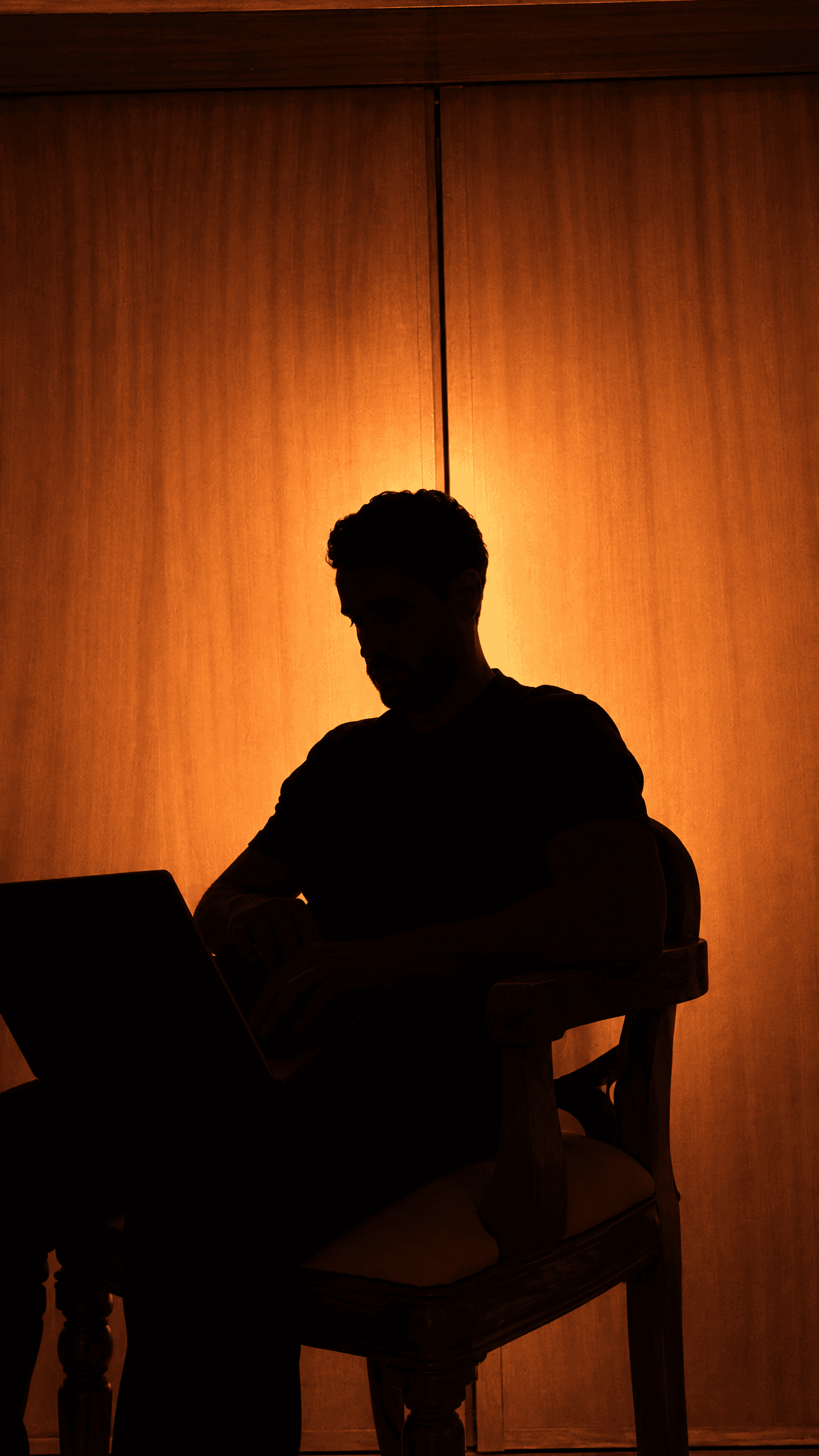
Exact prompt
Keep the first reference exactly: the same camera, framing, crop, place, pose and clothes. Change only the light, color and finish, to the lighting style of the second reference: a full SILHOUETTE. NO light on the front of his face or body. His face is NOT visible: no readable eyes, nose or skin tone. THE VIBE: A real iPhone photo of a man working on his laptop, reduced to a solid black shape against a glowing warm wall. Graphic, mysterious, cinematic. IDENTITY LOCK: The man from the first reference: his exact outline, head shape, short dark hair, beard profile and build, no aging. The first reference sets his head size, head shape, body and proportions, never larger. REFERENCE ROLES: The first reference is the whole photo: the man, his dark grey t-shirt and blue jeans, the silver laptop, the carved wooden armchair with the yellow cushion, the reddish wood-panelled wall, and the framing. The second reference is the lighting style only: a dark figure in front of a bright warm-lit wall. Take NOTHING else from it: not the other man, his beanie, sweater or beard, not his armchair, room, plant, sofa or picture frames, and none of its white text. No text anywhere in the image. THE SUBJECT: Same seated pose as the first reference, typing on the laptop on his lap, head tilted down to the screen. THE SETTING: The same wood-panelled wall and carved armchair as the first reference. No new lamps, windows, fixtures or objects in frame: only the light changes. THE LIGHT: KEY: none. He, the laptop and the chair are five stops under the wall, a near-solid black silhouette; his face, shirt, jeans and the chair read as black with at most the faintest edge where the wall light wraps around his hair, ear, beard line and shoulders. No fill from the front, no screen light on his face. FIELD: the wood wall behind him glows bright, washed by warm orange-amber light from out of frame below, brightest in a soft pool right behind his head and shoulders, falling off to darker amber toward the corners and top. GRADE: glowing orange-amber wall, pure black figure, maximum contrast. THE MOOD: mysterious, calm. THE COMPOSITION: identical to the first reference, his head the same size and in the same spot, same crop from the top of the wall panels to his knees and the chair legs, no zoom. THE CAMERA: the same vertical phone shot as the first reference, exposed for the bright wall. THE AFTER EFFECT: soft fine film grain. A real photo of a real person in real light, not an illustration, painting or render.
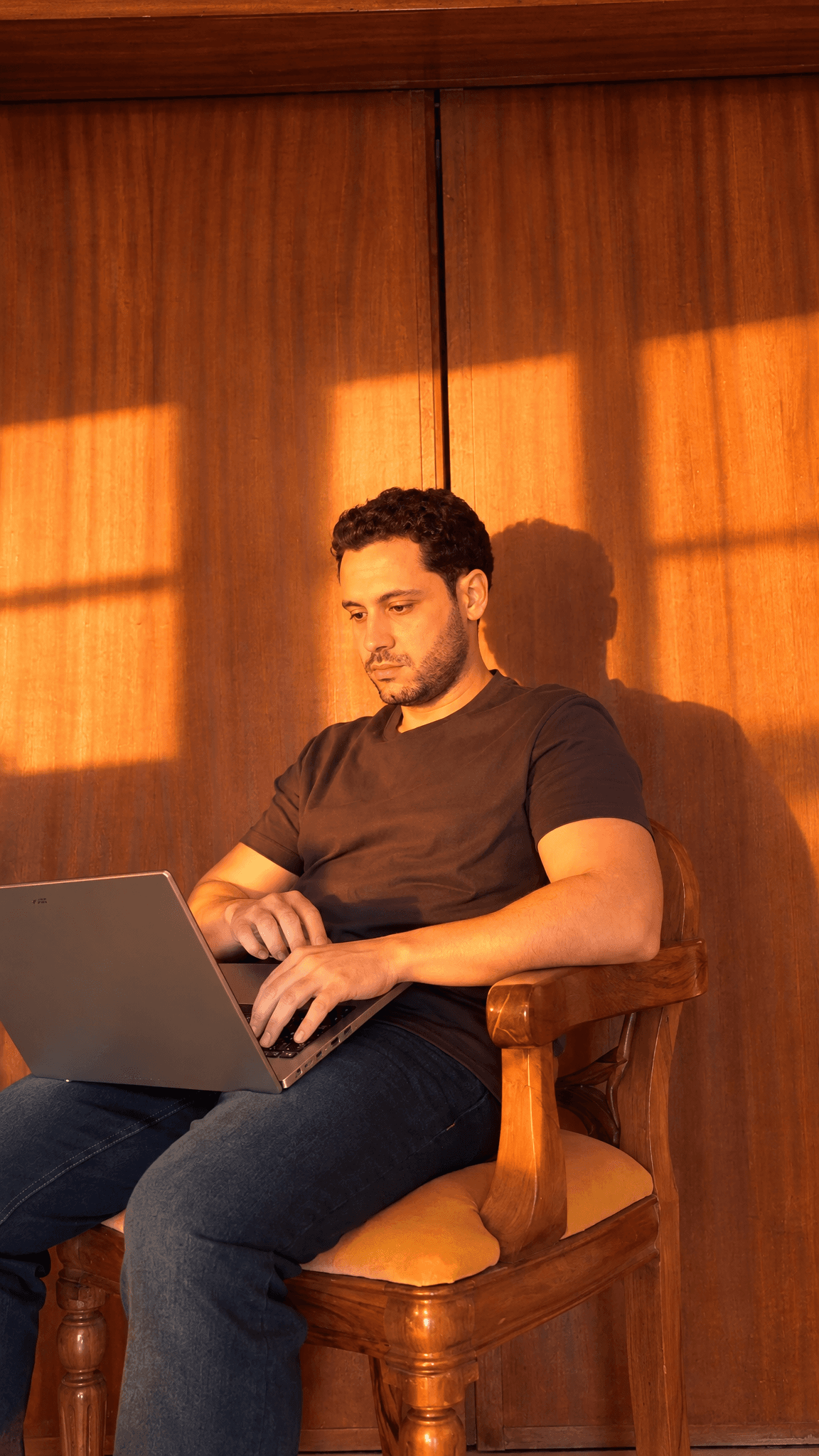
Exact prompt
Keep the first reference exactly: the same camera, framing, crop, place, pose, expression and clothes. Change only the light, color and finish, to the lighting style of the second reference: GOLDEN HOUR. THE VIBE: A real iPhone photo of a man working on his laptop as low late-afternoon sun cuts across the room and across him. Warm, glowing, nostalgic. IDENTITY LOCK: The man from the first reference, preserved exactly: his face, short dark hair, beard and build, no aging. The first reference sets his head size, head shape, body and proportions, never larger. REFERENCE ROLES: The first reference is the whole photo: the man, his dark grey t-shirt and blue jeans, the silver laptop, the carved wooden armchair with the yellow cushion, the reddish wood-panelled wall, and the framing. The second reference is the lighting style only: low golden sun through a window, hitting the person and casting window-shaped patches. Take NOTHING else from it: not the other man, his beanie, sweater or beard, not his armchair, room, plant, sofa or picture frames, and none of its white text. No text anywhere in the image. THE SUBJECT: Same seated pose as the first reference, typing on the laptop on his lap, eyes down on the screen. THE SETTING: The same wood-panelled wall and carved armchair as the first reference. No new lamps, windows, fixtures or objects in frame: only the light changes. THE LIGHT: KEY: low, hard, saturated golden-orange sunlight from a window out of frame on the left, raking across almost horizontally at head height. It hits HIM directly: a bright, crisp golden band across the left side of his face, beard, neck and shoulder, his arm and hands glowing, with hard-edged shadows on the right side of his face falling about two stops under. FIELD: crisp rectangular window-pane patches of golden light fall on the wood wall around and behind him, his head casting a sharp shadow on the wall to the right; between the patches the wall sits in warm shade two stops under. GRADE: rich golden-orange highlights, warm brown shadows, soft glow. THE MOOD: warm, nostalgic, end of the day. THE COMPOSITION: identical to the first reference, his head the same size and in the same spot, same crop from the top of the wall panels to his knees and the chair legs, no zoom. THE CAMERA: the same vertical phone shot as the first reference. THE AFTER EFFECT: soft highlight glow, fine film grain. A real photo of a real person in real light, not an illustration, painting or render.
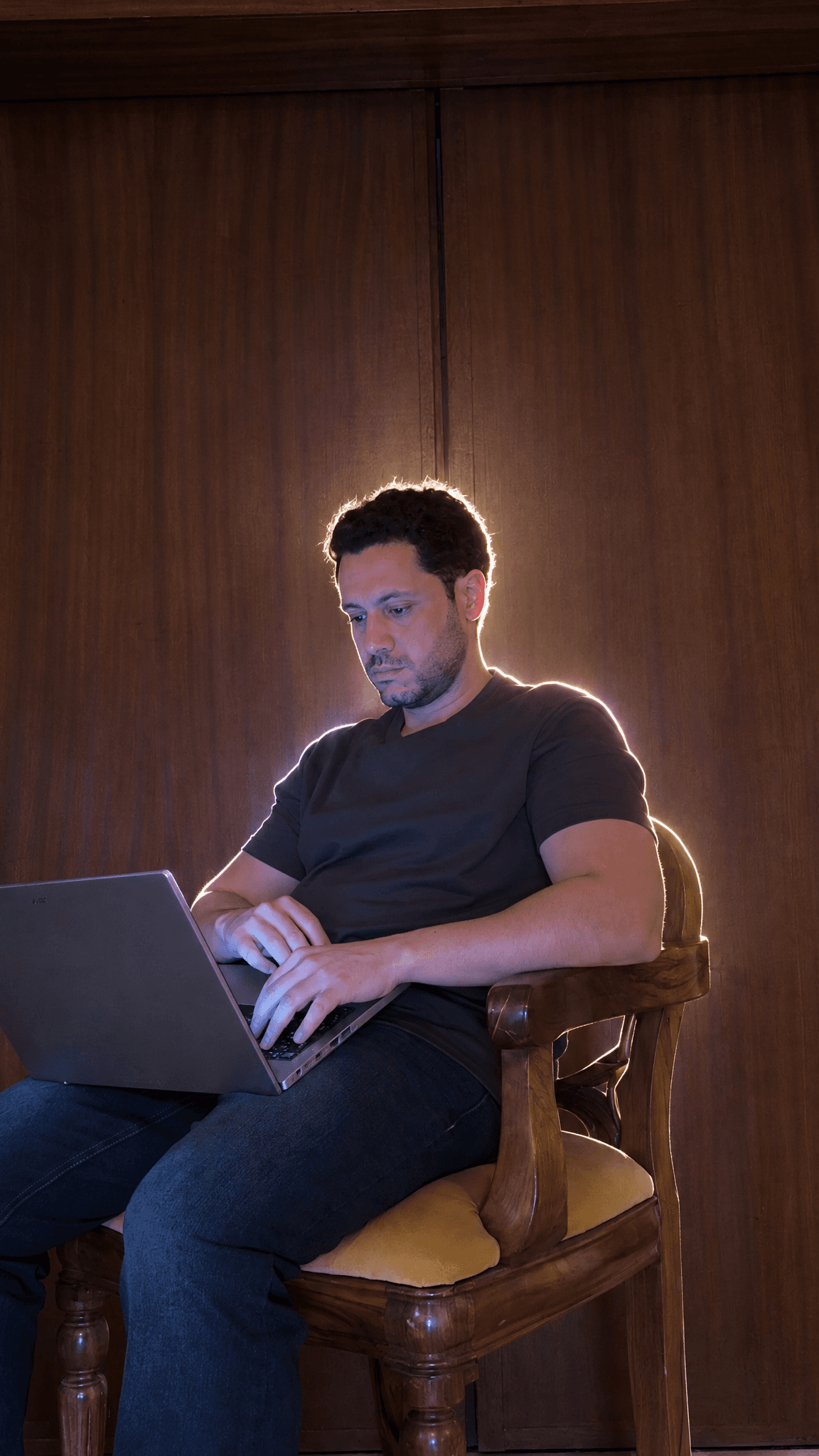
Exact prompt
Keep the first reference exactly: the same camera, framing, crop, place, pose, expression and clothes. Change only the light, color and finish, to the lighting style of the second reference: RIM BACKLIGHT. THE VIBE: A real iPhone photo of a man working on his laptop in a dim room, his outline glowing from a strong light behind him. Cool, clean, cinematic. IDENTITY LOCK: The man from the first reference, preserved exactly: his face, short dark hair, beard and build, no aging. The first reference sets his head size, head shape, body and proportions, never larger. REFERENCE ROLES: The first reference is the whole photo: the man, his dark grey t-shirt and blue jeans, the silver laptop, the carved wooden armchair with the yellow cushion, the reddish wood-panelled wall, and the framing. The second reference is the lighting style only: a bright glowing edge around the figure in a dim room. Take NOTHING else from it: not the other man, his beanie, sweater or beard, not his armchair, room, plant, sofa or picture frames, and none of its white text. No text anywhere in the image. THE SUBJECT: Same seated pose as the first reference, typing on the laptop on his lap, eyes down on the screen. THE SETTING: The same wood-panelled wall and carved armchair as the first reference. No new lamps, windows, fixtures or objects in frame: only the light changes. THE LIGHT: KEY: a strong hard white backlight from behind him, hidden behind his head and the chair, draws a thin bright glowing edge around his hair, ears, neck, shoulders and arms, with a little bloom. His front is two to three stops under, softly lit only by a faint cool glow from the laptop screen on his face and hands. FIELD: the room is dim, the wood wall a muted desaturated brown in soft shadow. GRADE: cool neutral, slightly desaturated, clean white edge highlights. THE MOOD: focused, calm, cinematic. THE COMPOSITION: identical to the first reference, his head the same size and in the same spot, same crop from the top of the wall panels to his knees and the chair legs, no zoom. THE CAMERA: the same vertical phone shot as the first reference. THE AFTER EFFECT: soft halation bloom on the rim edges, fine film grain. A real photo of a real person in real light, not an illustration, painting or render.
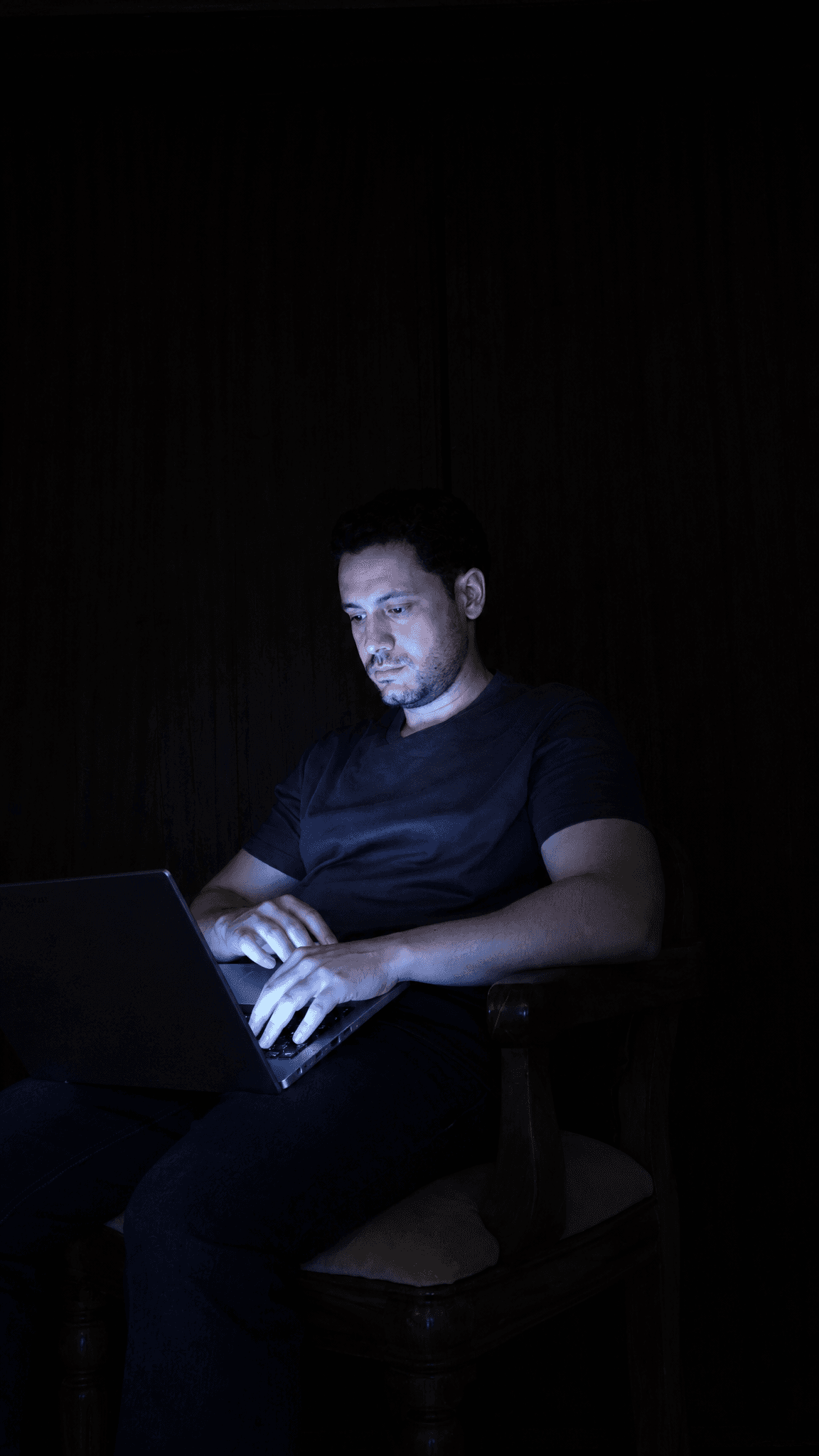
Exact prompt
Keep the first reference's camera, framing, crop, place, pose, expression and clothes. Relight the whole photo completely as a night scene lit ONLY by the laptop screen. The light on his face must change: it now comes from BELOW, from the glowing screen on his lap. THE VIBE: A real iPhone photo of a man alone at night in a pitch-black room, hunched over his laptop, his face floating in the dark in the cold glow of the screen. Late-night, cinematic. IDENTITY LOCK: The man from the first reference, preserved exactly: his face, short dark hair, beard and build, no aging. The first reference sets his head size, head shape, body and proportions, never larger. REFERENCE ROLES: The first reference is the man, his dark grey t-shirt and blue jeans, the silver laptop, the carved wooden armchair, the wood-panelled wall and the framing. The second reference is the lighting style only: a black room where the laptop screen lights the face from below. Take NOTHING else from it: not the other man, his beanie, sweater or beard, not his room, chair, plant or sofa, and none of its white text. No text anywhere in the image. THE SUBJECT: Same seated pose as the first reference, typing on the laptop on his lap, eyes down on the screen. THE SETTING: The same wall and armchair as the first reference, now in darkness. No new lamps, windows or objects. THE LIGHT: KEY: the laptop screen is the ONLY light source. Cold blue-white light shines UP from the screen onto his face: the underside of his chin, jaw and beard, the bottoms of his cheeks, his nostrils and the underside of his brow are lit, while the top of his head, his forehead top, hair, ears and the back of his neck fall into black shadow. Shadows on his face fall UPWARD. His fingers and forearms over the keyboard glow blue-white. The light dies within an arm's length of the screen. FIELD: everything beyond that is black: the wall five stops under, pure dark with no visible wood grain, the chair back, cushion, his legs and shoulders lost in black. No ambient light, no daylight, no fill from the front or above. GRADE: crushed blue-black, cold blue-white skin highlights, very high contrast. THE MOOD: lonely, late night, focused. THE COMPOSITION: identical to the first reference, his head the same size and in the same spot, no zoom. THE CAMERA: the same vertical phone shot, exposed for the screen-lit face, everything else falling to black. THE AFTER EFFECT: fine low-light grain. A real photo of a real person in real light, not an illustration, painting or render.
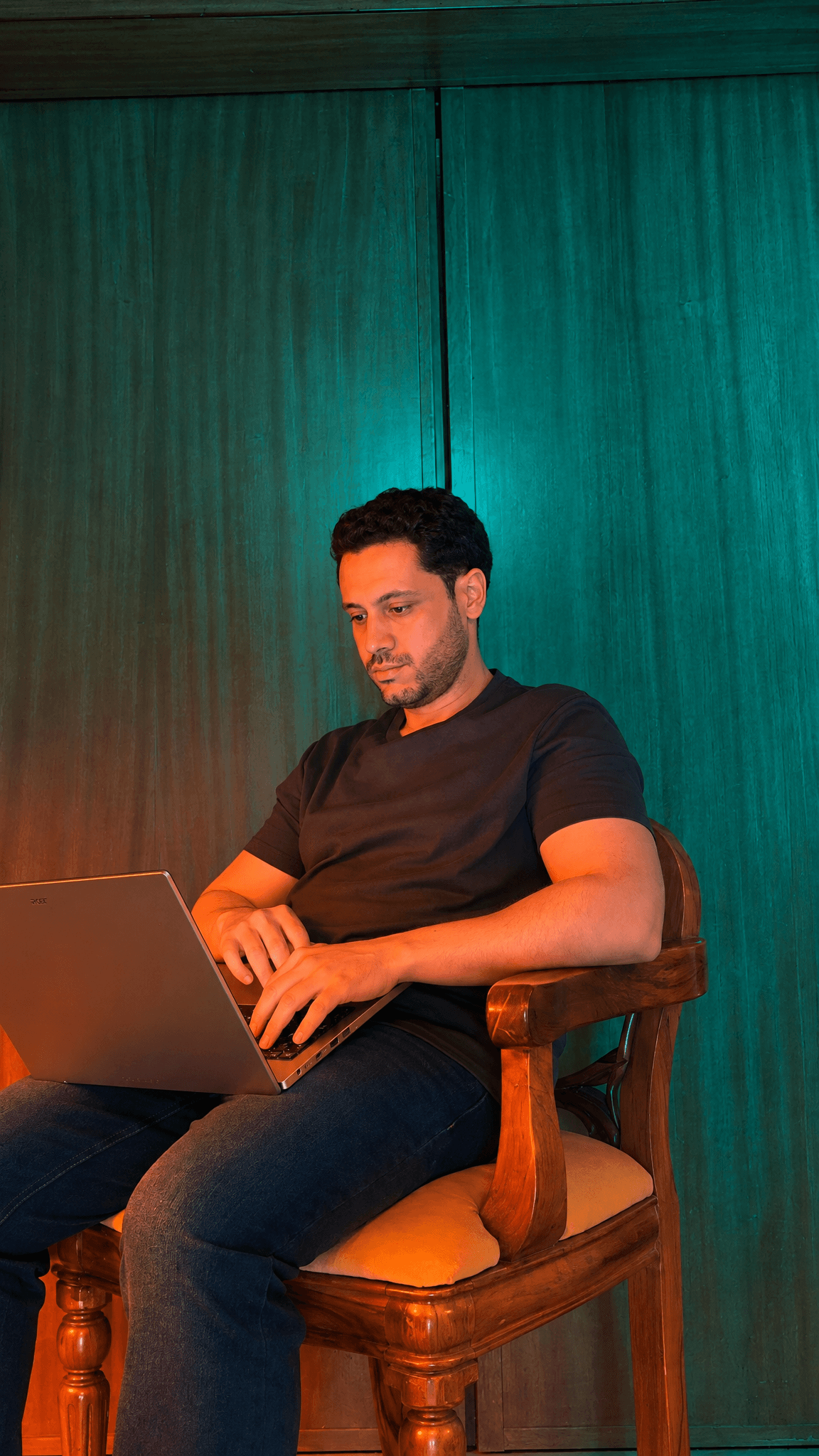
Exact prompt
Keep the first reference exactly: the same camera, framing, crop, place, pose, expression and clothes. Change only the light, color and finish, to the lighting style of the second reference: TEAL AND ORANGE. His skin is warm orange, never neutral. THE VIBE: A real iPhone photo of a man working on his laptop, lit warm orange against a room drowned in teal, like a blockbuster film grade. Bold, cinematic. IDENTITY LOCK: The man from the first reference, preserved exactly: his face, short dark hair, beard and build, no aging. The first reference sets his head size, head shape, body and proportions, never larger. REFERENCE ROLES: The first reference is the whole photo: the man, his dark grey t-shirt and blue jeans, the silver laptop, the carved wooden armchair with the yellow cushion, the reddish wood-panelled wall, and the framing. The second reference is the lighting style only: the whole room in teal, the person and the floor in warm orange. Take NOTHING else from it: not the other man, his beanie, sweater or beard, not his armchair, room, plant, sofa or picture frames, and none of its white text. No text anywhere in the image. THE SUBJECT: Same seated pose as the first reference, typing on the laptop on his lap, eyes down on the screen. THE SETTING: The same wood-panelled wall and carved armchair as the first reference. No new lamps, windows, fixtures or objects in frame: only the light changes. THE LIGHT: KEY: a warm saturated orange light from low front-left out of frame hits him directly: his face, neck, arms and hands glow warm orange, the left side of his face brightest, his jeans and the chair's arm and cushion catch orange too, and orange spill pools across the bottom of the frame. FIELD: the entire wood wall, top to bottom and edge to edge, is flooded with cool teal-cyan light, reading deep teal-green over the wood grain, one stop under his face; the shadow side of his face, hair and shirt take a teal cast. GRADE: teal everywhere in the background and shadows, orange on skin, strong complementary contrast, saturated. THE MOOD: bold, movie-like. THE COMPOSITION: identical to the first reference, his head the same size and in the same spot, same crop from the top of the wall panels to his knees and the chair legs, no zoom. THE CAMERA: the same vertical phone shot as the first reference. THE AFTER EFFECT: fine film grain. A real photo of a real person in real light, not an illustration, painting or render.
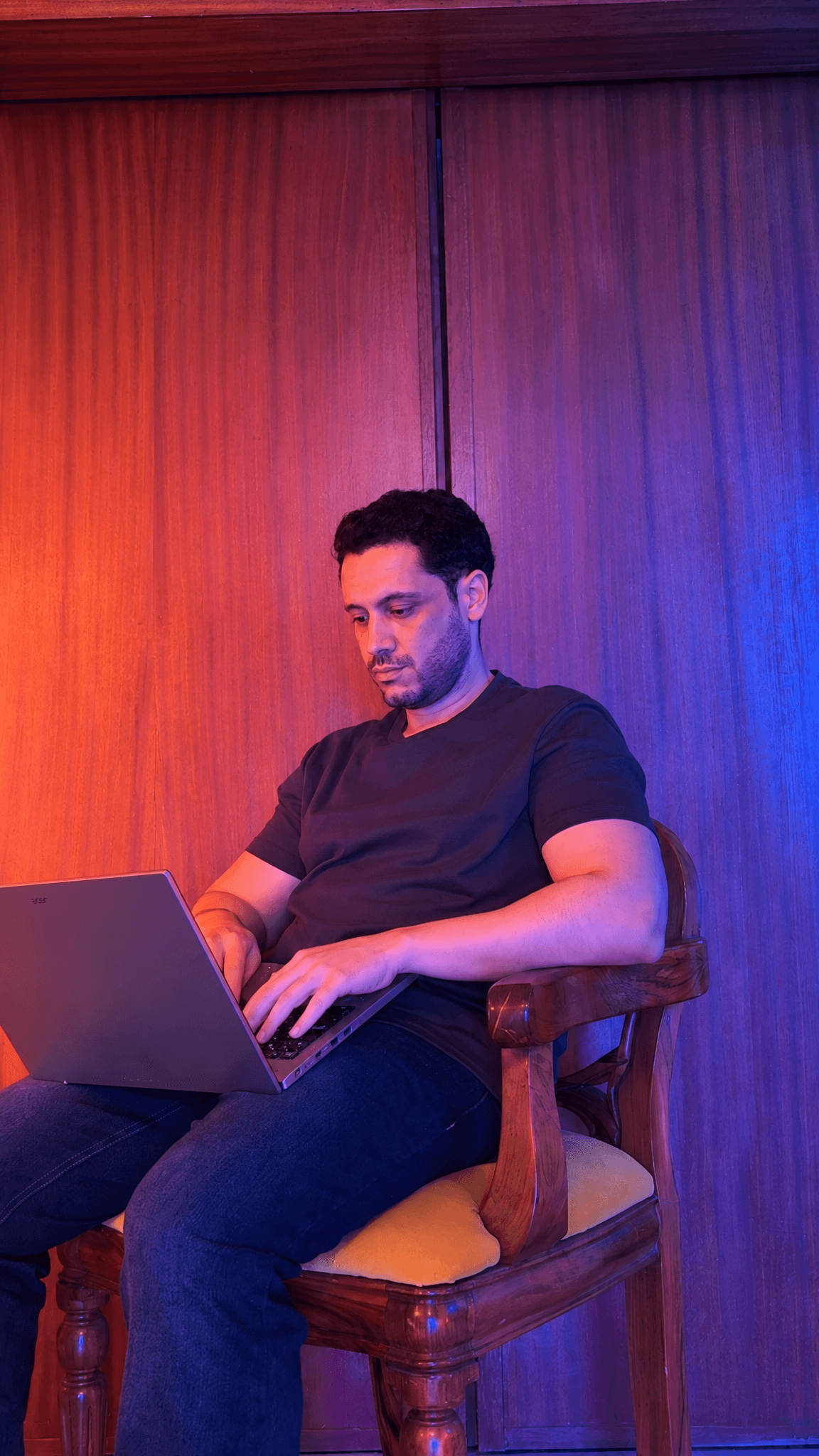
Exact prompt
Keep the first reference exactly: the same camera, framing, crop, place, pose, expression and clothes. Change only the light, color and finish, to the lighting style of the second reference: NEON. THE VIBE: A real iPhone photo of a man working on his laptop, the room washed in a pink-to-blue neon gradient. Dreamy, saturated, night-time. IDENTITY LOCK: The man from the first reference, preserved exactly: his face, short dark hair, beard and build, no aging. The first reference sets his head size, head shape, body and proportions, never larger. REFERENCE ROLES: The first reference is the whole photo: the man, his dark grey t-shirt and blue jeans, the silver laptop, the carved wooden armchair with the yellow cushion, the reddish wood-panelled wall, and the framing. The second reference is the lighting style only: hot pink-orange light from the left blending into blue-violet light from the right. Take NOTHING else from it: not the other man, his beanie, sweater or beard, not his armchair, room, plant, sofa or picture frames, and none of its white text. No text anywhere in the image. THE SUBJECT: Same seated pose as the first reference, typing on the laptop on his lap, eyes down on the screen. THE SETTING: The same wood-panelled wall and carved armchair as the first reference. No new lamps, tubes, signs, windows, fixtures or objects in frame: only the light changes. THE LIGHT: KEY: soft colored light from two sides out of frame: hot pink-orange from the left, electric blue-violet from the right. His face splits: the left side takes a warm magenta-orange cast, the right side a cool blue-violet cast. FIELD: the wood wall is washed in a smooth gradient, pink-orange on the left blending to purple then blue on the right, about one stop under his face. His dark grey shirt reads violet-black, the jeans deep blue. GRADE: saturated pink, purple and blue, soft contrast. THE MOOD: dreamy, late night, stylish. THE COMPOSITION: identical to the first reference, his head the same size and in the same spot, same crop from the top of the wall panels to his knees and the chair legs, no zoom. THE CAMERA: the same vertical phone shot as the first reference. THE AFTER EFFECT: light haze softening the colored light, fine film grain. A real photo of a real person in real light, not an illustration, painting or render.
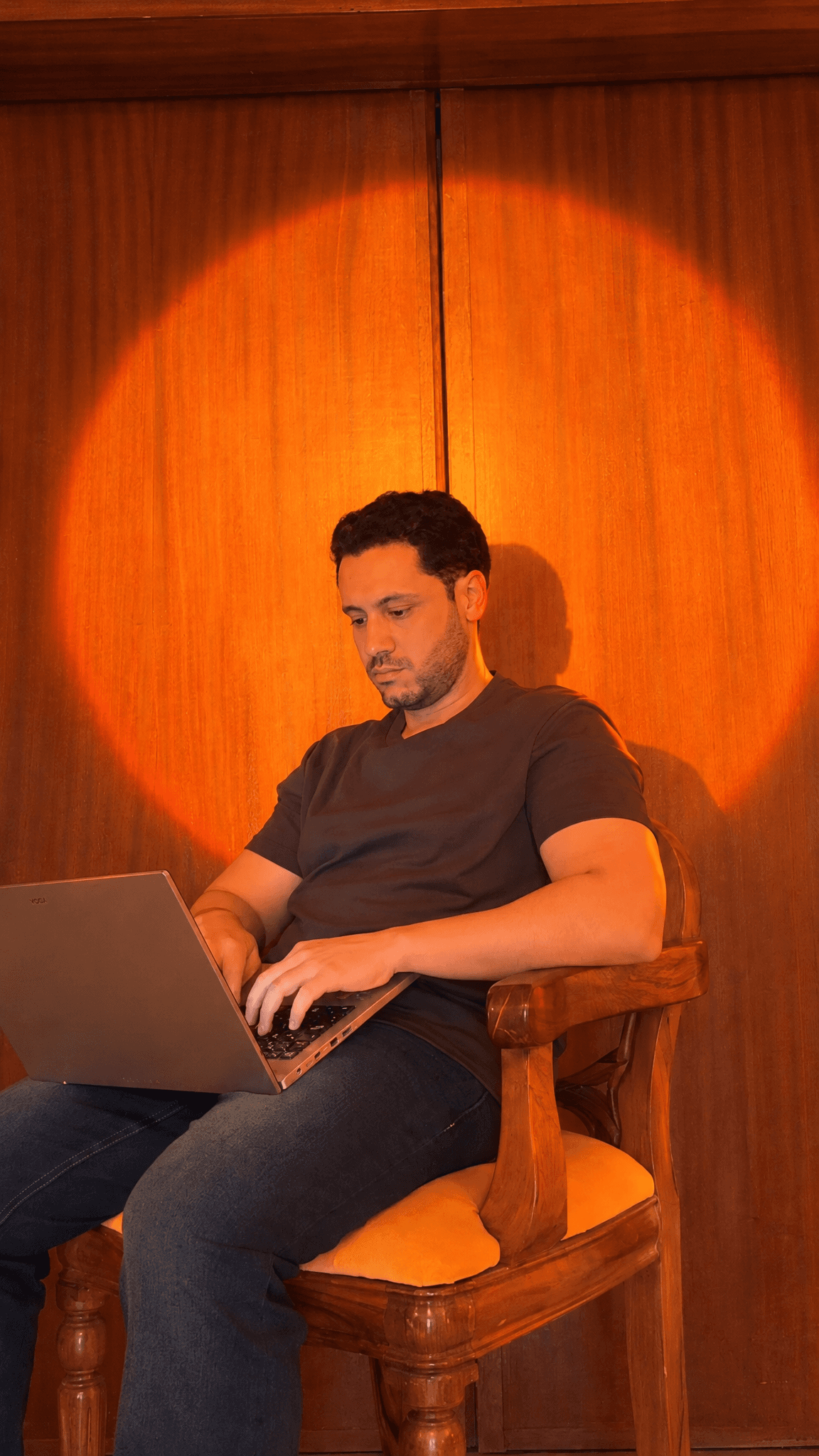
Exact prompt
Keep the first reference exactly: the same camera, framing, crop, place, pose, expression and clothes. Change only the light, color and finish, to the lighting style of the second reference: PROJECTOR LAMP. THE VIBE: A real iPhone photo of a man working on his laptop in front of a big glowing orange circle of light on the wall behind him, like a sunset projector lamp. Warm, dreamy, aesthetic. IDENTITY LOCK: The man from the first reference, preserved exactly: his face, short dark hair, beard and build, no aging. The first reference sets his head size, head shape, body and proportions, never larger. REFERENCE ROLES: The first reference is the whole photo: the man, his dark grey t-shirt and blue jeans, the silver laptop, the carved wooden armchair with the yellow cushion, the reddish wood-panelled wall, and the framing. The second reference is the lighting style only: a large glowing orange disc of projected light on the wall behind the person. Take NOTHING else from it: not the other man, his beanie, sweater or beard, not his armchair, room, plant, sofa or picture frames, and none of its white text. No text anywhere in the image. THE SUBJECT: Same seated pose as the first reference, typing on the laptop on his lap, eyes down on the screen. THE SETTING: The same wood-panelled wall and carved armchair as the first reference. No lamp, projector, fixture or new object visible in frame: only the projected light on the wall. THE LIGHT: KEY: warm orange spill from the projected light catches the edges of his hair, shoulder and the side of his face, soft. FIELD: a large round disc of saturated orange-red light is projected onto the wood wall behind him, about two-thirds of the frame width across, centered just above and behind his head, its edge soft with a deeper red rim, the wood grain visible inside it. Outside the circle the wall falls two stops under in dim warm brown. GRADE: glowing orange and amber, warm shadows. THE MOOD: warm, dreamy, aesthetic. THE COMPOSITION: identical to the first reference, his head the same size and in the same spot, same crop from the top of the wall panels to his knees and the chair legs, no zoom. THE CAMERA: the same vertical phone shot as the first reference. THE AFTER EFFECT: soft glow on the edge of the circle, fine film grain. A real photo of a real person in real light, not an illustration, painting or render.
And listen, the face is where it struggles. On teal and orange the whole wall went teal, but my skin stayed pretty close to normal instead of going orange. The wall carries the look for that one second, so I let it go.
5. Render each look on its own 3 second piece
Now the video. The model needs at least 3 seconds of clip to work with, so each look gets its own 3 second piece of my 8 seconds, starting on its second. Silhouette is second 1, so it gets seconds 1 to 4. Golden hour gets 2 to 5, and so on.
The last three looks don't have 3 seconds left after them, so teal and orange, neon and projector lamp all run on the last 3 seconds of the clip.
Each render gets my piece of clip and the still for that look, and the prompt says the look holds from the first frame to the last, with my motion and the camera exactly as in my clip.
Exact prompt
Create a new video from @video_1: the same locked vertical shot of a man in a dark grey t-shirt and blue jeans typing on a silver laptop in a carved wooden armchair in front of a wood-panelled wall, relit for the whole clip with one directional sunbeam. His motion, typing, head and hand movements and timing come from @video_1 exactly, frame for frame, no aging. The camera stays locked exactly as in @video_1. @image_1 is the look only: its light, color and finish. The place, pose and camera come from @video_1, not from the image. No new lamps, windows or objects, and no text. [SCENE 1] From the very first frame to the last, the look of @image_1 holds with no change: one hard shaft of warm golden-white sunlight angles down from the upper left of frame, a clearly visible diagonal beam through light haze with floating dust, landing on his face, shoulder, arms and hands. Everything outside the beam is dim, the wood wall a deep dark brown. He keeps typing exactly as in @video_1. Fine film grain.
Exact prompt
Create a new video from @video_1: the same locked vertical shot of a man in a dark grey t-shirt and blue jeans typing on a silver laptop in a carved wooden armchair in front of a wood-panelled wall, relit for the whole clip as a full silhouette. His motion, typing, head and hand movements and timing come from @video_1 exactly, frame for frame, no aging. The camera stays locked exactly as in @video_1. @image_1 is the look only: its light, color and finish. The place, pose and camera come from @video_1, not from the image. No new lamps, windows or objects, and no text. [SCENE 1] From the very first frame to the last, the look of @image_1 holds with no change: he is a near-solid black silhouette, his face, shirt, jeans, laptop and chair reading as black, with only a faint warm edge on his hair, beard line and shoulders. Behind him the wood wall glows bright orange-amber, brightest in a soft pool right behind his head and shoulders, falling off to darker amber toward the corners. He keeps typing exactly as in @video_1. Fine film grain.
Exact prompt
Create a new video from @video_1: the same locked vertical shot of a man in a dark grey t-shirt and blue jeans typing on a silver laptop in a carved wooden armchair in front of a wood-panelled wall, relit for the whole clip as golden hour. His motion, typing, head and hand movements and timing come from @video_1 exactly, frame for frame, no aging. The camera stays locked exactly as in @video_1. @image_1 is the look only: its light, color and finish. The place, pose and camera come from @video_1, not from the image. No new lamps, windows or objects, and no text. [SCENE 1] From the very first frame to the last, the look of @image_1 holds with no change: low, hard golden-orange sunlight rakes in from out of frame on the left, crisp rectangular window-pane patches of gold on the wood wall around him, his head casting a sharp shadow on the wall to the right, a warm golden glow on the left side of his face, arm and hands, the rest of the wall in warm shade. He keeps typing exactly as in @video_1. Fine film grain.
Exact prompt
Create a new video from @video_1: the same locked vertical shot of a man in a dark grey t-shirt and blue jeans typing on a silver laptop in a carved wooden armchair in front of a wood-panelled wall, relit for the whole clip with a rim backlight. His motion, typing, head and hand movements and timing come from @video_1 exactly, frame for frame, no aging. The camera stays locked exactly as in @video_1. @image_1 is the look only: its light, color and finish. The place, pose and camera come from @video_1, not from the image. No new lamps, windows or objects, and no text. [SCENE 1] From the very first frame to the last, the look of @image_1 holds with no change: a dim, cool room, a strong white backlight hidden behind him drawing a thin bright glowing edge around his hair, ears, neck, shoulders and arms with a little bloom, his front softly lit only by a faint cool glow from the laptop, the wood wall a muted desaturated brown in shadow. He keeps typing exactly as in @video_1. Fine film grain.
Exact prompt
Create a new video from @video_1: the same locked vertical shot of a man in a dark grey t-shirt and blue jeans typing on a silver laptop in a carved wooden armchair in front of a wood-panelled wall, relit for the whole clip as night, lit only by the laptop screen. His motion, typing, head and hand movements and timing come from @video_1 exactly, frame for frame, no aging. The camera stays locked exactly as in @video_1. @image_1 is the look only: its light, color and finish. The place, pose and camera come from @video_1, not from the image. No new lamps, windows or objects, and no text. [SCENE 1] From the very first frame to the last, the look of @image_1 holds with no change: the room is near black, the only light the cold blue-white glow of the laptop screen shining up from his lap onto the underside of his chin, beard, cheeks and his hands on the keys, falling off fast so his hair, shoulders, the chair and the wall sink into darkness. He keeps typing exactly as in @video_1. Fine low-light grain.
Exact prompt
Create a new video from @video_1: the same locked vertical shot of a man in a dark grey t-shirt and blue jeans typing on a silver laptop in a carved wooden armchair in front of a wood-panelled wall, relit for the whole clip in a teal and orange film grade. His motion, typing, head and hand movements and timing come from @video_1 exactly, frame for frame, no aging. The camera stays locked exactly as in @video_1. @image_1 is the look only: its light, color and finish. The place, pose and camera come from @video_1, not from the image. No new lamps, windows or objects, and no text. [SCENE 1] From the very first frame to the last, the look of @image_1 holds with no change: the whole wood wall flooded in cool teal-cyan, his shadow side teal, and a warm saturated orange light from the front left on his face, arms, hands and the lower part of the frame. Strong teal and orange contrast. He keeps typing exactly as in @video_1. Fine film grain.
Exact prompt
Create a new video from @video_1: the same locked vertical shot of a man in a dark grey t-shirt and blue jeans typing on a silver laptop in a carved wooden armchair in front of a wood-panelled wall, relit for the whole clip in neon colors. His motion, typing, head and hand movements and timing come from @video_1 exactly, frame for frame, no aging. The camera stays locked exactly as in @video_1. @image_1 is the look only: its light, color and finish. The place, pose and camera come from @video_1, not from the image. No new lamps, tubes, signs, windows or objects, and no text. [SCENE 1] From the very first frame to the last, the look of @image_1 holds with no change: soft colored light from both sides out of frame, hot pink-orange from the left and electric blue-violet from the right, the wood wall washed in a smooth pink-to-purple-to-blue gradient, the left side of his face magenta-orange and the right side blue-violet, light haze. He keeps typing exactly as in @video_1. Fine film grain.
Exact prompt
Create a new video from @video_1: the same locked vertical shot of a man in a dark grey t-shirt and blue jeans typing on a silver laptop in a carved wooden armchair in front of a wood-panelled wall, relit for the whole clip with a sunset projector lamp. His motion, typing, head and hand movements and timing come from @video_1 exactly, frame for frame, no aging. The camera stays locked exactly as in @video_1. @image_1 is the look only: its light, color and finish. The place, pose and camera come from @video_1, not from the image. No lamp, projector, window or new object visible, and no text. [SCENE 1] From the very first frame to the last, the look of @image_1 holds with no change: a large round disc of saturated orange-red light projected on the wood wall behind him, centered just above and behind his head, its edge soft with a deeper red rim, his head's shadow on it, warm orange spill on his hair, shoulder and the side of his face, the wall outside the circle dim warm brown. He keeps typing exactly as in @video_1. Fine film grain.
6. Cut each one to exactly 1 second and join them
Then I kept exactly one second from each render, the one that lines up with its spot in my clip. For most of them that's the first second. For the last three it's the first, middle and last second of the same 3 second piece.
That's 30 frames each at 30fps, joined in order with straight cuts. Before joining I checked the first and last frame of every second against my original clip, to make sure my hands and head were in the same spot on the same frame.
Exact prompt
Combine the clips in order
Then in Edits I put the 2 untouched seconds in front with the title "Lighting styles, copy these" on it, and added a numbered list in the corner that grows by one line on every cut. At the end I tacked on a short clip of me talking to the camera.
Why it works
The video model keeps the timing of your clip frame for frame. Whatever my hands do at 2.4 seconds in my clip, they also do at 2.4 seconds in every render. So when I cut one second out of each render and line them up, my typing carries straight through every cut and only the light changes.
I didn't trust the model to time 8 switches inside one render, so I did the cutting myself, and every switch landed exactly on the second.
Your turn: film 10 seconds of yourself doing something simple, sitting still, and pick 2 looks to start with.
If you'd rather skip the frame pulling and the trimming, Emero does all of it for you and remembers your looks for the next clip, at cost.
Here's the full cut one more time:
Exact prompt
Combine the clips in order

Get one of these every day
I test new workflows daily and send them with the exact prompts, the models and the costs
6,668 generations tested so far
More workflows
See all
Kling 4.0 + GPT Image 2.6 - turning yourself into an AI turtle in five clips
I turned myself into an old tortoise man across five phone clips, same face in every one
GPT Image 2.6 Flare, Kling 4.0 · 10 min render

Kling 4.0 + GPT Image 2.6 Flare - an AI commercial starring you, four ads from your own clips
Turn 3 second phone clips of yourself into an AI commercial: four ads, start to finish
GPT Image 2.6 Flare, Kling 4.0, Nano Banana Pro · 7 min render

Kling 4.0 edit mode - copy the color grade of any photo onto one phone clip
Copies the color grade of four photos onto one low-angle phone clip, sky and all
GPT Image 2.6 Flare, Kling 4.0 · 10 min render