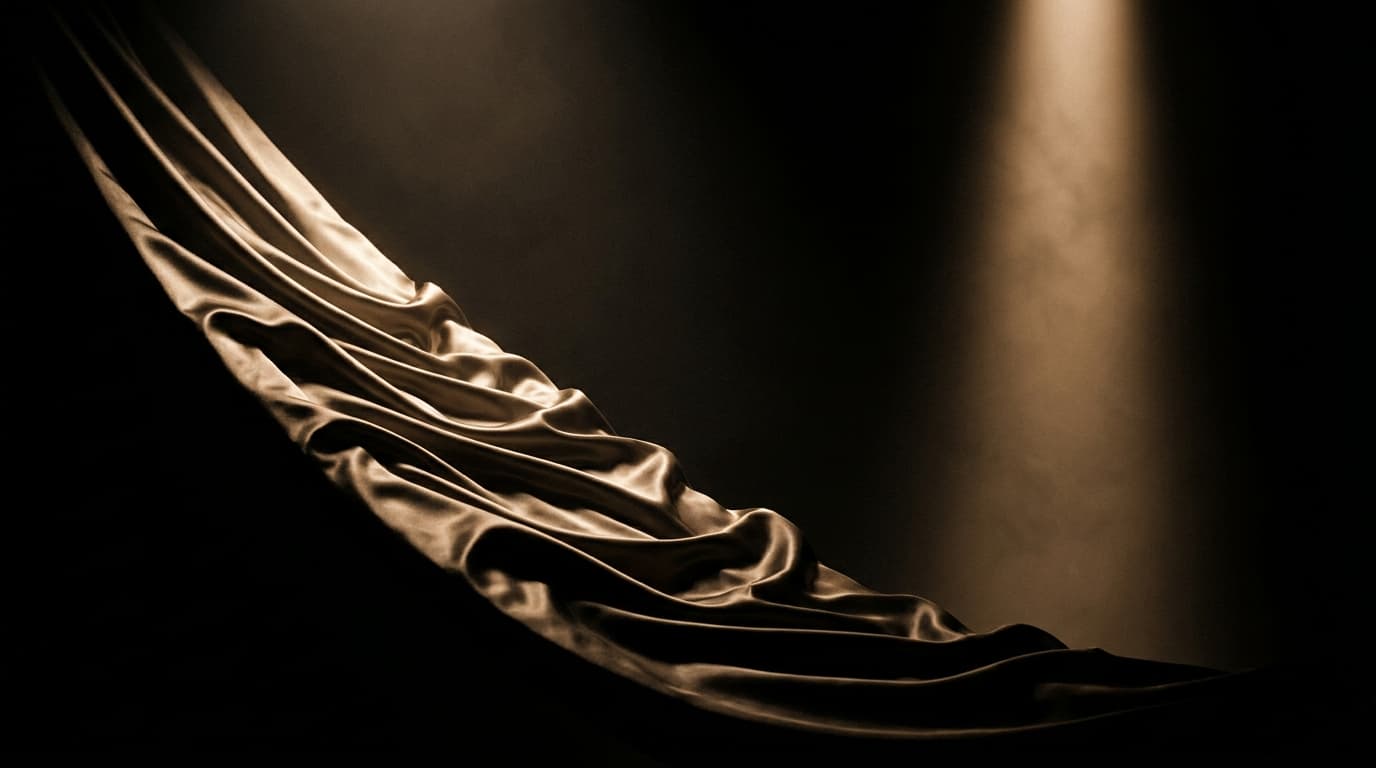
Photo meets ink: one samurai, five treatments
A real editorial photo with hand-drawn elements living inside it, pushed from subtle to full collage
 Tested by Nouamane Benbrahim
Mixed media looks fake when the drawing sits on top of the photo. The trick is asking for a photograph where the drawn elements were physically there when it was taken.
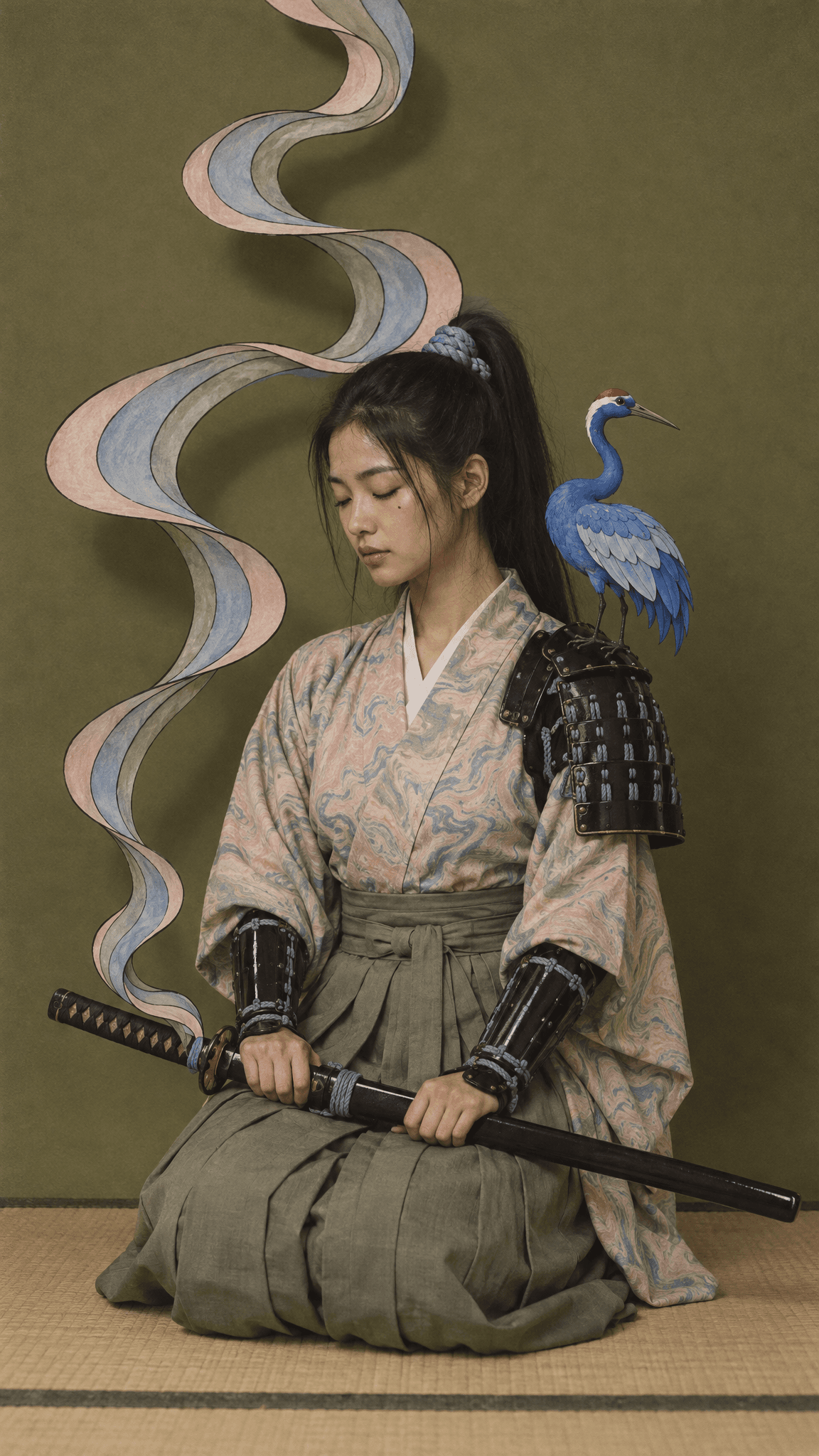
1. The anchor photo
A vintage film editorial shot with exactly two illustrated elements in the real scene. Keep it to two, or it turns into a sticker sheet.
Exact prompt
A vintage film fashion-editorial photograph of a real woman samurai kneeling in front of a plain olive-green seamless backdrop, with exactly two handmade-looking illustrated elements physically present in the real scene: a thick inked marbled ribbon rising out of her sword's scabbard, and a small bright blue crane perched on her shoulder. THE VIBE: A real 1970s-style editorial photograph — warm, muted, quiet, shot on film — where a little bit of illustration has come to life inside the real world. The illustrated elements look like physical handmade objects with inked outlines: thick layered cut paper and painted clay, with real volume, soft shading and real cast shadows, touching the real surfaces around them. Calm, still, poetic. IDENTITY LOCK: A Japanese woman, about 24, invented for this series. Long straight jet-black hair in a high ponytail tied with a thick braided powder-blue silk cord, a few loose strands at the temples. Straight dark brows, single-lidded dark brown eyes, small straight nose, softly full lips, light skin with a warm-neutral undertone, a small dark beauty mark just below her left eye. Lean athletic build. THE SUBJECT: Everything about her is real and photographic. She kneels in seiza, three-quarters to camera-left, eyes closed, chin slightly lowered, both hands resting on a real katana held horizontally across her thighs, the blade still sheathed. She wears a real silk kimono printed with a soft marbled suminagashi pattern of pale pink, powder blue and sage — a fine, tonal print reading as soft marbled paper from a distance — and real pleated hakama in a soft muted sage green. Real black lacquered armour: one shoulder guard on her left shoulder, forearm guards on both arms, laced with powder-blue silk cord. Real black lacquered scabbard and a real wrapped hilt. THE FACE: Real, unretouched skin with fine visible texture, faint pores, slightly uneven natural tone. Mostly matte. Minimal natural makeup: bare skin, no foundation, no contour, no highlighter, a soft muted rose lip. THE SETTING: A plain matte olive-green seamless paper backdrop curving down into a strip of real pale tatami floor with a thin dark green border. Nothing else. THE LIGHT: KEY: one large soft source from high camera-left, gentle fall-off across her face, the shadow side about one stop under, soft shadows. FIELD: mid, the olive backdrop evenly lit by the same source. Colour grade: vintage colour film — warm muted tones, slightly lifted blacks, soft contrast, gentle warm cast in the highlights, fine natural grain. No teal-orange, no glossy HDR. THE KEY DETAILS: Only two illustrated elements, both clearly illustrations but with physical volume: - The ribbon: one long, thick, ribbon-like stream rising out of the mouth of her scabbard at the hilt, curling up beside her in loose wandering S-loops into the empty olive space above her head. It is built from several stacked layers like thick cut paper — pale pink, powder blue and sage bands nested inside each other like contour lines, each layer edged with a dark inked outline — with soft shading on its curves and a real soft shadow falling onto the olive backdrop behind it. One loop passes behind her ponytail. - The crane: a small crane, about the size of her head, standing on top of her black lacquered left shoulder guard, its thin dark inked legs and feet clearly gripping the lacquer, a soft contact shadow under its feet. It looks like a handmade painted figure: a bright saturated cobalt-blue body with softly shaded feathers, paler sky-blue wing layers, dark inked outlines, a small red crown, neck curved, head turned to look toward camera-right. No other illustrated elements. No flowers, no petals, no waves, nothing else in the frame. THE MOOD: Silent, focused, dreamlike — a real moment where the spirit of the sword quietly rises. THE COMPOSITION: Vertical 9:16. She kneels in the lower-middle, the top of her head about 35% down from the top edge. The ribbon rises from the sword at lower-left and wanders up into the upper-left and upper-centre empty backdrop. The crane sits on the right, on her shoulder. At least half the frame is plain olive backdrop. THE CAMERA: Medium-format film camera, 80mm lens, eye level with her kneeling height, f/5.6, everything crisp, fine film grain throughout.
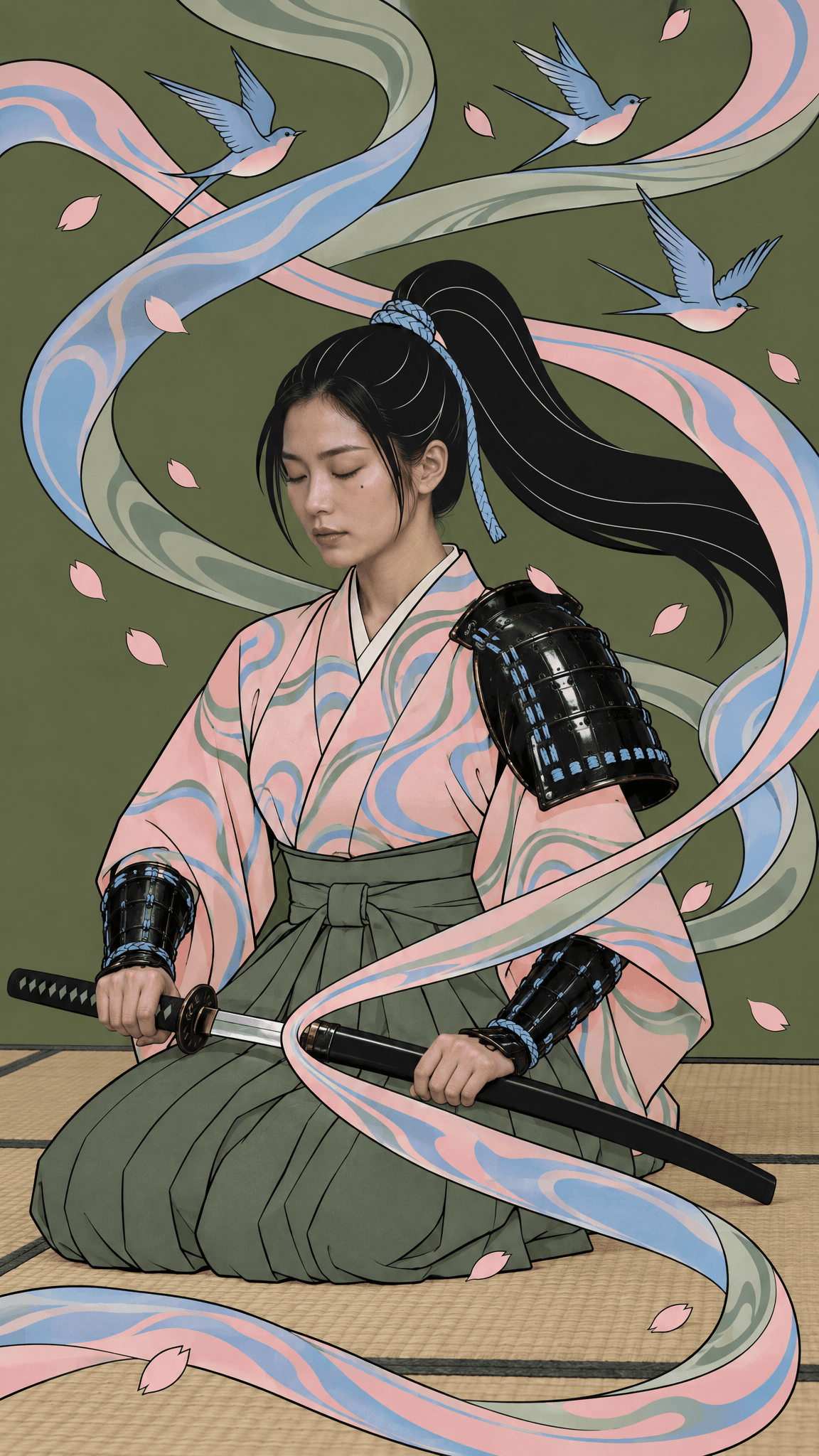
2. Flip the ratio
Same woman, but now the world is flat drawing and only her skin and armour stay photographic.
Exact prompt
A flat Japanese-style illustration with a real woman's skin and real lacquered armour set into it: a kneeling woman samurai drawn in bold, clean, flat illustration, surrounded by big sweeping drawn ribbons — where ONLY her face, neck, hands and her black lacquered armour are photographic. Everything else, including her hair, is flat drawing. THE VIBE: A still ritual moment before battle that feels alive and animated — a modern flat Japanese print in full motion. Energetic, sweeping, graphic, but clean: a handful of big bold shapes in motion, not ornate detail. The only real-world textures are her skin and her armour; the drawn world around them moves. IDENTITY LOCK: A Japanese woman, about 24, invented for this series. Straight dark brows, single-lidded eyes, small straight nose, softly full lips with natural rose colour, light skin with a warm-neutral undertone, a small clearly visible dark beauty mark just below her left eye. THE SUBJECT: She kneels in seiza, three-quarters to camera-left, eyes closed, chin slightly lowered, both hands resting on a katana held horizontally across her thighs, the blade drawn a finger-width out of the scabbard. PHOTOGRAPHIC, real: her face, neck and both hands (real skin); her armour — one black lacquered shoulder guard on her left shoulder and two black lacquered forearm guards laced with powder-blue silk cord, real glossy lacquer. DRAWN, completely flat, bold dark outlines, flat colour, no shading, no photographic texture: her hair — drawn like a woodblock print: ONE solid flat graphic black shape with a crisp outline, a high ponytail as a single smooth flat black sweep, with a few thin drawn curve lines inside it; no individual photographic strands, no sheen, no flyaways. A powder-blue cord tied around it drawn as a simple outlined braid. Her kimono — flat powder-pink shapes with a few large simple marbled swirl lines in powder blue and sage drawn as clean lines, no soft shading. Her hakama — flat solid sage green with drawn pleat lines. Her katana — flat drawn black scabbard and simple drawn guard. THE FACE: Real, unretouched skin with fine visible texture, faint pores, slightly uneven natural tone. Mostly matte. Minimal natural makeup: bare skin, no foundation, no contour, no highlighter, soft rose lip. A crisp clean edge where her real face meets the flat drawn hair and drawn collar — like a photo of a face set into a print. THE SETTING: A single flat matte olive-green background, a flat drawn straw-coloured tatami floor with clean dark border lines. THE LIGHT: Real skin and armour lit softly from high camera-left, shadow side about one stop under, low contrast, real lacquer highlights. Drawn parts are flat colour with no lighting. Palette: powder pink, powder blue, sage, olive, black. No teal-orange, no HDR. THE KEY DETAILS: Drawn, flat, bold outlines, flat fills: - Five wide flowing ribbons — powder pink, powder blue, sage, pink, blue — each a smooth clean band with one simple marbled stripe inside, bursting out of the gap where the blade leaves the scabbard, sweeping wide around her: two loop in front of her across the tatami and past her knees, three rise behind her shoulders, cross over the top of her head in big S-curves and fill the upper part of the frame from left to right. - Three flat drawn swallows in powder blue with pink bellies, wings wide, riding the ribbons above her. - About ten simple flat pink cherry petals scattered in the flow. No foam, no wave crests, no small curls, no background patterns, no extra flowers. Smooth confident curves only. Clear areas of flat olive remain visible between the ribbons. THE MOOD: Calm face, everything around her in motion — a print in mid-breath. THE COMPOSITION: Vertical 9:16. She kneels in the lower-middle, top of her head about 35% down. The ribbons wrap around her and fill the upper frame, with the strongest curve sweeping diagonally from the sword at lower-left to the top-right corner. Roughly half ribbons, half flat olive. THE CAMERA: The photographic skin and armour look shot on a 50mm lens at f/5.6, crisp. The drawn parts are clean flat ink, no grain.
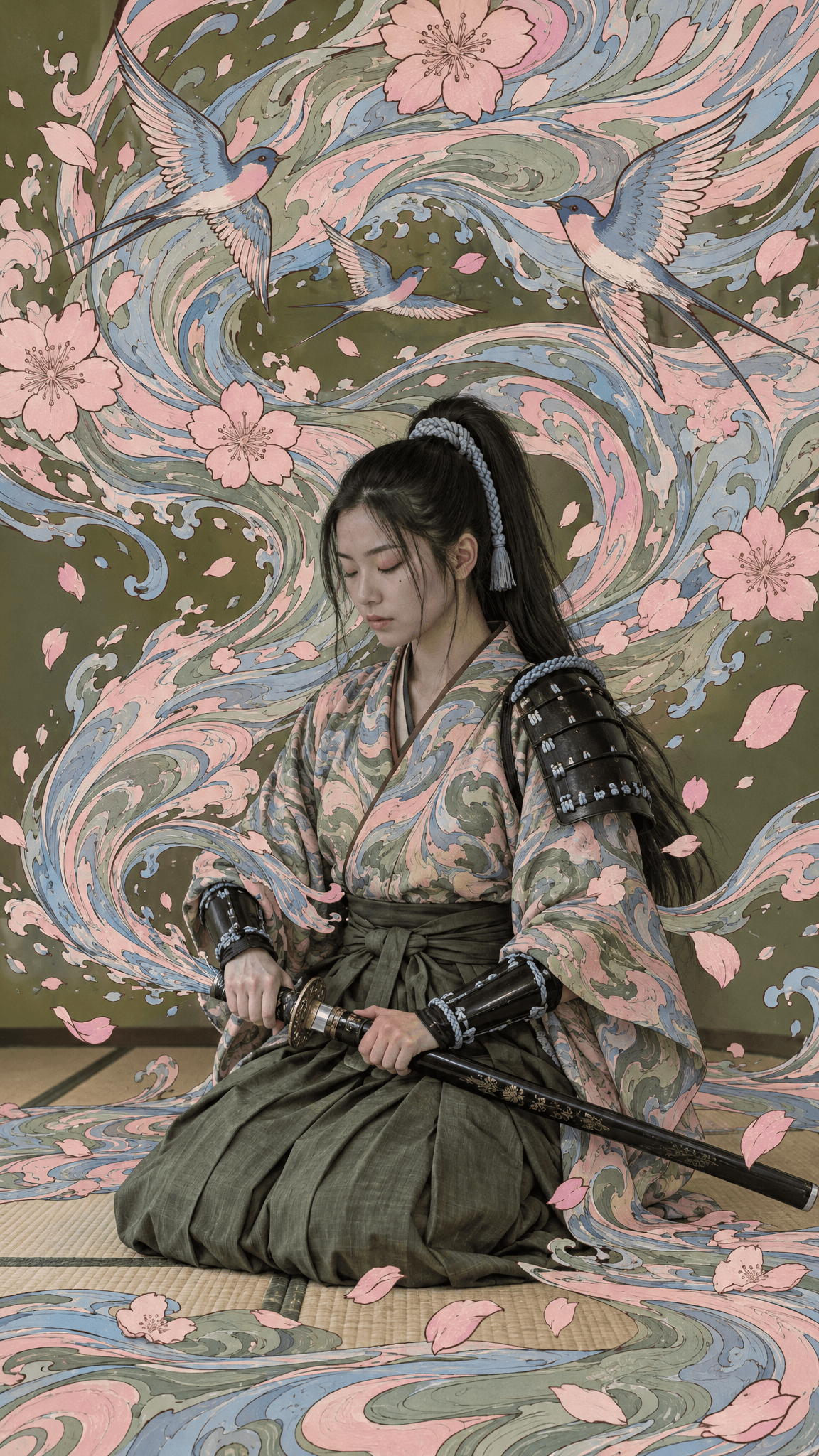
3. Let the drawing take over
Push the illustration until it's as important as the photo: pouring out of the sword, filling the air.
Exact prompt
A surreal mixed-media editorial illustration-photograph: a real photographed woman samurai kneeling in a tatami room, completely swept up in huge, bold, hand-drawn 2D illustrated elements that dominate the picture — the drawing is as important as the photograph, wrapping around her, pouring out of her sword and filling the air. THE VIBE: A dreamlike, animated, almost psychedelic-yet-pastel moment of ritual before battle. The samurai's spirit made visible: thick marbled-ink currents explode out of her sheathed katana and coil through the whole room like living water, drawn birds and blossoms riding them. It feels like a still frame from an animated art film — lush, graphic, flowing, full of movement — not a photo with stickers on it. IDENTITY LOCK: A Japanese woman, about 24, invented for this series. Long straight jet-black hair in a high ponytail tied with a thick braided powder-blue cord, a few loose strands at the temples. Straight dark brows, single-lidded dark brown eyes, small straight nose, softly full lips with natural rose colour, light skin with a warm-neutral undertone, a tiny beauty mark just below her left eye. Lean athletic build. THE SUBJECT: She kneels in seiza on the tatami, three-quarters to camera-left, eyes closed in focus, chin slightly lowered. Both hands rest on the black lacquered scabbard of a katana held horizontally across her thighs, her right thumb pushing the guard a finger-width out of the scabbard. She wears a kimono top in a bold marbled-ink suminagashi pattern of powder pink, powder blue and sage green with thin dark contour lines, the same marbled pattern as the drawn currents so her clothes seem to flow into them. Wide pleated hakama in muted sage green. One black lacquered shoulder guard on her left shoulder only, black lacquered forearm guards laced with powder-blue silk cord. THE FACE: Real, unretouched skin with fine visible texture, faint pores, slightly uneven natural tone. Mostly matte. Minimal natural makeup: bare skin, no foundation, no contour, no highlighter, soft rose lip. THE SETTING: A bare tatami room: a flat, saturated matte olive-green wall, pale straw tatami with thin dark green borders. Plain, so the drawing owns the space. THE KEY DETAILS: The illustrated layer — flat 2D hand-drawn art with confident dark brown outlines and flat pastel fills, clearly drawn, never photographic: - From the small gap where the blade leaves the scabbard, a massive thick marbled-ink current bursts out — wide flowing ribbons of powder pink, powder blue and sage, each striped with marbled swirls and outlined — surging upward behind her, curling over her head in great S-shaped waves and filling the entire upper half of the frame. - Smaller marbled streams spill off the current, pool across the tatami around her knees and run off the bottom edge of the frame like drawn liquid. - Three drawn swallows in powder blue and pink, wings spread wide, ride the current above her head. - A scatter of large drawn cherry blossoms and petals in pink, caught in the flow, some passing in front of her body and overlapping her shoulder. - The drawn current passes BEHIND her ponytail and IN FRONT of her right arm, so the drawing and the photograph interweave in depth. THE LIGHT: KEY: soft even window light from high camera-left, shadow side about one stop under, low contrast. FIELD: mid-bright flat olive wall. The drawn currents cast soft pastel-tinted shadows onto the wall and floor where they pass close. Colour grade: soft pastel, slightly desaturated photograph, flat clean colour on the illustrations, no teal-orange, no glossy HDR. THE MOOD: Serene focus inside a storm of drawn motion — calm face, wildly alive surroundings. THE COMPOSITION: Vertical 9:16. She kneels in the lower-middle third, the top of her head about 40% down. The drawn current dominates the upper half and sweeps diagonally from the sword up and over her to the top-right corner. Dense, layered, full frame — very little empty wall. THE CAMERA: Full-frame camera, 50mm, eye level with her kneeling height, f/5.6, crisp, fine film grain on the photographic parts only.
4. A detail shot for the set
Close on the hand and the hilt. The second reference is a style reference only, for the ink technique, and the prompt says so.
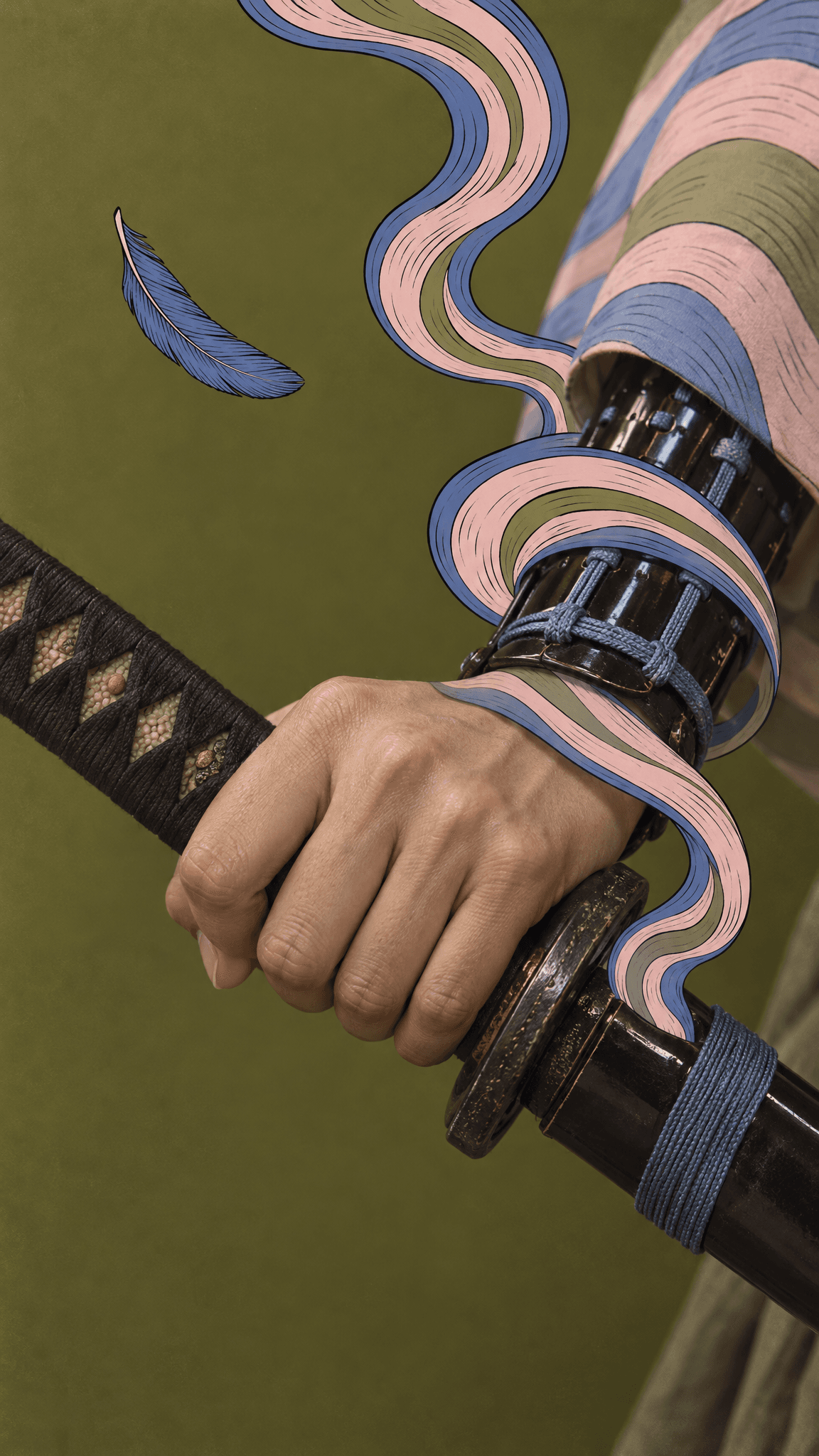
Exact prompt
A vintage film close-up photograph of the woman samurai's real hand gripping her katana's hilt, with a thick illustrated inked ribbon curling out of the scabbard and around her wrist. The first reference supplies the character, her wardrobe, palette and look; the second reference is a STYLE reference only for the inked ribbon technique — take nothing else from it. THE VIBE: An intimate macro detail from the samurai's ritual: the real texture of a hand on wrapped silk and lacquer, the quiet tension of the grip, and the sword's spirit slipping out as living drawn liquid that wraps around her. Real skin versus drawn nature, side by side. IDENTITY LOCK: The woman samurai from the first reference. Do NOT source her from the second reference. Relit entirely by this scene's light. THE SUBJECT: Her right hand, real and photographic, wrapped around the katana's hilt: four fingers curled firmly around the black silk-wrapped handle with its pale diamond-shaped wrap pattern, the thumb resting against the round dark iron guard, knuckles slightly raised with tension. The hilt and the sheathed blade run diagonally through the frame from lower-left to upper-right. Above her wrist, the edge of her black lacquered forearm guard laced with powder-blue silk cord, and the cuff of her kimono sleeve printed with the wavy pink, periwinkle and olive band pattern from the first reference. Short, clean, unpainted natural nails. THE FACE: (No face in frame — the skin realism lives in the hand.) Real, unretouched skin at close range: fine visible pores, the fine creases across the knuckles and finger joints, faint tendons and the subtle rise of veins on the back of the hand, natural uneven tone with slightly warmer, pinker knuckles and fingertips, a soft natural sheen only on the knuckle tops, tiny fine hairs on the back of the hand and wrist. Light skin with a warm-neutral undertone, matte overall — not airbrushed, not waxy, not glossy. THE SETTING: The plain matte olive-green backdrop from the first reference, soft and out of focus behind the hand. THE LIGHT: KEY: soft light from high camera-left, raking gently across the back of the hand so the knuckle creases, pores and tendons read, the palm side and the underside of the fingers about one stop under. FIELD: mid olive backdrop. Lacquer and the iron guard catch soft highlights. Colour grade: warm vintage colour film, slightly lifted blacks, soft contrast, fine grain, as in the first reference. THE KEY DETAILS: - The ribbon: from the mouth of the scabbard just past the guard, a thick drawn ribbon slips out and coils once loosely around her wrist and the forearm guard, then curls up and away into the empty olive space at the top of the frame. Drawn in the second reference's technique — nested contour bands with fine dark ink edges and fine inked hatching inside the pink — in the palette of the first reference: pale pink, periwinkle blue and olive-sage. Where it passes over her skin it casts a soft shadow onto the back of her hand, and where it wraps behind the wrist it disappears behind it, so it sits in real depth. - One single small drawn cobalt-blue crane feather, in the same inked style, drifting in the air above her knuckles. No other illustrated elements. THE MOOD: Quiet, tense, intimate — a held breath before the draw. THE COMPOSITION: Vertical 9:16, tight close-up. The hand and hilt fill the middle of the frame on a diagonal, the gripping fingers at the centre. The ribbon coils around the wrist at lower-right and rises into the upper third. The feather floats in the upper-left. Clean olive space around the edges. THE CAMERA: Medium-format film look with a 100mm macro lens, close focus, f/5.6 so the whole grip is sharp and the backdrop falls soft, fine grain.
5. Same language, no person
A yin-yang of two koi around a tea kettle, painted in the same palette. It holds the set together without repeating her.
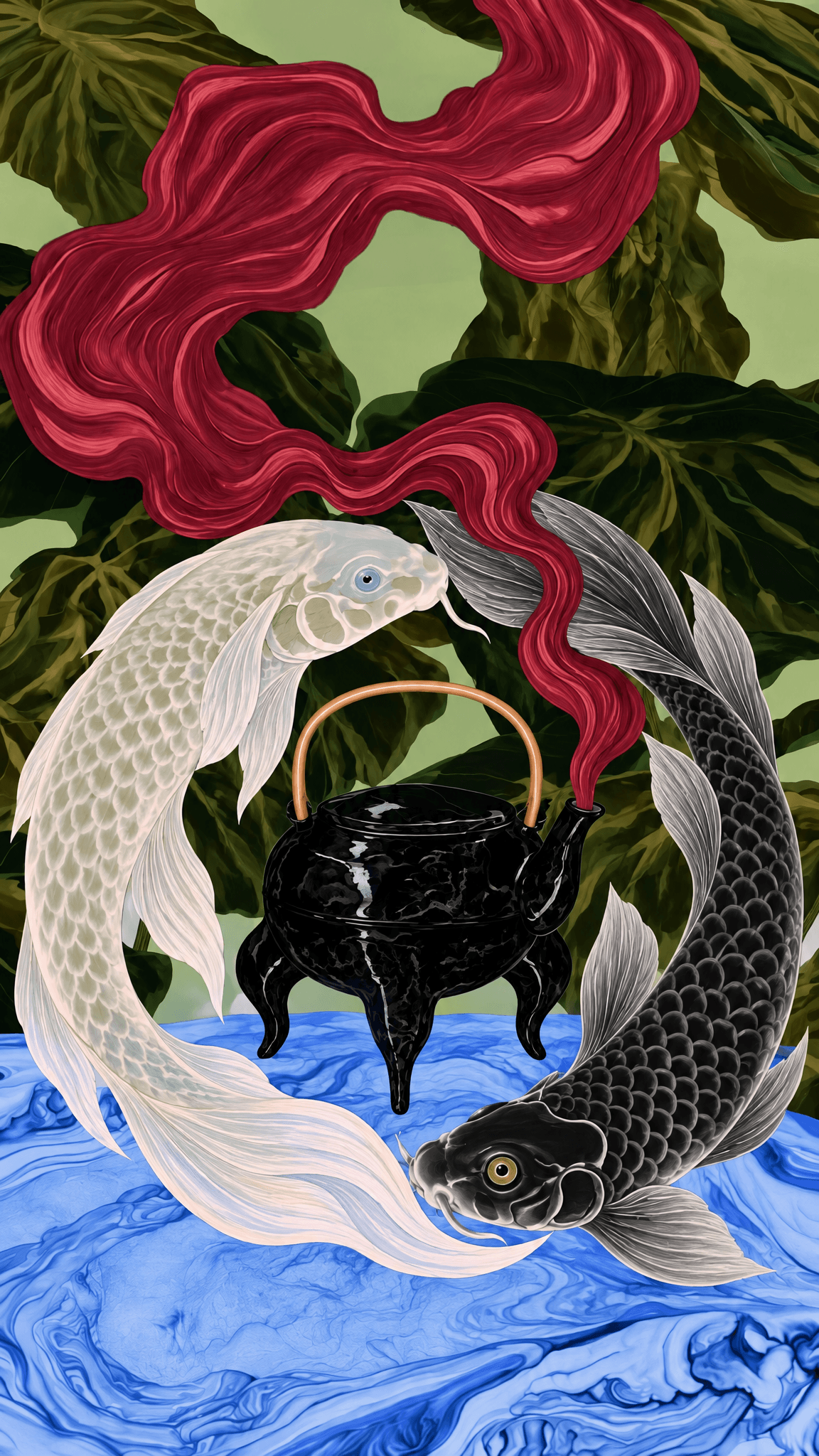
Exact prompt
A new painterly digital illustration composed from the start around a yin-yang: two koi, one white and one black, swim head-to-tail in a single closed circle around a black iron tea kettle, the two fish together forming the yin-yang symbol — not two fish placed beside a kettle. THE CHARACTER ANCHOR: Preserve from the first reference — the white koi's look (pale ivory-white body, soft olive-grey scale pattern, long flowing translucent white fins and tail, pale blue eye, two barbels), the black glossy marbled iron kettle with three tapered legs, thin tan-bamboo arched handle and short spout at the right, the dark-green broad leaves on a pale sage background, and the painterly flat-graphic illustration style. These remain unchanged. THE ITERATION ANCHOR: Carry forward from the second reference — the black koi's look, the blue marbled floor and the burgundy-red smoke colours, and the soft even light. THE NEW CHANGE: the two koi are rearranged into a yin-yang circle around the kettle. THE VIBE: A balanced, meditative emblem — light and dark chasing each other in an endless loop around a steaming kettle. Ornamental, serene, quietly mystical, like a tea-ceremony daydream turned into a symbol. THE CHARACTERS: Together the two koi trace one continuous circle, each occupying one half, with 180-degree rotational symmetry, both swimming clockwise, each fish's head tucked against the other's tail. - The white koi (from the first reference) forms the LEFT half of the circle: its head at the top of the circle (12 o'clock), facing right, its body arcing down the left side of the kettle in a smooth curve that thickens at the shoulders and tapers, its long flowing white tail fanning out at the bottom of the circle (6 o'clock). - The black koi (from the second reference) forms the RIGHT half: its head at the bottom of the circle (6 o'clock), facing left, its nose right at the white koi's tail; its body arcs up the right side of the kettle; its long smoky-grey tail fans out at the top of the circle (12 o'clock), right beside the white koi's head. Deep glossy ink-black body with a charcoal scale pattern, thin pale silver-grey edge highlights on every scale, outline and fin edge, translucent smoky-grey fins with fine fin rays, a pale gold eye, two thin barbels. - Like the dots of a yin-yang, the white koi's pale blue eye sits on the black koi's side of the loop near its tail, and the black koi's gold eye sits in the white koi's half near its tail. The two fish are the same size, the curves of both bodies mirrored. THE SETTING: Dark-green broad leaves with olive veins layered across a pale sage-green background, filling the upper two thirds, as in the first reference. A marbled floor across the bottom third in the blue of the second reference — azure-to-cobalt with deeper indigo veins and creamy white streaks — keeping the swirling marble shapes of the first reference. THE KEY DETAILS: The black iron kettle sits in the exact centre of the circle, fully visible inside the ring — all three legs, the arched bamboo handle and the spout clear, neither fish covering it. A single sculpted ribbon of smoke rises from the spout, in the burgundy-red of the second reference with lighter rose ridges and darker oxblood folds and the same fine combed striations, curling up out of the ring's top-right, between the two fish where head meets tail, and looping across the upper part of the frame. THE LIGHT: Soft, even, diffuse frontal light on both koi and the kettle, gentle soft shading, specular glints on the kettle's glossy black and on the black koi's scales; subjects even with the field. FIELD: mid-bright sage background, leaves mid-dark. A faint cool blue bounce from the floor on the lower curve of the circle and the kettle legs; a faint warm tint from the smoke on the fins nearest it. THE MOOD: Harmony and balance, endless motion held still — a yin-yang emblem rendered as an ornamental tea-ceremony painting. THE COMPOSITION: Vertical 9:16. The koi circle is centred horizontally, its centre at about 60% down the frame, diameter about 85% of the frame width, the top of the circle at about 38% down and the bottom at about 85% down, clear margin on the left and right edges. The kettle sits in the middle of the ring; the smoke fills the upper portion above the circle; the lower curve of the circle passes over the blue floor. THE CAMERA: Flat, straight-on illustrative view, even sharpness, the same painterly digital-illustration finish with fine texture as the first reference.
Why it works
Every step says what to preserve from the reference before it says what to change. That's how five very different images still read as one campaign.

Get one of these every day
I test new workflows daily and send them with the exact prompts, the models and the costs
5,784 generations tested so far