GPT Image 2.6 Sunburst + Kling 4.0 - a drone orbit camera move around a puma fashion spot
A drone camera move that circles the outfit and lands on the exact end frame
 Tested by Nouamane Benbrahim
Disclaimer: This is an independent creative test made with AI, for demonstration only. It isn't an ad for any brand shown or named, and isn't affiliated with, sponsored or endorsed by them. All trademarks belong to their owners
This is the video I posted on Instagram, here's the link: https://www.instagram.com/reel/DgIYb9Kt3iV/
In this post you'll learn how to:
- get a drone-style camera move that flies in, circles the outfit and lands on your exact end frame
- keep the studio and the view out the window the same from every camera angle
- dress a model in real pieces from a brand's current collection
- put three clips into a 9:16 start frame / end frame reel layout
I'm remaking my animal fashion spots from the very first one, same animal and same idea, but with a new outfit, and this time the camera actually moves.
The first spot I ever made was a woman in a white studio, a black puma walking in with her bag, the two of them walking off and the logo showing up on the wall. I'm not affiliated with Prada, this was just a test. The new part is the camera. I told Claude I wanted "a drone shot where it goes in and goes around and shows the outfit, and then comes back out to the end frame".
Here's my exact process.
1. Build the empty studio from a prompt
Everything happens in one room, so I make the room first, from a prompt alone: a seamless white cyclorama, a tall window just out of frame on the left, long window shadows across the wall and floor, nobody in it.
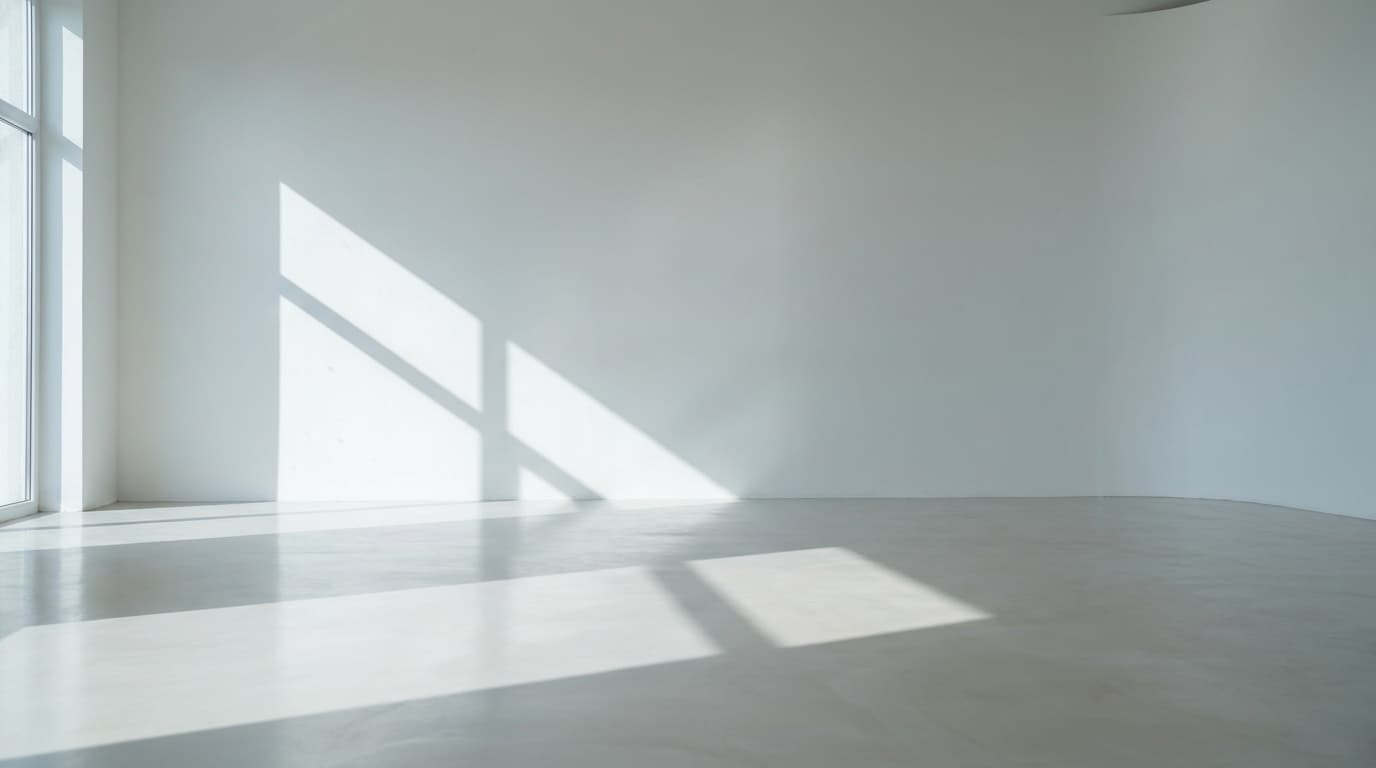
Exact prompt
Create a new photorealistic image. This is a photograph taken inside a minimalist white studio from the start — not a composite. Shoot the whole space natively, with a single unified natural light source across every surface. THE VIBE: Austere, hushed, expensive emptiness — the pared-back quiet-luxury minimalism of a high-fashion campaign set before anything is placed in it. The room feels intellectual and cool, precise but not sterile, where the quality of light and the fall of a shadow are the only events. Stillness and generous negative space. THE SETTING: A clean, modern white studio — a seamless matte-white cyclorama sweep curving gently from floor to wall with no visible seam, its surface carrying the faintest real texture and tonal variation so it reads as painted plaster, not a flat digital void. A polished pale microcement floor with a soft satin sheen, subtle and almost imperceptible reflections. One tall floor-to-ceiling window just out of frame to the left. Architectural, uncluttered, refined proportions. THE LIGHT: Soft directional daylight raking in low from the left through the unseen window, casting long, clean, elongated geometric shadows across the white sweep and floor — the crisp diagonal of a window frame and mullions stretched across the wall. Gentle falloff from bright highlight to soft grey shadow, smooth gradients, no harsh clipping. Cool-neutral white balance with the faintest warmth where the sun lands. THE KEY DETAILS: The natural window-cast shadows are the subject — long, soft-edged diagonal bars and a rectangle of light on the floor. Delicate dust motes suspended in the light shaft. Subtle tonal gradation across the seamless wall. THE MOOD: Editorial, muted, cold-clinical calm with a breath of warmth. Restrained luxury. A clean neutral grade, whites held just off pure white, soft grey shadows, nothing oversaturated. THE COMPOSITION: Wide architectural frame, eye level, straight-on and balanced. Vast negative space with the shadows placed on a rule-of-thirds diagonal as the leading lines; low emphasis, open airy upper frame. THE CAMERA: Cinematic editorial architectural still — wide framing, eye-level straight position, deep focus with everything sharp edge to edge, lit exclusively by the single window daylight source with no studio strobes and no artificial separation, a clean cool-neutral naturalistic grade in the vein of Roger Deakins' understated natural light. Light falls off gently toward the frame edges. Hyperreal, tactile, every surface present.
I wanted the wall and the floor to read as one white surface, so then I asked for the same room with a white floor and everything else kept exactly the same.
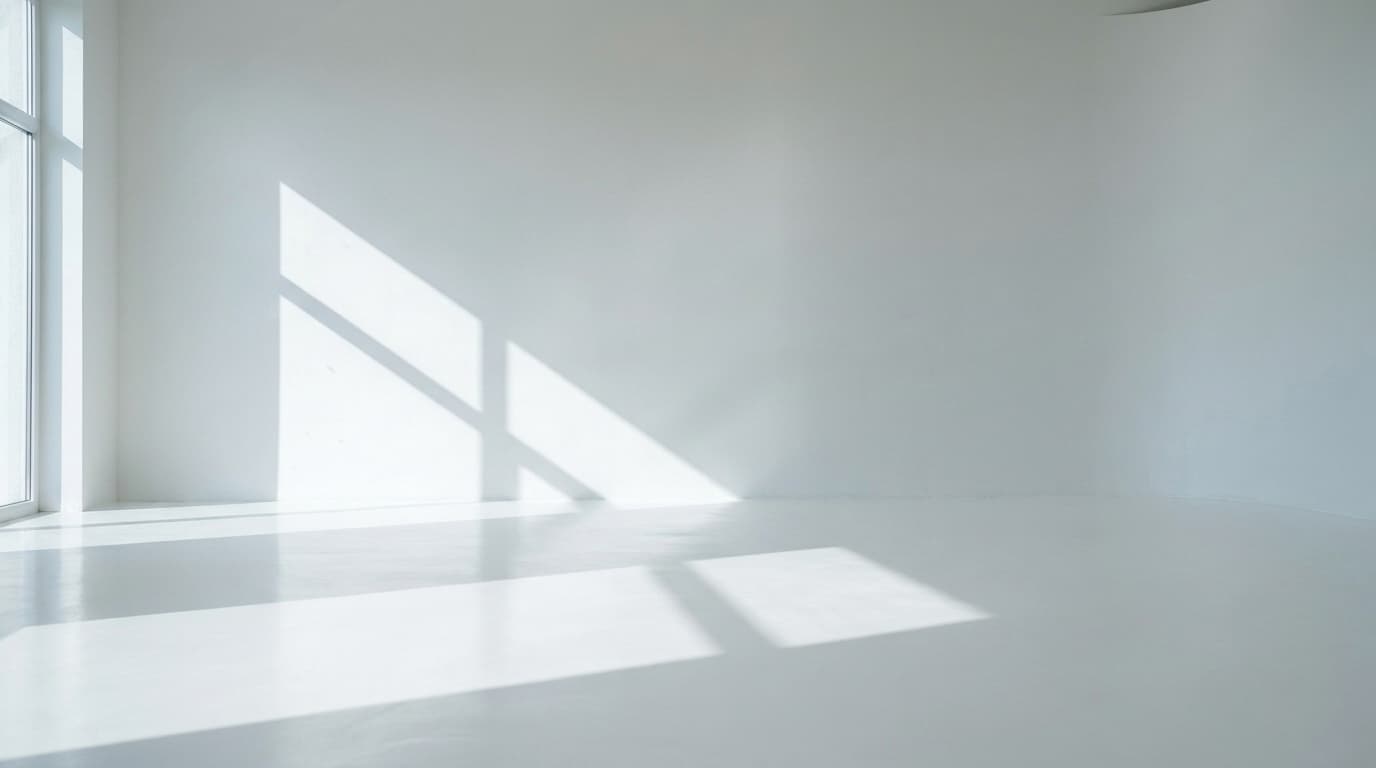
Exact prompt
Create a new photorealistic image, but the floor is now white. Preserve everything else from the reference exactly — the seamless matte-white cyclorama wall, the soft low directional daylight from the left, the long clean geometric window-cast shadows, the composition, framing, grade and mood all stay identical. THE FLOOR (CHANGED): The floor is now a clean matte white, continuous with the seamless white cyclorama sweep so wall and floor read as one unbroken white surface, no visible seam. A soft satin sheen with subtle, almost imperceptible reflections, the faintest real texture and tonal variation so it reads as painted plaster rather than a flat digital void — never pure clipped white. THE SETTING (LOCKED): The minimalist white studio, the seamless curving cyclorama, the tall floor-to-ceiling window just out of frame to the left. Do NOT redesign the environment. THE LIGHT (LOCKED): Soft directional daylight raking in low from the left, casting long, clean, elongated geometric window-frame and mullion shadows across the white sweep and now the white floor, with gentle falloff to soft grey and smooth gradients. Cool-neutral white balance with the faintest warmth where the sun lands. Delicate dust motes in the light shaft. THE MOOD (LOCKED): Editorial, muted, cold-clinical calm with a breath of warmth, restrained luxury, clean neutral grade, whites held just off pure white. THE COMPOSITION (LOCKED): Wide architectural frame, eye level, straight-on, vast negative space, the shadows on a rule-of-thirds diagonal as leading lines, open airy upper frame. THE CAMERA (LOCKED): Cinematic editorial architectural still, deep focus everything sharp edge to edge, lit exclusively by the single window daylight source, clean cool-neutral naturalistic grade, gentle edge falloff. Hyperreal and tactile.
2. Make her once in a plain outfit
Next I put the model alone in the room, full length and small in the left third, with lots of empty floor on the right for the animal. I lock in her face, hair and build here, in a simple white dress, so I can dress her in anything later and she stays the same person.
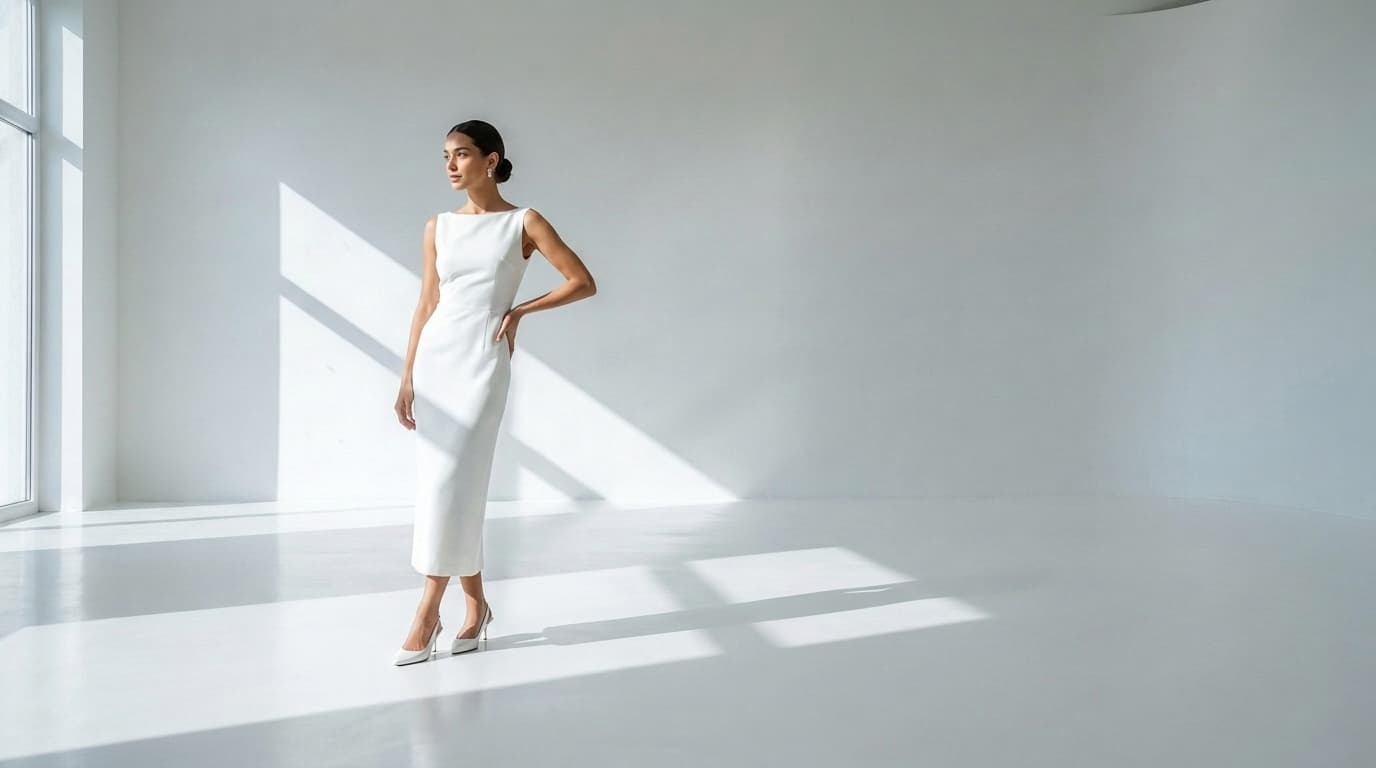
Exact prompt
Create a new photorealistic image. This is a photograph taken inside the same minimalist white studio from the start — not a replacement or composite. A woman stands in the space; rebuild the entire scene as if shot natively here, with a single unified natural light source falling across both her and the environment. THE VIBE: Austere, hushed, expensive minimalism — a high-fashion campaign frame. Intellectual and cool, precise but not sterile. She is the quiet event in a vast field of white negative space; the fall of light and shadow still does half the work. IDENTITY LOCK: A woman in her late twenties, tall and slender with an elegant editorial build. Dark brown hair pulled back into a sleek, low, centre-parted bun, not a single flyaway out of place. Warm light-olive skin. Dark brown almond-shaped eyes, groomed brows. Refined, understated bare-luxe makeup — clean matte skin, soft neutral lip, no heavy contour. THE SUBJECT: She wears a classic minimalist white Prada-style ensemble — a crisp tailored sleeveless white column dress in a fine structured wool-crepe, clean architectural lines, a precise boat neckline, subtly structured shoulders, falling just below the knee, impeccably pressed. On her feet, sleek pointed-toe white leather slingback pumps. Delicate minimalist silver stud earrings, nothing else. Her hands are completely empty — no handbag, no purse, no bag of any kind. She stands in a poised, classic editorial pose: relaxed contrapposto with her weight on her right leg, left knee softly bent, her right hand resting lightly on her hip, left arm relaxed at her side, shoulders angled a few degrees off the lens, chin lifted slightly, gaze sent just off-camera to the left toward the light. Composed, serene, effortless. THE FACE: Natural skin texture, no airbrushing, no plastic or waxy skin, real skin with subtle tonal variation, fine peach-fuzz catching the soft directional light, faint natural sheen. Eyes with a natural catchlight and individual lashes. Soft organic light. THE SETTING (LOCKED, from the first reference): The clean modern white studio — the seamless matte-white cyclorama sweep curving unbroken into the continuous matte-white floor, wall and floor reading as one white surface with the faintest painted-plaster texture and a soft satin floor sheen. The tall floor-to-ceiling window just out of frame to the left. Do NOT redesign the environment. THE LIGHT (LOCKED, from the first reference): Soft directional daylight raking in low from the left through the unseen window, casting long, clean, elongated geometric window-frame and mullion shadows across the white sweep and floor. That same single source lights the woman — a soft key from her left, gentle falloff across her dress to soft grey shadow on her right, and her own long soft-edged shadow cast to the right, aligned in direction and length with the existing window shadows. Cool-neutral white balance with the faintest warmth where the sun lands. Delicate dust motes in the light shaft. THE MOOD: Editorial, muted, cold-clinical calm with a breath of warmth. Restrained luxury. Clean neutral grade, whites held just off pure white, soft grey shadows, nothing oversaturated. THE COMPOSITION: Wide architectural frame, eye level, straight-on. She stands off-centre on the left rule-of-thirds line, full length in frame with generous headroom and vast open white negative space filling the rest, the window shadows leading diagonally toward her. Airy, balanced, unhurried. THE CAMERA: Cinematic editorial fashion still — wide-to-medium framing, eye-level straight position, deep focus with subject and space sharp, lit exclusively by the single window daylight source with no studio strobes and no artificial rim separation, a clean cool-neutral naturalistic grade in the vein of Roger Deakins' understated natural light. Gentle light falloff toward the frame edges. Hyperreal, tactile, present.
3. Pull the outfit from the real collection
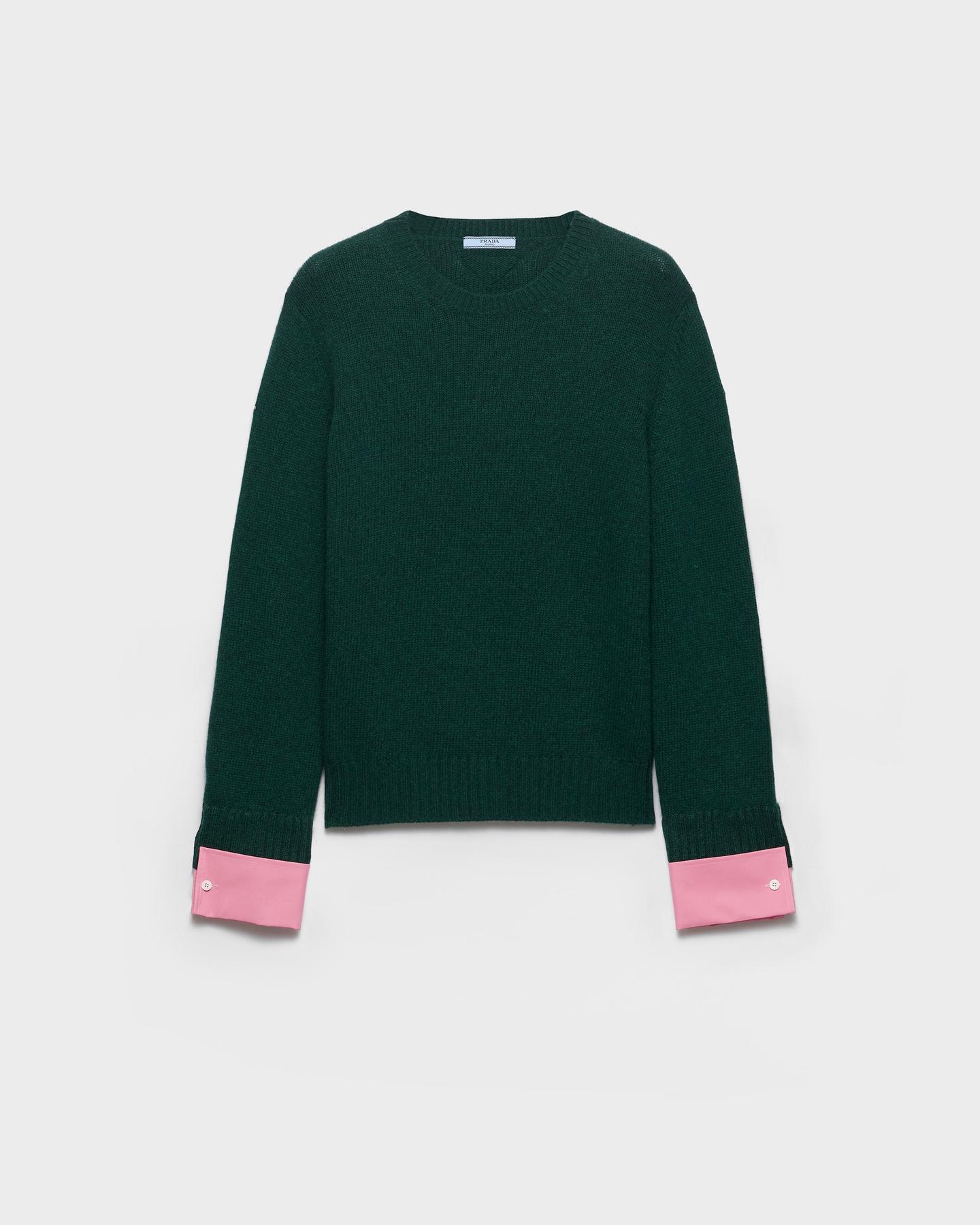
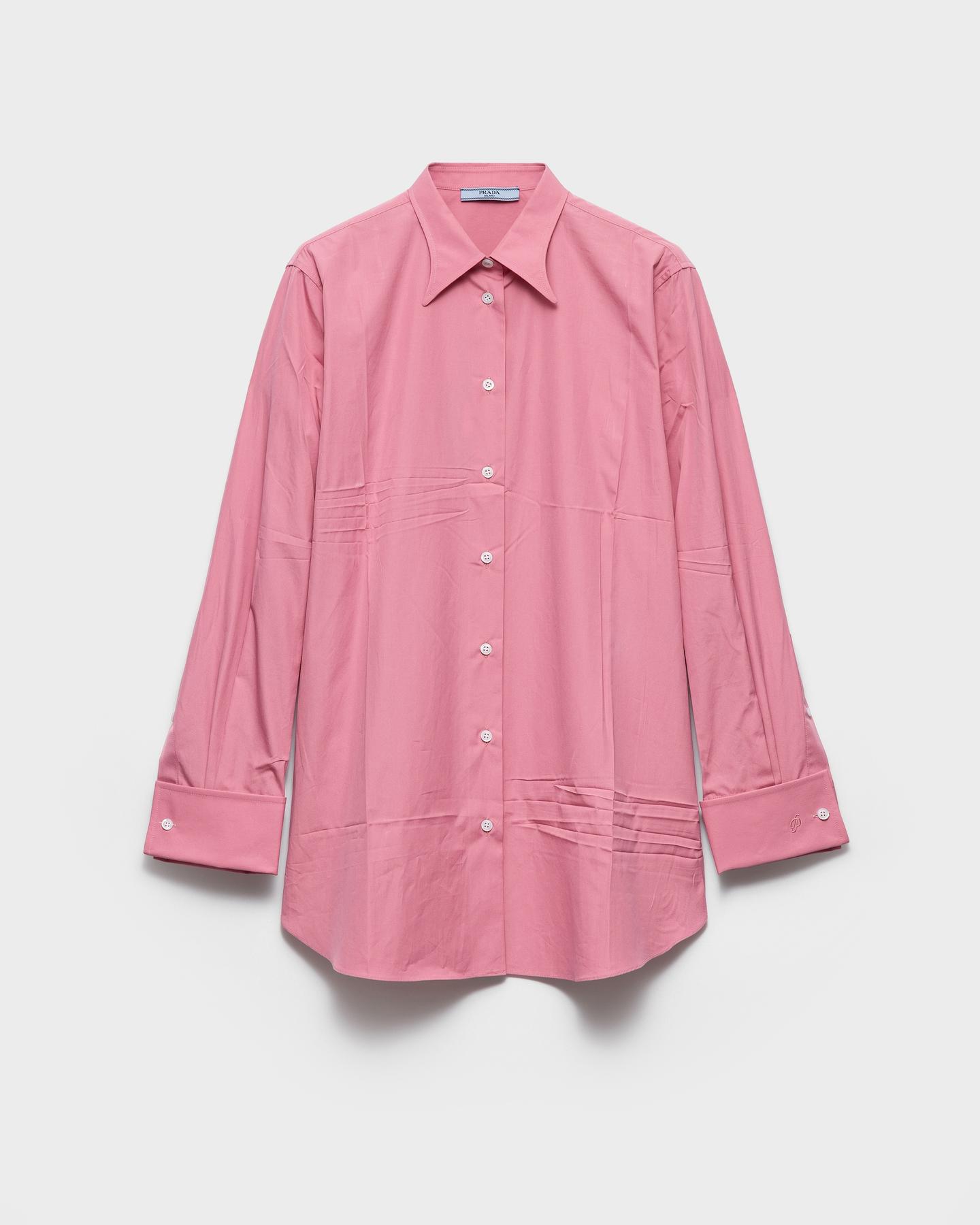
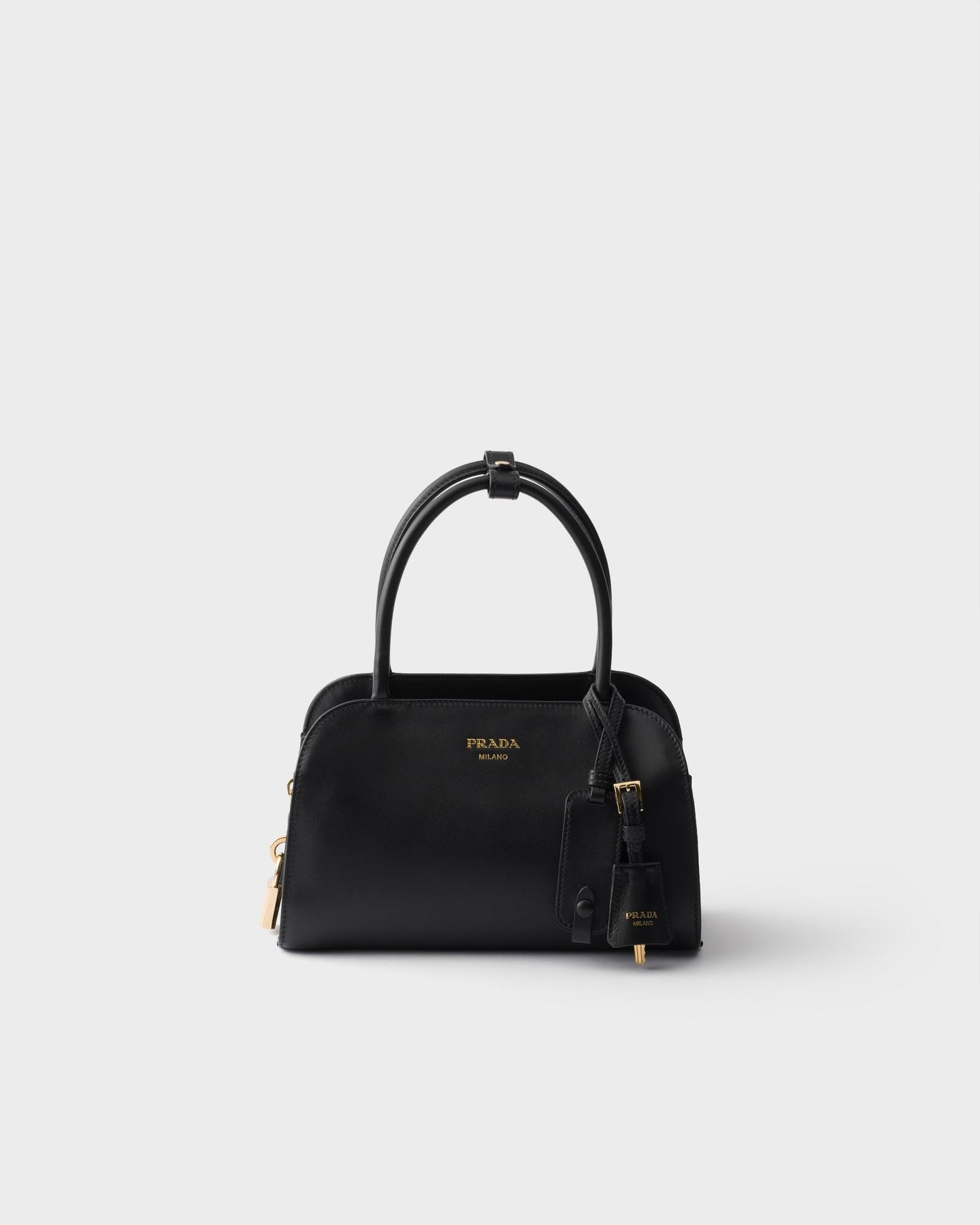
Then I go to the brand's site and pick pieces from the current collection. I went with a bottle-green wool and cashmere sweater, a pink poplin shirt underneath so the collar and cuffs peek out, and a structured black top-handle bag. I use the real product photos as references instead of describing them.
4. Dress her
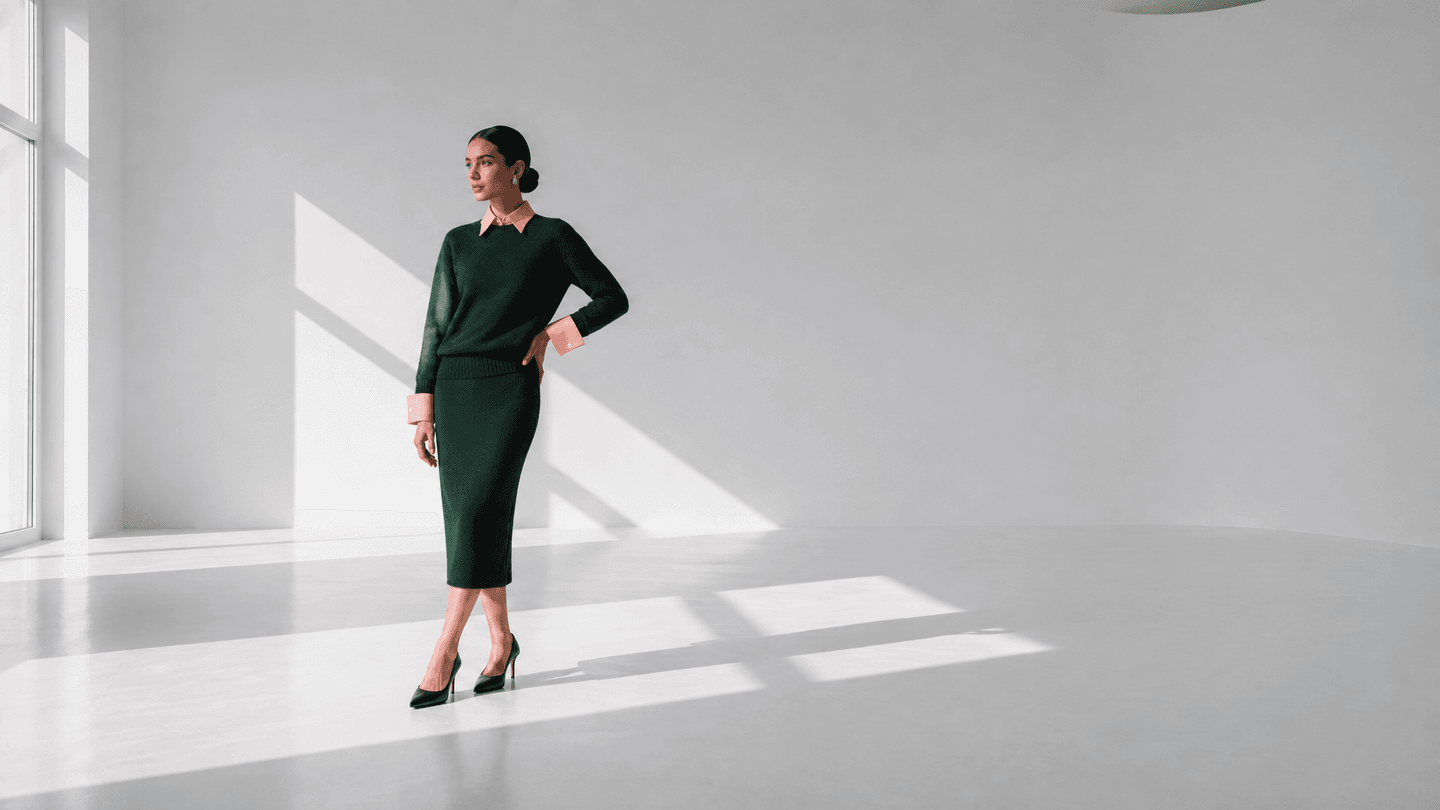
Now I pass the frame from step 2 as the first reference for her face, the room and where she stands, and tell it to ignore the white dress. The sweater and the shirt photos go in as the second and third references. She ends up in the same spot, same size, in the new outfit, with her hands empty so the puma can bring the bag.
Exact prompt
Create a new photorealistic image. This is a photograph taken natively inside the same minimalist white studio as the first reference, from the same camera position and framing, not a composite: one unified natural window light falls on the woman and the room alike. Keep the woman's face, hair and build from the first reference, and the room, camera and where she stands; IGNORE her white dress and white shoes in the first reference. THE VIBE: Austere, hushed, expensive minimalism, a high-fashion campaign frame. One saturated bottle-green figure with flashes of pink against a vast field of white; the fall of light and shadow does half the work. IDENTITY LOCK: The same woman from the first reference, preserved exactly: late twenties, tall and slender, dark brown hair in a sleek low centre-parted bun, warm light-olive skin, dark almond-shaped eyes, understated bare-luxe makeup. THE SUBJECT: She wears the bottle-green wool-and-cashmere crew-neck sweater from the second reference, matched exactly: a deep bottle green (true colour: dark saturated forest green), relaxed fit, ribbed crew neck and hem, small blue-and-white label at the back neck. Underneath it she wears the begonia-pink cotton poplin shirt from the third reference: its pointed pink collar peeks out over the sweater's neckline and its wide begonia-pink double cuffs with white buttons fold out over the sweater's sleeve ends, exactly as in the second reference. Below: a slim bottle-green wool pencil skirt falling just below the knee, matching the sweater, and sleek pointed-toe black leather pumps. Small silver stud earrings. Her hands are completely empty: no handbag, no bag of any kind. ONE pose: relaxed contrapposto, weight on her right leg, right hand resting lightly on her hip so the pink cuff shows, left arm relaxed at her side, gaze sent just off-camera to the left toward the light. THE FACE: Natural skin texture with fine pores and subtle tonal variation, no airbrushing, no plastic or waxy skin, natural catchlights. THE SETTING: Exactly the studio from the first reference: seamless matte-white cyclorama sweeping into a continuous matte-white floor with a soft satin sheen and faint painted-plaster texture, a tall window at the left edge. Empty except for her. THE LIGHT: KEY: soft directional daylight raking in low from the window on the LEFT, lighting her left side and front, soft-edged, gentle falloff to soft grey shade on her right side; the green reads deep and rich in the light, near-black green on the shaded side; the pink cuffs glow bright. FIELD: the bright white wall and floor with the same long, clean window-frame and mullion shadows stretching across the floor to the right as in the first reference. Her own soft shadow falls to the right along the floor, matching. Cool-neutral white balance, faint warmth where the sun lands, naturalistic grade, deep focus. THE KEY DETAILS: the pink collar and pink cuffs against the bottle green; the black pumps grounded on the white floor with a contact shadow. THE MOOD: Editorial, restrained, cool, with a playful pop of pink. THE COMPOSITION: 16:9, the same wide frame as the first reference. She stands full length, small, in the LEFT THIRD, in the same spot and at the same size as the woman in the first reference, with vast empty white floor and wall to the right for an animal to enter later and open space above. THE CAMERA: Cinematic editorial fashion still, eye level, locked-off, deep focus, lit only by the window, no strobes.
5. Bring in the puma
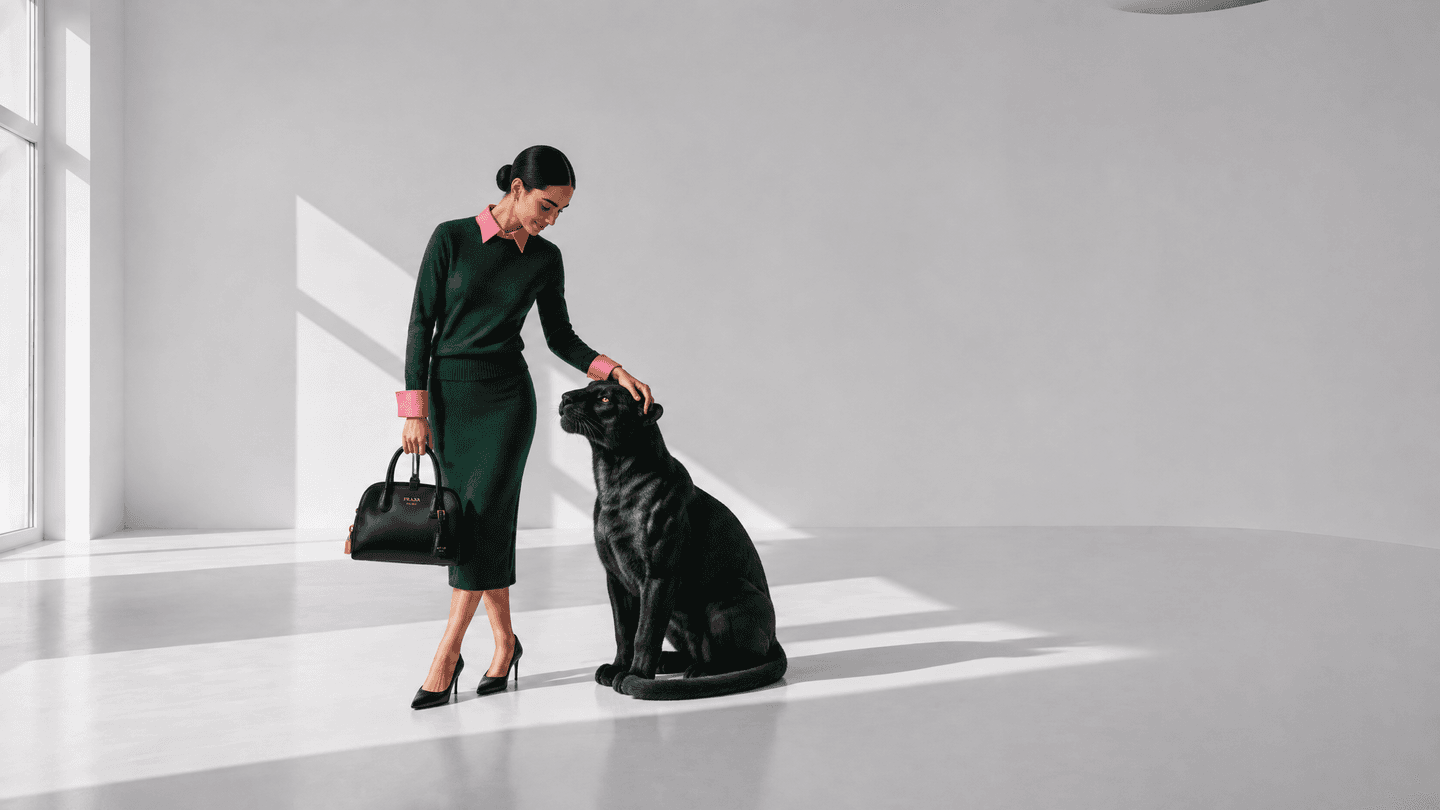
Next is the delivery frame. The puma sits on the right, she holds the bag in one hand and has the other on its head. I described the bag down to the gold lettering and the padlock on the side so it matches the real one.
I had an older frame of this same puma next to her, so I passed it in for the puma's look and where it sits. If you don't have one, leave that reference out and lean on the description of the puma in the prompt.
Exact prompt
Create a new photorealistic image. This is the same photograph as the first reference, taken a moment later in the same white studio from the same camera, not a composite: the woman, her outfit, her face and the room are preserved exactly from the first reference, and a real black puma now sits beside her, lit by the same window light with real cast shadows. Use the second reference ONLY for the black puma and how the woman and puma are arranged; IGNORE the second reference's woman, her white dress, her shoes and her bag. THE VIBE: Austere, hushed, expensive minimalism with a tender, surreal edge: a sleek black big cat has just delivered her purse. Three dark shapes (the black cat, the black bag, her dark hair) and one bottle-green figure with pink flashes against an all-white room. IDENTITY LOCK: The woman from the first reference, preserved exactly: late twenties, sleek dark brown low centre-parted bun, warm light-olive skin, dark almond eyes, understated makeup. THE SUBJECT: She wears exactly the outfit from the first reference: the bottle-green crew-neck sweater with the begonia-pink shirt collar and wide pink cuffs showing, the bottle-green pencil skirt and black pointed pumps. She stands on the LEFT half of the image, leaning gently toward the puma on her right. Her hand nearest the puma (on the RIGHT side of the frame) rests on top of the puma's head mid-caress, fingers in its fur, the pink cuff showing. Her other hand (on the LEFT side of the frame) holds the handbag by its handles, held slightly forward as if just received. Soft, serene smile, head tilted toward the cat. THE ANIMAL: The same full-grown melanistic puma as in the second reference: a sleek solid jet-black big cat, glossy short fur with real individual-hair texture, luminous amber-gold eyes, muscular and calm, at true natural size. It sits upright on its haunches on the RIGHT half of the frame, tail curled around its front paws, head lifted into her hand. THE BAG: The exact handbag from the third reference, matched exactly: a structured black smooth leather top-handle bag with a rounded domed top, two rolled black leather handles held together by a small leather strap, gold "PRADA MILANO" lettering on the front, a gold padlock on the side and a black leather key-bell tag hanging from the handle. THE SETTING: Exactly the studio from the first reference: seamless matte-white cyclorama, continuous white floor with a soft satin sheen, tall window at the left edge. THE LIGHT: KEY: the same soft directional daylight raking in low from the LEFT lights her and the puma's left side; the puma's glossy black fur catches a soft sheen along its back and head, its far side falls into deep soft black. FIELD: the same bright white wall and floor with the same long window-frame shadows stretching to the right. The puma casts a soft contact shadow and a long shadow to the right along the floor, matching hers. Cool-neutral white balance, faint warmth, naturalistic grade, deep focus. THE KEY DETAILS: her fingers in the puma's fur; the gold lettering on the black bag; the pink cuffs. THE MOOD: Editorial, calm, tender, quietly impossible. THE COMPOSITION: 16:9, same camera and framing as the first reference. She stays at the same size as in the first reference, on the left; the seated puma just to her right; both in the lower-centre-left of the frame, with open white space above and to the right. THE CAMERA: Cinematic editorial fashion still, eye level, locked-off, deep focus, lit only by the window.
6. Make the end card
The last frame is the white-floor studio from step 1 with the logo on the wall. I gave it the studio and a logo image as references and asked for the logo once, centred in the upper middle of the wall.
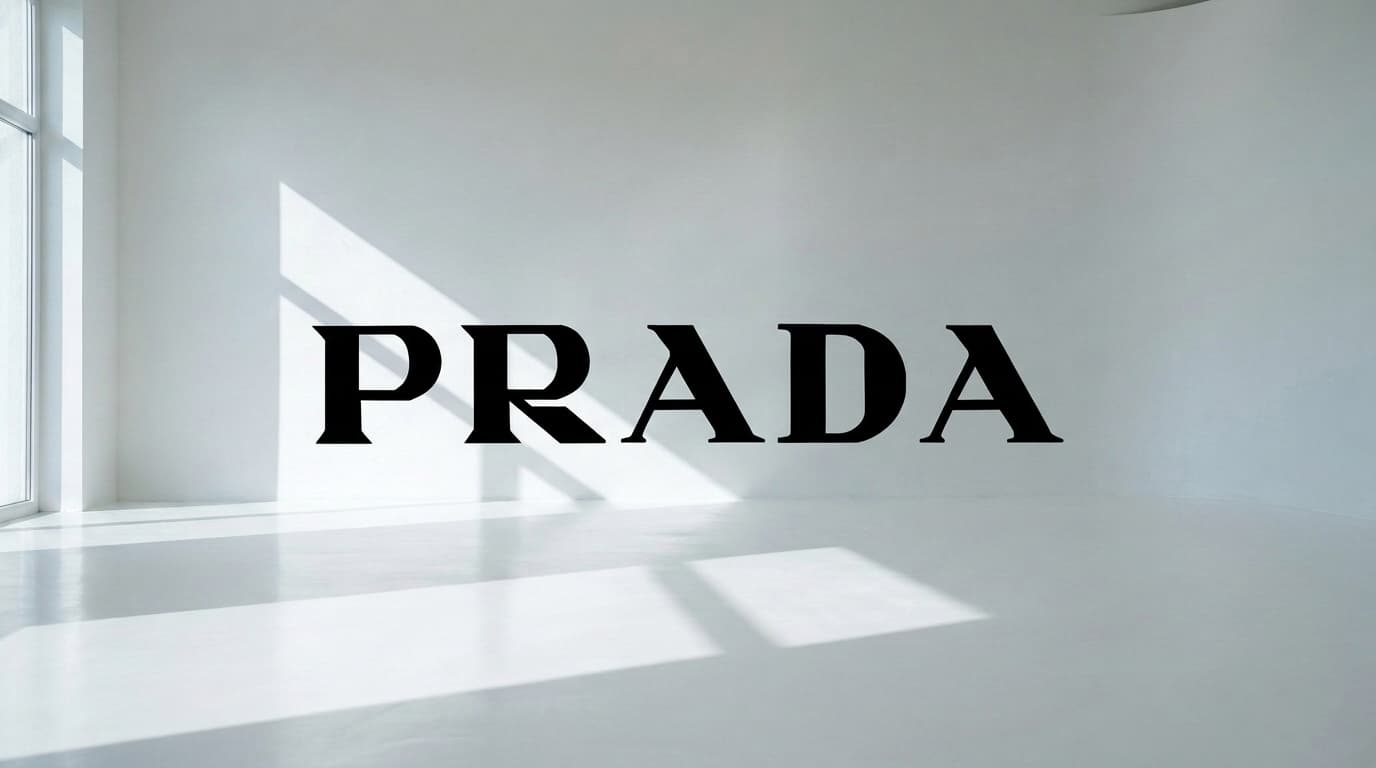
Exact prompt
Create a new photorealistic image — a minimalist luxury fashion-film end-card. Take the empty white studio scene from the first reference and place the black PRADA wordmark from the second reference onto it as a clean, crisp graphic title. THE VIBE: Austere, hushed, expensive minimalism — a high-fashion campaign sign-off frame. Vast white emptiness, one dark wordmark, nothing else. Restrained, iconic, still. THE SETTING (from the first reference): The clean modern white studio — the seamless matte-white cyclorama sweep curving unbroken into the continuous matte-white floor, faint painted-plaster texture, soft satin floor sheen. Preserve it exactly. THE LOGO (from the second reference): The PRADA wordmark — bold black serif capital letters, the exact letterforms, spacing and proportions from the second reference, reproduced precisely and legibly with clean sharp edges. Rendered in solid deep black, perfectly level and horizontal, centred left-to-right, sitting in the clean upper-middle white space of the frame at an elegant restrained scale (roughly a third of the frame width), like a crisp printed campaign title laid over the scene. Do NOT distort, restyle, misspell, or add any other text. THE LIGHT (from the first reference): Soft directional daylight raking in low from the left, long clean window-frame and mullion shadows falling to the right across the lower white floor. Cool-neutral white balance with the faintest warmth. Delicate dust motes in the light shaft. THE MOOD: Editorial, muted, cold-clinical calm with a breath of warmth. Restrained luxury. Clean neutral grade, whites held just off pure white, the wordmark deep solid black. THE COMPOSITION: Wide frame, eye level, straight-on, symmetrical. The black wordmark centred in the upper-middle white negative space; the soft window shadows across the lower floor as the only other element; generous open white all around. Balanced, airy, iconic. THE CAMERA: Cinematic editorial still — wide framing, eye-level straight position, deep focus everything sharp, lit exclusively by the single window daylight source, clean cool-neutral naturalistic grade. Gentle edge falloff. The wordmark itself is a flat crisp graphic, not lit or textured. Hyperreal, tactile studio; sharp clean logo.
7. Plan the camera move before the first render
A camera move has a lot of choices in it, so I settle them all before I render anything: which way it circles, how far it goes and how it gets back. I went with half an orbit to the right, away from the window, then back the same way and out to the wide shot. Each clip is 5 seconds.
8. Make the walk-in with the drone move
The walk-in goes from the empty studio to her dressed pose. In the prompt I describe the whole thing as one continuous take: she walks in, the view glides toward her like a slow drone, arcs halfway around her to show the back of the outfit, swings back and pulls out.
The most important line in that prompt says the view lands on the final wide frame only on the very last frame. I add it so the camera keeps moving until the end of the clip instead of arriving early and holding.
Exact prompt
Create a new video where, in an empty sunlit white studio, a young woman with a sleek dark brown low bun, wearing a bottle-green crew-neck sweater with a begonia-pink shirt collar and wide pink cuffs, a bottle-green pencil skirt and black pointed pumps, walks in from the right and settles into a poised pose in the left third, while a smooth drone-like move flies in close, arcs halfway around her to show the outfit from the side and back, swings back the same way, and pulls back out to land exactly on the original wide frame. One continuous take, no cuts. Soft natural window daylight from the left, cool editorial fashion-film mood. ONE single woman only: exactly one person in the frame at all times, no duplicates, no clones, no reflections of people. [SCENE 1] THE STARTING FRAME: the empty white studio exactly as in the first frame, a tall window on the left, long window-frame shadows across the white wall and floor, nobody in the room, wide eye-level view. Video animates FROM this position. Almost immediately the woman steps in from the RIGHT edge of the frame, walking forward toward the left with an unhurried, natural stride, feet planted on the floor, walking forward, NOT backward, not sliding, not drifting. As she crosses into the window light, the view glides smoothly forward toward her, gimbal-smooth like a slow drone, closing in to a full-length shot of her. [SCENE 2] Still one continuous move: the view arcs around her to the RIGHT, away from the window, circling about halfway around her at body height so we see her side and then her back: the bottle-green sweater, the pink cuffs at her wrists, the slim green pencil skirt and the black pumps. She slows to a stop and keeps breathing, blinking, settling her weight onto one leg. Then the view swings back the same way it came, around to her front, and pulls smoothly back out and wide, reversing the push-in, settling into the exact original wide framing of the empty studio with her small in the left third, right hand on her hip, gaze toward the window. The view lands on that final wide frame only on the very last frame of the clip and holds; it does not reach it early. The studio, window light and long floor shadows stay consistent from every angle. Her outfit stays exactly the same throughout. Deep focus, smooth stabilised motion, no shake.
9. Use the first clip as a reference for the next one
The catch with circling the camera is that the model has to make up the parts of the room you haven't seen yet, like the view out the window. If every clip makes up its own, the room changes between clips. So for the delivery clip I passed the walk-in as a reference video and said it's for the studio and the camera style only, and not to copy her walk or poses. The window and the city outside it came out the same as in the walk-in.
Exact prompt
Create a new video where, in a sunlit white studio, a young woman with a sleek dark brown low bun, in a bottle-green crew-neck sweater with a begonia-pink shirt collar and wide pink cuffs, a bottle-green pencil skirt and black pointed pumps, stands by the window as a real black puma pads in from the right carrying a structured black leather top-handle handbag in its mouth, sits beside her and offers it up; she takes the bag in one hand and strokes the puma's head with the other. Meanwhile a smooth drone-like move flies in close, arcs halfway around the pair to the right, away from the window, swings back the same way and pulls back out to land exactly on the wide final frame. One continuous take, no cuts. Soft natural window daylight from the left, calm, tender editorial mood. ONE single woman and ONE black puma only: no duplicates, no clones. @image_1 is the opening shot and @image_2 is the final shot. @video_1 is the studio and camera style only: match how this same studio, window and the view outside it look from every angle as the shot circles, and its smooth drone-like move. Do NOT copy the woman's walk or poses from @video_1. [SCENE 1] THE STARTING FRAME: the woman standing in the window light in the left third, weight on one leg, right hand on her hip, the right side of the studio empty, wide eye-level view. Video animates FROM this position. She breathes, blinks and turns her head as a real adult black puma enters from the RIGHT edge of the frame, padding forward toward her with a smooth, low, muscular cat gait, paws planted on the floor, walking forward, NOT backward, not sliding, not drifting. It is a lean, live melanistic puma at true natural size with glossy short black fur and amber eyes, and it keeps exactly this size the whole time, never shrinking or growing. It carries the black handbag gently by its rolled top handles in its mouth the whole way; the bag never drops. At the same time the view glides smoothly forward toward the two of them, gimbal-smooth like a slow drone. [SCENE 2] Still one continuous move: the view arcs around the pair to the RIGHT, circling about halfway around at body height so we see her outfit from the side and back and the puma's sleek profile as it sits down on its haunches beside her, tail curling around its paws, and lifts its head to offer the bag. She leans toward it, takes the bag by its handles in her hand and rests her other hand on top of its head, the pink cuffs showing. Then the view swings back the same way to the front and pulls smoothly back out and wide, settling into the exact wide framing of the final frame: her on the left holding the bag, the seated puma on the right with its head in her hand. The hand-off and the final framing land only on the very last frame of the clip and hold; she does not take the bag early and does not hand it back. Her outfit, the bag and the studio stay exactly the same throughout. Deep focus, smooth stabilised motion, no shake.
And listen, it's not perfect. The orbit is fast, and the hand-off happens while the camera is behind her, so you never actually see her take the bag. It just shows up in her hand when the camera pulls back.
10. Keep the ending still
For the walk-off I dropped the orbit. The camera stays locked, she and the puma turn right and walk out of the frame, and the logo shows up once on the empty wall. Since the camera doesn't move here, I skipped the reference video too.
Exact prompt
Create a new video where, in a minimalist sunlit white studio with a tall window on the left, a young woman with a sleek dark brown low bun, in a bottle-green crew-neck sweater with a begonia-pink shirt collar and wide pink cuffs, a bottle-green pencil skirt and black pumps, stands beside a sleek solid-black puma, holding a black structured handbag. She and the puma turn and walk away together toward the RIGHT side of the frame, side by side, and both exit the frame, leaving the studio empty. Once the white space is clear, the bold black PRADA wordmark appears. The camera is completely static and locked off the whole time. Cool-neutral natural grade, calm and elegant. [SCENE 1] @image_1 is the opening shot. THE STARTING FRAME: the woman stands on the left with the black handbag in one hand, her other hand resting on the head of the seated black puma on the right. THE SETTING (UNCHANGED FROM FRAME): the white walls, the floor, the window on the left and the long soft daylight shadows falling to the right remain static. She blinks, breathes, lifts her hand from the puma's head and straightens. The puma rises from sitting onto all four paws. Both TURN their bodies to face the right side of the frame first, then walk forward in the direction they face, toward the right, unhurried and smooth, the puma at her side, its tail swaying. They walk forward naturally, NOT backward, not sliding, not drifting; feet and paws step and plant on the floor. The puma stays exactly the same size relative to her throughout. She keeps the black handbag in her hand the whole way. Both fully exit the frame on the right. [SCENE 2] @image_2 is the final shot. The empty white studio holds for a beat, then the bold black PRADA wordmark appears all at once, centred in the upper-middle white space, crisp sharp black serif capitals, exactly as in @image_2, and holds perfectly still to the end. The logo appears ONCE only: no flicker, no second appearance, no fade out. Camera: static, locked off, eye-level wide framing, no camera shake, no zoom, no orbit, no push. Soft window light from the left, constant throughout. No text other than the PRADA wordmark.
11. Put it in the reel layout
Last, I put the three clips one after another on a black 9:16 canvas. The start and end frame of each clip sit on top, the clip runs full width under them, and a small label goes under the clip. You can build this in the Instagram Edits app, or just ask Claude to build it for you.
Why it works
With a moving camera, the risk is a jump at every cut. If a clip ends somewhere random, the next one starts from a different spot and the edit falls apart. That doesn't happen here because each clip starts and ends on a frame I made, so the camera can go wherever it wants in the middle and it still comes back to the exact shot the next clip picks up from.
The other thing was the room. Once the camera starts circling, the model has to make up the back of the studio and the view out the window. That's why I fed the walk-in back in as a reference, "so that the studio stays consistent", and the delivery clip kept the same window and the same city outside.
If you want the locked-camera version of this same idea, here's the first time I made it.
Your turn: take a start and end frame you already have and ask for half an orbit around your subject, in one direction, back out to the end frame.
Emero writes camera moves like this for you and remembers your studio and your look between spots, all at cost.
Here's the full cut one more time:

Get one of these every day
I test new workflows daily and send them with the exact prompts, the models and the costs
6,824 generations tested so far
More workflows
See all
Kling 4.0 + GPT Image 2.6 - 7 movie looks on one phone clip
Turn one phone clip into 7 movie looks that switch every time you put your glasses on
GPT Image 2.6 Flare, Kling 4.0 · 12 min render

Kling 4.0 + GPT Image 2.6 Flare - an AI commercial starring you, four ads from your own clips
Turn 3 second phone clips of yourself into an AI commercial: four ads, start to finish
GPT Image 2.6 Flare, Kling 4.0, Nano Banana Pro · 7 min render

Kling 4.0 + GPT Image 2.6 - 8 lighting styles on one clip, one per second
Relight one phone clip into 8 lighting styles that switch exactly once per second
GPT Image 2.6 Flare, Kling 4.0 · 16 min render