Nano Banana Pro - four jacket product shots with no model
Four product shots of one jacket with no model: hero, macro, out in the world and a flat lay
 Tested by Nouamane Benbrahim
Disclaimer: This is an independent creative test made with AI, for demonstration only. It isn't an ad for any brand shown or named, and isn't affiliated with, sponsored or endorsed by them. All trademarks belong to their owners
Do you actually need a model to sell a jacket?
I wanted to find out, so I made 4 shots of one jacket with nobody wearing it. It's a black track jacket with a hood, flame panels that fade from red into yellow, and a red diamond zip pull, a real product from a fashion brand. Not a client, this was a test. The only thing I attached was the brand's own product photo on a plain white background.
Here's my exact process.
1. Start from one clean product photo
I start from the brand's product photo: the whole jacket, straight on, flat light, nothing else in frame. Every shot gets that photo attached, plus a line telling the model to keep the jacket exactly as it is.
Then I give each shot one job. Someone looking at a jacket wants to know what it looks like, what the fabric is like, what it looks like out in the world, and what its full shape is. So that's four shots.
2. The hero shot
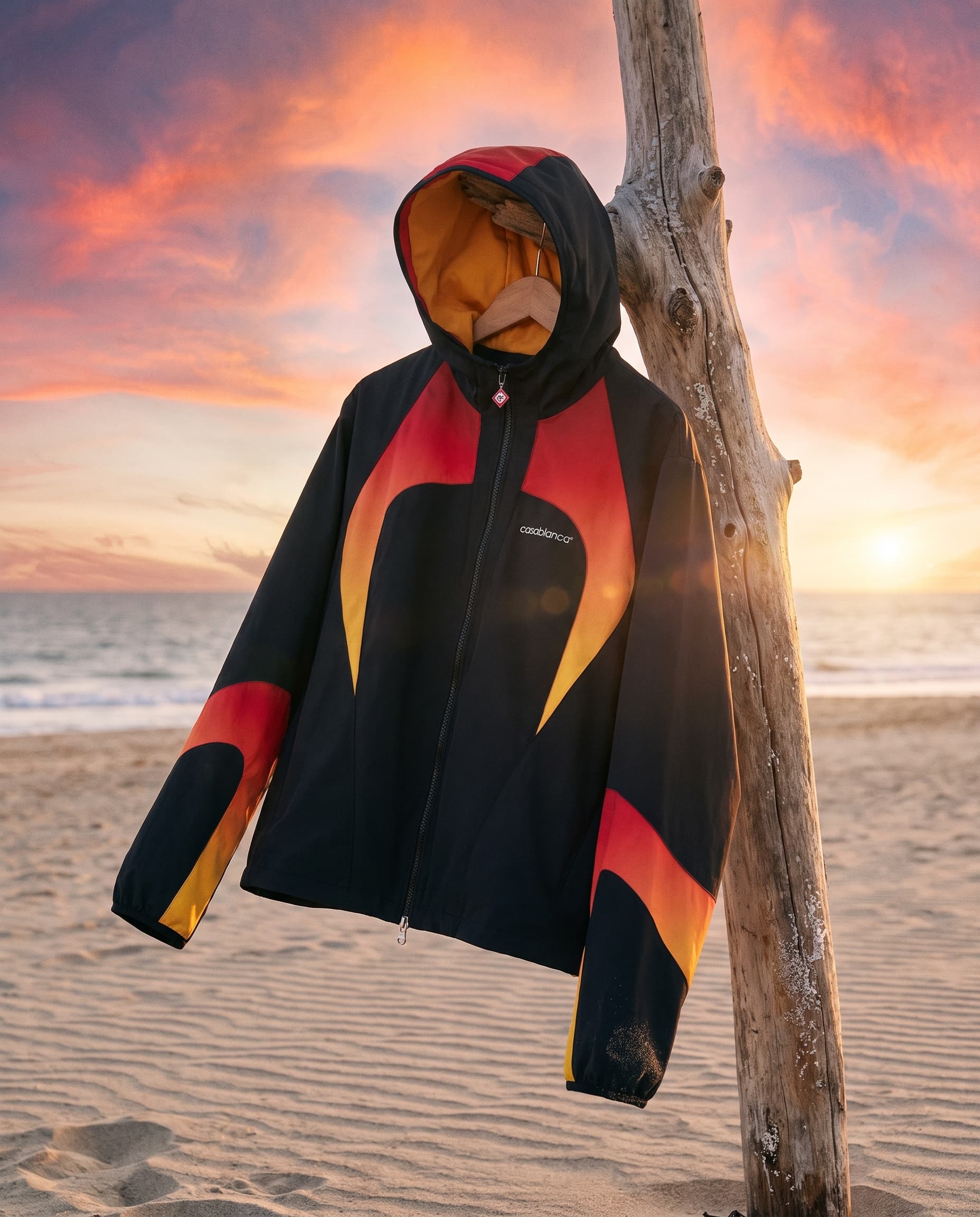
The hero is the one people see first, so it's the whole jacket, big and sharp. I hung it from an old driftwood post on the beach with the sun setting right behind it, half zipped, the hem lifting in the wind.
Exact prompt
Create a new photorealistic image. Preserve the exact design of the jacket from the first reference. THE VIBE: Someone left it here and walked into the sea. The jacket hangs alone against a burning sky — a relic of the last night of summer, quietly heroic. THE SUBJECT: The black matte technical-shell hooded zip jacket from the first reference, preserved exactly: red-to-orange-to-yellow gradient horn-shaped panels curving down from both shoulders across the chest, gradient crescent panels on both forearms, yellow-orange hood lining with a red top edge, small white lowercase wordmark on the left chest, silver zipper with a red diamond-shaped zip pull, yellow cuff edges. It hangs by its hood from a knot on a tall weathered, sun-bleached driftwood post planted in the sand, zipped halfway, sleeves hanging with a slight natural twist, the hem lifting in the breeze. Matte nylon shell with soft sheen along folds; crisp stitched seams where the gradient panels meet the black. THE SETTING: A wide empty beach at sunset; soft rippled sand, a line of sea foam in the middle distance, calm sea, a dramatic sky of peach, coral and violet clouds with the sun just above the horizon. THE LIGHT: The low sun directly behind the jacket, backlighting it; a bright rim of gold traces the hood, shoulders and sleeve edges; the gradient panels glow warmly where light grazes them; gentle warm bounce from the sand lifts the black fabric so its folds and texture read. No blown highlights. THE KEY DETAILS: Salt-crusted texture and cracks in the driftwood; a few grains of sand clinging to the cuff; a faint sun flare. THE MOOD: Warm-nostalgic amber and rose grade with deep rich blacks — a campaign hero still. THE COMPOSITION: Vertical frame, three-quarter view of the jacket, hanging slightly above centre, large and dominant, razor-sharp; horizon low; the post rising from the bottom of frame. THE CAMERA: Cinematic product capture, 85mm-feel lens, shallow depth of field so the sea and sky fall soft behind the sharp jacket, natural light only. THE AFTER EFFECT: Fine film grain across the frame. THE LABEL: The small white wordmark and the red diamond zip pull are accurate and readable at a glance; no other text.
The backlight puts a gold edge on the hood and shoulders, and the panels pick up the colors of the sunset. One thing I didn't ask for: I wrote that it hangs by the hood from a knot in the wood, and it put it on a wooden hanger instead. Not a big deal here, but now I check every shot for stuff I never wrote.
3. The macro
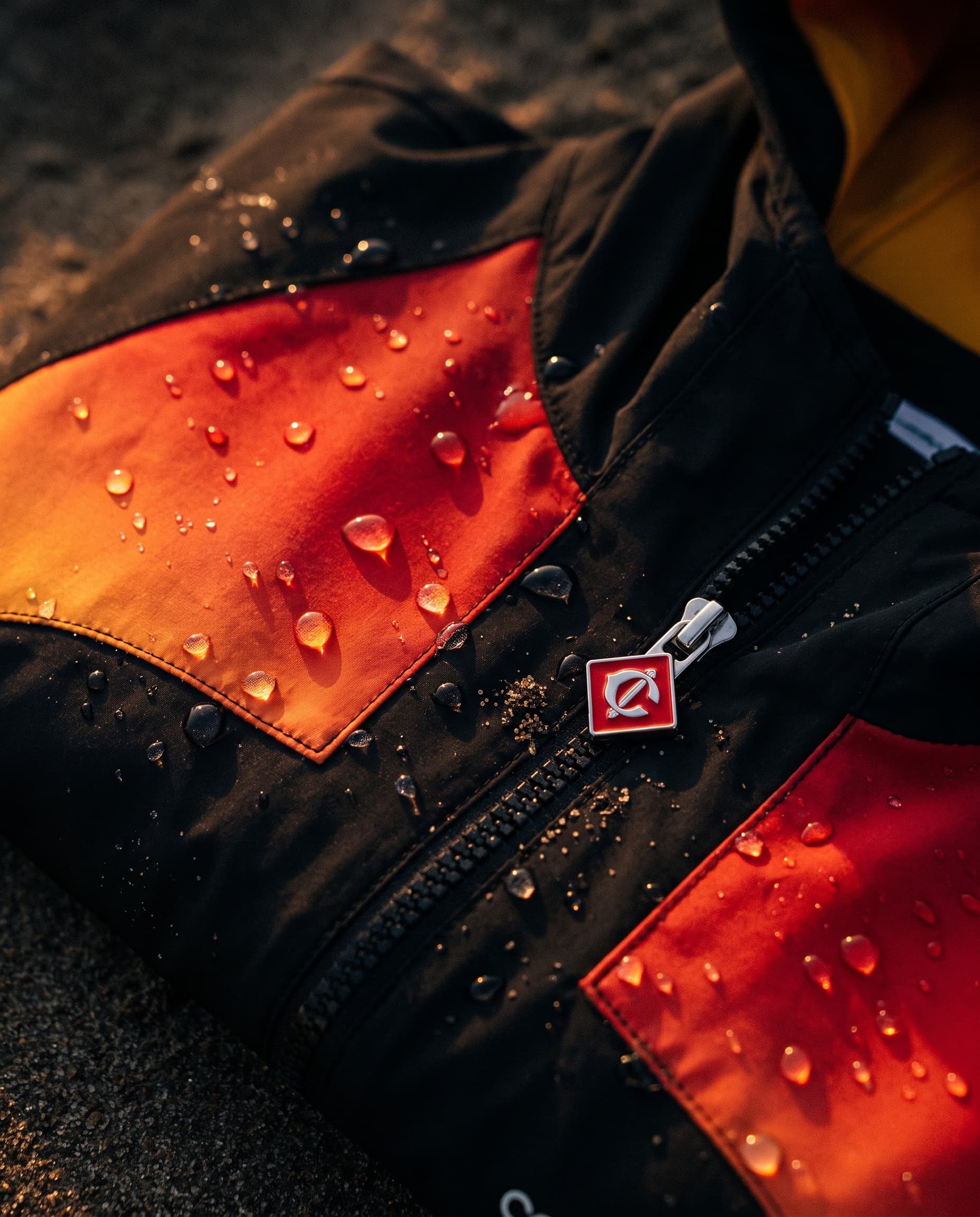
Next is a close-up of the material. The zip runs diagonally across the frame, the zip pull sits in the corner, salt water is beaded on the fabric, and a low orange light skims across it so you see the weave.
Exact prompt
Create a new photorealistic image. Preserve the exact design of the jacket from the first reference. THE VIBE: An intimate close look at the fire in the fabric. Salt water beads on the shell like it just came out of the sea at dusk — tactile, hyperreal, alive. THE SUBJECT: An extreme close-up of the black matte technical-shell hooded zip jacket from the first reference, laid folded on a surface: the frame is filled by the upper chest where the red-to-orange-to-yellow gradient horn-shaped panel meets the black shell along a crisp stitched seam, and the silver zipper running diagonally through the frame with its red diamond-shaped enamel zip pull resting on the fabric. Matte nylon micro-weave texture visible; the gradient is smooth and saturated from deep red into orange into golden yellow. THE SETTING: The jacket rests on dark damp sand with a few grains stuck to the fabric. THE LIGHT: Low raking warm amber light from frame-left skims across the surface, bringing out the weave and every droplet; small beads of water sit on the shell, each with a bright specular highlight and a tiny refracted glow of the orange panel inside it; the silver zipper teeth throw crisp specular streaks; the red enamel pull glints. Deep shadows on the right. THE KEY DETAILS: Water droplets of varying size, a couple of sand grains, the metal teeth of the zipper, the edge of the seam stitching. THE MOOD: Warm amber against rich black, punchy-saturated but moody. THE COMPOSITION: Vertical frame, tight macro, zipper as a diagonal leading line from lower-left to upper-right, the red diamond zip pull at the lower-right third, the gradient panel curving across the upper portion. THE CAMERA: Cinematic macro capture, very shallow depth of field, focus on the zip pull and nearest droplets with the fabric rolling off softly into blur, practical light only. THE AFTER EFFECT: Subtle film grain. THE LABEL: The red diamond zip pull rendered accurately; no text in frame.
The droplets look great. But this is where the jacket drifted the most. The curved flame panels came out as straight-edged patches, and the zip pull turned into a different logo. My guess is that with only a sliver of the jacket in frame, the model has less of the real shape to hold on to. So on my next try I'm attaching a tight crop of the zip pull and one panel as a second reference, instead of only the full jacket.
4. The jacket out in the world
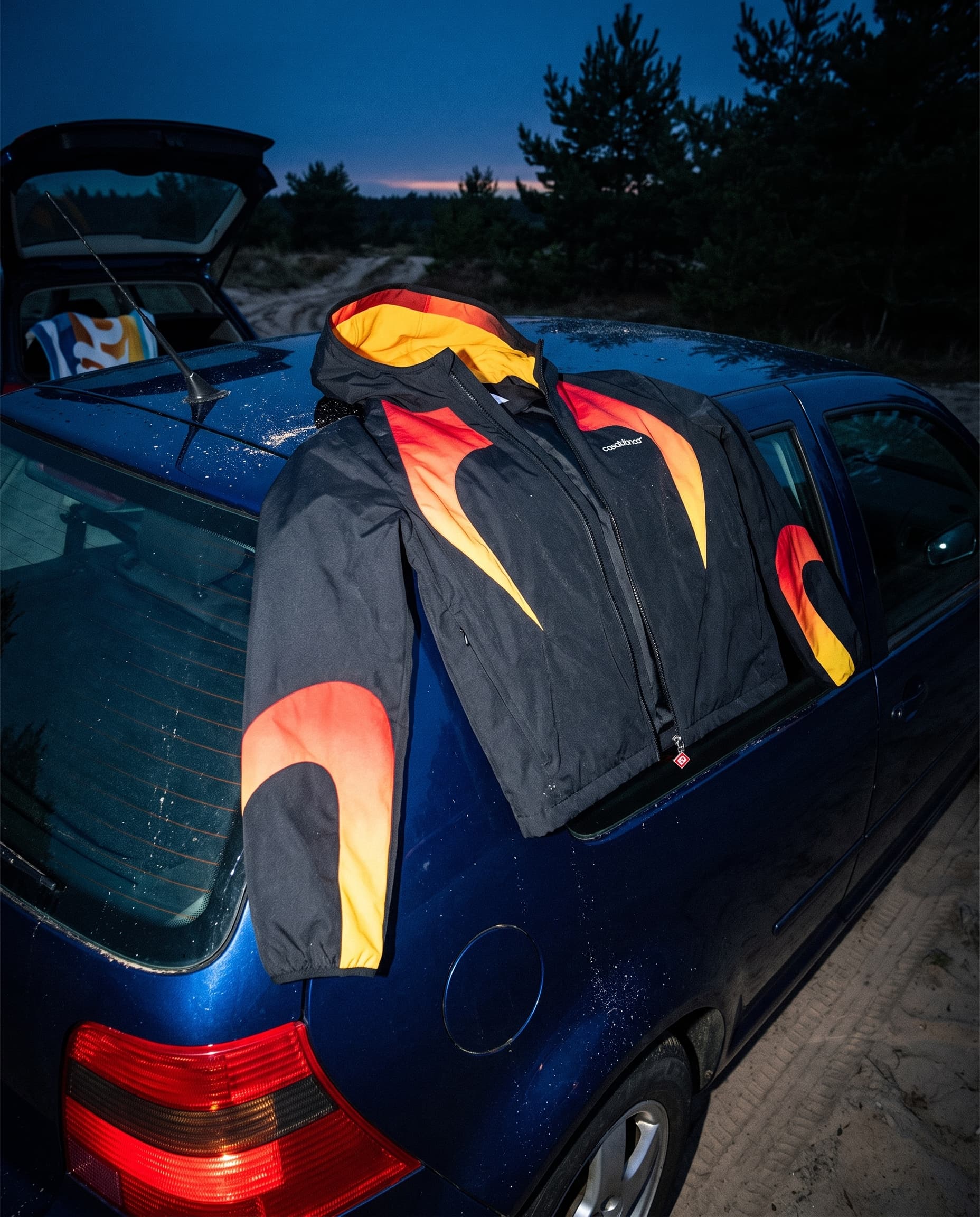
Then I put it somewhere it would actually end up. After a swim, thrown over the roof of an old hatchback, one sleeve hanging down over the window, the hood flopped open so you see the yellow lining. I wanted a hard flash at blue hour, with the taillight glowing at the bottom of the frame.
Exact prompt
Create a new photorealistic image. Preserve the exact design of the jacket from the first reference. THE VIBE: A road trip that ran out of road at the coast. The jacket thrown over the car roof after a swim, blue night coming down fast — raw, spontaneous, a flash-lit memory. THE SUBJECT: The black matte technical-shell hooded zip jacket from the first reference, preserved exactly: red-to-orange-to-yellow gradient horn-shaped panels from both shoulders down the chest, gradient crescent panels on both forearms, yellow-orange hood lining, small white lowercase wordmark on the left chest, silver zipper with a red diamond-shaped zip pull, yellow cuff edges. It is draped casually over the roof of an old dark-blue 2000s hatchback, unzipped, one sleeve hanging down over the rear side window, the hood flopped open showing the yellow lining. THE SETTING: A sandy coastal pull-off at blue hour; dark pine trees silhouetted behind, a deep navy sky with a faint last glow at the horizon, the car's rear hatch open, sandy tyre tracks, a beach towel stuffed in the back. THE LIGHT: A hard on-camera flash from slightly above the lens hits the jacket and the car roof, making the gradient panels pop saturated against the black, with crisp shadows falling behind; the surroundings drop into deep teal-blue ambient; the car's red taillight glows at frame-bottom, bleeding red onto the paint. THE KEY DETAILS: Water droplets and sand on the car roof, the glossy car paint reflecting the flash, the red taillight. THE MOOD: Teal-and-red night grade with crushed blacks — gritty snapshot energy. THE COMPOSITION: Vertical frame, medium-wide from a slightly high angle at the rear corner of the car, jacket on the roof in the upper-centre, the taillight at the lower-left, trees and sky above. THE CAMERA: Direct flash snapshot, deep focus, everything sharp, slightly loose handheld framing. THE AFTER EFFECT: Visible grain in the shadows, subtle flash falloff and vignette at the edges. THE LABEL: The small white wordmark readable but small; no other text; no licence plate text.
The panels held up well on this one. The flash keeps everything crisp, and the antenna and the sandy tire tracks make it look like somebody's actual car.
5. The flat lay
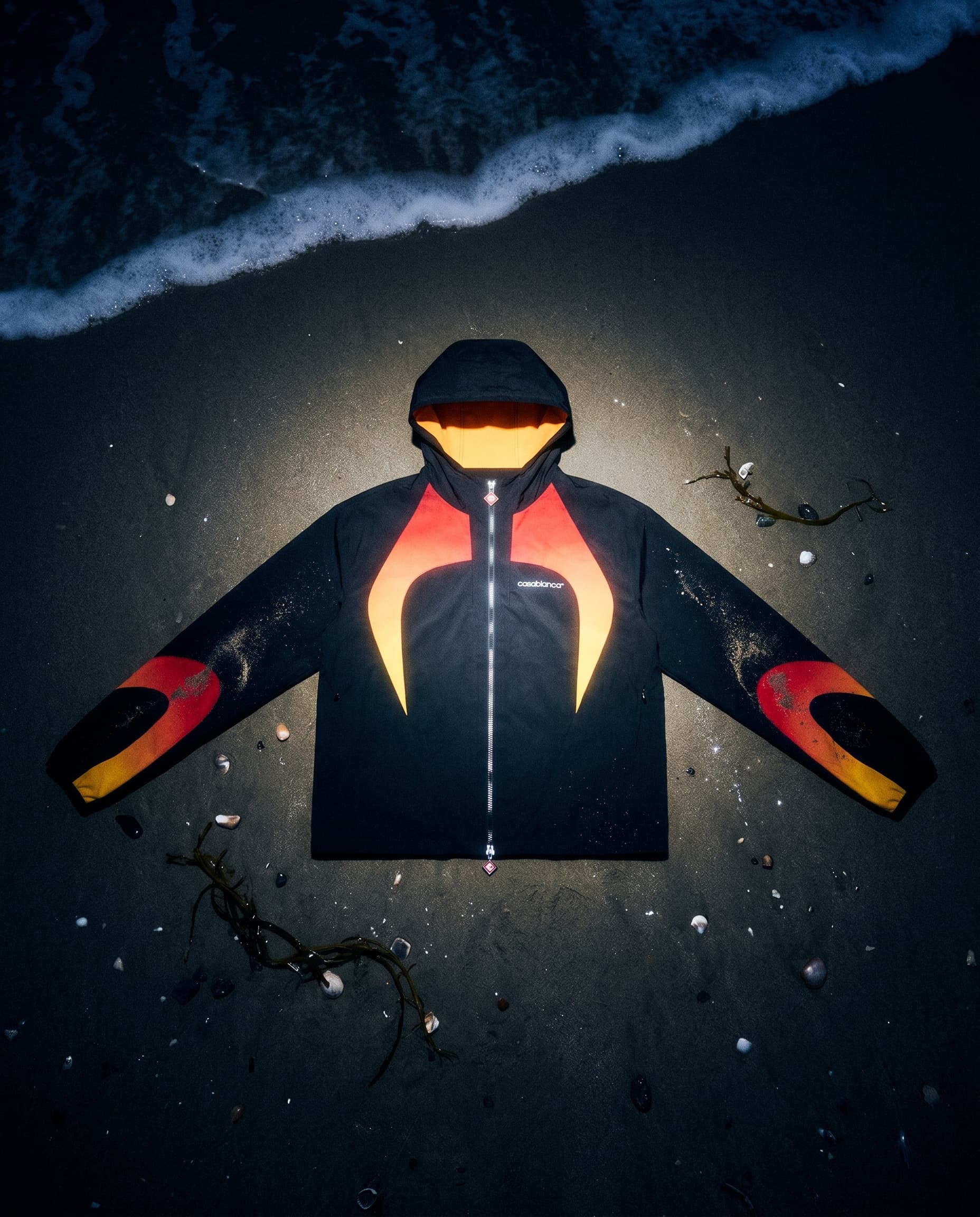
The last one is shot straight down at night on wet sand. The jacket is laid out with its arms spread wide, a single flashlight beam on it, and the edge of the tide curling across the top.
Exact prompt
Create a new photorealistic image. Preserve the exact design of the jacket from the first reference. THE VIBE: Late night on an empty beach, a single torch beam finds something left behind. The flames on the jacket seem to glow on their own in the dark — mysterious, quiet, graphic. THE SUBJECT: The black matte technical-shell hooded zip jacket from the first reference, preserved exactly: red-to-orange-to-yellow gradient horn-shaped panels from both shoulders down the chest, gradient crescent panels on both forearms, yellow-orange hood lining, small white lowercase wordmark on the left chest, silver zipper with a red diamond-shaped zip pull, yellow cuff edges. It lies flat, zipped, arms spread wide open to either side, hood laid flat above the collar showing the yellow lining, as if a person had been lying there. THE SETTING: Dark wet sand at night at the edge of the tide; a thin line of white sea foam curves across the top of the frame; small shells and a strand of seaweed nearby. THE LIGHT: A single hard flashlight beam from the top of the frame creates an oval pool of light on the jacket, falling off quickly into near-black at the edges; the gradient panels read vivid red-orange; the wet sand glints with specular sparkles; everything outside the pool drops into deep navy black. THE KEY DETAILS: The sea foam line, damp sand texture, a few grains on the sleeves, the silver zipper catching the beam. THE MOOD: Low-key, deep navy and black with a vivid flame accent. THE COMPOSITION: Vertical frame, directly top-down, jacket centred and large with arms spread, foam line across the top, generous dark space around. THE CAMERA: Cinematic top-down capture, deep focus across the jacket, practical light only. THE AFTER EFFECT: Heavy film grain in the dark areas. THE LABEL: The small white wordmark readable; no other text.
I wrote that it should look like someone had been lying there, and the arms came out spread wide and loose. I also asked for a few shells and a strand of seaweed nearby, so the sand around it doesn't look empty.
Why it works
I gave each shot one question to answer about the jacket, so none of them repeat each other. The hero shows the whole thing, the macro shows the fabric up close, the car shows it out in real life, and the flat lay shows the full shape with nothing hiding it.
Your turn: take one product photo and make just the macro first. In my test it was the shot where the jacket drifted the most, so you'll find out quick what needs fixing.
Emero writes these product prompts for you and keeps your product photo on file for the next shoot, all at cost.

Get one of these every day
I test new workflows daily and send them with the exact prompts, the models and the costs
5,979 generations tested so far
More workflows
See all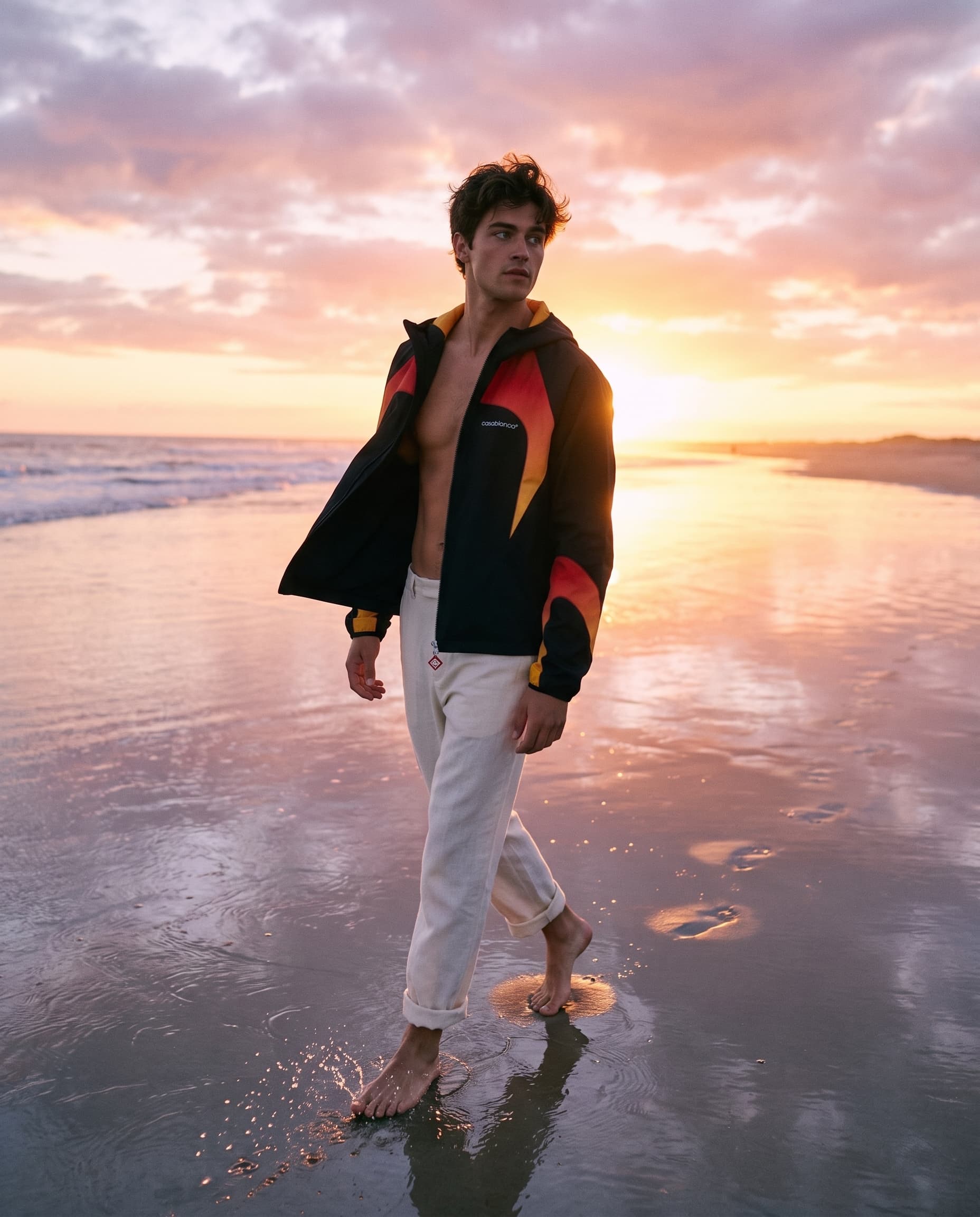
Nano Banana Pro - menswear campaign from a moodboard, one model in five lights
Turn a moodboard into five menswear shots, each lit a different way, with one model across all
Nano Banana Pro · 2 min render
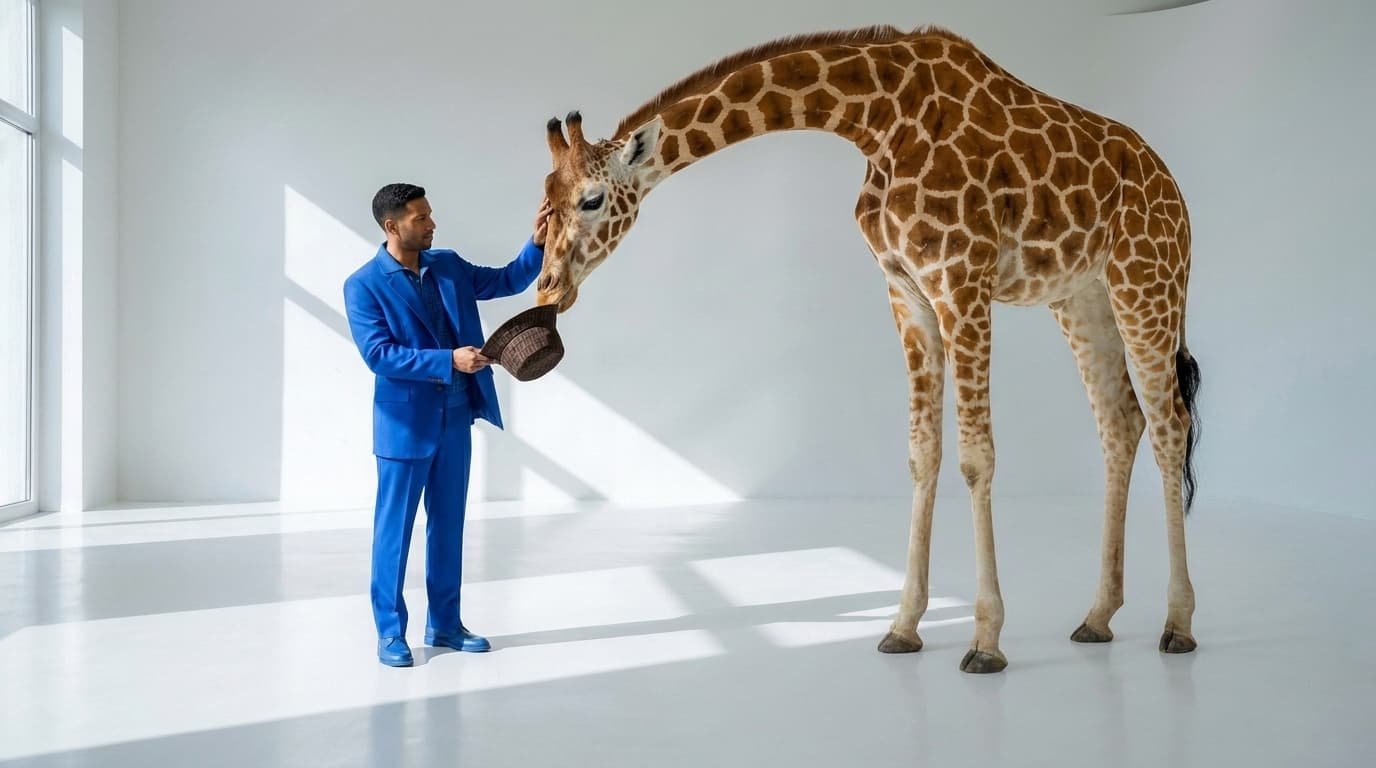
Nano Banana Pro + Kling 3.0 - a giraffe too tall for the frame hands down a hat
How I fit a giraffe into a 16:9 fashion spot: let it run off the top and bend the neck down
Nano Banana Pro, Kling 3.0 · 8 min render
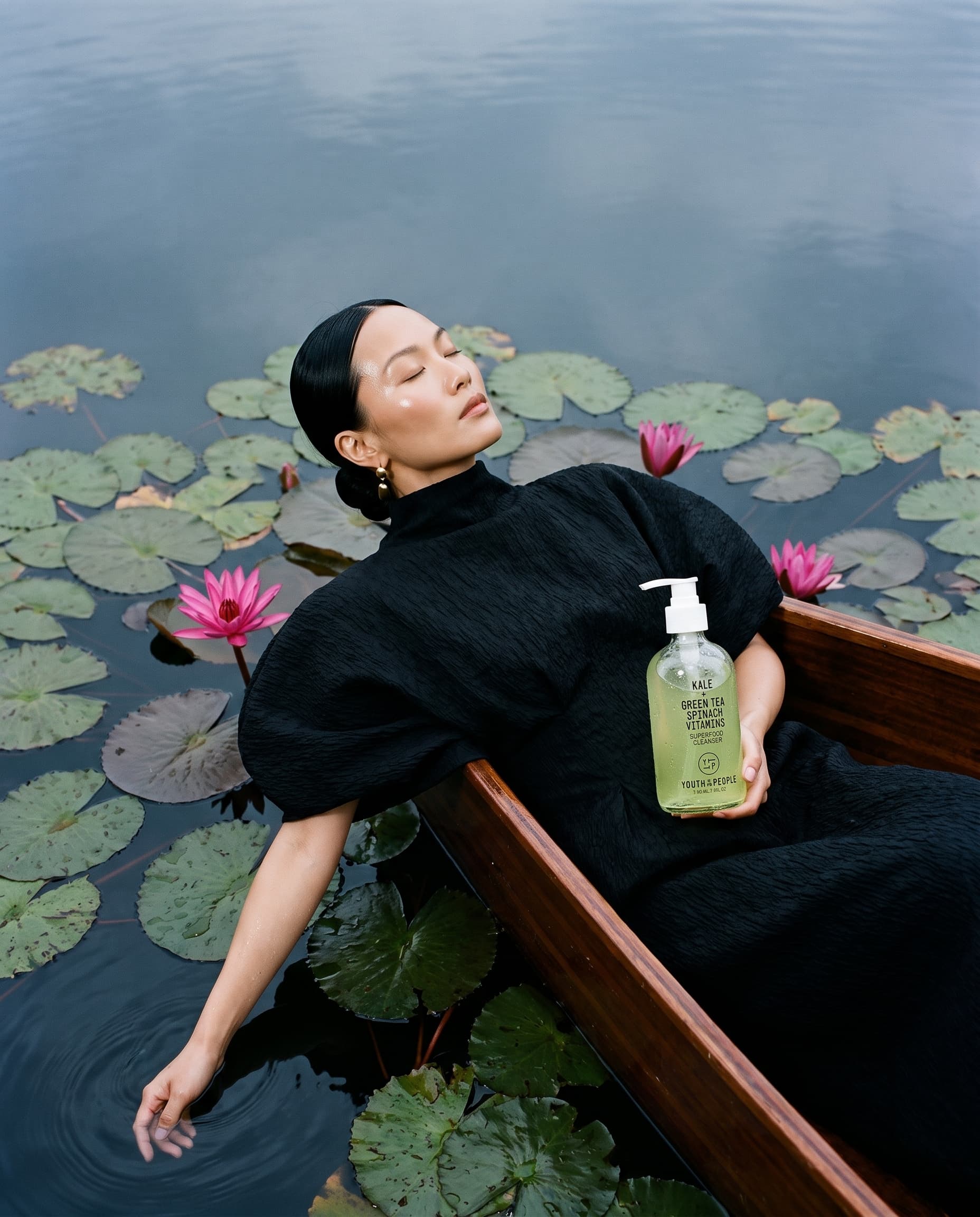
Nano Banana Pro - skincare model shots in a lily pond from a moodboard
Four skincare model shots in a lily pond, each with a different woman, built from one moodboard
Nano Banana Pro · 2 min render