Disclaimer: This is an independent creative test made with AI, for demonstration only. It isn't an ad for any brand shown or named, and isn't affiliated with, sponsored or endorsed by them. All trademarks belong to their owners
Gemini - 70s fashion campaign from a moodboard and one jacket
Turn a 1970s moodboard and one jacket photo into five campaign shots of people wearing it
 Tested by Nouamane Benbrahim
Ever tried to get an AI campaign to actually match your moodboard?
I had a moodboard of 1970s photos and one product photo of a jacket with a stitched face across the front. I wanted campaign shots of real-looking people wearing it, in that exact look. Five shots, five different people, five different places.
Here's my exact process.
1. Start with a clean product photo
First, I grab one clean photo of the jacket: front on, on a white background, with the whole graphic visible. That photo goes into every prompt as the reference.
2. Turn the moodboard into words
The image model never sees your moodboard, so I had Claude study it and describe it back to me. It came back with 1970s America, warm and a little sun-faded. Rust, camel, chocolate brown, mustard and cream. Golden hour or warm lamp light, visible grain, faded blacks. Wide-leg trousers and flares, big hair, wood-paneled rooms, record players, old cars and sunny streets.
That description goes into every prompt, so all 5 shots share the same colors, light and grain. I also kept the jacket's dusty lavender as the only cool color in the frame.
3. Describe the jacket every time
The reference image carries the jacket, but I still write out the graphic in every prompt: the cream left eye, the dark brown right eye, the tan brows, the nose shapes and the lips at the hem. I did this because I didn't want the model redrawing any part of the face on its own.
4. Give each shot its own person, place and camera
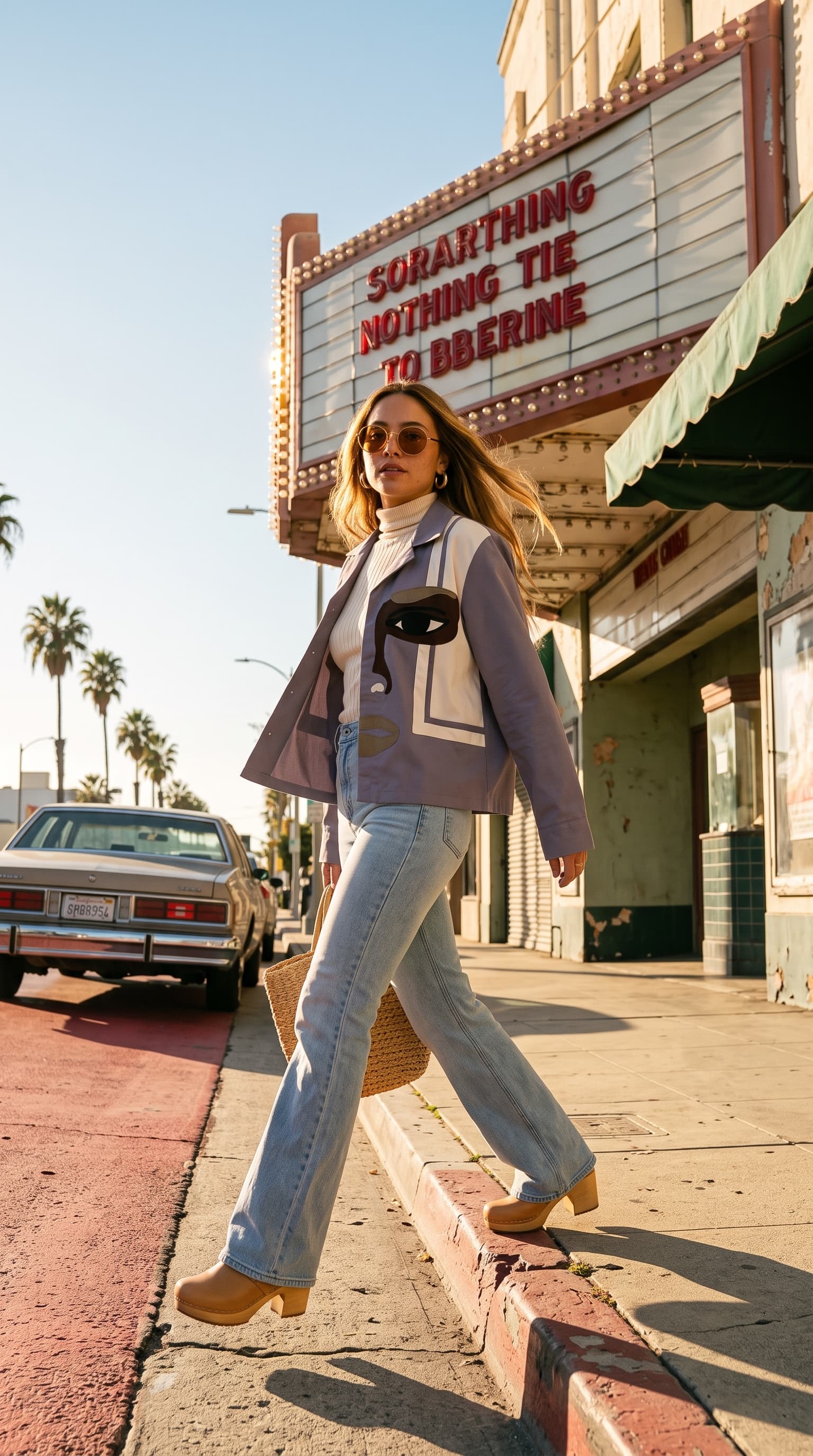
Then I plan the 5 shots so no two look alike. A guy crouched at a turntable in a wood-paneled den. A woman stepping off the curb under an old theater marquee. A guy leaning on a rust-orange coupe. A skater carving down an empty hill road. Two friends laughing on a shag rug next to an old TV.
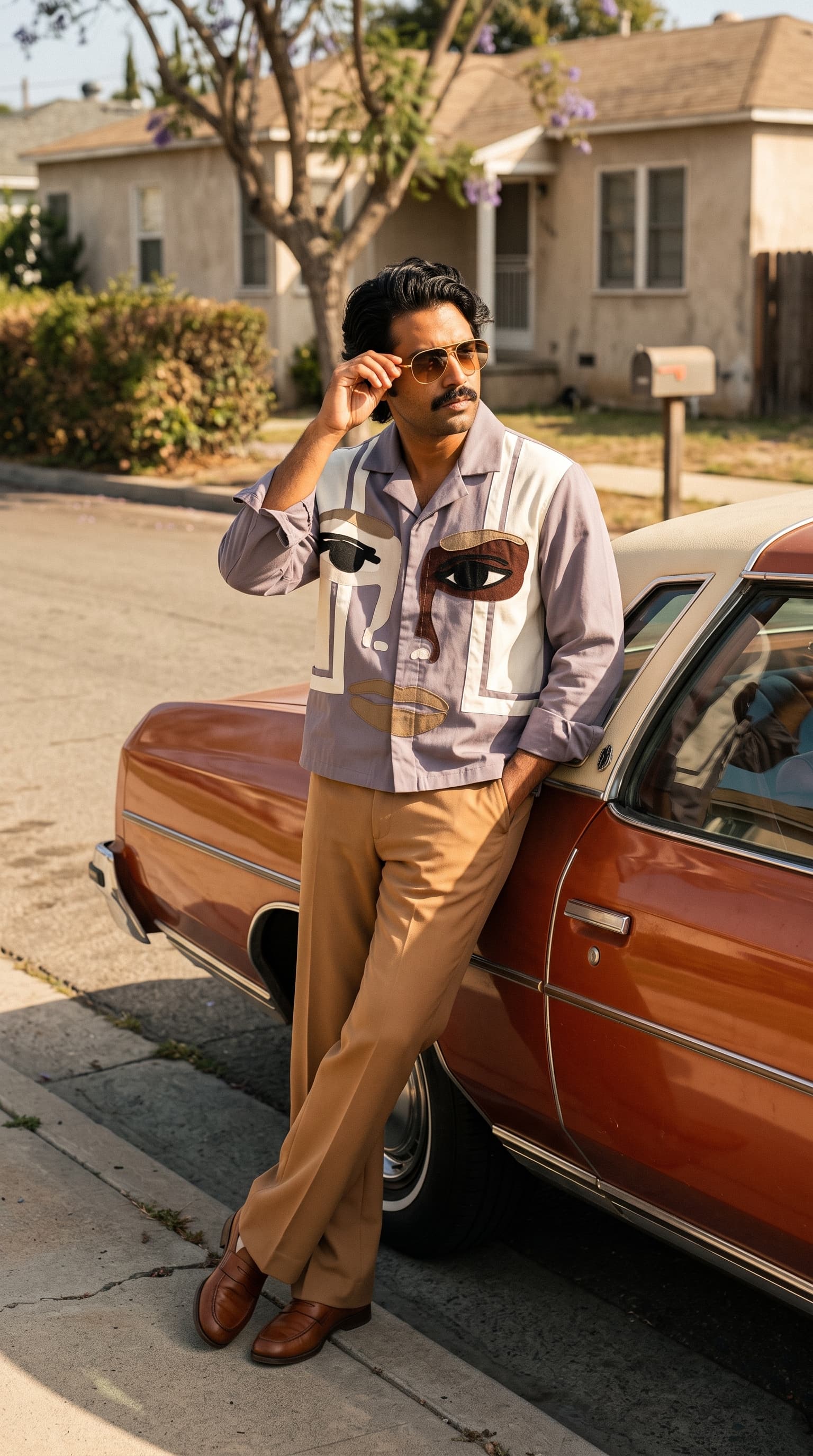
Each one gets one pose, its own lens and its own camera height. The car lean was a three-quarter shot on a longer lens, and it came out the closest to the real jacket. Both eyes, the nose and the lips are all there.
Exact prompt
Create a new photorealistic image. This is a photograph taken on a quiet residential street beside a vintage car from the start — not a composite. Rebuild the entire scene as if shot natively here, with unified lighting across subject and environment. THE VIBE: Late summer 1977, the engine still ticking after a long drive. Laid-back swagger, unbothered, sun-bleached Americana. IDENTITY LOCK: The garment is preserved exactly from the first reference — the cropped, boxy camp-collar shirt-jacket in dusty lavender-grey cotton twill, two cream vertical panel stripes, stitched appliqué abstract face: cream left eye patch with black eye and tan brow, dark chocolate-brown right eye patch with tan brow, cream and brown nose shapes, full tan appliqué lips, red woven collar label. Do NOT redesign the appliqué. THE SUBJECT: A South Asian man in his early thirties, wavy black hair swept back, thick moustache, warm medium-brown skin, gold-rimmed aviator sunglasses with brown gradient lenses, a thin gold chain. He wears the jacket from the first reference buttoned, sleeves pushed to the forearm, tucked into high-waisted camel wide-leg trousers, brown leather loafers. He leans back against the car's front fender, one ankle crossed over the other, one hand in his trouser pocket, the other holding his sunglasses' temple, gaze off to the right down the street. THE FACE: Natural skin texture, no airbrushing, no plastic or waxy skin, warm golden undertone with natural sheen. THE SETTING: A sleepy 1970s suburban street: a faded rust-orange 1970s two-door coupe with chrome trim and a cream vinyl roof, a leggy hedge, a stucco bungalow, a jacaranda tree, cracked sidewalk, a mailbox. Lived in, not staged. THE LIGHT: Late-afternoon warm sun from frame-right, hard crisp shadows, specular glints on the chrome matching the light on his cheekbone, warm amber grade. THE KEY DETAILS: The appliqué face on the jacket centred and readable; reflections of the street in the car's paint. THE MOOD: Warm-nostalgic 70s grade — rust orange, camel, cream, lavender jacket as the cool accent. THE COMPOSITION: Vertical three-quarter-length shot, subject slightly left of centre, car body filling the lower right, street receding into soft background. THE CAMERA: Editorial campaign still, 85mm lens, eye level, shallow depth of field, background bokeh, naturalistic Deakins-style sunlight, no studio lighting. THE AFTER EFFECT: Fine film grain, soft warm fade, lifted blacks.
5. Put the camera low for movement
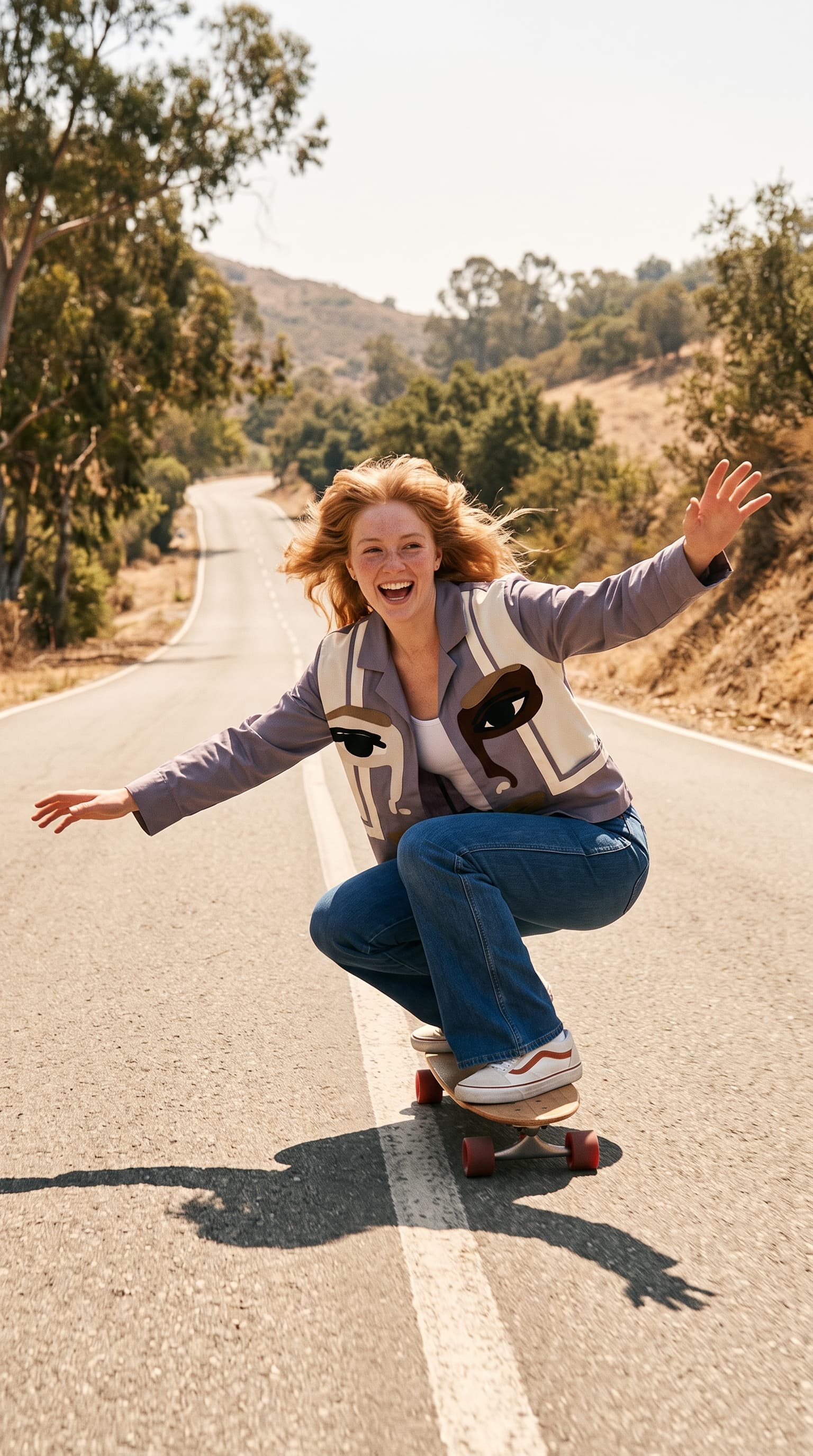
For the skater I asked for the camera almost on the road, her body frozen mid-crouch with only the wheels and the ends of her hair blurred. I went low because it makes the flares look way longer.
Exact prompt
Create a new photorealistic image. This is a photograph taken on an empty sun-baked asphalt road in the hills from the start — not a composite. Rebuild the entire scene as if shot natively here, with unified lighting across subject and environment. THE VIBE: Pure 1970s skate-culture freedom — carving down an empty road, wind, speed and laughter. Kinetic, playful, youthful. IDENTITY LOCK: The garment is preserved exactly from the first reference — the cropped, boxy camp-collar shirt-jacket in dusty lavender-grey cotton twill, two cream vertical panel stripes, stitched appliqué abstract face: cream left eye patch with black eye and tan brow, dark chocolate-brown right eye patch with tan brow, cream and brown nose shapes, full tan appliqué lips, red woven collar label. Do NOT redesign the appliqué. THE SUBJECT: A young woman in her early twenties with voluminous feathered strawberry-blonde hair flying back, fair skin with freckles and a light sun flush, wearing the jacket from the first reference buttoned over a white tank, high-waisted indigo flared jeans, white canvas sneakers with a burnt-orange stripe. She rides a short wooden skateboard with red urethane wheels in a deep low crouch, knees bent, both arms flung wide for balance, fingers spread, mouth open mid-laugh, eyes on the road ahead. THE FACE: Natural skin texture, no airbrushing, no plastic or waxy skin, visible freckles, gentle natural flush. THE SETTING: A two-lane asphalt road curving down through dry golden hills, a faded white center line, eucalyptus and scrub on the shoulder, hazy sky. THE LIGHT: Bright late-morning sun from high front-left, crisp shadow of her body on the asphalt, warm highlights, faded warm shadows. THE KEY DETAILS: The jacket's appliqué face visible on her chest as she crouches; hair strands streaming; grit on the road. THE MOOD: Warm, sun-faded 70s snapshot grade — denim blue, rust, cream, lavender jacket. THE COMPOSITION: Vertical, full body, subject centre-frame riding toward the camera at a slight diagonal, road's center line as a leading line, open road behind her. THE CAMERA: Editorial campaign still, 35mm lens, low camera near road level, fast shutter freezing her body, background slightly soft, naturalistic sunlight, no studio lighting. THE AFTER EFFECT: Slight motion blur on the spinning wheels and trailing hair ends, body sharp; full-frame film grain, faded warm colour like an old print.
Check the jacket though. The lips are gone and the face got simplified. When she crouches the fabric bunches up, and my guess is that's where the model starts dropping pieces.
6. Add one social shot
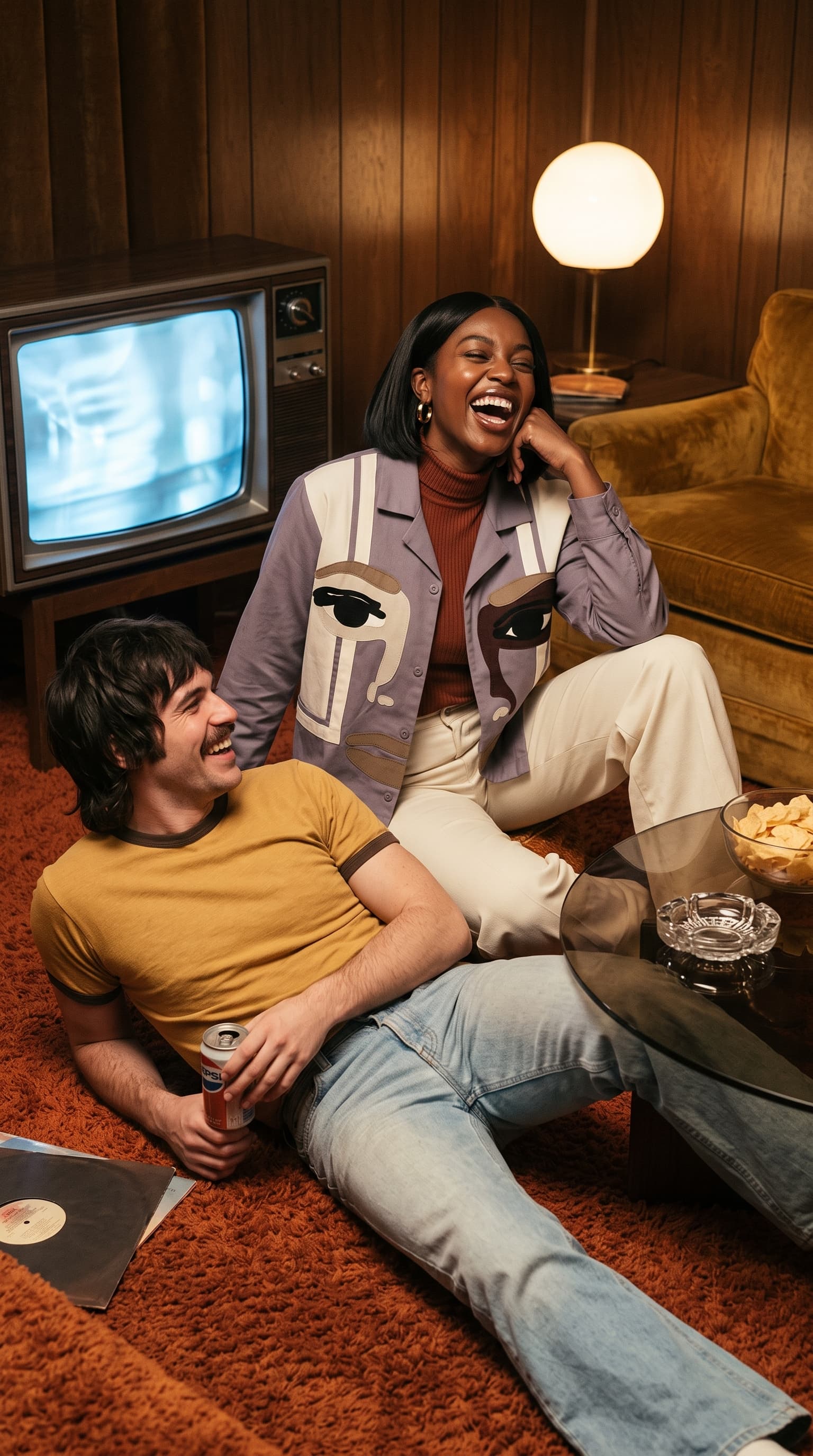
I wanted at least one frame with people together. I made sure the prompt says only one of the two friends wears the jacket. The lips came out faint here, but the rest of the face held.
Exact prompt
Create a new photorealistic image. This is a photograph taken in a sunken 1970s lounge from the start — not a composite. Rebuild the entire scene as if shot natively here, with unified lighting across subject and environment. THE VIBE: Two friends killing a lazy evening in 1978 — laughter, a TV humming, total ease together. Warm, social, intimate. IDENTITY LOCK: The garment is preserved exactly from the first reference — the cropped, boxy camp-collar shirt-jacket in dusty lavender-grey cotton twill, two cream vertical panel stripes, stitched appliqué abstract face: cream left eye patch with black eye and tan brow, dark chocolate-brown right eye patch with tan brow, cream and brown nose shapes, full tan appliqué lips, red woven collar label. Only ONE person wears it. Do NOT redesign the appliqué. THE CHARACTERS: The first is a Black woman in her mid-twenties with a sleek chin-length glossy bob, deep warm skin, gold hoops, wearing the jacket from the first reference over a rust ribbed turtleneck and high-waisted cream wide-leg trousers; she sits on the rug leaning back on one hand, knees up, head thrown back laughing. The second is a white man in his late twenties with shaggy dark-brown hair and a moustache, in a mustard ringer tee and faded light-wash flared jeans, lying on his side on the rug propped on an elbow, grinning at her, holding a can of soda. THE FACE: Natural skin texture, no airbrushing, no plastic or waxy skin, real tonal variation on both. THE SETTING: A conversation-pit living room: a burnt-orange shag rug, a mustard velvet sofa, a wood-grain CRT television glowing in the corner, a smoked-glass coffee table with a bowl of chips and an ashtray-free dish, a globe lamp, wood paneling, a vinyl sleeve on the floor. THE LIGHT: Warm tungsten from a globe lamp frame-right plus a cool blue flicker from the TV frame-left, mixed colour temperature, soft pools of light, deep brown shadows. THE KEY DETAILS: The appliqué face on her jacket clearly visible; the TV screen showing only soft abstract glow, no legible image. THE MOOD: Warm-nostalgic 70s grade — rust, mustard, cream, lavender jacket. THE COMPOSITION: Vertical, both occupy the frame together on the rug, she in the upper-centre, he lower-left angled toward her, slightly high camera looking down. THE CAMERA: Editorial campaign still, 35mm lens, slightly high angle, moderate depth of field, all light from practical sources, no studio lighting. THE AFTER EFFECT: Full-frame film grain, lifted blacks, warm faded print colour.
7. Check every frame for text
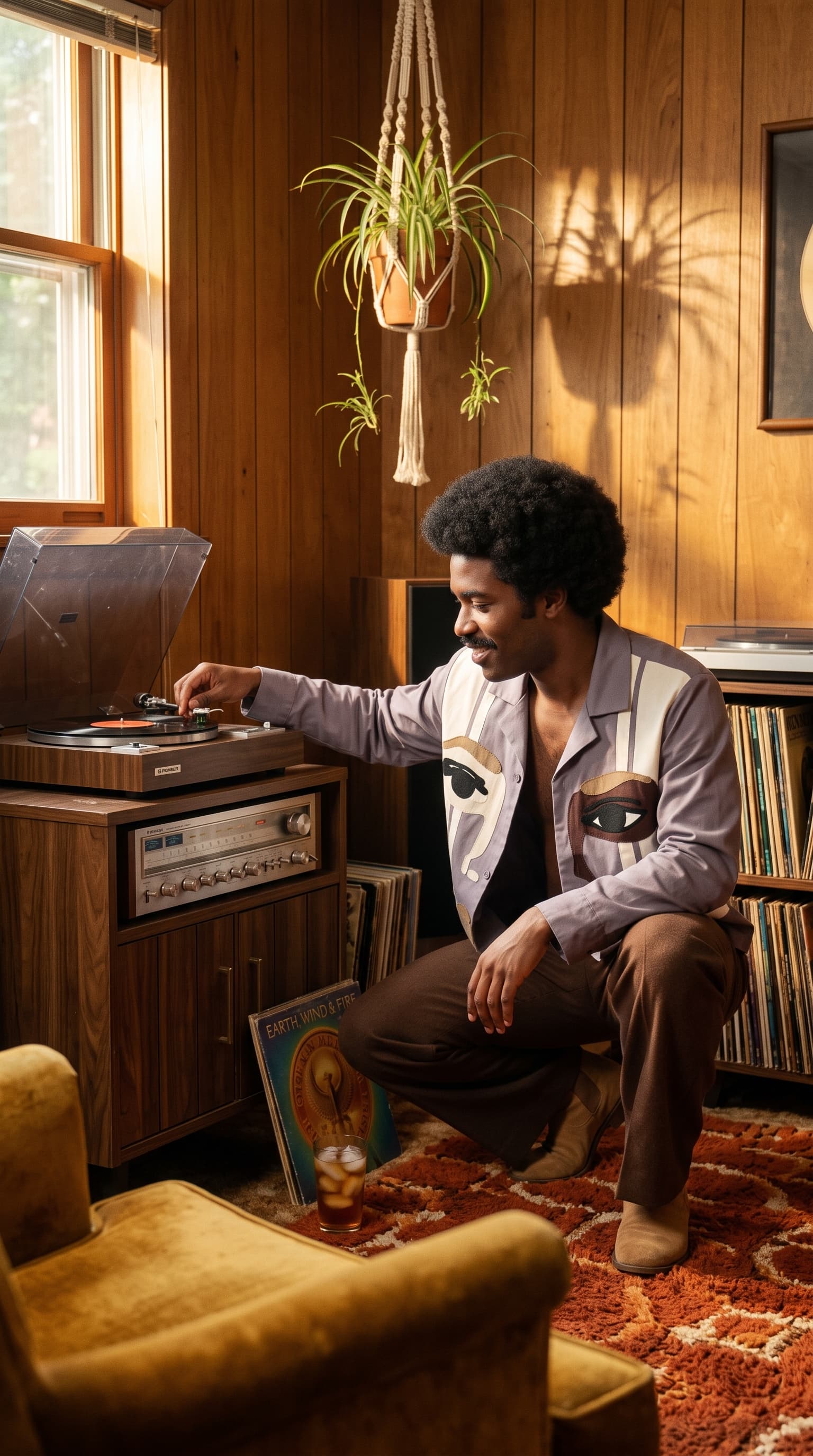
Quick warning: two shots had problems I didn't see coming. In the den shot a record sleeve leaning on the cabinet shows a real band's name, and the jacket lost its nose and lips while he crouched.
Exact prompt
Create a new photorealistic image. This is a photograph taken in a 1970s wood-paneled living room from the start — not a composite. Rebuild the entire scene as if shot natively here, with unified lighting across subject and environment. THE VIBE: A warm, unhurried Sunday afternoon in 1976, the needle just dropped on a favourite record. Effortlessly cool, lived-in, nostalgic — a found print from a family shoebox, sun-faded and golden. IDENTITY LOCK: The garment is preserved exactly from the first reference — the cropped, boxy, long-sleeve camp-collar shirt-jacket in dusty lavender-grey cotton twill, with two cream vertical panel stripes down the front and the stitched appliqué abstract face across the chest: the left eye on a cream patch with a black eye shape and tan brow, the right eye on a dark chocolate-brown patch with a tan brow, cream and brown nose shapes, full tan appliqué lips at the hem, the small red woven label inside the collar. Do NOT redesign, recolour or simplify the appliqué. THE SUBJECT: A Black man in his late twenties with a full rounded afro and a neat moustache, lean build, wearing the jacket from the first reference buttoned over a bare chest, high-waisted wide-leg chocolate-brown wool trousers, tan suede boots. He crouches low in front of a turntable, one hand lowering the tonearm, the other resting on his knee, head tilted down, gaze on the spinning record, a slight private smile. THE FACE: Natural skin texture, no airbrushing, no plastic or waxy skin, real deep skin with warm red-brown undertone and natural sheen on the cheekbones and brow. THE SETTING: A cramped 1970s den: honey-toned wood paneling, a walnut hi-fi cabinet with a silver-faced receiver and turntable, shelves packed with worn vinyl spines, a mustard velvet armchair edge, a burnt-orange patterned shag rug, a spider plant in a macramé hanger, dust motes. Not a clean showroom — a real, used room. THE LIGHT: Low late-afternoon sun raking through a side window from frame-left, hard warm shaft across the jacket and floor, deep amber shadows, highlights creamy, shadows brown-orange. THE KEY DETAILS: The appliqué face on the jacket fully visible and facing camera; a record sleeve leaning on the cabinet; a half-finished glass of iced tea on the floor. THE MOOD: Warm-nostalgic 1970s grade — rust, camel, brown, cream, with the jacket's lavender the one cool note. THE COMPOSITION: Full-length vertical frame, subject lower-right of centre, turntable at mid-left, generous headroom, foreground out-of-focus edge of the armchair. THE CAMERA: Editorial campaign still, 50mm lens, eye-level slightly low, shallow depth of field, naturalistic Deakins-style lighting, all light from practical sources, no studio lighting. THE AFTER EFFECT: Full-frame fine film grain, lifted blacks, gentle warm fade, faint halation around the window highlights.
On the marquee shot I asked for letters that read as nothing, and the model still spelled out gibberish across the whole sign. I haven't fixed these two yet. Before I'd post them, I'd crop the sleeve out of the den shot and swap the marquee for a blank one.
Exact prompt
Create a new photorealistic image. This is a photograph taken on a sunny old downtown sidewalk beneath a vintage theater marquee from the start — not a composite. Rebuild the entire scene as if shot natively here, with unified lighting across subject and environment. THE VIBE: Golden-hour Southern California in the late 1970s — a woman strolling to a matinee like she owns the block. Breezy, confident, sun-warmed, a little cinematic. IDENTITY LOCK: The garment is preserved exactly from the first reference — the cropped, boxy camp-collar shirt-jacket in dusty lavender-grey cotton twill with two cream vertical panel stripes and the stitched appliqué abstract face: cream left eye patch with black eye and tan brow, dark chocolate-brown right eye patch with tan brow, cream and brown nose shapes, full tan appliqué lips, small red woven collar label. Do NOT redesign or simplify the appliqué. THE SUBJECT: A woman in her mid-twenties with long honey-brown center-parted hair blowing back, light olive skin, round amber-tinted sunglasses, gold hoop earrings, wearing the jacket from the first reference open over a cream ribbed turtleneck, high-waisted faded light-wash flared jeans, tan platform clogs, a woven straw bag on her forearm. She is caught mid-stride stepping off the curb, weight on her front foot, jacket swinging open, glancing back over her shoulder past the camera. THE FACE: Natural skin texture, no airbrushing, no plastic or waxy skin, subtle warm tonal variation. THE SETTING: A weathered 1920s theater facade with a white marquee of red plastic letters reading nothing legible, peeling paint, a faded green canvas awning, a red-painted curb, palm trees and pale blue sky beyond, a parked vintage car at the edge. THE LIGHT: Low golden sun from behind-left, strong rim light through her hair, warm bounce off the pavement, long soft shadows, amber highlights and warm brown shadows. THE KEY DETAILS: The jacket's appliqué face clearly visible as it swings open; sun flare catching the marquee bulbs. THE MOOD: Warm-nostalgic, Kodachrome-like 70s grade — rust, cream, faded blue denim, lavender jacket. THE COMPOSITION: Vertical, full length, low camera angle making the flares long, subject left-of-centre, marquee filling the upper right, headroom above her head. THE CAMERA: Editorial campaign still, 35mm lens, low angle, moderate depth of field with soft background, naturalistic Deakins-style light, all light from the sun, no studio lighting. THE AFTER EFFECT: Full-frame film grain, slight warm light leak at the frame edge, lifted blacks.
Why it works
Claude reading the moodboard did most of the creative work before I wrote a single prompt. The colors, the light, the clothes and the places all came from that one description, and each shot only changed the person, the place and the camera.
Your turn: put 5 or 6 photos you love in a chat and ask Claude to describe the colors, the light and the clothes back to you.
And if you're tired of pasting the same look into every prompt, Emero saves your look once and handles the prompting on every shot after that. Everything's at cost.

Get one of these every day
I test new workflows daily and send them with the exact prompts, the models and the costs
5,979 generations tested so far
More workflows
See all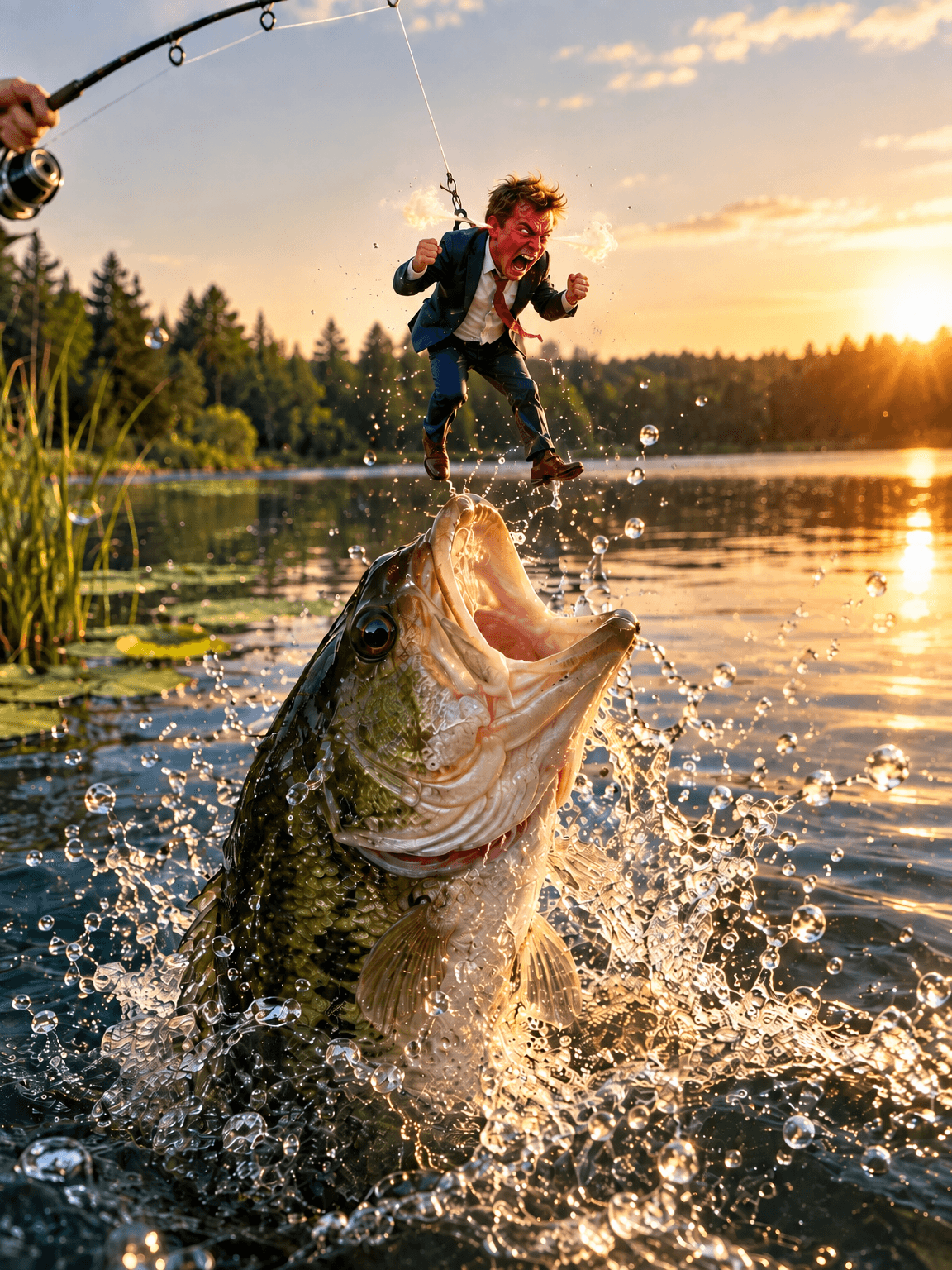
GPT Image 2.5 Flare - fix one thing in an image without losing the rest
Change one detail in an AI image, like size, mood or pose, while the rest of the picture stays put
GPT Image 2.5 Flare · 2 min render
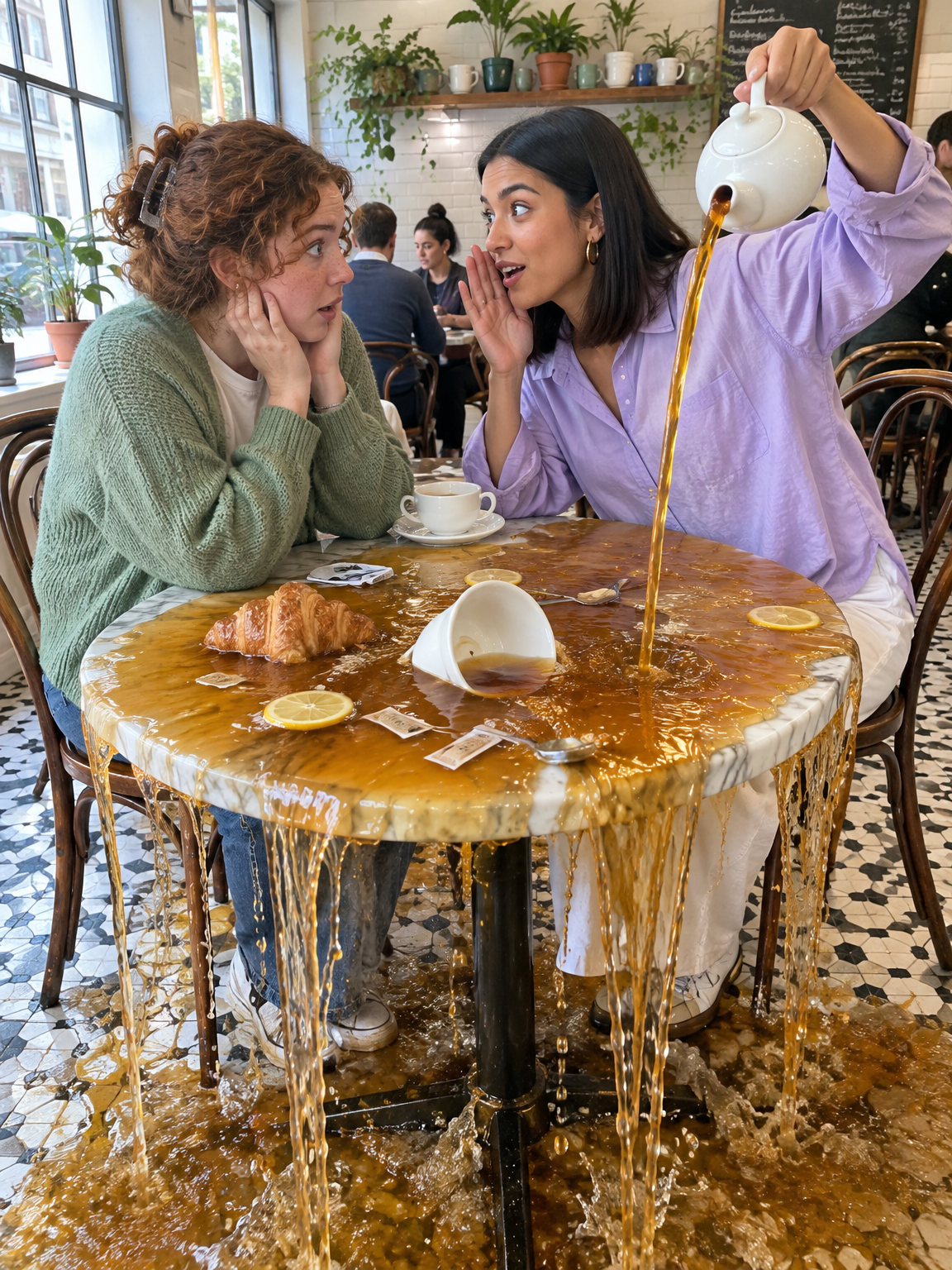
GPT Image 2.5 Flare - Gen Z slang taken literally
Turn slang like spill the tea, glazing and catfished into photos that show the words literally
GPT Image 2.5 Flare · 2 min render
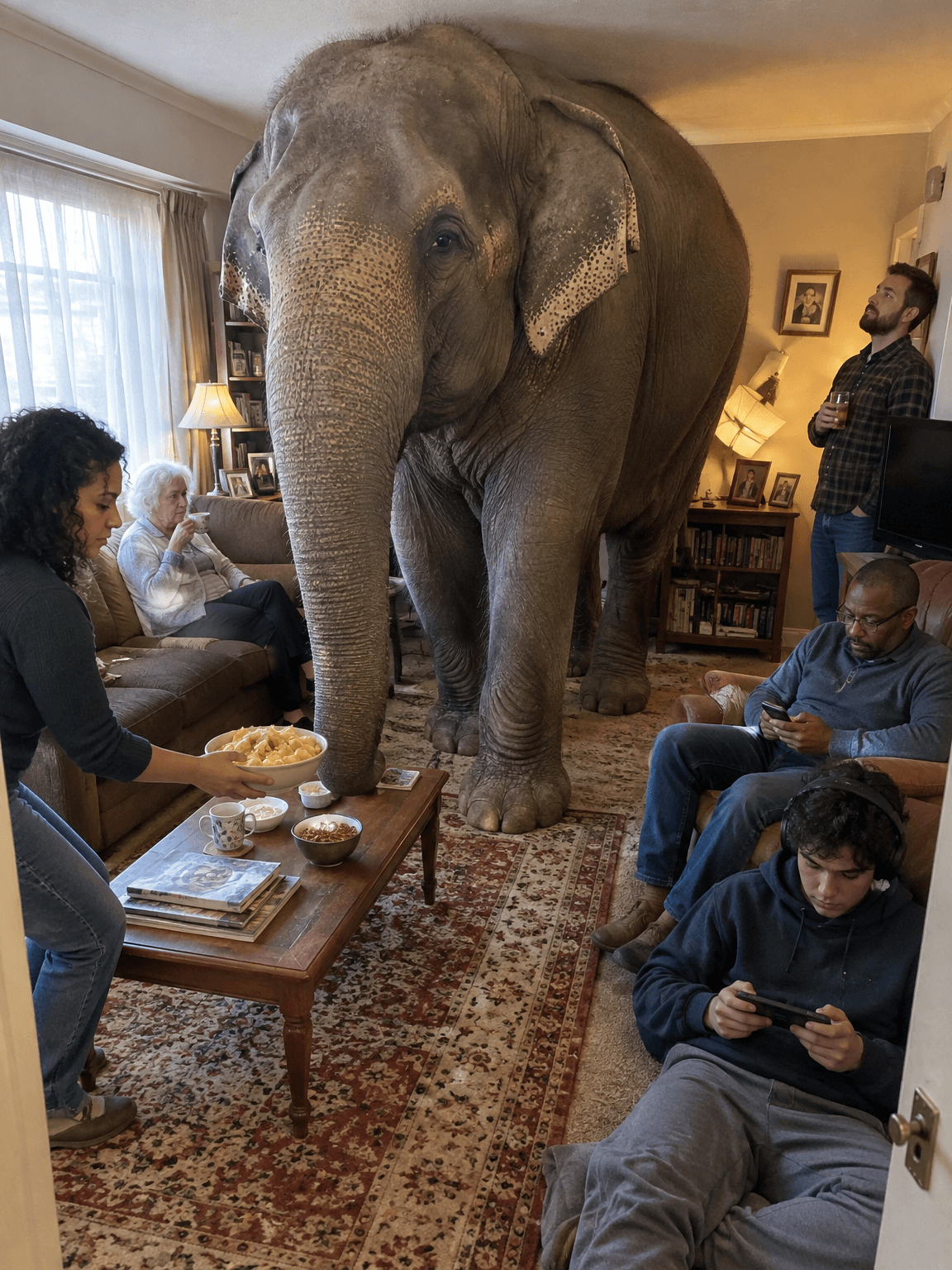
GPT Image 2.5 Flare - old sayings turned into deadpan photos
Turn everyday sayings into realistic photos where one impossible thing happens and nobody reacts
GPT Image 2.5 Flare · 1 min render