Disclaimer: This is an independent creative test made with AI, for demonstration only. It isn't an ad for any brand shown or named, and isn't affiliated with, sponsored or endorsed by them. All trademarks belong to their owners
GPT Image 2.5 Flare - old sayings turned into deadpan photos
Turn everyday sayings into realistic photos where one impossible thing happens and nobody reacts
 Tested by Nouamane Benbrahim
What would an old saying look like if you took it word for word?
I made a run of these for a carousel: the elephant in the room, couch potato, cold feet, the grass is always greener, hold your horses and sleep like a baby. Some landed and a couple really didn't, so I'll show you both.
Here's my exact process.
1. Pick sayings you can point at
The ones that work have a thing in them you could actually photograph: an elephant, a potato, a horse, ice. "Break the ice" or "under the weather" need a lot more explaining before the picture makes sense, so I skipped those for now.
2. Put one impossible thing in a boring photo
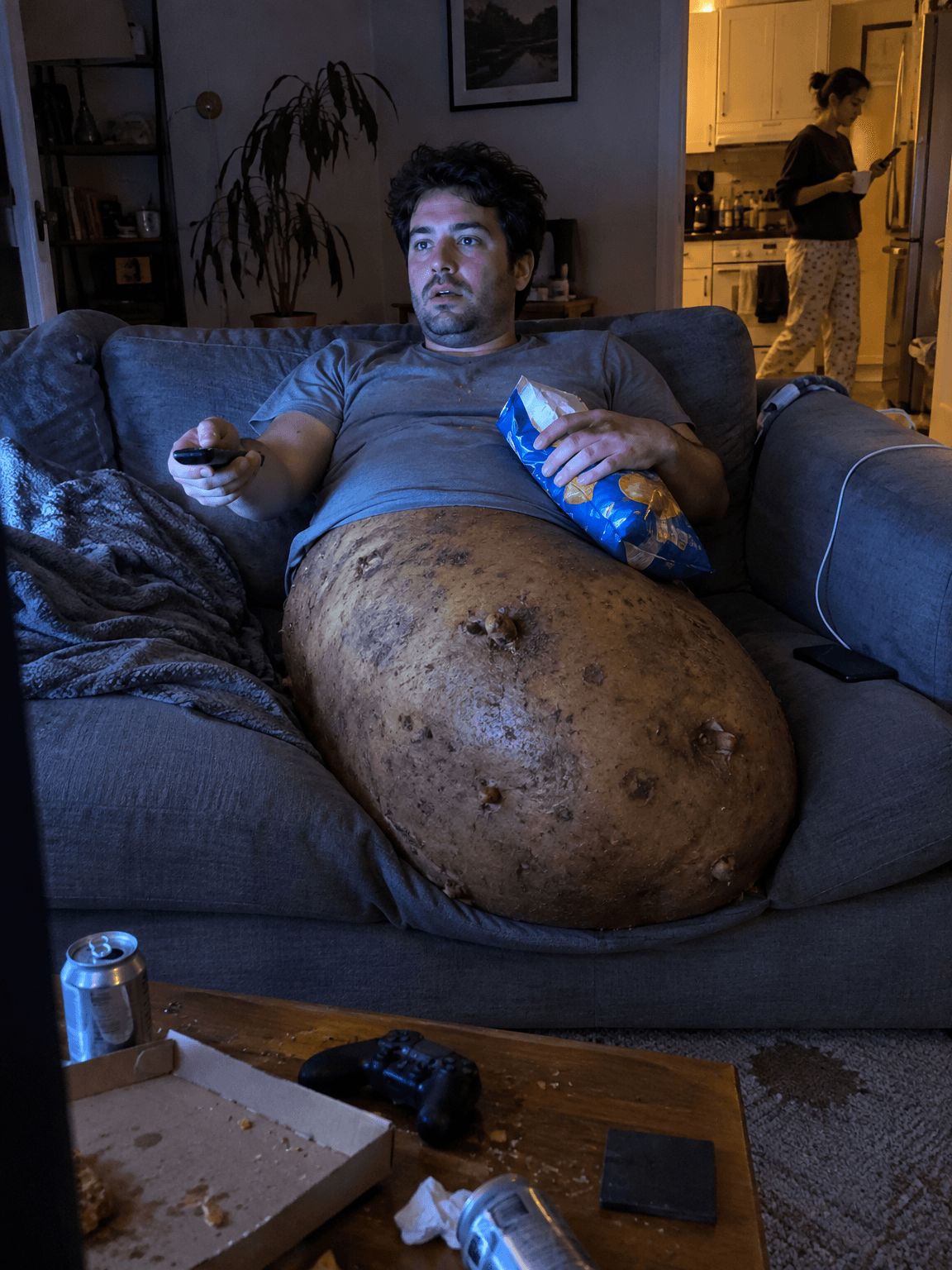
Everything in the picture is normal except one thing. For couch potato that's a regular guy in a messy apartment at night, chips on his stomach, remote in his hand, lit by the TV. The only weird part is that from the waist down he's a giant russet potato sunk into the cushion.
I spent most of the prompt on where the human stops and the potato starts. His t-shirt hem tucks over the spot where skin turns into potato skin, and the change happens over a few centimetres with no seam. I also asked for the cushion to squish under the weight, so it looks heavy.
Exact prompt
Create a new photorealistic image of a man on his living-room sofa who is literally turning into a potato from the waist down, at night, watching TV. THE VIBE: The saying "couch potato" played completely straight — a guy has been on the couch so long that his lower half has become a giant russet potato, and he hasn't noticed or doesn't care. His partner walks past in the background completely unbothered. Absurd, deadpan, understated, captured as a casual phone snapshot as if this were totally normal. THE SUBJECT: A man in his early thirties with messy dark brown hair, a few days of stubble, light olive skin, slouched deep into the middle seat of the sofa, wearing a wrinkled grey crew-neck t-shirt with a small food stain. Upper body fully human: relaxed shoulders, one arm draped over a bag of chips resting on his stomach, the other hand holding a TV remote pointed at the screen, face lit blankly by the TV, mouth slightly open, eyes glazed and fixed on the screen. From the waist down there are no legs — his body transitions seamlessly at the waistband into one huge oblong russet potato, about the size of a beanbag, sunk heavily into the sofa cushion. The potato has real russet skin: matte light-brown, rough and papery, faint netting texture, scattered small dark "eyes" and a few tiny sprouts, specks of dry soil, a slightly bumpy uneven shape. The t-shirt hem tucks naturally over where skin becomes potato skin, the transition gradual over a few centimetres, no seam or cut. The cushion visibly compresses under the potato's weight. THE FACE: Natural skin texture, no airbrushing, no plastic or waxy skin, real skin with subtle tonal variation, slight under-eye shadows. THE SETTING: A small, lived-in apartment living room at night: a worn grey fabric sofa with a crumpled throw blanket, crumbs and a couple of empty soda cans on the coffee table, a pizza box, a game controller, a phone charger cable snaking across the cushion. A rug with a coffee stain, a floor lamp switched off, a houseplant drooping slightly. In the background on the right, through a doorway into the kitchen, a woman in pyjamas walks past carrying a mug, glancing at her phone, completely ignoring him. THE LIGHT: Low-key, motivated light only: the TV (just off-frame left, facing him) is THE KEY source — a cool blue-white flickering glow on his face, chest, the chip bag and the front of the potato, bright where it hits, the far side of him falling into soft shadow. A warm tungsten light spilling from the kitchen doorway in the background lights the woman and rims the back of the sofa. Everything between the two sources is dim; blacks soft but deep. Same light on the human half and the potato half — one unified subject. THE KEY DETAILS: The seamless human-to-potato transition at the waist is the punchline; the chip bag on his stomach and the remote in his hand sell it. No text, no logos, no brand names on the chips, cans, TV or pizza box. THE MOOD: Everyday late-night realism with one surreal rule, cool-and-warm mixed colour grade, moderate contrast. THE COMPOSITION: Portrait frame shot from slightly to the side of the TV, at seated eye level, looking at him on the sofa. He and his potato half fill the centre of the frame from head to the cushion, the whole potato clearly visible. Coffee table clutter in the lower foreground, the kitchen doorway and the woman small in the upper right background. THE CAMERA: Shot on an iPhone at eye level, deep focus, everything sharp, NO background blur; casual social-media snapshot.
3. Have everyone ignore it
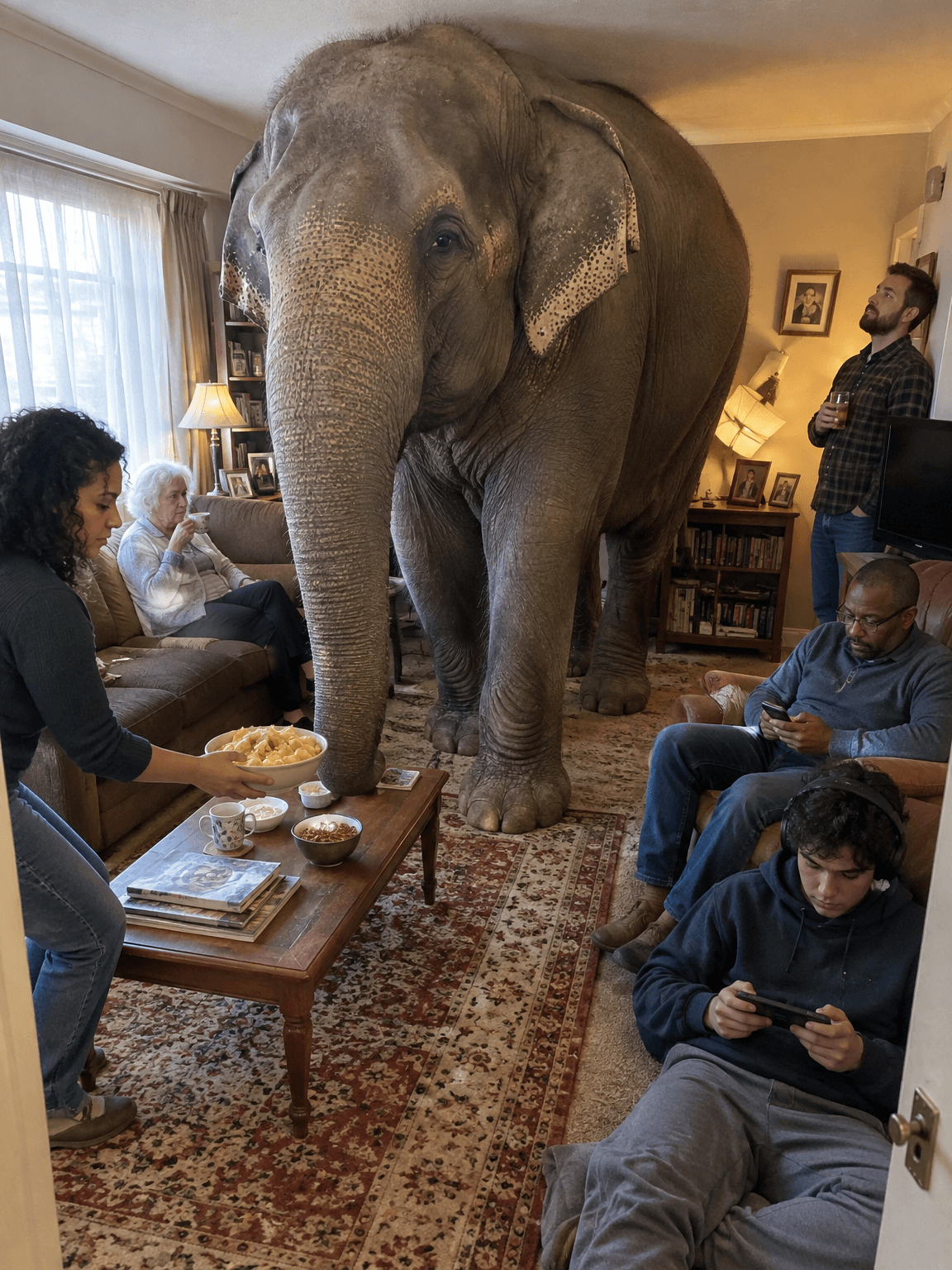
The elephant one is basically a family visit where five people carefully don't look at the elephant. Grandma sips her tea staring straight ahead, the teen plays his game, the guy by the door looks at the ceiling.
The detail that sells it is the woman passing a bowl of chips over the elephant's trunk without looking at it. I wrote that in as the punchline, and it's the first thing my eye goes to.
Exact prompt
Create a new photorealistic image of a literal elephant standing in an ordinary American family living room during a tense family gathering, everyone pointedly ignoring it. THE VIBE: The saying "the elephant in the room" played completely straight — a full-grown elephant crammed into a cosy suburban living room during an awkward holiday visit, and every person carefully, politely pretending it isn't there. Absurd, deadpan, understated, captured as a casual phone snapshot as if this were totally normal. THE SUBJECT: An adult grey Asian elephant standing in the middle of the living room, its back nearly brushing the ceiling, ears folded close, trunk hanging calmly and resting near the coffee table, one front foot planted on the patterned area rug. Realistic wrinkled grey skin with pink mottling on the ears and trunk, coarse sparse hairs, dusty knees, small amber eye looking calmly around the room. It stands still and patient, slightly squeezed by the furniture. THE CHARACTERS: Five family members of mixed ages and ethnicities around the room, all avoiding the elephant: an older white-haired woman in a cardigan on the sofa sipping tea and staring straight ahead; a middle-aged Black man in a sweater on the armchair intently reading his phone; a woman in her thirties with dark curly hair passing a bowl of chips over the elephant's trunk without looking at it; a teenage boy in a hoodie slumped on the floor with headphones, eyes on a handheld game; a man in his forties with a beard standing near the doorway holding a drink, glancing at the ceiling. Tight polite smiles, stiff postures, nobody making eye contact with the elephant or each other. THE FACE: Natural skin texture, no airbrushing, no plastic or waxy skin, real skin with subtle tonal variation. THE SETTING: A cosy, slightly cluttered 1990s-built suburban living room: beige carpet with a red-and-cream patterned area rug, a brown fabric sofa and a recliner, a wooden coffee table with snack bowls, mugs and a stack of magazines, framed family photos on the wall, a bookshelf, a floor lamp, a TV on a stand, a window with sheer curtains. The elephant's bulk pushes against a side table, a lampshade slightly tilted, a picture frame askew. Lived-in, not a showroom. THE LIGHT: Warm late-afternoon daylight through the sheer-curtained window from the left as THE KEY source, plus a warm floor lamp on the right. The same light falls on the elephant and the people; the elephant casts a large soft shadow across the rug and onto the sofa; window light catches the edge of its ear and trunk. Unified lighting — the elephant is clearly inside the room, not composited. THE KEY DETAILS: The woman passing the chip bowl around the trunk without looking is the punchline. No text, no signs, no brand names anywhere. THE MOOD: Everyday family realism with one surreal rule, warm natural colour grade, mild contrast. THE COMPOSITION: Portrait frame shot from the room's entrance at standing eye level. The elephant dominates the centre, its head and trunk slightly left of centre, its body filling the middle of the frame from near the ceiling to the floor. The family members are arranged around it at different depths, all clearly visible. Floor and rug in the lower portion, ceiling barely above the elephant's back. THE CAMERA: Shot on an iPhone at standing eye level, wide-angle phone lens, deep focus, everything sharp, NO background blur; casual social-media snapshot.
4. Flip it when the straight version is boring
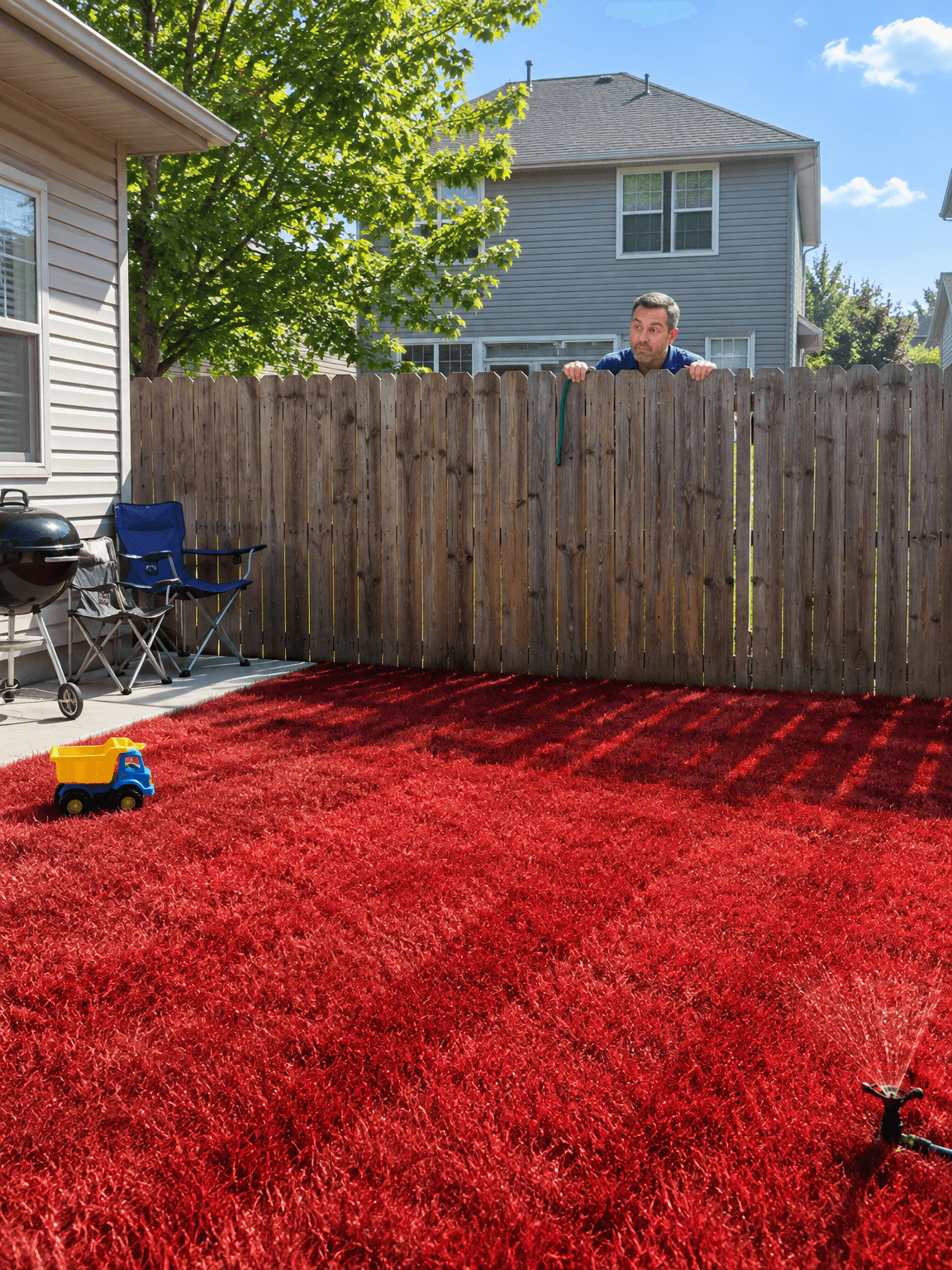
"The grass is always greener" taken straight is just a green lawn. So I made the lawn on our side bright crimson red, and put the neighbour on his ordinary green side peeking over the fence at it, a little jealous.
I had to say the red lawn is deep crimson and clearly real grass with mow stripes, never pink or brown and not paint or carpet. Otherwise you're never sure what you're looking at.
Exact prompt
Create a new photorealistic image of two neighbouring American suburban backyards divided by a wooden fence, on a sunny summer afternoon. THE VIBE: The old saying "the grass is always greener on the other side" played completely straight, then flipped — one yard has a perfectly normal green lawn, the yard next door has a lawn of vivid red grass, and the neighbour on the green side is peeking over the fence at it with quiet, deadpan envy. Absurd, witty, understated, captured as a casual phone snapshot as if this were totally normal. THE SUBJECT: A middle-aged man with short greying brown hair, light stubble, fair skin with a slight sunburn on the nose, wearing a faded navy polo shirt, peeking over the top of the fence from the green-lawn side. Only his head, shoulders and both hands are visible above the fence top — fingers curled over the top boards, chin just above them, eyebrows raised, eyes fixed on the red lawn, mouth slightly pursed in envious longing. A garden hose dangling forgotten from one hand over his side. THE FACE: Natural skin texture, no airbrushing, no plastic or waxy skin, real skin with subtle tonal variation, faint flush on the cheeks and nose from the sun. THE SETTING: Shot from the red-lawn backyard looking back toward the fence. In the foreground and middle ground, a lush, freshly mowed lawn of vivid deep crimson-red grass — real individual grass blades, natural texture, mow stripes, a few blades catching the light, exactly like a healthy lawn but red. Around it: a beige vinyl-sided house corner with a small concrete patio, a charcoal grill, two folding lawn chairs, a kid's plastic toy truck in the grass, a sprinkler. A 1.8 m weathered cedar privacy fence runs across the frame; beyond it the neighbour's two-storey grey-sided house, his side's patchy ordinary green lawn just visible through a gap between two fence boards, a maple tree overhanging. THE LIGHT: Bright mid-afternoon summer sun from the upper left, crisp shadows of the fence boards falling across the red grass, warm daylight on the man's face and hands; the red lawn bounces a faint warm red tint up onto the fence boards and under his chin. Blue sky with a few small clouds. THE KEY DETAILS: The red lawn is a deep, saturated, unmistakable crimson — never pink, never brown, clearly grass, not paint or carpet. The man's envious stare is the punchline. No text, no signs, no brand names anywhere. THE MOOD: Everyday American suburban realism with one surreal rule, natural punchy colour grade, mild contrast. THE COMPOSITION: Portrait frame. The red lawn fills the bottom half, stretching from the camera to the fence. The fence runs horizontally across the middle of the frame; the man's head and hands peek over it slightly right of centre, small but clearly readable. The neighbour's house and tree fill the top third with sky above. THE CAMERA: Shot on an iPhone at standing eye level from the red-lawn yard, deep focus, everything sharp, NO background blur; casual social-media snapshot.
5. Show what the impossible thing does to the room
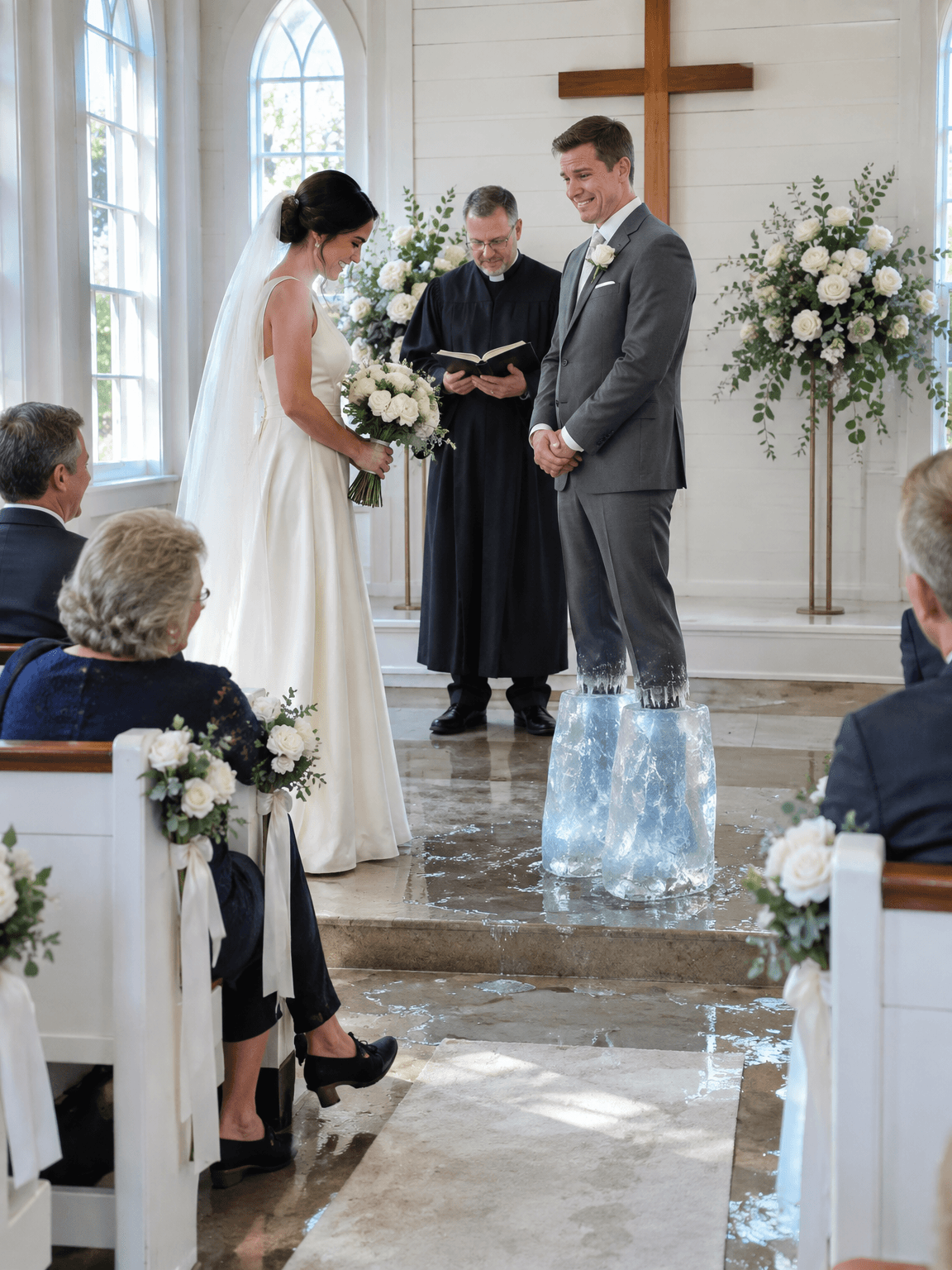
Cold feet is a groom at the altar whose feet are two huge blocks of ice. What makes it feel real is everything around the ice: water running down the blocks, puddles spreading across the floor, frost and tiny icicles on his trouser hems, the bride glancing down at the puddle getting close to her dress, and a guest in the front row lifting her feet off the wet floor.
Exact prompt
Create a new photorealistic image of a groom standing at the altar during a wedding ceremony whose feet are literally two enormous blocks of ice. THE VIBE: The saying "cold feet" played completely straight — at the most important moment of his life, the groom's feet have turned into huge frozen blocks of ice, slowly melting into puddles on the church floor, and everyone keeps smiling politely as if nothing is wrong. Absurd, deadpan, understated, captured as a casual phone snapshot from the pews. THE SUBJECT: A groom in his early thirties with short neat brown hair, clean-shaven, fair skin with a nervous flush on his cheeks and a faint sheen of sweat on his forehead, wearing a fitted charcoal-grey suit, crisp white shirt, silver tie and a white rose boutonnière. He stands stiffly at the altar facing his bride, hands clasped tightly in front of him, forced tight smile, eyes slightly wide. His trouser legs end at the ankles, and from the ankles down his feet ARE two enormous rectangular blocks of solid ice, each about knee-high and twice as long as a normal shoe — clear and bluish at the core, frosted white at the edges, with trapped air bubbles and internal cracks, cold mist curling off their surfaces. The bottom of each trouser hem is stiff with frost and tiny icicles. The blocks are visibly melting: water beads running down their sides, small puddles spreading across the floor around them. THE CHARACTERS: Facing him, the bride in a simple ivory satin gown with a long veil, dark hair in an updo, holding a white bouquet, smiling sweetly while glancing down at the puddle approaching her hem. Between them, an officiant in a black robe reading from a small book, eyes on the page. In the front pews, guests in formal wear smiling politely; one older woman discreetly lifting her feet off the wet floor. THE FACE: Natural skin texture, no airbrushing, no plastic or waxy skin, real skin with subtle tonal variation. THE SETTING: A small traditional white wooden chapel: white-painted pews with white flower bouquets and ribbons on the aisle ends, a cream aisle runner leading to a raised altar step, tall arched windows with clear glass, a simple wooden cross on the back wall, flower arrangements of white roses and eucalyptus on stands beside the altar. The aisle runner near the groom is darkened and soaked with meltwater. THE LIGHT: Bright soft daylight pouring in through the tall arched windows on the left as THE KEY source, lighting the couple from the side. The same light refracts THROUGH the ice blocks — glowing pale blue and white inside, with bright specular highlights on their wet surfaces and caustic sparkles cast onto the wet floor. Reflections of the windows in the spreading puddles. Unified lighting across the people, the ice and the chapel. THE KEY DETAILS: The two huge melting ice-block feet are the punchline; the groom's strained smile and the bride glancing at the puddle sell it. No text, no signs, no brand names anywhere. THE MOOD: Everyday wedding realism with one surreal rule, bright airy colour grade, mild contrast. THE COMPOSITION: Portrait frame shot from the centre aisle a few rows back, at standing eye level, looking up the aisle toward the altar. The groom stands slightly right of centre in full body, the ice-block feet clearly visible on the altar step in the lower-middle of the frame; the bride faces him on the left, the officiant between and behind them. The tops of a few pews and guests' heads in the lower foreground. THE CAMERA: Shot on an iPhone at standing eye level, deep focus, everything sharp, NO background blur; casual social-media snapshot.
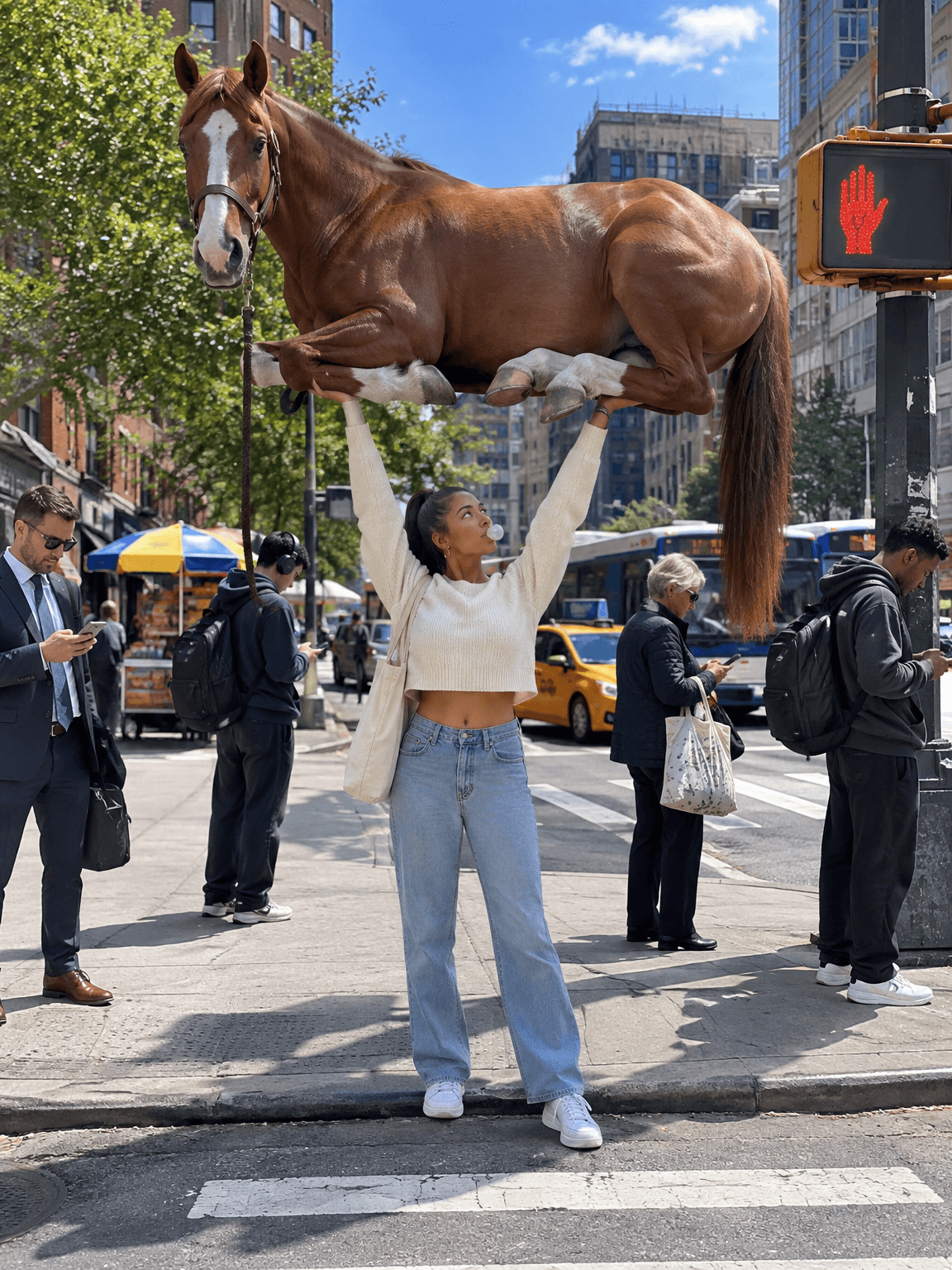
Same idea with hold your horses. A woman waits at a crosswalk holding a full-size horse straight over her head, chewing gum, totally calm. The horse throws a big shadow over her and the sidewalk, and the walk signal shows a red hand.
Exact prompt
Create a new photorealistic image of an ordinary woman effortlessly holding a full-size horse up above her head while waiting at a busy city crosswalk on a sunny afternoon. THE VIBE: The saying "hold your horses" played completely straight — a regular commuter waiting for the walk signal is casually hoisting an entire horse over her head like it's a grocery bag, totally calm, while everyone around her waits for the light, unbothered. Absurd, deadpan, poppy and instantly readable, captured as a casual phone snapshot as if this were totally normal. THE SUBJECT: A woman in her late twenties with a dark brown high ponytail, warm tan skin, wearing white sneakers, light-wash jeans, a cropped cream knit sweater and small gold hoop earrings, a tote bag on her shoulder, standing at the curb. Both arms are raised straight overhead, elbows locked, palms flat and supporting a full-size chestnut horse lying horizontally across her hands — one hand under its chest, one under its belly — balanced perfectly above her head. Her stance is relaxed: weight on one hip, one foot slightly forward, face completely calm, chewing gum, glancing up at the pedestrian signal. No strain on her face at all. THE HORSE: A glossy chestnut horse with a white blaze down its face and white socks, a neat black mane, a simple brown leather halter with a lead rope dangling down beside the woman's arm. It lies calmly across her hands, legs folded neatly under it, head turned toward the camera with an unbothered, mildly bored expression, ears forward, tail hanging down. Real horse hair texture, visible muscles and veins, a few hairs catching the sun. THE CROWD: Five or six other pedestrians waiting at the crosswalk around her in everyday city clothes — a man in a suit on his phone, a delivery courier with a backpack, an older woman with a shopping bag, a teen with headphones — all looking at their phones or the traffic light, nobody looking at the horse. THE FACE: Natural skin texture, no airbrushing, no plastic or waxy skin, real skin with subtle tonal variation. THE SETTING: A busy downtown American intersection: a white-striped crosswalk on asphalt, a pedestrian signal pole showing a red hand, a yellow taxi and a city bus waiting at the light, mid-rise brick and glass buildings, storefronts with generic abstract signage (no real brand names), a street tree, a hot-dog cart umbrella in the background. THE LIGHT: Bright mid-afternoon sun from the upper right as THE KEY source, lighting the horse's back and the woman's raised arms and face; the horse casts a large shadow down over her and onto the sidewalk; blue sky with a few clouds. Unified light across the woman, the horse, the crowd and the street. THE KEY DETAILS: The horse lifted perfectly overhead and the woman's total calm are the punchline; the dangling lead rope and the red-hand signal sell "hold". No text, no logos, no brand names anywhere. THE MOOD: Everyday city realism with one surreal rule, bright punchy natural colour grade, mild contrast. THE COMPOSITION: Portrait frame shot from across the crosswalk at standing eye level, slightly low. The woman stands centred in full body, head-to-sneakers filling about the lower half of the frame; the horse held overhead fills the upper-middle of the frame, fully visible from nose to tail, with sky and buildings around it. The other pedestrians on either side at the same curb. THE CAMERA: Shot on an iPhone at standing eye level, deep focus, everything sharp, NO background blur; casual social-media snapshot.
6. Check the proportions
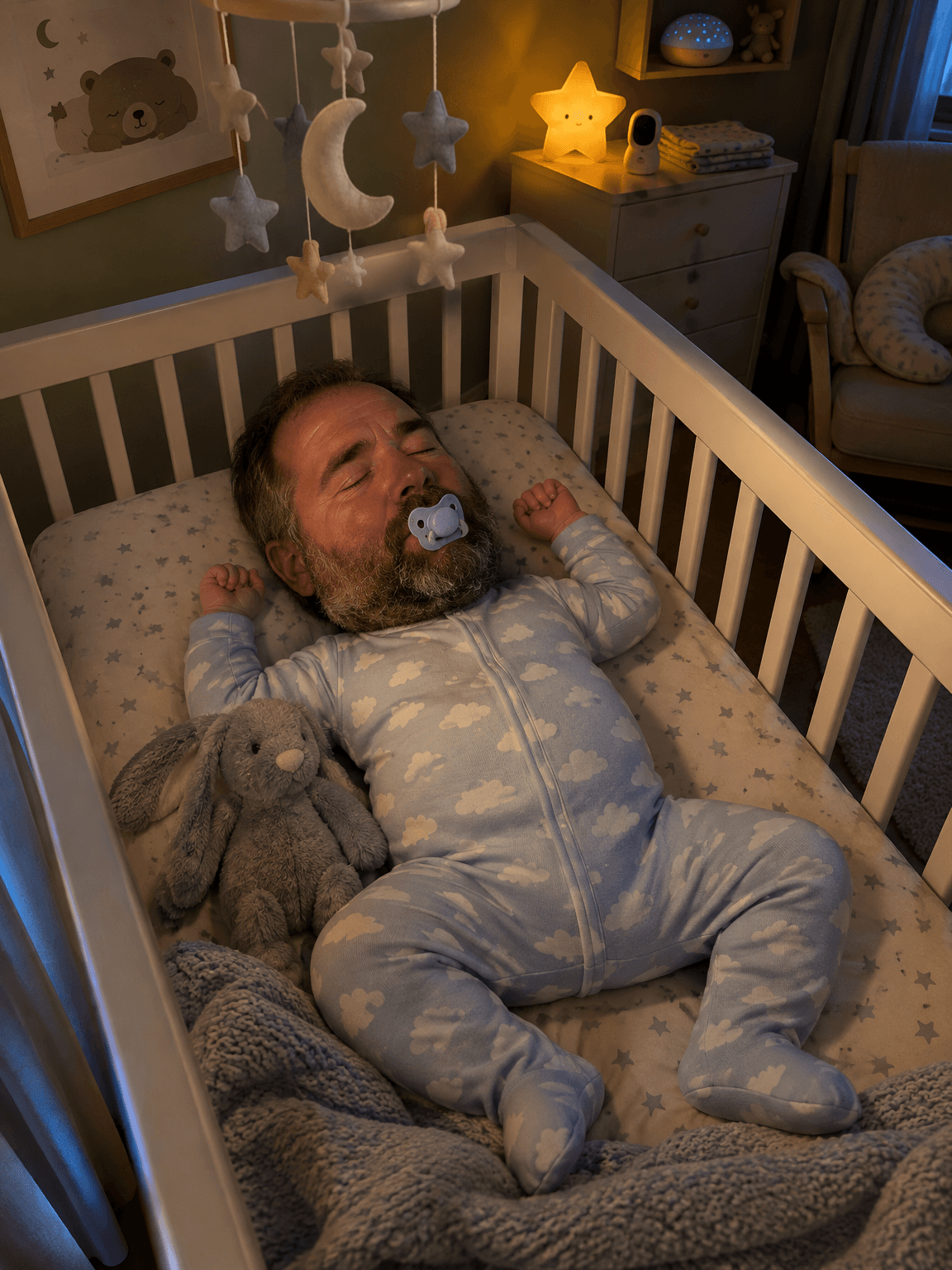
Sleep like a baby is a bearded middle-aged guy's head on a baby's body, asleep in a crib with a pacifier and both arms up over his head.
Exact prompt
Create a new photorealistic image of a grown man's head on a baby's body, sound asleep in a crib in a cosy nursery at night. THE VIBE: The saying "sleep like a baby" played completely straight — a stressed, stubbly middle-aged man has finally achieved perfect sleep by literally becoming a baby from the neck down, curled up in a crib in footie pyjamas, utterly blissed out, while the nursery around him is completely normal. Absurd, deadpan, poppy and instantly readable, captured as a casual phone snapshot by a parent peeking in. THE SUBJECT: A full-size adult man's head — mid-forties, receding brown hair with grey at the temples, a thick salt-and-pepper beard, crow's feet, a slightly ruddy nose, heavy eyebrows — attached naturally at the neck to the small chubby body of a baby about eight months old, proportioned like a real infant: round belly, short chubby arms and legs, tiny hands and feet. The baby body wears a soft pale-blue footie onesie with little white clouds. He lies on his back in the classic baby sleep pose — both chubby arms flung up beside his head, little fists loosely curled, tiny legs splayed like a frog. His face is pure bliss: eyes peacefully closed, a light snore, mouth slightly open around a pastel-blue pacifier, a tiny bit of drool in his beard, cheeks flushed and relaxed, every line of stress gone. The head is clearly much too big for the body, which is the joke, but the neck transition is seamless and realistic, no visible seam. THE FACE: Natural skin texture, no airbrushing, no plastic or waxy skin, real adult skin with pores, natural age lines and individual beard hairs; soft smooth baby skin on the chubby hands. THE SETTING: A cosy suburban nursery at night: a white wooden crib with vertical slats, a fitted sheet printed with little stars, a fuzzy grey bunny plush tucked under one of his arms, a soft knitted blanket kicked down to his feet. A hanging crib mobile with felt moons and stars above him. Behind the crib: soft sage-green walls, a framed print of a sleepy bear, a white dresser with a baby monitor and a stack of folded onesies, a rocking chair with a nursing pillow, a sound machine glowing on a shelf. THE LIGHT: Dim, warm, low-key night light. A small star-shaped night-light on the dresser is THE KEY source — a warm amber glow falling across the crib and his face and beard, softly lighting the blanket and bunny; the far corners of the room fall into deep soft shadow. A faint cool blue moonlight from a window off to one side rims the crib slats. Unified light across the head, the body and the crib. THE KEY DETAILS: The bearded adult head on the tiny chubby body, the pacifier and the arms-up baby sleep pose are the punchline. No text, no logos, no brand names anywhere. THE MOOD: Tender, cosy nursery realism with one surreal rule, warm amber night grade, soft contrast, slight phone-camera low-light grain. THE COMPOSITION: Portrait frame shot from standing beside the crib, looking down over the rail at him at a gentle angle. He fills the middle of the frame, lying diagonally on the mattress, head toward the top of the frame, the crib slats framing the edges and the mobile hanging into the top of the frame. THE CAMERA: Shot on an iPhone in night mode at standing eye level, deep focus, everything sharp, NO background blur; casual social-media snapshot.
I asked for the body of an eight-month-old, and it came out closer to a toddler. His head doesn't look that oversized on it, so the joke is softer than it should be. If I redo it, I'll make the body way smaller.
7. Know when to drop one
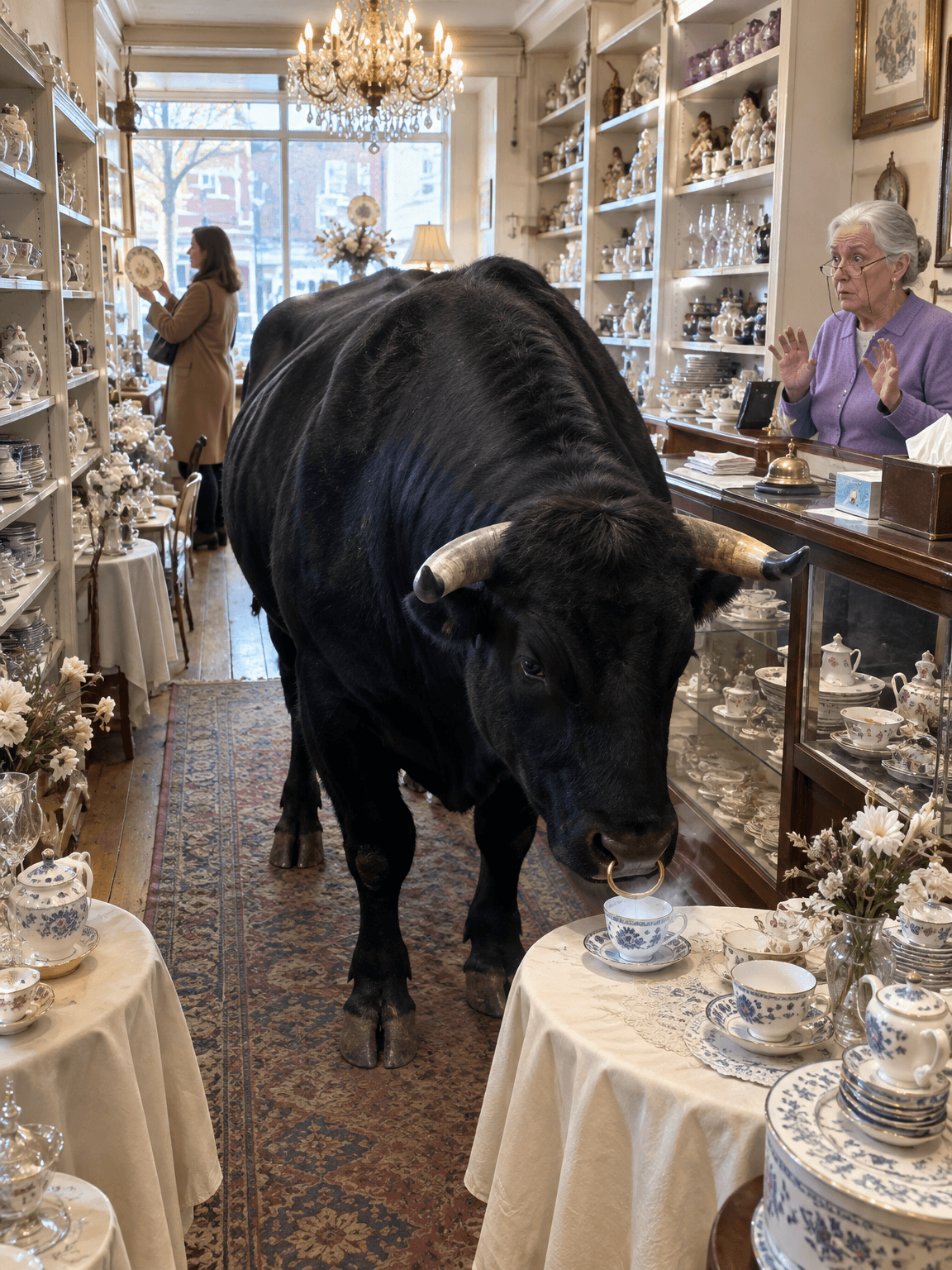
Not every saying works. For bull in a china shop I flipped it so the bull is being super careful, sniffing one teacup while the clerk freezes. Looking at it, it's just a nice photo of a bull in a shop, and nothing about it made me laugh, so it didn't make the carousel.
Exact prompt
Create a new photorealistic image of a real bull carefully browsing inside an upscale porcelain and fine-china boutique, on a quiet weekday afternoon. THE VIBE: The saying "bull in a china shop" played completely straight, then flipped — a huge bull is standing in a delicate china shop, but instead of smashing everything it is being impossibly careful, holding perfectly still between the shelves, while the anxious shop clerk freezes behind the counter and a customer keeps browsing, unbothered. Absurd, deadpan, understated, captured as a casual phone snapshot as if this were totally normal. THE SUBJECT: A massive black Angus-type bull with a glossy coat, thick neck, short curved horns, a brass ring in its nose, standing in the narrow centre aisle of the shop. It stands rigidly still, legs placed precisely between floor displays, shoulders hunched in, head lowered gently to inspect a single delicate blue-and-white porcelain teacup on a low display table, nostrils just above it, eyes focused and careful. Its tail is held tight against its body so it doesn't swing. Real coarse hair texture, dust on its hooves, slight breath condensation near the teacup. THE CHARACTERS: Behind the glass counter on the right, a thin older shop clerk with silver hair in a neat bun, reading glasses on a chain, a lavender cardigan — frozen mid-motion with both hands raised slightly, wide eyes, lips pressed together in silent terror. In the background near the window, a well-dressed woman in a camel coat calmly holding up a gilded dinner plate to the light, completely ignoring the bull. THE FACE: Natural skin texture, no airbrushing, no plastic or waxy skin, real skin with subtle tonal variation and natural age lines on the clerk. THE SETTING: A small, elegant, slightly old-fashioned fine-china boutique: tall white wooden shelves floor to ceiling lined with stacked plates, teacups, saucers, gravy boats, crystal glasses and porcelain figurines; round display tables draped in cream linen holding delicate tea sets; a crystal chandelier; a patterned runner on worn wooden floorboards; a glass counter with a vintage brass bell and tissue paper. Nothing broken — every piece intact, some cups trembling very slightly on their saucers near the bull. Cluttered and precious, not a showroom. THE LIGHT: Soft diffuse daylight from the large front window at the back of the frame as THE KEY source, plus the warm glow of the chandelier overhead. The same light falls on the bull, the people and the china: highlights glint along the bull's glossy back and horns and on the porcelain rims; the bull casts a soft shadow across the floor runner and a display table. Unified lighting — the bull is clearly inside the shop, not composited. THE KEY DETAILS: The bull's gentle, careful inspection of a single teacup is the punchline; the clerk's frozen panic sells it. No text, no signs, no brand names anywhere. THE MOOD: Everyday small-shop realism with one surreal rule, warm natural colour grade, mild contrast. THE COMPOSITION: Portrait frame shot from the shop entrance at standing eye level, looking down the aisle. The bull fills the centre of the frame, its body angled three-quarters toward camera, head lowered to the teacup on the low table in the lower middle. The clerk is on the right behind the counter, the customer small near the window in the background. Shelves of china line both sides of the frame. THE CAMERA: Shot on an iPhone at standing eye level, deep focus, everything sharp, NO background blur; casual social-media snapshot.
Bite the bullet didn't make it either. A patient biting a giant brass bullet at the dentist reads fine, but it wasn't punchy enough.
Why it works
The ones I kept all have a body part or an object that turned into something else (potato legs, ice feet), or something huge where it can't be (an elephant in a living room, a horse over someone's head). The ones I dropped needed you to already be in on the saying before the photo was funny.
Your turn: pick one saying with a physical thing in it and write the most boring version of the scene first. Then change just that one thing.
Emero keeps a list of what landed and what didn't, so your next carousel starts from the ones that worked, at cost.

Get one of these every day
I test new workflows daily and send them with the exact prompts, the models and the costs
5,979 generations tested so far
More workflows
See all
GPT Image 2.5 Flare - fix one thing in an image without losing the rest
Change one detail in an AI image, like size, mood or pose, while the rest of the picture stays put
GPT Image 2.5 Flare · 2 min render
GPT Image 2.5 Flare - Gen Z slang taken literally
Turn slang like spill the tea, glazing and catfished into photos that show the words literally
GPT Image 2.5 Flare · 2 min render
Nano Banana Pro - skincare texture and macro shots from one jar photo
Four close-up shots that show off a skincare formula, made from a single product photo
Nano Banana Pro · 1 min render