Nano Banana Pro + MiniMax H3 - 10 second chase ad with three hard cuts
A 10 second chase ad that cuts three times, built from one start frame and one end frame
 Tested by Nouamane Benbrahim
Disclaimer: This is an independent creative test made with AI, for demonstration only. It isn't an ad for any brand shown or named, and isn't affiliated with, sponsored or endorsed by them. All trademarks belong to their owners
Can one AI video prompt cut between three locations and still end exactly where you want?
I wanted a 10 second ad where a guy's hat blows off, it cuts to him chasing it down the street, cuts again to him chasing it through a park, and ends on a close-up of the hat sitting in the grass. I ran it twice: once with a felt hat on a 70s Los Angeles boulevard, once with a straw boater in Miami. The first run broke in a way I didn't see coming.
Here's my exact process.
1. Pick the look
I told the agent "make it feel like tarantino movie". I reused the guy in the tuxedo from an earlier test as the face reference, and everything else got rebuilt around him.
The agent turned that one line into real details: a sun baked 70s boulevard with palm trees, a cherry red muscle car and a mustard sedan, the camera down low looking up at him, warm saturated colors and heavy film grain.
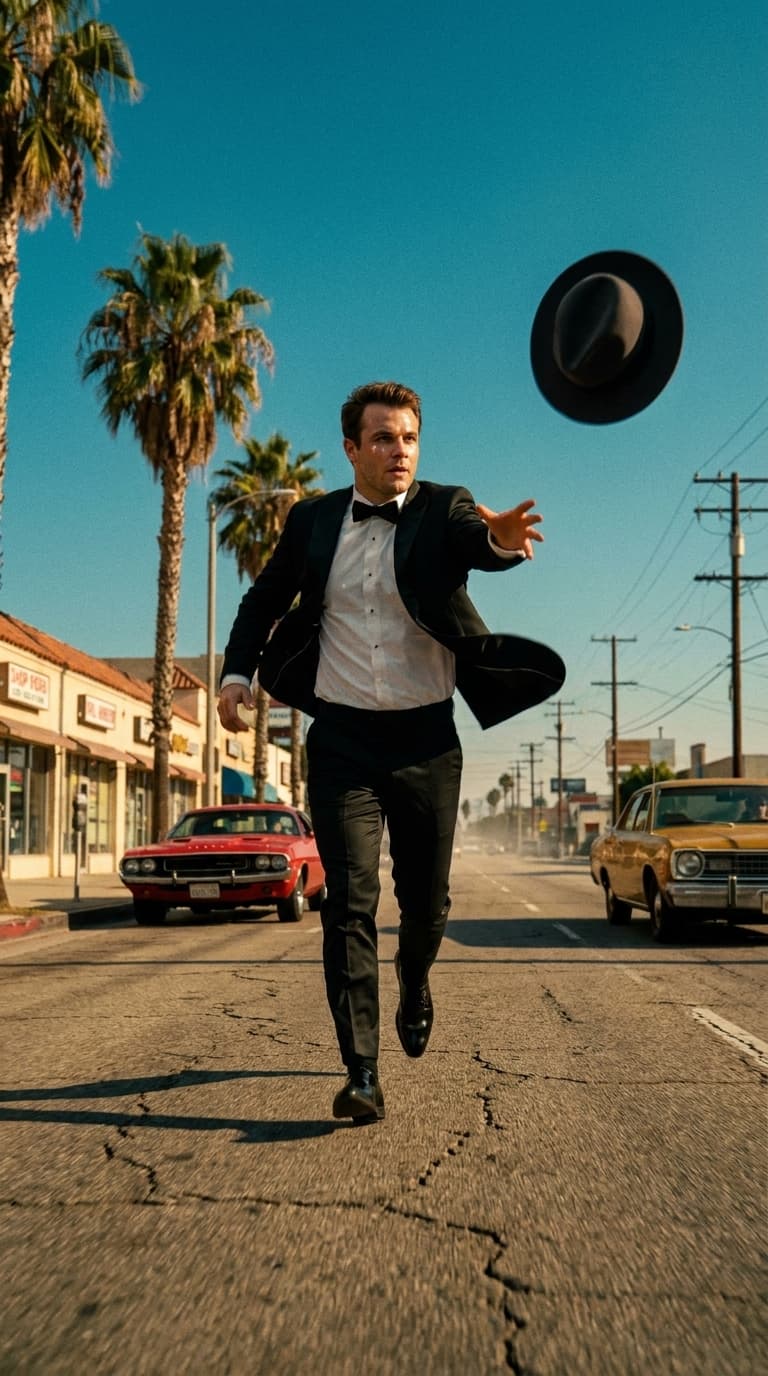
Exact prompt
Create a new photorealistic image. This is a frame from a 1970s-set crime-comedy feature film, shot on a Los Angeles boulevard from the start — not a composite, not a phone photo. Rebuild the entire scene as if shot natively here on film, with unified lighting across subject and environment. Editorial fashion photography, unretouched, no beauty filter, no skin smoothing. THE VIBE: Tarantino-style cinema — cool, swaggering, sun-baked, slightly absurd. A man in a tuxedo is sprinting flat-out down the middle of a hot, empty LA boulevard after his fedora, which a gust has stolen. Played completely straight, which makes it funny. Retro, stylised, confident. IDENTITY LOCK: Preserve the white man with short dark side-parted hair and a clean-shaven jaw, from the first reference. Do NOT source face, hair or outfit from anywhere else. He is relit entirely by this scene's light; the reference's overcast light and city setting are discarded. THE SUBJECT: He sprints hard toward the camera, mid-stride with his back foot fully off the asphalt, torso pitched forward, his right arm stretched out ahead reaching up for the hat, fingers splayed, his left arm pumping back. Eyes locked on the hat, jaw set, deadly serious. He wears the classic black tuxedo — satin peak-lapel dinner jacket flapping open behind him, crisp white dress shirt, thin black bow tie knocked slightly crooked, black trousers, black patent oxford shoes. No makeup. THE FACE: Real, unretouched skin with fine visible texture, faint pores, slightly uneven natural tone, a light sheen of sweat at the temples from the heat and the run. Mostly matte. THE SETTING: A wide, sun-bleached Los Angeles boulevard in the 1970s: cracked pale asphalt with faded yellow lane lines, a row of tall skinny palm trees receding down the street, a low stucco strip of shopfronts with faded awnings, a 1970s cherry-red muscle car and a mustard-yellow sedan parked at the curb, telephone poles and sagging wires overhead. Heat haze shimmering far down the road. All signs blank or unreadable, no logos, no car badges. THE LIGHT: Late-afternoon California sun, low and raking from frame-left — the ONLY light. Warm hard light across his face, shirt and lapels on the left side, the right side falling into warm-brown shadow, a long hard shadow stretching to frame-right across the asphalt. NO lens flare, no visible sun disc, no blown-out sky. The sky a deep saturated cyan-blue. Exposed for his face; deep warm shadows. THE KEY DETAILS: The classic black felt fedora with a black band, real life-size, tumbling in the air about two metres ahead of his reaching fingertips toward the camera, slightly above his head height and to frame-right, clearly out of reach. No text, no logos. THE MOOD: A 1970s crime-film opening — cocky, sun-drenched, stylised and deadpan. Colour grade: warm, saturated retro film palette — golden-amber skin, bold cherry red and mustard yellow, deep cyan sky, rich crushed warm blacks in the tuxedo, slightly faded highlights. THE COMPOSITION: Vertical frame, shot from very low — near ground level — looking up at him, the dramatic low-angle "trunk shot" perspective. He is centred, his full figure from head to shoes filling about 45% of the frame height, the top of his head about 25% down from the top of the frame, his shoes about 70% down. The hat floats in the upper right third ahead of him, not touching the edge. The palms and boulevard recede behind him, the deep blue sky fills the top. Cracked asphalt fills the lower frame. THE CAMERA: Cinematic feature-film capture — a wide anamorphic-feel lens from very low, slight wide-angle stretch at the edges, deep-ish focus so he, the hat and the cars stay readable, gentle edge falloff. Real film texture: heavy visible film grain across the whole frame including the face, slight gate weave softness, warm halation around the bright highlights. Tarantino-style 1970s cinema. Not an iPhone photo, not digital. THE AFTER EFFECT: Slight motion blur on his trailing arm and the flapping jacket; his face and the hat stay crisp. No text, no logos, no readable signage anywhere. looks like a real actor in a frame from a 1970s feature film, not a render.
2. Lock his face with a close-up
Next I made a close-up of him wearing the hat, two fingers on the brim, a little smirk. In my tests small faces in wide shots tend to drift, so having one sharp image of his face gives every later frame something to match.
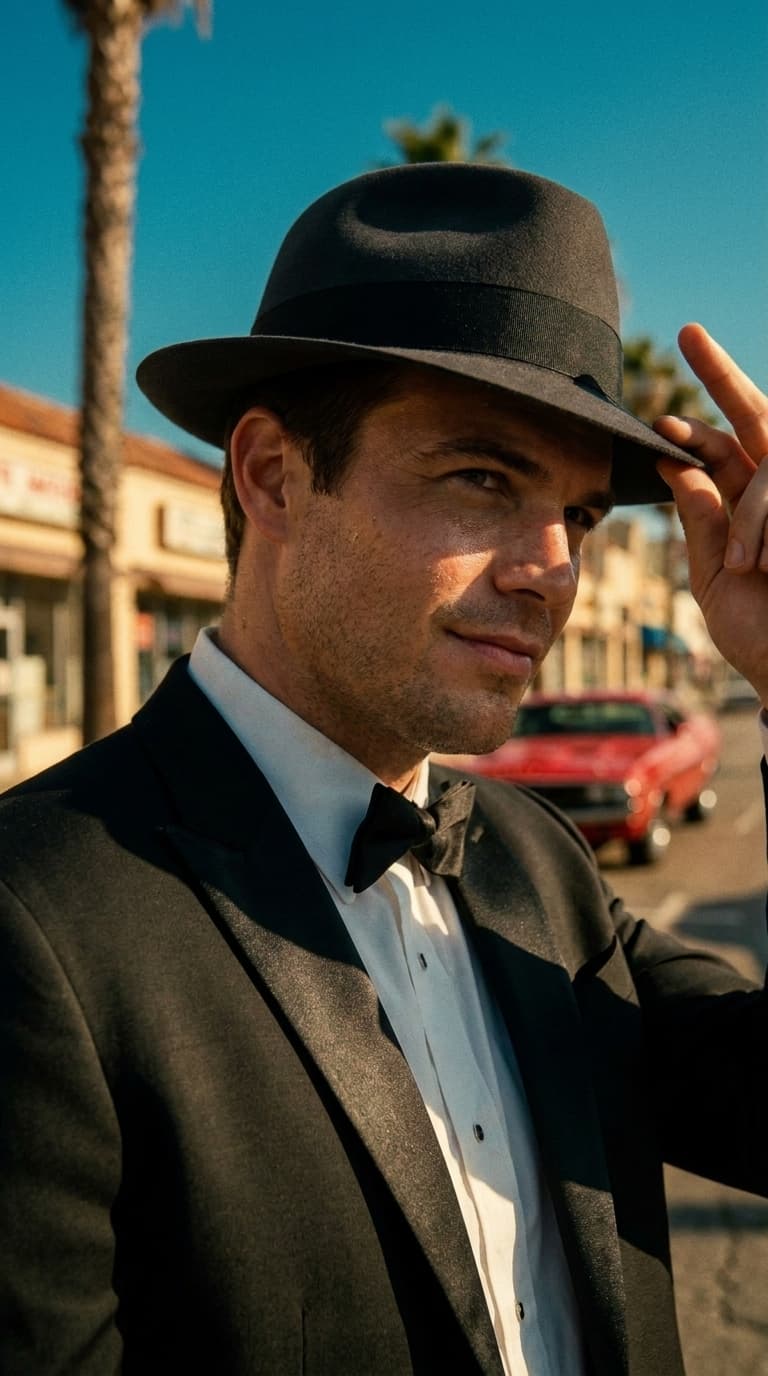
Exact prompt
Create a new photorealistic image. This is a close-up frame from a 1970s-set crime-comedy feature film, shot on the same sun-baked Los Angeles boulevard from the start — not a composite, not a phone photo. Rebuild the scene as if shot natively here on film, with unified lighting across subject and environment. Editorial fashion photography, unretouched, no beauty filter, no skin smoothing. THE VIBE: Tarantino-style cinema — cool, swaggering, sun-baked, deadpan. The calm before the gust: a man in a tuxedo stands on a hot LA boulevard wearing his fedora, utterly composed, about to have his day ruined. IDENTITY LOCK: Preserve the white man with short dark side-parted hair and a clean-shaven jaw, in the black tuxedo with the white dress shirt and thin black bow tie, from the first reference. Do NOT source face, hair or outfit from anywhere else. THE SUBJECT: He wears the classic black felt fedora with a black grosgrain band, from the first reference, sitting straight and sharp on his head, the brim casting a soft shadow across his forehead. Head-and-shoulders, his body angled three-quarters to frame-left, his face turned back toward frame-right, gaze slightly off-camera to the right, eyes narrowed a touch against the sun. One hand raised, two fingers touching the front of the brim as he sets it just right. Cool, self-assured, the faintest smirk. The satin peak lapels and white shirt collar visible, bow tie perfectly straight. No makeup. THE FACE: Real, unretouched skin with visible pores across the nose and cheeks, fine texture, slightly uneven natural tone with a faint warm flush on the cheeks and nose, a few tiny imperfections, a light sheen of heat-sweat at the temples. Minimal natural look: bare skin, no foundation, no contour, no highlighter, lightly groomed brows. A natural, correctly-proportioned nose with a defined bridge, clean tip and even nostrils. Light-blue-grey eyes with a natural iris gradient and a soft catchlight. A faint shadow of stubble along the jaw at skin level. Hair strands at the temple below the hat brim, a few flyaways. THE SETTING: The same 1970s LA boulevard, thrown well out of focus behind him: a tall palm trunk, the soft cherry-red shape of the parked muscle car, the stucco shopfronts and a deep cyan sky. No readable text, no signage, no logos, no license plates. THE LIGHT: Late-afternoon California sun, low and raking from frame-right — the ONLY light. Hard warm light across the right side of his face, the brim and the satin lapel, which catches a hot specular streak; the left side of his face falls into warm-brown shadow; the brim casts a crisp shadow across his brow, his eyes still readable in it. Warm golden bounce off the pale street lifts the shadows slightly. No lens flare, no visible sun. THE KEY DETAILS: The fedora's felt texture and the band crisp and tactile; a tiny wisp of breeze just lifting the edge of his jacket lapel — a hint of the gust to come. No text, no logos. THE MOOD: A 1970s crime-film character introduction — cocky, still, sun-drenched. Warm, saturated retro film grade: golden-amber skin, deep cyan sky, cherry red accent, crushed warm blacks in the tux and hat, slightly faded highlights. THE COMPOSITION: Vertical close-up. His head, hat and shoulders fill the frame, the top of the fedora crown about 18% down from the top of the frame, his face in the upper-middle, centred slightly left of centre, his shoulders and lapels filling the bottom third. Open blurred street and sky to the right of his face, in the direction of his gaze. THE CAMERA: Cinematic feature-film capture — slightly low angle looking up at him, a medium-telephoto portrait lens, shallow depth of field with his eyes and the hat brim tack sharp and the background melting into soft warm bokeh. Real film texture: heavy visible film grain across the whole frame including the face, warm halation around bright highlights, gentle edge falloff. Tarantino-style 1970s cinema. Not an iPhone photo, not digital. No text, no logos, no readable signage anywhere. looks like a real actor in a frame from a 1970s feature film, not a render.
3. Make the start frame
My first version had him running down the middle of the road. That's not where a guy is right before his hat flies off, so I said "he should be on the street kinda mid walk, caught in the moment".
I also left a lot of open sky above and beside the hat. The hat needs somewhere to fly in the first second of the video.
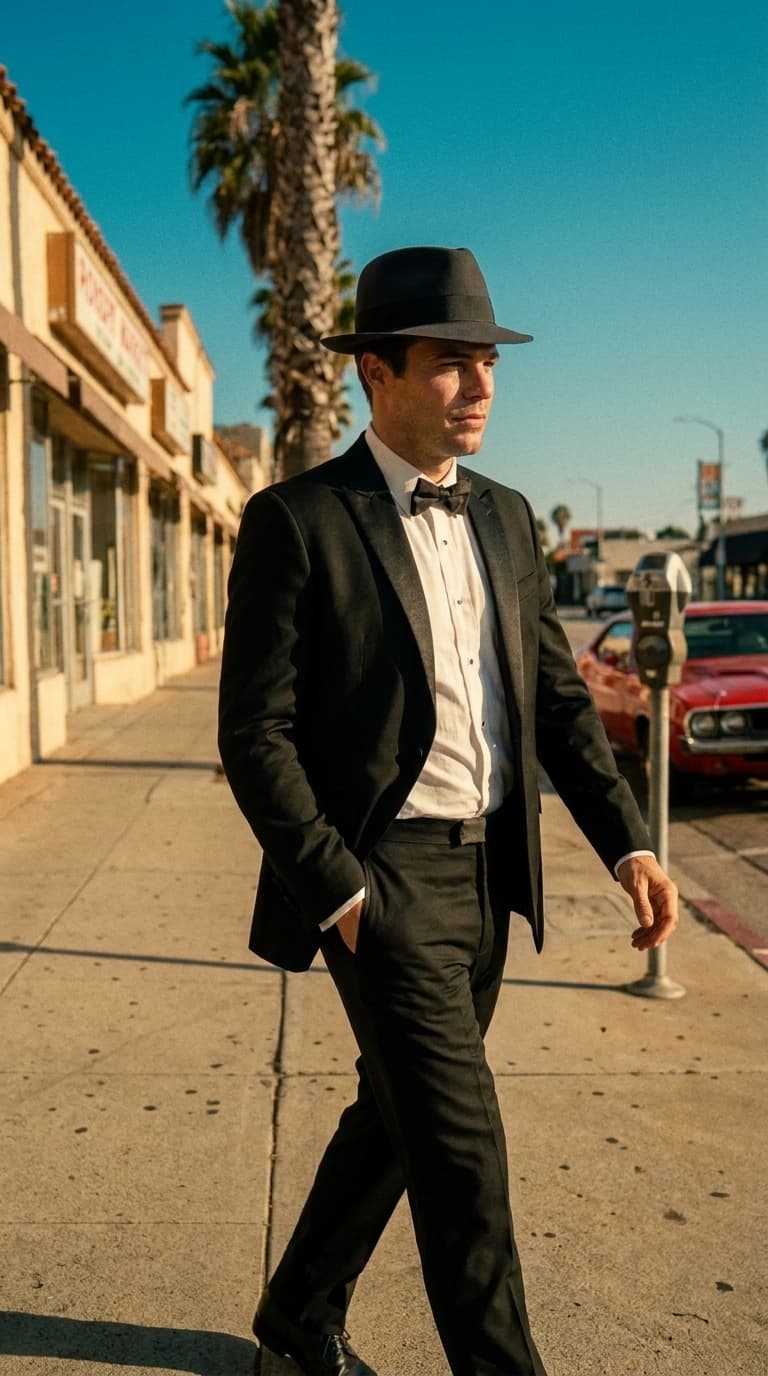
Exact prompt
Create a new photorealistic image. This is a candid frame from a 1970s-set crime-comedy feature film, shot on a sun-baked Los Angeles sidewalk from the start — not a composite, not a phone photo. Rebuild the scene as if shot natively here on film, with unified lighting across subject and environment. Editorial fashion photography, unretouched, no beauty filter, no skin smoothing. THE VIBE: Tarantino-style cinema — cool, swaggering, sun-baked, deadpan. An ordinary moment caught mid-stride: a man in a tuxedo and fedora strolls along a hot LA sidewalk, unaware, a second before a gust steals his hat. Observed, not posed. IDENTITY LOCK: Preserve the white man with short dark hair and light stubble, in the black tuxedo with the white dress shirt and black bow tie, wearing the black felt fedora with the black band, from the first reference. Do NOT source face, hair or outfit from anywhere else. He is relit by this scene's light. THE SUBJECT: He is walking along the sidewalk toward frame-right, caught mid-step — weight on his front foot, body angled three-quarters toward the camera, one hand casually in his trouser pocket, the other arm swinging loose. His head is turned slightly, glancing off to the side at something down the street, relaxed, unaware of the camera. The fedora sits straight on his head. Jacket hanging open, lapels shifting with the walk. No makeup. THE FACE: Real, unretouched skin with fine visible texture, faint pores across the nose and cheeks, slightly uneven natural tone, a few tiny imperfections. Mostly matte — natural shine only faintly on the nose tip and centre of the forehead. Minimal natural makeup: bare skin, no foundation, no contour, no highlighter, lightly groomed brows. THE SETTING: A 1970s Los Angeles sidewalk: sun-bleached concrete paving with cracks and a few cigarette butts, a low stucco strip of shopfronts with faded striped awnings and dusty display windows behind him, a tall palm trunk at the curb, a parking meter, the cherry-red 1970s muscle car parked at the curb at the edge of frame, telephone wires overhead. A couple of passersby far behind, soft. All signs blank or unreadable, no logos, no license plates. THE LIGHT: Late-afternoon California sun, low and raking from frame-right — the ONLY light. Hard warm light across the right side of his face, the hat brim and the shirt front; the left side falls into warm-brown shadow; the brim casts a crisp shadow across his brow; his long hard shadow falls to frame-left across the sidewalk and up the stucco wall. Warm bounce off the pale concrete lifts the shadows slightly. No lens flare, no visible sun. THE KEY DETAILS: The fedora sitting on his head — the brim just catching the first lift of a breeze. A few dry palm fronds and a scrap of paper skittering along the pavement. No text, no logos. THE MOOD: A candid 1970s crime-film moment — cool, sun-drenched, deadpan. Warm, saturated retro film grade: golden-amber skin, deep cyan sky, cherry red and faded mustard accents, crushed warm blacks in the tux and hat, slightly faded highlights. THE COMPOSITION: Vertical frame, waist-up medium shot. He is left of centre, the top of the fedora crown about 25% down from the top of the frame, his face around 32% down, his waist at the bottom edge. Generous open space above and around the hat — the cyan sky, the awning and palm — so the hat has room to fly away. Nothing touching the frame edges. THE CAMERA: Cinematic feature-film capture — eye level, a long telephoto lens from across the street, compressing the shopfronts close behind him, shallow depth of field with him sharp and the background in soft warm bokeh. Observational, candid framing, as if he doesn't know he's being filmed. Real film texture: heavy visible film grain across the whole frame including the face, warm halation around bright highlights, gentle edge falloff. Tarantino-style 1970s cinema. Not an iPhone photo, not digital. No text, no logos, no readable signage anywhere. looks like a real actor in a candid frame from a 1970s feature film, not a render.
4. Make the end frame
Then the last shot of the ad: the hat sitting in the grass of a park, shot from right at ground level so it looks kind of heroic, with palm trees and a green bench blurred behind it.
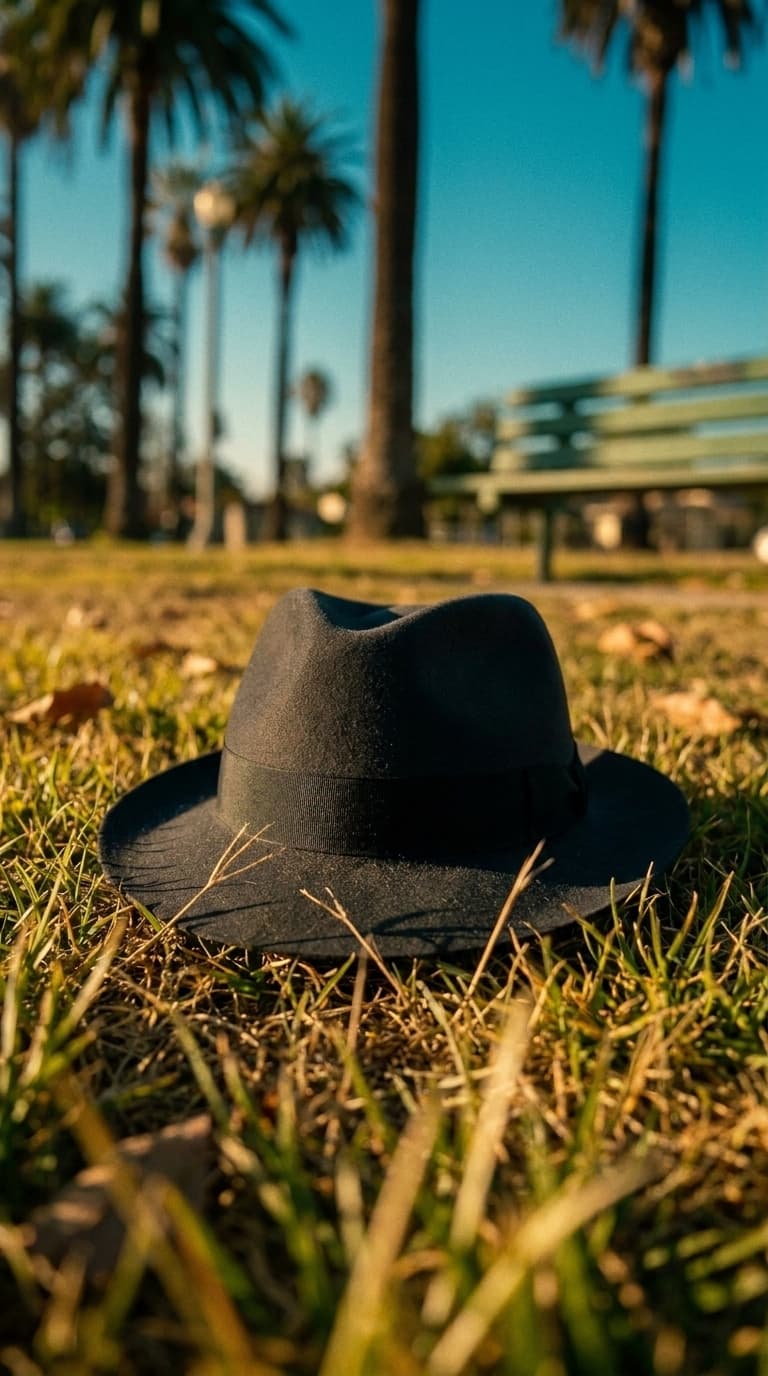
Exact prompt
Create a new photorealistic image. This is a close-up frame from a 1970s-set crime-comedy feature film, shot at ground level in a Los Angeles park from the start — not a composite, not a phone photo. Rebuild the scene as if shot natively here on film, with unified lighting across the hat and the environment. THE VIBE: Tarantino-style cinema — the deadpan payoff after a long chase. The runaway fedora has finally come to rest in the grass of a sunny LA park, sitting there smugly, as if waiting. Still, quiet, slightly absurd, heroic. THE SUBJECT: The black felt fedora with the black grosgrain band, from the first reference — use ONLY the hat from the first reference; no person, no face, no tuxedo in this frame. It rests upright on its brim in the grass, tilted slightly toward the camera, the crown pinch and the band facing us at a three-quarter angle. The felt has a soft matte nap with fine fibres visible, a little dust and two blades of dry grass caught on the brim from rolling across the park; the brim edge is crisp, the band's ribbed grosgrain texture sharp. THE SETTING: A 1970s Los Angeles park in late afternoon: slightly patchy, sun-dried green-and-gold lawn, a few fallen palm fronds and dry leaves, a worn dirt path. Behind, thrown far out of focus: tall skinny palm trees, a green wooden park bench, a low hedge, and the deep cyan sky. Foreground: a few out-of-focus grass blades right in front of the lens, partly occluding the bottom edge. No people, no text, no signage, no logos. THE LIGHT: Late-afternoon California sun, low and raking from behind the hat to frame-right — the ONLY light. A warm golden rim glows along the top of the crown and the brim edge, the fibres of the felt catching the light; the front of the hat sits in soft warm shade lifted by bounce from the sunlit grass; the hat throws a long soft shadow toward the camera and to frame-left across the grass. Backlit grass blades glow translucent gold. No lens flare, no visible sun disc. THE KEY DETAILS: The texture of the felt and the band; the grass pressed down slightly under the brim where it sits; dust motes floating in the low sunlight. No text, no logos, no label. THE MOOD: The final shot of a 1970s crime-film chase — sun-drenched, mock-heroic, deadpan. Warm, saturated retro film grade: golden-amber grass and light, deep cyan sky, the hat a rich crushed warm black, slightly faded highlights. THE COMPOSITION: Vertical close-up from ground level. The hat sits in the lower-middle of the frame, centred, filling about 45% of the frame width, its crown top about 45% down from the top of the frame and its brim base about 72% down. Above it, soft blurred palms and the cyan sky; below it, out-of-focus foreground grass. Nothing touching the frame edges. THE CAMERA: Cinematic feature-film capture — the lens almost resting on the grass, looking slightly up at the hat, giving it a heroic, monumental presence. Shallow depth of field: the hat's band and brim tack sharp, the foreground grass and the park background melting into soft warm bokeh. Real film texture: heavy visible film grain across the whole frame, warm halation around the rim-lit edges, gentle edge falloff. Tarantino-style 1970s cinema. Not an iPhone photo, not digital. No text, no logos, no readable signage anywhere. Every element feels tactile and present, like a real frame from a 1970s feature film, not a render.
5. Write one scene per cut
Now the video. I gave it the walk frame as the start and the hat in the grass as the end, and wrote the middle as scenes in order with "HARD CUT" at the start of each new location: the hat blows off and out of frame, cut to him chasing it down the boulevard as it rolls, cut to the park, cut to the close-up.
It cut at exactly those three spots and landed on my end frame. The flyaway at the start is great, his face drops right as the hat lifts off.
But my reaction when I watched it was "in some parts his hat basically looks like two hats". It took me a second to see why. A black hat on pale asphalt in hard sun casts a black shadow about the same size and shape, and every time the hat bounced off the ground the two split apart. On top of that, a felt hat can't really roll. The crown is pinched and the brim is soft, so the video made it hop instead.
Exact prompt
Create a new video, a 1970s-style crime-comedy film sequence in three hard cuts. A man in a black tuxedo and black felt fedora strolls down a sun-baked Los Angeles sidewalk until a gust snatches his hat clean off his head and carries it out of frame. Hard cut: he sprints down the middle of the hot boulevard chasing the hat as it rolls along the asphalt on its brim like a wheel, always just out of reach. Hard cut: he chases it across the grass of a sunny palm-lined park, the hat still rolling and bouncing ahead of him. The final shot is a ground-level close-up of the hat coming to rest upright in the park grass. Warm, saturated 1970s film look throughout — golden late-afternoon sun, deep cyan sky, cherry-red and mustard accents, heavy film grain, deadpan Tarantino-style energy. Same man, same tuxedo, same black fedora in every shot. [SCENE 1] THE STARTING FRAME: the man mid-stride on the sidewalk, one hand in his pocket, glancing down the street, fedora on his head. Video animates FROM this position. He keeps strolling forward toward frame-right, relaxed. A sudden gust whips palm fronds and paper along the pavement and lifts the fedora straight off his head — it spins up and away over his shoulder and flies out of the top of the frame. His hand shoots up, too late; his face drops in disbelief. [SCENE 2] HARD CUT to a low-angle wide shot in the middle of the sun-bleached boulevard, palm trees and 1970s cars lining the street: the fedora rolls fast along the asphalt on the edge of its brim, wobbling like a runaway wheel, toward the camera. Behind it, the man in the tuxedo sprints flat-out after it, jacket flapping, bow tie crooked, arm reaching, running forward naturally — NOT backward, not sliding. The frame tracks backward low to the ground just ahead of the rolling hat. [SCENE 3] He lunges and grabs at it; the hat hits a crack in the asphalt, bounces, and keeps rolling away from his fingertips. He stumbles, recovers, keeps running. [SCENE 4] HARD CUT to a sunny 1970s LA park — sun-dried golden grass, tall palms, a green wooden bench. The hat rolls and bounces across the lawn, kicking up dry grass, the man still sprinting after it in the background, out of breath, tuxedo dishevelled. [SCENE 5] HARD CUT to a ground-level close-up: the hat rolls into frame through the grass, wobbles, slows, and settles upright on its brim in the grass, tilted slightly toward the lens. Stillness. The palms and the green bench soft in the background, dust motes in the low golden light. Hold on the hat — the frame is locked; no camera movement. The hat is the same black felt fedora with a black band throughout. No text, no logos, no readable signs, no license plates.
6. Switch to a hat that can roll
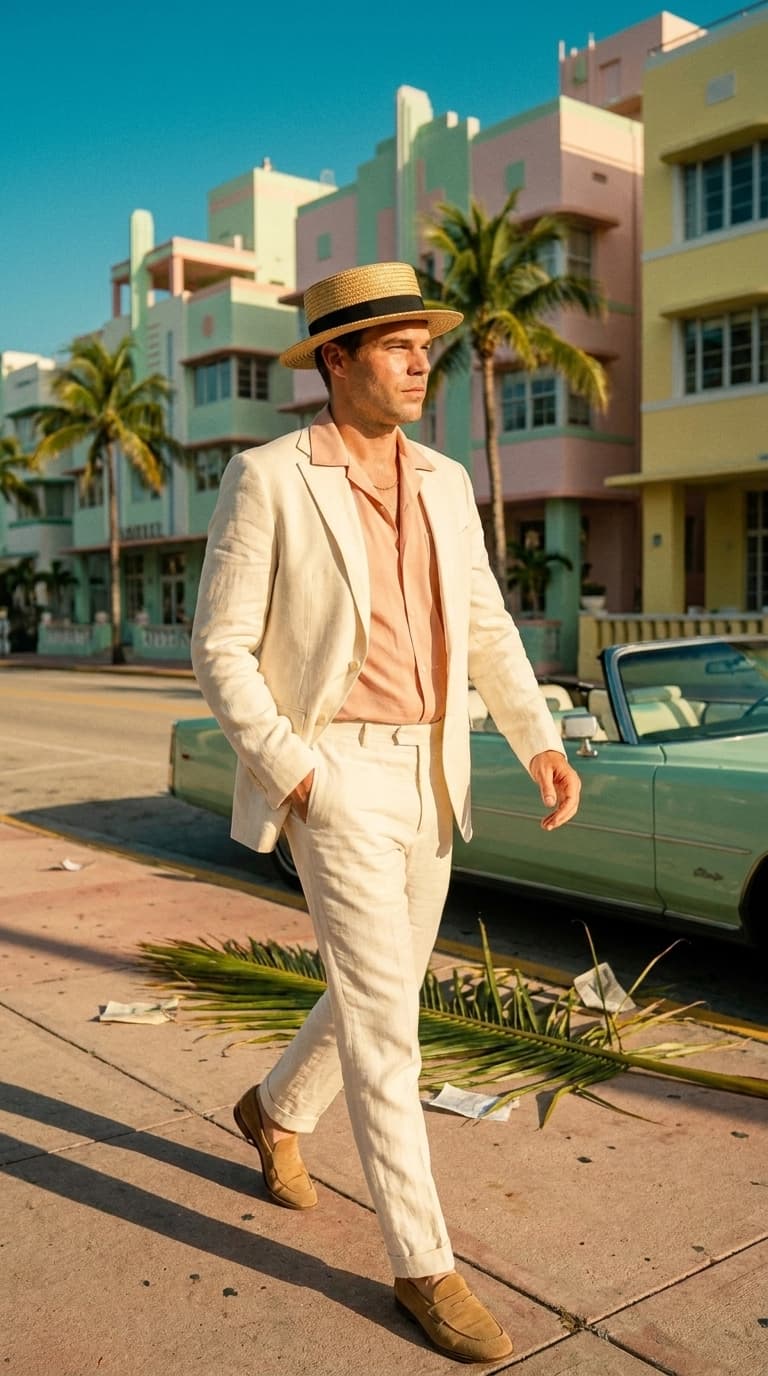
So I picked a hat that actually rolls: a stiff straw boater. The brim is perfectly round and rigid, so it can wheel down a street on its edge, and the pale straw can never get mixed up with its own shadow.
While I was at it I said "give him a more miami look" and moved the whole thing to Miami Beach: an ivory linen suit, a salmon silk shirt open at the neck, a thin gold chain, loafers with no socks and pastel Art Deco hotels behind him.
Exact prompt
Create a new photorealistic image. This is a candid frame from a 1970s-set crime-comedy feature film, shot on a sun-drenched Miami Beach Art Deco sidewalk from the start — not a composite, not a phone photo. Rebuild the scene as if shot natively here on film, with unified lighting across subject and environment. Editorial fashion photography, unretouched, no beauty filter, no skin smoothing. THE VIBE: Tarantino-style cinema in Miami — cool, swaggering, sun-drenched, deadpan, a little sleazy-glamorous. An ordinary moment caught mid-stride: a sharply dressed man in a white linen suit and straw boater strolls along the beachfront deco strip, unaware, a second before a gust steals his hat. Observed, not posed. IDENTITY LOCK: Preserve the white man with short dark hair and light stubble, from the first reference — his face, hair and build only. Do NOT source his outfit or hat from the first reference; he is fully restyled below. He is relit entirely by this scene's light; the reference's light and setting are discarded. THE SUBJECT: He is walking along the sidewalk toward frame-right, caught mid-step — weight on his front foot, body angled three-quarters toward the camera, one hand casually in his trouser pocket, the other arm swinging loose. His head is turned slightly, glancing off down the street, relaxed, unaware of the camera. He wears the classic stiff straw boater hat: natural golden-tan woven straw, a flat round crown and a flat, perfectly round rigid brim, with a black grosgrain band — sitting straight on his head. An ivory-white linen two-piece suit, single-breasted, softly rumpled with natural linen creases, jacket hanging open; a pale salmon-pink silk camp-collar shirt open at the neck; ivory linen trousers; tan suede loafers, no socks. A thin gold chain at the collar. No makeup. THE FACE: Real, unretouched skin with fine visible texture, faint pores across the nose and cheeks, slightly uneven natural tone, a faint sun flush, a few tiny imperfections. Mostly matte — natural shine only faintly on the nose tip and centre of the forehead. Minimal natural makeup: bare skin, no foundation, no contour, no highlighter, lightly groomed brows. THE SETTING: A 1970s Miami Beach Art Deco strip: pastel deco hotel facades behind him — mint green, flamingo pink and pale lemon stucco with rounded corners, horizontal racing stripes, porthole windows and eyebrow ledges; a few faded striped awnings; tall skinny palms along the curb; a 1970s mint-green convertible parked at the curb at the edge of frame; a sun-bleached concrete sidewalk with cracks. A couple of passersby far behind, soft. All signs blank or unreadable, no hotel names, no logos, no license plates. THE LIGHT: Late-afternoon Florida sun, low and raking from frame-right — the ONLY light. Hard warm light across the right side of his face, the boater brim and the linen jacket; the left side falls into warm shadow with a faint pink bounce from the pastel facades; the brim casts a crisp shadow across his brow; his long hard shadow falls to frame-left across the sidewalk. No lens flare, no visible sun. THE KEY DETAILS: The boater sitting on his head — its pale golden straw clearly lighter than everything around it, the rigid round brim catching the first lift of a sea breeze. A few palm fronds and a scrap of paper skittering along the pavement. No text, no logos. THE MOOD: A candid 1970s crime-film moment in Miami — cool, sun-drenched, deadpan. Warm, saturated retro film grade: golden-amber skin, deep cyan sky, candy pastels of the deco facades, warm creamy whites in the linen, slightly faded highlights. THE COMPOSITION: Vertical frame, waist-up medium shot. He is left of centre, the top of the boater about 25% down from the top of the frame, his face around 32% down, his waist at the bottom edge. Generous open space above and to the right of the hat — the cyan sky, the deco cornices and a palm — so the hat has room to fly away. Nothing touching the frame edges. THE CAMERA: Cinematic feature-film capture — eye level, a long telephoto lens from across the street, compressing the deco facades close behind him, shallow depth of field with him sharp and the background in soft warm bokeh. Observational, candid framing. Real film texture: heavy visible film grain across the whole frame including the face, warm halation around bright highlights, gentle edge falloff. Tarantino-style 1970s cinema. Not an iPhone photo, not digital. No text, no logos, no readable signage anywhere. looks like a real actor in a candid frame from a 1970s feature film, not a render.
7. Clean up the start frame
Three quick fixes before animating.
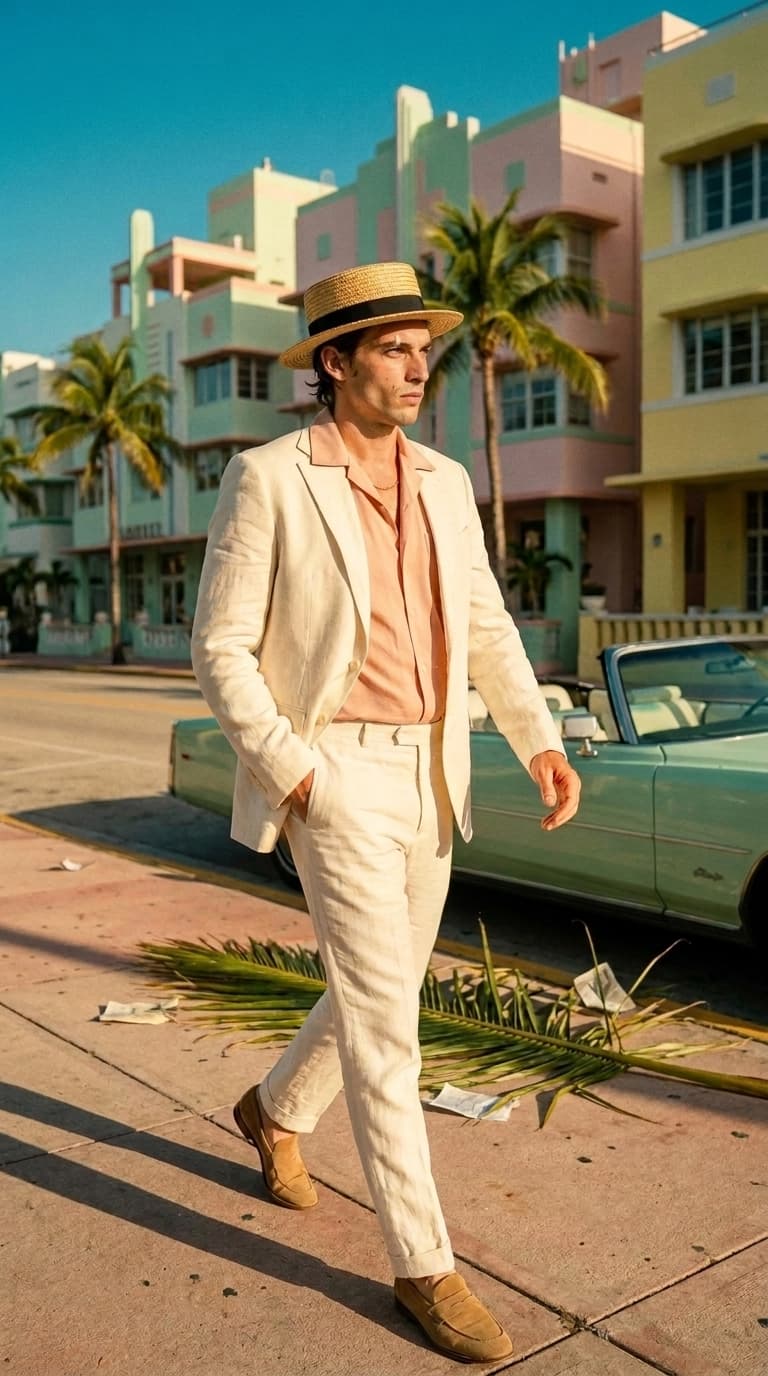
His face looked too AI, too smooth and generic, so I asked for "more of an editorial face". I described a specific one: a long lean face, sharp cheekbones, a nose with a small bump, a little scar through one eyebrow and a mole on his cheek.
Exact prompt
Create a new photorealistic image, but with a completely different, more distinctive editorial-model face on the man. Preserve the outfit, pose, framing, setting, light and film look of the first reference exactly. Editorial fashion photography, unretouched, no beauty filter, no skin smoothing. Do NOT keep the face from the first reference — replace the face and hair entirely with the new face described below. THE VIBE: Tarantino-style cinema in Miami — cool, swaggering, sun-drenched, deadpan. A candid frame of a striking, slightly unusual-looking man who could be a high-fashion model, strolling the deco strip a second before a gust steals his hat. THE NEW FACE (the only change): A man in his late twenties with a striking, editorial, slightly unconventional face — the kind cast for a luxury fashion campaign, not a generic handsome face. A long, lean face with high sharp cheekbones and slightly hollow cheeks beneath them; a strong angular jaw and a defined chin; a long straight nose with a slight bump on the bridge and a faint asymmetry; deep-set, slightly hooded pale grey-green eyes; thick, straight, dark untamed brows, the left one interrupted by a small pale scar; a full lower lip and a thin upper lip; a small mole on the right cheek. Dark brown hair, slightly grown out and slicked back loosely, a few strands falling forward under the brim. Light uneven stubble along the jaw. Light olive skin with a sun-tanned warmth across the nose and cheekbones. Expression: aloof, bored, faintly amused, lips closed — a model's unbothered neutral, gaze off down the street. THE FACE (finish): Real, unretouched skin with clearly visible texture — visible pores across the nose and cheeks, slightly uneven tone, faint redness at the nostrils, a few tiny blemishes and freckles from the sun, fine lines at the outer eye corners when he squints into the light. Mostly matte — natural shine only faintly on the nose tip and centre of the forehead. Minimal natural makeup: bare skin, no foundation, no contour, no highlighter. Natural, correctly proportioned features with slight real-life asymmetry — NOT symmetrical, NOT smooth, NOT a generic AI face. THE SUBJECT (UNCHANGED): The same pose as the first reference — walking toward frame-right mid-step, one hand in his trouser pocket, glancing off down the street — wearing the same straw boater with the black band, ivory linen suit, salmon-pink silk camp-collar shirt open at the neck, thin gold chain and tan suede loafers, from the first reference. THE SETTING (LOCKED): The same pastel Art Deco Miami Beach street as the first reference — mint, pink and lemon deco facades, palms, the mint-green convertible at the curb, the fallen palm frond and paper scraps on the sidewalk. Do NOT reimagine this environment. THE LIGHT (LOCKED): The same low late-afternoon sun from frame-right as the first reference — hard warm light on the right side of his face and the boater brim, the brim's crisp shadow across his brow, the left side in warm shadow. Same warm, saturated 1970s film grade. THE CAMERA: Same framing and position as the first reference. Real film texture: heavy visible film grain across the whole frame including the face and skin, warm halation around bright highlights. Not an iPhone photo, not digital. No text, no logos, no car badges, no readable signage anywhere. looks like a real fashion model photographed on location in a 1970s feature film, not a render.
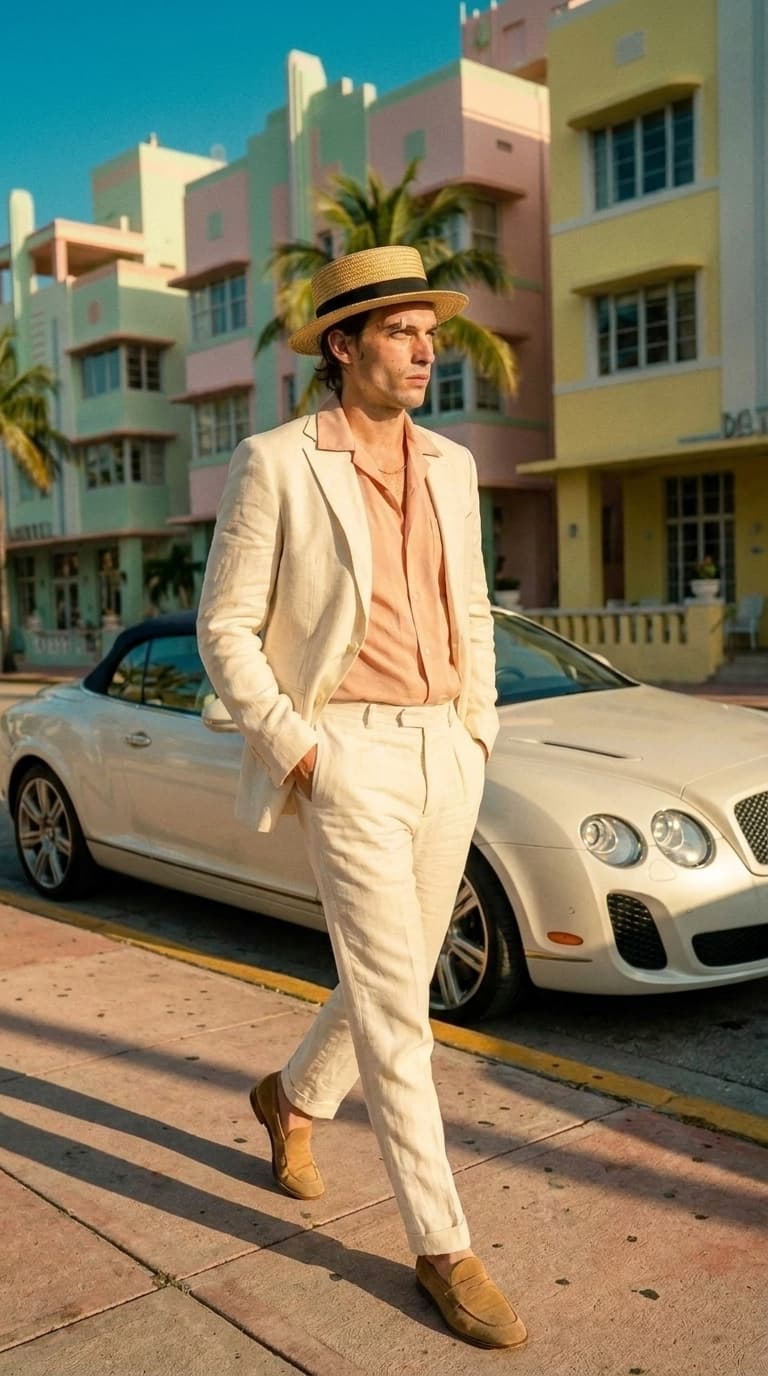
Then I cleaned up the set. There was a weird palm leaf and some paper on the ground, and I wanted the street to read as Miami today, so the old convertible became a modern one. I also asked for a boxier 80s jacket with the sleeves pushed up, and that part didn't take.
Exact prompt
Create a new photorealistic image, but cleaned up and set in present-day Miami Beach, with the man's outfit pushed to a 1980s Miami look. Preserve the man's face, hair, pose and the straw boater exactly, from the first reference. Editorial fashion photography, unretouched, no beauty filter, no skin smoothing. NO palm frond on the ground. NO paper scraps, litter or debris anywhere. NO vintage car. THE VIBE: Tarantino-style cinema set in modern-day Miami — cool, swaggering, sun-drenched, deadpan. A striking man dressed like he stepped out of 1980s Miami strolls a clean, present-day Ocean Drive sidewalk, a second before a gust steals his hat. IDENTITY LOCK: Preserve the man with the long lean editorial face, sharp cheekbones, dark grown-out hair falling under the brim and light stubble, from the first reference. Do NOT change his face or hair. THE SUBJECT: The same pose as the first reference — walking toward frame-right mid-step, one hand in his trouser pocket, glancing off down the street. The same natural golden straw boater with the black band. His outfit is now a 1980s Miami look: an oversized, boxy ivory-white linen suit jacket with broad soft-padded shoulders, its sleeves pushed up to the forearms, worn open; the same pale salmon-pink silk camp-collar shirt open at the neck with the thin gold chain; high-waisted, pleated, relaxed ivory linen trousers with a slight taper; the same tan suede loafers, no socks. No makeup. THE FACE: Real, unretouched skin with fine visible texture, faint pores, slightly uneven natural tone, a faint sun flush. Mostly matte. Minimal natural makeup: bare skin, no foundation, no contour, no highlighter. THE SETTING: The same pastel Art Deco facades and palms as the first reference, as they look today on Ocean Drive — mint, flamingo-pink and lemon stucco, well kept. The sidewalk is clean, smooth, freshly swept pale concrete paving with no debris, no stains, no litter. At the curb, in place of the vintage car: a sleek modern present-day luxury convertible sports car, top down, glossy pearl-white paint, clean modern lines, NO badge or logo, NO license plate. A modern black street-light pole at the curb. No text, no hotel names, no signage. THE LIGHT (LOCKED): The same low late-afternoon sun from frame-right as the first reference — hard warm light on the right side of his face, the boater brim and the linen; the brim's crisp shadow across his brow; his long shadow falling to frame-left across the clean sidewalk. Same warm, saturated cinematic film grade: golden-amber skin, deep cyan sky, candy pastels, creamy whites. THE COMPOSITION: Same framing and position as the first reference, with the hat in the same place and open sky above and to the right of it. THE CAMERA: Same camera as the first reference. Real film texture: heavy visible film grain across the whole frame including the face and skin, warm halation around bright highlights. Not an iPhone photo, not digital. No text, no logos, no car badges, no readable signage anywhere. looks like a real fashion model photographed on location in a feature film, not a render.
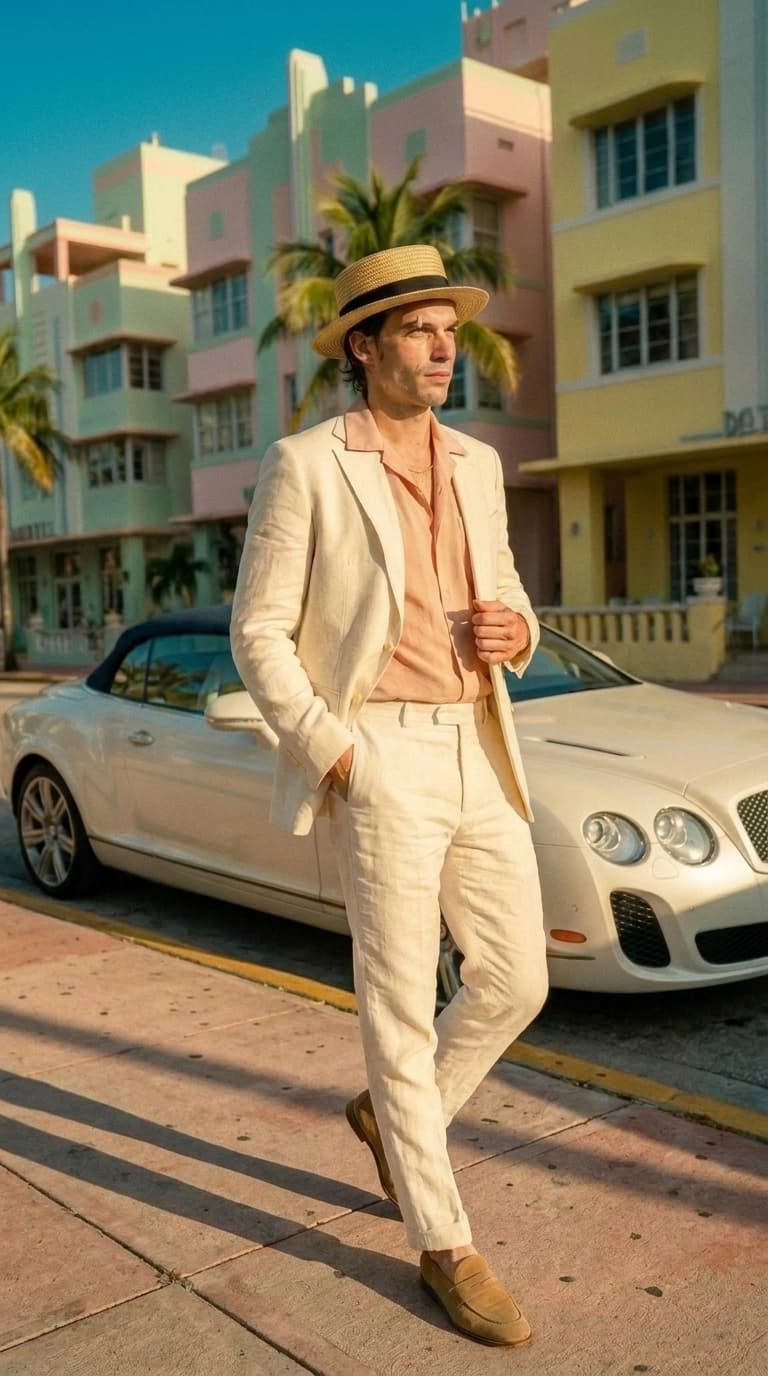
Last, I swapped the walk for a pose: "instead of mid stride make him just pose there confidently". His top half nailed it, one hand on his lapel, chin up. His legs still look like they're mid step, but I let it go.
Exact prompt
Create a new photorealistic image. This is a frame from a feature film shot on this same present-day Miami Beach Art Deco sidewalk — not a composite. The man now stands still in a confident pose instead of walking; everything else is preserved from the first reference. Editorial fashion photography, unretouched, no beauty filter, no skin smoothing. THE VIBE: Tarantino-style cinema in modern-day Miami — cool, swaggering, sun-drenched, deadpan. He owns the sidewalk: utterly self-assured, a second before a gust steals his hat. IDENTITY LOCK: Preserve the man with the long lean editorial face, sharp cheekbones, dark grown-out hair falling under the brim and light stubble, from the first reference. Do NOT change his face or hair. THE SUBJECT: He stands still on the sidewalk, body angled three-quarters toward the camera, weight sunk onto his back leg with the front knee relaxed and that foot turned slightly out; hips cocked. His left hand rests in his trouser pocket, pushing the jacket open; his right hand loosely holds the lapel of his open jacket at chest height. Shoulders back, chin lifted slightly, head turned a touch to frame-right, gazing coolly off down the street with a faint, self-satisfied half-smile. He wears exactly the same outfit as the first reference: the natural golden straw boater with the black band sitting straight on his head, the ivory-white linen suit, the pale salmon-pink silk camp-collar shirt open at the neck with the thin gold chain, and the tan suede loafers with no socks. No makeup. THE FACE: Real, unretouched skin with fine visible texture, faint pores, slightly uneven natural tone, a faint sun flush. Mostly matte. Minimal natural makeup: bare skin, no foundation, no contour, no highlighter. THE SETTING (LOCKED): The same clean present-day Ocean Drive sidewalk as the first reference — the same pastel mint, pink and lemon Art Deco facades and palms, the same white modern convertible parked at the curb behind him. Clean pale concrete, no debris. Do NOT reimagine this environment. THE LIGHT (LOCKED): The same low late-afternoon sun from frame-right as the first reference — hard warm light on the right side of his face, the boater brim and the linen; the brim's crisp shadow across his brow; his long shadow falling to frame-left across the sidewalk. Same warm, saturated cinematic film grade. THE COMPOSITION: Same framing as the first reference — he stands left of centre, full figure, with the boater in the same place and open sky above and to the right of it. His feet sit above the bottom 10% of the frame. THE CAMERA: Same camera and lens as the first reference. Real film texture: heavy visible film grain across the whole frame including the face and skin, warm halation around bright highlights. Not an iPhone photo, not digital. No text, no logos, no car badges, no readable signage anywhere. looks like a real fashion model photographed on location in a feature film, not a render.
8. Remake the end frame with the new hat
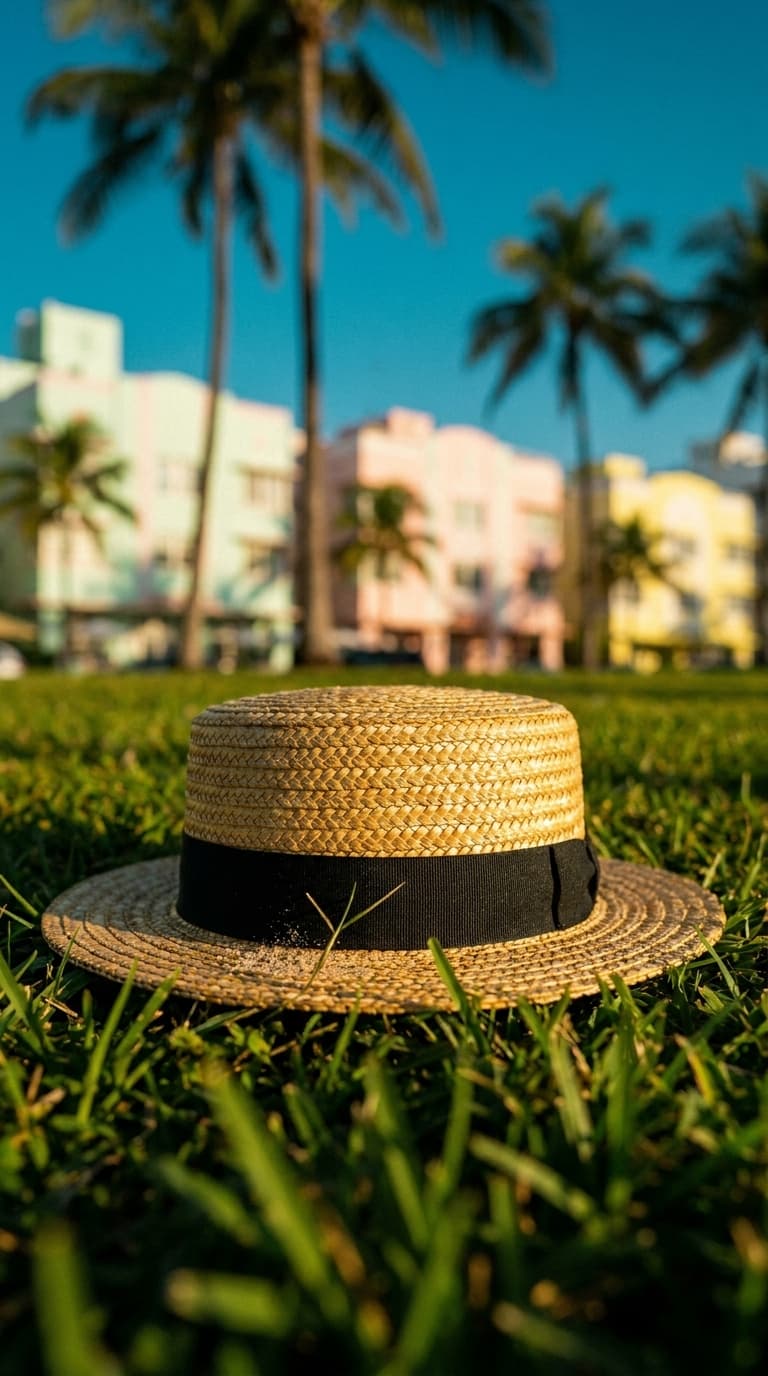
Same idea as before, the boater sitting upright in the grass at ground level. This time the park is the beachfront one across the street, so you can see the pastel hotels and palm trees blurred behind it.
Exact prompt
Create a new photorealistic image. This is a close-up frame from a feature film, shot at ground level in a present-day Miami Beach oceanfront park from the start — not a composite, not a phone photo. Rebuild the scene as if shot natively here on film, with unified lighting across the hat and the environment. THE VIBE: Tarantino-style cinema in modern-day Miami — the deadpan payoff after a long chase. The runaway straw boater has finally come to rest in the grass, sitting there smugly, as if waiting. Still, quiet, mock-heroic. THE SUBJECT: The natural golden straw boater with the black grosgrain band, from the first reference — use ONLY the hat from the first reference; no person, no car, no street in this frame. A stiff boater: a flat round crown and a flat, perfectly round rigid brim. It rests upright, crown up, flat on its brim in the grass, tilted very slightly toward the camera, the band facing us. The woven straw is crisp and tactile, every strand of the tight weave visible, a little sand dust and two blades of grass caught on the brim from rolling across the park. THE SETTING: A present-day Miami Beach oceanfront park in late afternoon: a lush, clipped green lawn with a few fallen palm fronds' small pieces far in the background only, a sandy-white winding path. Behind, thrown far out of focus: tall slender palms, and beyond them the soft pastel shapes of Art Deco hotels — mint, flamingo pink, lemon — and the deep cyan sky. Foreground: a few out-of-focus grass blades right in front of the lens, partly occluding the bottom edge. No people, no text, no signage, no logos. THE LIGHT: Late-afternoon Florida sun, low and raking from behind the hat to frame-right — the ONLY light. A warm golden rim glows along the top edge of the crown and the brim edge, the straw strands catching and glowing where the light passes through the weave; the front of the hat in soft warm shade lifted by green-gold bounce from the sunlit grass; the hat throws a long shadow toward the camera and to frame-left across the grass. Backlit grass blades glow translucent. No lens flare, no visible sun disc. THE KEY DETAILS: The texture of the woven straw and the ribbed black band; the grass pressed down slightly under the brim; dust motes floating in the low sunlight. No text, no logos, no label. THE MOOD: The final shot of a sun-drenched crime-comedy chase — mock-heroic, deadpan. The same composition and mood as the second reference, now with the boater in a Miami park. Warm, saturated cinematic film grade: golden-amber light, deep cyan sky, candy pastels in the bokeh, the golden straw glowing. THE COMPOSITION: Vertical close-up from ground level, matching the second reference. The hat sits in the lower-middle of the frame, centred, filling about half the frame width, its crown top about 48% down from the top of the frame and its brim base about 70% down. Above it, soft blurred palms, pastel deco shapes and cyan sky; below it, out-of-focus foreground grass. Nothing touching the frame edges. THE CAMERA: Cinematic feature-film capture — the lens almost resting on the grass, looking slightly up at the hat for a heroic, monumental presence. Shallow depth of field: the hat's band and brim tack sharp, foreground grass and background melting into soft warm bokeh. Real film texture: heavy visible film grain across the whole frame, warm halation around the rim-lit edges, gentle edge falloff. Not an iPhone photo, not digital. No text, no logos, no readable signage anywhere. Every element feels tactile and present, like a real frame from a feature film, not a render.
9. Run it again, faster and with sound
Same structure as step 5 with two changes. I said "i want the hat to fly away fast not in slow motion", so the prompt says real time speed and no slow motion anywhere. And I wanted sound effects only, no music, so I listed the sounds I wanted: the gust, his loafers slapping the pavement, the straw scraping over asphalt, seagulls, the surf.
This time the hat rolls down the road on its brim like a wheel, and it's gone off his head in about a second. It lands on the end frame again.
And listen, it's not perfect. When the hat flies off, his slicked back hair turns into a big curly mop. He's also missing from the first street shot, so it's just the hat rolling until he lunges in. Next time I'll add a line saying his hair stays exactly the same after the hat comes off.
Exact prompt
Create a new video, a crime-comedy film sequence in present-day Miami Beach with three hard cuts, all at real-time speed — NO slow motion anywhere. A sharply dressed man in an ivory linen suit, salmon silk shirt and a golden straw boater stands confidently on a sunny Art Deco sidewalk when a sudden, violent gust rips the boater off his head and whips it out of frame in an instant. Hard cut: he sprints down the middle of Ocean Drive chasing the boater as it rolls fast along the asphalt on the edge of its round brim like a runaway wheel, always just out of reach. Hard cut: he chases it across the grass of the palm-lined oceanfront park, the boater still rolling ahead of him. The final shot is a ground-level close-up of the boater coming to rest upright in the grass. Warm, saturated cinematic film look — golden late-afternoon sun, deep cyan sky, candy-pastel deco hotels, film grain, deadpan Tarantino-style energy. Same man, same suit, same straw boater in every shot. AUDIO: Diegetic sound effects only — absolutely NO music, no score, no soundtrack, no singing, no dialogue, no voiceover. Sounds: the sharp whoosh of a sudden gust of wind, the hat snapping off his head, his startled breath, fast footsteps of leather loafers slapping on concrete and asphalt, the rattling scrape of the straw brim rolling over asphalt, a passing car, distant seagulls and ocean surf, his heavy breathing as he runs, soft thuds of feet on grass, the hat's rustle as it settles in the grass, then quiet with gentle wind and surf. [SCENE 1] THE STARTING FRAME: the man standing on the sidewalk, one hand in his pocket, the other gripping his jacket lapel, chin up, gazing off down the street, the boater on his head. Video animates FROM this position. He holds the confident pose for a brief beat. Then, at full real-time speed, a sharp gust snaps through the street — the boater is ripped straight off his head and flung fast up and out of the top-right of the frame in a split second, no slow motion. His hair whips, his hand flies up a beat too late, his cool expression collapses into shock. [SCENE 2] HARD CUT to a low-angle shot in the middle of sunny Ocean Drive, pastel deco hotels and palms lining the street: the boater rolls fast along the asphalt on the edge of its rigid round brim like a wheel, wobbling, heading toward the lens. Behind it the man sprints flat-out after it, linen jacket flapping, arm reaching, running forward naturally — NOT backward, not sliding. The frame tracks backward low to the ground just ahead of the rolling hat. [SCENE 3] He lunges and grabs at it; the boater bounces off the curb and keeps rolling away from his fingertips. He stumbles, recovers, keeps sprinting. [SCENE 4] HARD CUT to the sunny oceanfront park — clipped green lawn, tall palms, the pastel hotels behind. The boater rolls fast across the grass on its brim, the man still sprinting after it in the background, out of breath, suit dishevelled. [SCENE 5] HARD CUT to a ground-level close-up: the boater rolls into frame through the grass, wobbles in a tight circle, and settles flat and upright on its brim in the grass. Stillness. Palms and pastel deco shapes soft in the background, golden light. Hold on the hat — the frame is locked; no camera movement. The boater is always the same pale golden straw boater with a black band — one hat, never duplicated. No text, no logos, no readable signs, no license plates, no car badges.
Why it works
Giving the video both a start frame and an end frame meant I only had to describe the middle. Both runs cut at the three places I wrote "HARD CUT" and both landed on my last shot, so the whole little story came out of one prompt and I didn't have to stitch three clips together.
The hat swap is the part I'd steal. I picked the fedora because it fit the look, and I didn't think about whether it could roll until I watched it hop down the street.
Your turn: look at the one object your ad is about and ask yourself if it can physically do what you need it to do on camera.
And if you want help planning the cuts, Emero writes the scene by scene prompt for you and keeps your character and props the same from chat to chat, at cost.

Get one of these every day
I test new workflows daily and send them with the exact prompts, the models and the costs
5,979 generations tested so far
More workflows
See all
Nano Banana Pro + MiniMax H3 - a 10 second hat chase ad from a start and end frame
A man chases his runaway hat across three locations in one 10 second clip with hard cuts
Nano Banana Pro, MiniMax H3 · 23 min render
Nano Banana Pro + Kling 3.0 - a rooster hands over a cap in one clean move
A Gallic rooster struts into a white studio and hands a man a white cap in one clean move
Nano Banana Pro, Kling 3.0 · 8 min render
Nano Banana Pro vs GPT Image 2.5 Flare - one street ad keyframe in 12 tries
Fixing the light and the subject distance on one street ad frame across 12 tries
Nano Banana Pro, GPT Image 2.5 Flare, MiniMax H3 · 8 min render