Nano Banana Pro vs GPT Image 2.5 Flare - one street ad keyframe in 12 tries
Fixing the light and the subject distance on one street ad frame across 12 tries
 Tested by Nouamane Benbrahim
Disclaimer: This is an independent creative test made with AI, for demonstration only. It isn't an ad for any brand shown or named, and isn't affiliated with, sponsored or endorsed by them. All trademarks belong to their owners
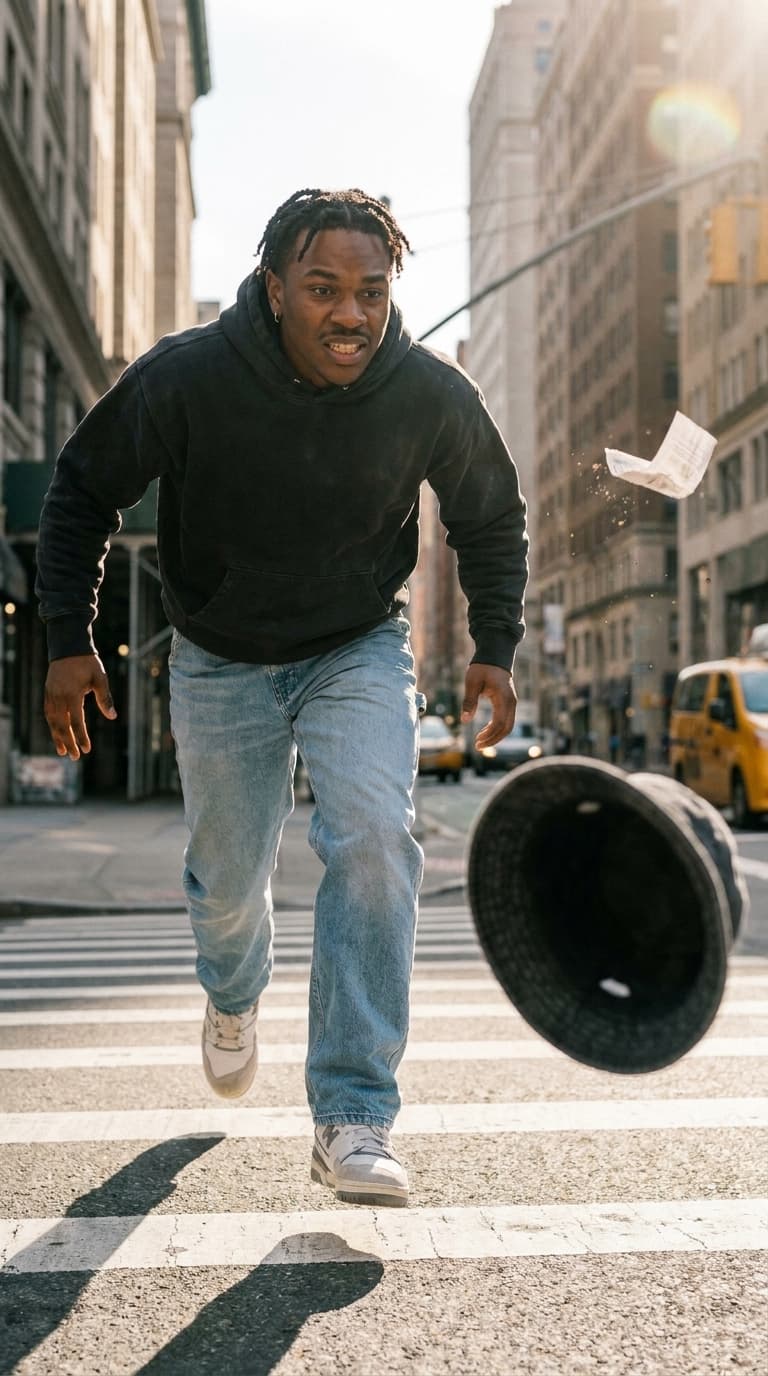
How many tries does one good AI keyframe take? For this one it took me 12.
I was making the opening frame for a 9:16 ad about a guy chasing his hat down the street. Reels have to open on motion, so the first frame is him mid-chase. Two things kept going wrong: the light and how far away he was. Each image shows which model made it.
Here's my exact process, including everything that broke.
1. My first frame missed the vibe
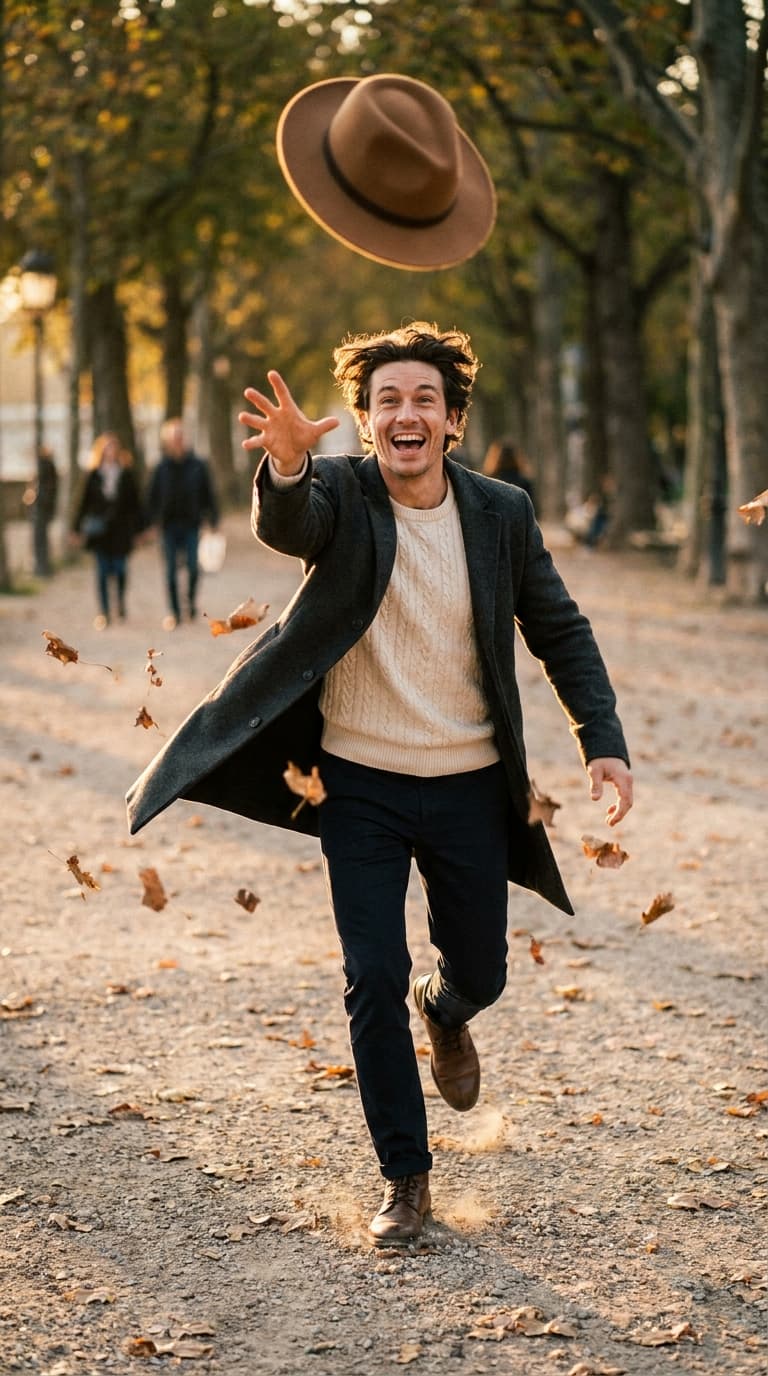
My first frame came back as a guy chasing his fedora through a park at golden hour, like a sweet autumn movie poster. Worse, the hat sits straight above his head and he's grinning at the camera, so it reads like he tossed it on purpose.
I wanted streetwear, so I told the agent "should feel like a streetwear ad style".
Exact prompt
Create a new photorealistic image. This is a photograph taken on a tree-lined park promenade at golden hour from the start — a single frame caught mid-action. Editorial fashion photography, unretouched, no beauty filter, no skin smoothing. THE VIBE: A gust has just stolen his hat and he is losing the race to it — playful, breathless, slightly absurd, the warm romance of an autumn afternoon underneath the comedy. Pure momentum: everything in the frame is moving. IDENTITY LOCK: The man is about 30, light olive skin with a warm neutral undertone, short dark-brown hair with a slight wave pushed back and wind-tousled, dark-brown eyes, a defined jaw with short even dark stubble, straight brows, lean athletic build. THE SUBJECT: The man is sprinting mid-stride toward camera on a slight diagonal, his left foot fully airborne behind him, right foot striking the path, torso leaning forward, his right arm stretched up and forward reaching for the hat, fingers spread, his left arm swinging back for balance. Expression: wide-eyed, mouth half-open in a breathless half-laugh of disbelief, eyes locked up on the hat, not on the camera. He wears the open charcoal-grey wool overcoat flaring out behind him in the wind, the cream cable-knit crewneck sweater, slim dark-navy trousers, and brown leather lace-up boots. Minimal natural look: bare skin, no makeup. THE FACE: Real, unretouched skin with fine visible texture, faint pores across the nose and cheeks, slightly uneven natural tone, and a few tiny imperfections. Mostly matte — natural shine only faintly on the nose tip and centre of the forehead. Strands of hair lifted by the wind with a few flyaways. THE SETTING: A long gravel promenade in a city park in late October, lined both sides by old plane trees with orange and yellow leaves, black wrought-iron lamp posts and a weathered green wooden bench along the edge; drifts of fallen leaves along the path borders, some scuffed by footsteps. Dry leaves swirl through the air in the same gust carrying the hat. A couple of distant blurred passersby far down the path. Not a clean, empty showroom park — a real, used one. THE LIGHT: Low golden-hour sun behind and to the right of the man, raking down the promenade: a warm amber rim along his hair, shoulder and the edge of the flaring coat; his front in soft shade lifted only by warm bounce from the gravel; his long shadow falling toward the camera across the path. The hat is backlit, its felt brim edged with a thin glowing rim. Airborne leaves glow translucent where the sun passes through them. Sun is the ONLY light — no studio fill; his contrast, black level and warm grade match the scene exactly. THE KEY DETAILS: The hat — a camel-brown wool felt fedora with a dark-brown grosgrain band — tumbling through the air tilted on its side, about two metres ahead of his reaching fingertips and slightly above them, in the upper-middle of the frame, close to the lens. Gravel kicked up behind his back boot. Leaves whipping past in the gust. No text, no logos, no signage anywhere. THE MOOD: The opening beat of a warm, witty romantic-comedy commercial — kinetic, light-hearted, golden. Warm-nostalgic grade, amber highlights, soft teal-green in the deep shadows under the trees. THE COMPOSITION: Vertical frame. The hat sits in the upper-middle of the frame, around 30% down from the top, a little right of centre, large and close. The man is centred slightly left below it, his full figure from head to boots filling about 60% of the frame height, his head roughly 40% down from the top, boots above the bottom 15% of the frame. The promenade and tree lines converge behind him as leading lines toward the low sun. Nothing critical at the far right edge. Dynamic diagonal composition built as frame 1 of a video — everything mid-motion. THE CAMERA: Cinematic commercial capture, low angle from about hip height, a 35mm-equivalent lens, moderately shallow depth of field — the man sharp, the hat just crisp, the background trees and passersby softly defocused, gentle light falloff at the frame edges. Spielberg-style warm wonder and kinetic energy. Fine natural film grain across the whole frame, including the face and skin. THE AFTER EFFECT: Slight motion blur on his trailing hand, the swinging coat hem and the swirling leaves; his face and the hat stay sharp. looks like a real actor photographed on location, not a render.
2. Restyle it as streetwear
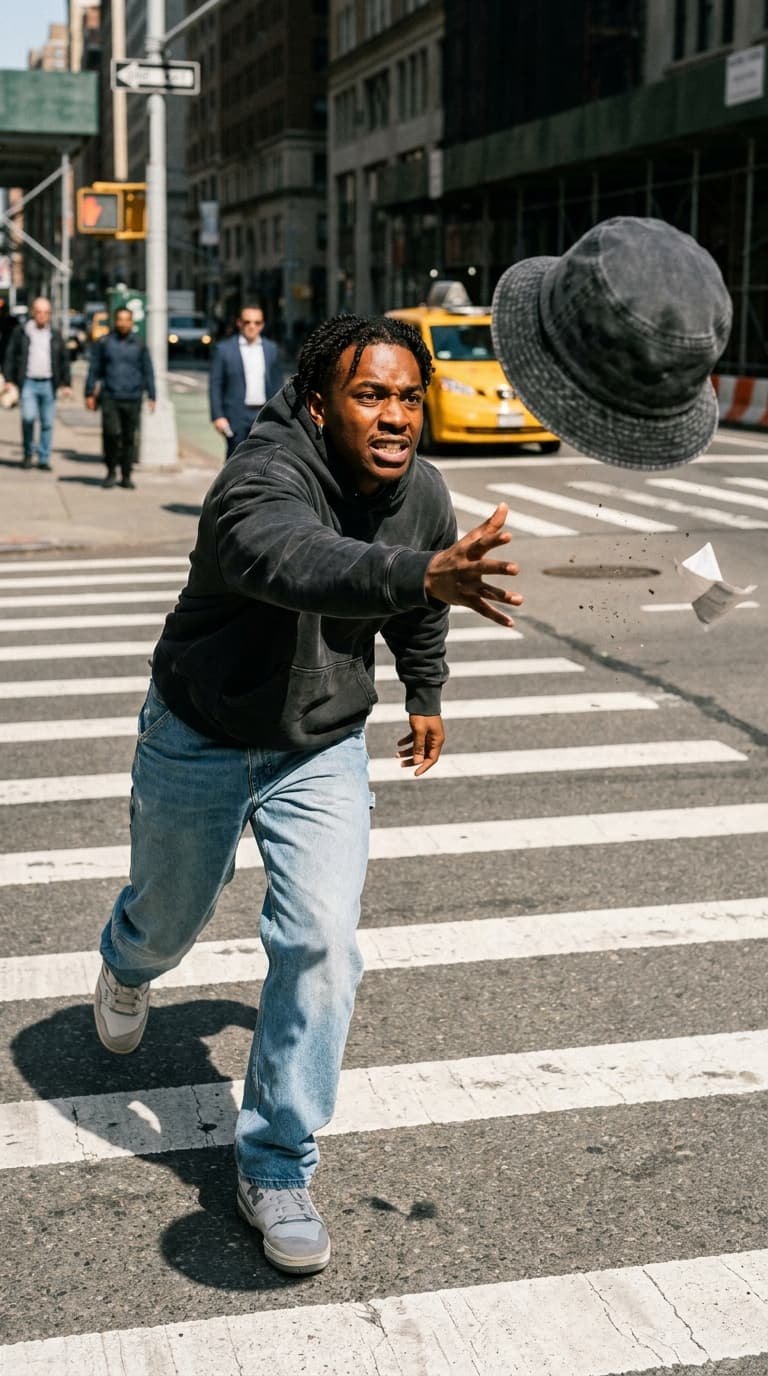
New guy, new everything: washed black hoodie, light wash carpenter jeans, chunky sneakers, a downtown crosswalk with a yellow cab, hard midday sun.
The chase finally read. His eyes are locked on the hat and his hand is just short of it. But my reaction was "camera looks like iphone. it's meant to look like a tv ad".
Exact prompt
Create a new photorealistic image. This is a photograph taken on a city street crosswalk at midday from the start — a single frame caught mid-action. Editorial fashion photography, unretouched, no beauty filter, no skin smoothing. THE VIBE: A streetwear campaign shot with raw, kinetic swagger — a gust has ripped his hat off and he is flat-out sprinting after it through the street. Urgent, loud, a little ridiculous, all attitude. The hat is clearly escaping him; he is losing the race. IDENTITY LOCK: The man is about 24, deep brown skin with a warm red-copper undertone, short twists about two inches long, dark-brown eyes, a thin moustache and light chin stubble, a small silver hoop in his left ear, slim athletic build. THE SUBJECT: The man sprints hard toward camera on a diagonal from frame-left, mid-stride with his back foot fully off the ground and his front sneaker striking the asphalt, torso pitched forward, his right arm stretched out ahead toward the hat with fingers splayed, still well short of it, his left arm pumping back. His eyes are locked up and forward on the hat, never on the camera; brows pulled up, jaw clenched, mouth tight in a strained, desperate grimace of effort. He wears the oversized boxy washed-black heavyweight hoodie with no print, the baggy faded light-blue carpenter jeans stacking over his shoes, the chunky white-and-grey leather sneakers, and a thin silver chain bouncing out of the hoodie collar. No logos or text on any garment. No makeup. THE FACE: Real, unretouched skin with fine visible texture, faint pores across the nose and cheeks, slightly uneven natural tone, and a few tiny imperfections. Mostly matte — natural shine only faintly on the nose tip and centre of the forehead. His deep brown skin keeps its warm red-copper undertone depth and warmth in the shadows, never ashy or grey. THE SETTING: A gritty downtown intersection: faded, cracked white crosswalk stripes on worn dark asphalt, a steel manhole cover, a puddle-stain by the curb, a row of pre-war brick and concrete buildings with fire escapes behind, a yellow taxi-coloured car blurred at the far edge of the frame, a couple of pedestrians far back on the corner. All signage blank or unreadable. Not a clean, staged street — a real, used one. THE LIGHT: Hard direct midday sun high and to the right of camera — crisp, deep, hard-edged shadows; his shadow falls short and sharp to frame-left on the crosswalk stripes. The hat casts its own small hard shadow on the asphalt below it. Strong specular highlights on his cheekbones and the sneaker leather. The sun is the ONLY light — no studio fill; his contrast and black level match the street exactly. Punchy-saturated grade, deep inky blacks, slightly cool shadows. THE KEY DETAILS: The hat — a washed-black cotton bucket hat with no logo — spinning through the air tilted on its edge, about two metres ahead of his reaching fingertips, out toward the camera and to frame-right, unmistakably out of his reach. A loose sheet of paper and grit whipping across the street in the same gust. No text, no logos, no brand names anywhere. THE MOOD: A loud, confident streetwear lookbook-meets-campaign frame — the energy of a skate-video opener. Punchy-saturated, high contrast. THE COMPOSITION: Vertical frame. The hat is large and close to the lens in the right half of the frame, its centre about 35% down from the top and not touching the right edge. The man is in the left-centre behind it, full figure from head to sneakers filling about 55% of the frame height, the top of his head about 30% down from the top, his sneakers above the bottom 18% of the frame. The crosswalk stripes run diagonally across the lower frame as leading lines toward him. Dynamic diagonal composition built as frame 1 of a video — everything mid-motion. THE CAMERA: Cinematic streetwear capture: low angle from knee height, a wide 24mm-equivalent lens exaggerating depth so the hat looms large in the foreground and he charges up through the frame, deep focus with both hat and runner sharp, slight wide-angle distortion at the edges. Spike Jonze skate-video energy. Fine natural film grain across the whole frame, including the face and skin. THE AFTER EFFECT: Slight motion blur on his trailing arm, the hoodie hem and the flying paper; his face and the hat stay sharp. looks like a real model photographed on location, not a render.
3. Make it look like a TV ad
The fix was all camera words. I dropped the camera to knee height looking up, asked for a wide cinema lens and a shallow focus, and put a low late sun behind him with a soft flare and a warm and teal grade.
That did it. It looks like a crew shot it. Two problems though: his arms dropped to his sides so he's not really chasing anymore, and the sun felt like way too much.
Exact prompt
Create a new photorealistic image. This is a frame from a high-end national TV commercial, shot on a city street crosswalk from the start — not a composite, not a phone photo. Rebuild the entire scene as if shot natively here by a professional film crew, with unified lighting across subject and environment. Editorial fashion photography, unretouched, no beauty filter, no skin smoothing. THE VIBE: A big-budget streetwear brand spot — polished, cinematic, expensive-looking, but with raw kinetic swagger. A gust has ripped his bucket hat off and he is flat-out sprinting after it; the hat is escaping him. Urgent, a little ridiculous, all attitude. IDENTITY LOCK: Preserve the young man with short twists, deep brown skin and a thin moustache, from the first reference. Do NOT source face, hair or outfit from anywhere else. He wears the same washed-black oversized hoodie, baggy light-wash carpenter jeans and chunky grey-and-white sneakers, from the first reference. He is relit entirely by this scene's light. THE SUBJECT: He is in a true full-speed sprint toward camera on a diagonal from frame-left — BOTH feet off the ground at the peak of the stride, front knee driving high, back leg extended behind, torso pitched forward, right arm stretched out toward the hat with fingers splayed and still well short of it, left arm pumping back. Eyes locked up and forward on the hat, never on the camera; brows up, jaw clenched, a strained, desperate grimace. Hoodie and jeans rippling with the speed. No makeup. THE FACE: Real, unretouched skin with fine visible texture, faint pores across the nose and cheeks, slightly uneven natural tone, a few tiny imperfections. Mostly matte — natural shine only faintly on the nose tip and centre of the forehead. His deep brown skin keeps its warm red-copper undertone depth and warmth in the shadows, never ashy or grey. THE SETTING: The same gritty downtown crosswalk: worn white stripes on dark asphalt, brick and concrete buildings with fire escapes, a yellow taxi and a few pedestrians far behind — all melted into soft creamy background blur. All signage blank and unreadable, no traffic signals readable. THE LIGHT: Hard, low-ish late-afternoon sun from behind him and to frame-right: a bright warm rim carving his shoulders, twists and outstretched arm; his front lifted by soft warm bounce off the pale crosswalk; his long shadow falling toward the camera. Gentle anamorphic-style lens flare streak from the sun at the top right. The sun is the ONLY light; his contrast and black level match the scene. Polished commercial grade: rich teal shadows, warm skin and highlights, deep clean blacks, controlled highlights. THE KEY DETAILS: The hat — the washed-black denim bucket hat — spinning through the air on its edge, very close to the lens at frame-right, large in the foreground, about two metres ahead of his fingertips, unmistakably out of reach, slightly soft at its far edge. A sheet of paper and grit whipping through the frame. No text, no logos, no brand names anywhere. THE MOOD: The opening shot of a premium streetwear TV commercial — glossy, cinematic, confident. THE COMPOSITION: Vertical frame. The hat dominates the right-centre foreground, its centre about 38% down from the top, not touching the right edge. The runner is left-centre behind it, full figure from head to sneakers filling about 55% of the frame height, top of his head about 28% down from the top, his lowest foot above the bottom 20% of the frame. Crosswalk stripes converge diagonally toward him. Built as frame 1 of a moving shot. THE CAMERA: Cinematic commercial capture — low angle from knee height, a wide 24mm-equivalent cinema lens close to the hat so it looms in the foreground and he charges up through frame. Shallow depth of field: the runner tack sharp, the background buildings and cab in soft creamy bokeh, the nearest edge of the hat falling slightly soft. Gentle light falloff and subtle vignette at the frame edges, cinematic lens character, slight anamorphic flare. Spike Jonze commercial energy with the polish of a big-brand spot. Fine natural film grain across the whole frame, including the face and skin. Not an iPhone photo — no deep focus, no flat phone processing. THE AFTER EFFECT: Slight motion blur on his trailing arm, the hoodie hem and the flying paper; his face and the hat stay crisp. looks like a real model filmed on location for a TV commercial, not a render.
Quick thing I noticed at this point. Three frames in, every single one was sunny, and I never asked for sun once. The agent kept picking it for me. So now I decide the light myself before anything else.
4. Try a second model
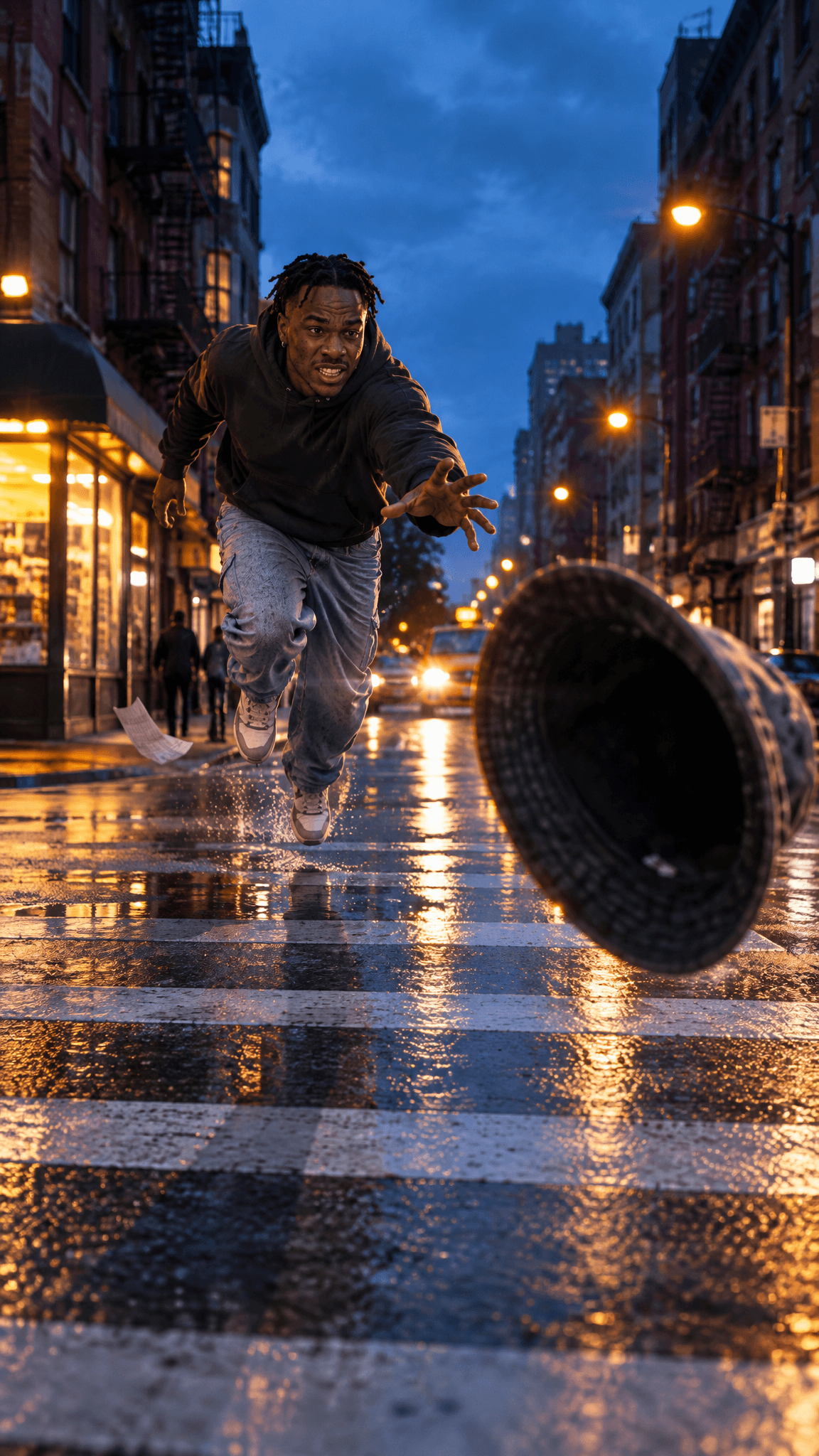
I gave the frame to the second model and asked for blue hour instead: a rain wet street, a lit corner shop on one side and taxi headlights behind him.
It nailed the pose. Arm fully out, eyes on the hat, the hat huge right by the lens. But the whole image came out over processed, crunchy and gritty, like a heavy HDR filter. Honestly it was so bad I went straight back to the first model.
Exact prompt
Create a new photorealistic image. This is a frame from a high-end national TV commercial, shot on a downtown city crosswalk at blue hour from the start — not a composite, not a phone photo. Rebuild the entire scene as if shot natively here by a professional film crew, with unified lighting across subject and environment. Editorial fashion photography, unretouched, no beauty filter, no skin smoothing. THE VIBE: A premium streetwear brand spot — glossy, cinematic, expensive, with raw kinetic swagger. A gust has ripped his bucket hat off and it is escaping toward the camera; he is sprinting flat-out after it, losing the race. Urgent, a little ridiculous, all attitude, with the electric hush of a city just after sunset. IDENTITY LOCK: Preserve the young man with short twists, deep brown skin, thin moustache and small earring, from the first reference. Do NOT source face, hair or outfit from anywhere else. He wears the same washed-black oversized hoodie, baggy light-wash carpenter jeans and chunky grey-and-white sneakers, from the first reference. He is relit entirely by this scene's blue-hour and practical light; the reference's sunlight is discarded completely. THE SUBJECT: He is in a full-speed sprint toward the camera, deep down the street — both feet off the ground at the peak of the stride, front knee driving up, back leg extended, torso pitched forward. His right arm is stretched far out ahead reaching for the hat, fingers splayed, nowhere near it; his left arm pumps back. His eyes are locked on the hat, never on the camera; brows up, jaw clenched, a strained, desperate grimace. Hoodie and jeans rippling with speed. No makeup. THE FACE: Real, unretouched skin with fine visible texture, faint pores across the nose and cheeks, slightly uneven natural tone, a few tiny imperfections. Mostly matte. His deep brown skin keeps its warm red-copper undertone depth and warmth in the shadows, never ashy or grey. THE SETTING: A downtown street of pre-war brick and stone buildings with fire escapes, just after sunset. The asphalt and crosswalk stripes are rain-wet from an earlier shower, holding long glossy reflections of the lights. A lit corner bodega shopfront on frame-left, a row of streetlamps receding down the block, a yellow taxi stopped far behind him with its headlights on. A couple of pedestrians far back, silhouetted. All signage blank and unreadable, no logos. THE LIGHT: Four bounded sources and darkness between them. (1) The deep cobalt blue-hour sky above the buildings — the soft cool ambient fill on everything. (2) The warm tungsten glow from the bodega shopfront at frame-left — his KEY light, wrapping warm amber across the left side of his face, hoodie and outstretched arm. (3) The taxi headlights behind him — a crisp bright rim on his twists, shoulders and the edges of his jeans, and his shadow stretching toward the camera across the wet street. (4) Sodium-orange streetlamps down the block. His right side falls into cool blue shadow. The same warm and cool colours reflect in the wet asphalt beneath him and on the hat. No sun anywhere, no studio fill. Exposed for the practicals; he sits slightly under, lit only where the shopfront and headlights hit. Commercial grade: deep blues and teals against warm amber, clean deep blacks, controlled highlights. THE KEY DETAILS: The hat — the washed-black denim bucket hat — tumbling on its edge VERY close to the lens in the right-centre foreground, large, filling about a fifth of the frame width, slightly soft at its nearest edge, its brim catching a warm glint from the shopfront. It is clearly several metres ahead of his fingertips. A sheet of paper and fine spray kicking up from the wet street behind his sneakers. No text, no logos, no brand names anywhere. THE MOOD: The opening shot of a premium streetwear TV commercial — glossy, moody, kinetic, with a romantic city-at-dusk undertone. THE COMPOSITION: Vertical frame. The hat dominates the near right-centre foreground, its centre about 40% down from the top, not touching the right edge. The man is far behind it in the centre-left, deep down the street: his full figure from head to sneakers fills about one third of the frame height, the top of his head about 35% down from the top, his feet about 68% down. A wide stretch of glossy wet crosswalk fills the lower frame between him and the camera. The receding streetlamps and building lines converge toward him. THE CAMERA: Cinematic commercial capture — low angle from knee height, a wide 24mm-equivalent cinema lens close to the hat so it looms huge in the foreground while he is small and far behind. Shallow-to-moderate depth of field: the runner sharp, the hat crisp with its nearest edge just soft, background lights blooming into soft round bokeh. Gentle light falloff and subtle vignette at the frame edges, cinematic lens character, subtle anamorphic streak on the headlights. Spike Jonze commercial energy with big-brand polish. Fine natural film grain across the whole frame, including the face and skin. Not an iPhone photo. THE AFTER EFFECT: Slight motion blur on his trailing arm, the hoodie hem, the flying paper and the spray; his face and the hat stay crisp. looks like a real model filmed on location for a TV commercial, not a render.
5. Kill the sun
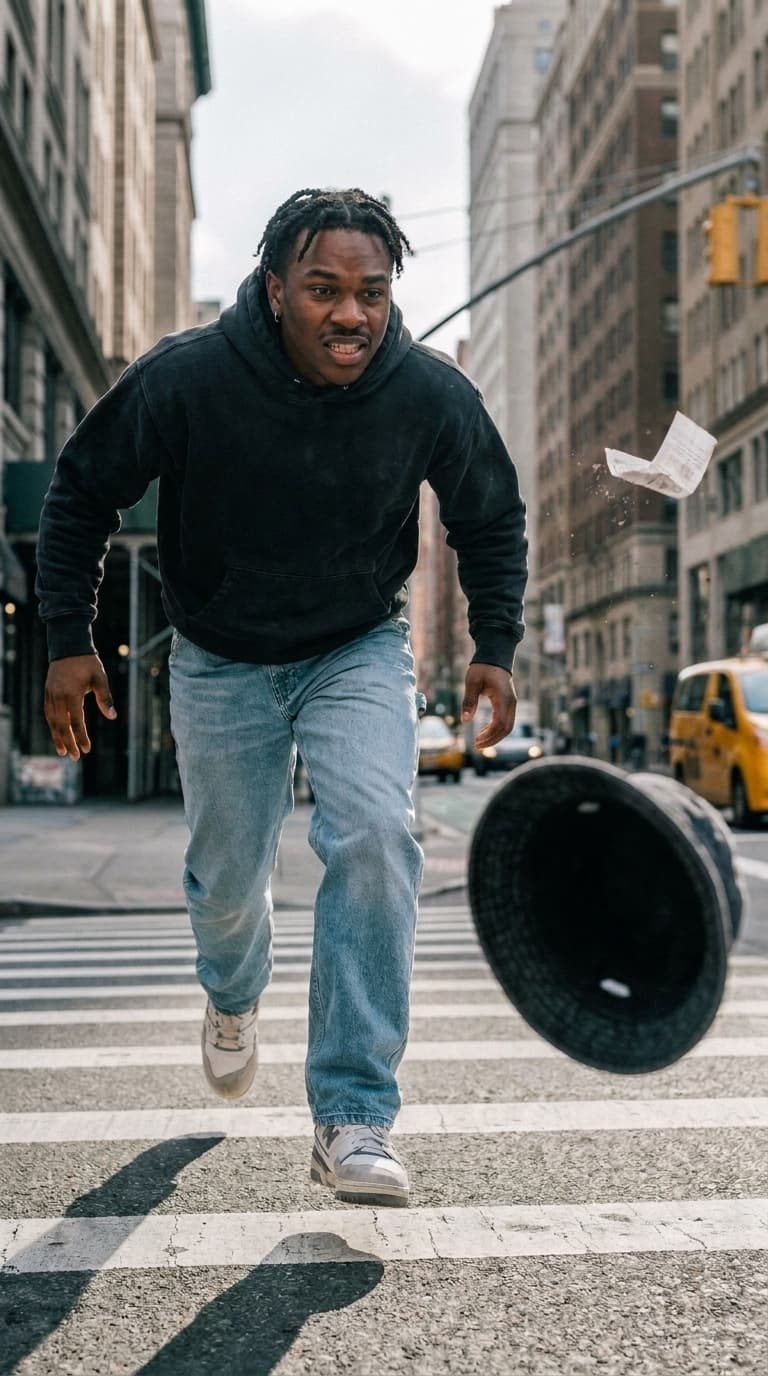
Back on the first model, I took the TV ad frame and asked for a bright overcast sky as the only light. I wrote "NO sun visible, NO lens flare, NO sun rim, NO hard shadows" right at the top, then described a flat grey sky and a cool grade with the yellow cab and the blue denim as the only color.
This was the one. The flat grey sky made the whole thing feel cooler and way more streetwear.
One thing to watch for: the hard shadows under his legs carried over from the sunny version. Overcast light wouldn't cast those, so if you look closely it gives the edit away.
Exact prompt
Create a new photorealistic image, but with soft overcast daylight instead of sunlight. Preserve the young man with short twists, deep brown skin, thin moustache and small earring, his washed-black oversized hoodie, baggy light-wash carpenter jeans and chunky grey-and-white sneakers, his sprinting pose, the camera angle, framing and the street, from the first reference. Editorial fashion photography, unretouched, no beauty filter, no skin smoothing. NO sun visible, NO lens flare, NO sun rim, NO hard shadows, NO golden warm glow. THE VIBE: A premium streetwear TV commercial — polished, cinematic, graphic, cool-toned. A gust has ripped his bucket hat off and he is sprinting after it as it tumbles toward the camera. IDENTITY LOCK: Preserve the young man, from the first reference. Do NOT source face, hair, skin or outfit from anywhere else. THE SUBJECT (UNCHANGED): Same airborne sprint toward camera, same wardrobe, same position and size in frame as the first reference. No makeup. THE FACE: Real, unretouched skin with fine visible texture, faint pores across the nose and cheeks, slightly uneven natural tone, a few tiny imperfections. Mostly matte. His deep brown skin keeps its warm red-copper undertone depth and warmth in the shadows, never ashy or grey. THE SETTING (LOCKED): The same downtown crosswalk, the same brick and stone buildings, the same traffic signal, the same yellow taxi at frame-right, the same flying paper, the same washed-black bucket hat tumbling large in the right foreground. Do NOT reimagine this environment. THE LIGHT: A thick, bright overcast sky is the ONLY light — a huge soft white-grey softbox overhead. Soft, even, directional-from-above light: gentle modelling on his face and the hoodie folds, soft diffuse shadows pooling beneath him and the hat on the asphalt, no hard edges. The sky above the buildings is a flat pale grey with no sun spot. His contrast, black level and grade match the scene. Cool, slightly desaturated commercial grade: neutral-cool greys and concrete tones, the yellow taxi and the blue denim as the colour accents, his skin kept warm and rich, deep clean blacks in the hoodie. THE MOOD: A cool, confident streetwear campaign opener — graphic and moody rather than golden. THE CAMERA: Same low knee-height angle and wide cinema lens as the first reference. Cinematic commercial capture, shallow depth of field with the background buildings and cab in soft cinematic blur, gentle edge falloff and subtle vignette, fine natural film grain across the whole frame including the face. Not an iPhone photo. No text, no logos, no readable signage anywhere. looks like a real model filmed on location for a TV commercial, not a render.
6. Move him further away (it didn't)
Now I wanted him further down the street with the hat close to the lens, so there's a real gap to chase across.
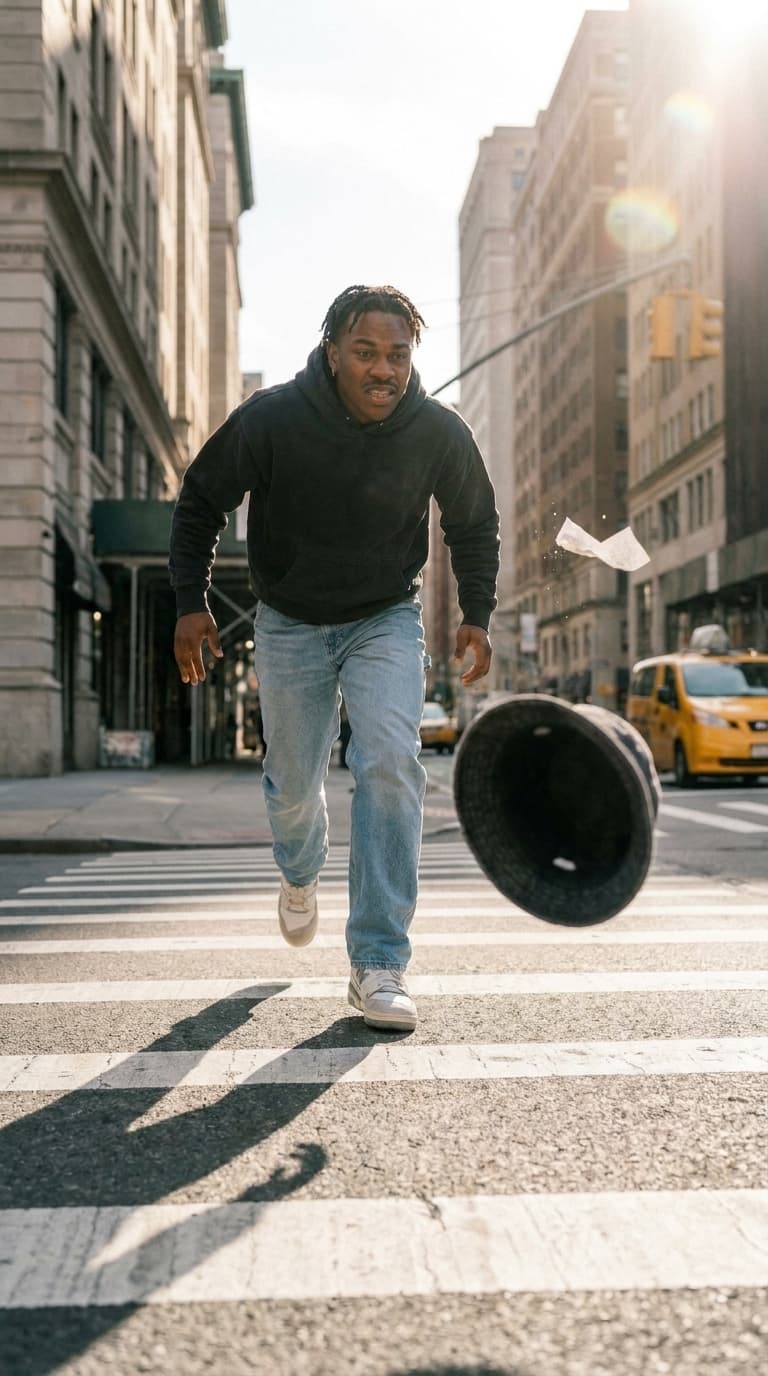
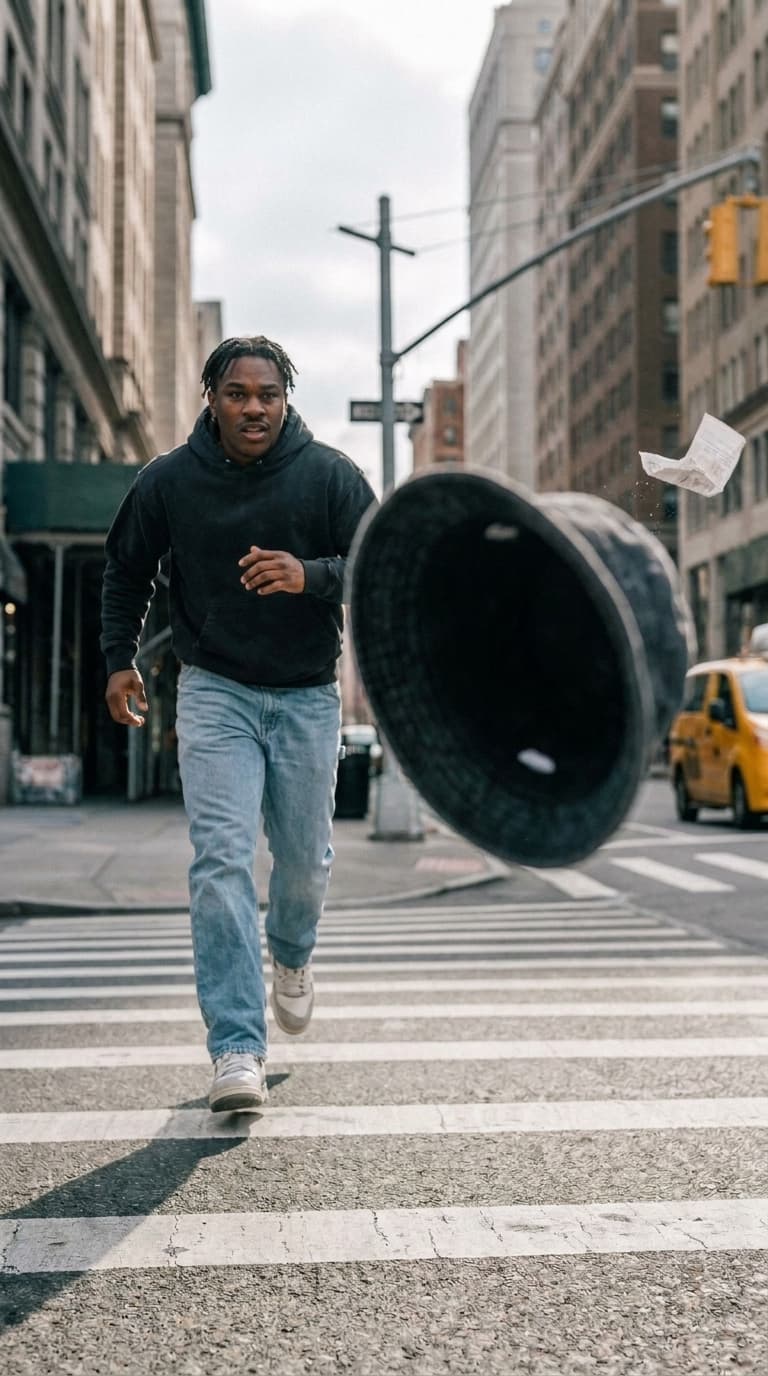
Across the next few frames I asked for him further away four times, and only one of them really worked. On the first try the hat even shrank back down with him and ended up next to his hand. On the second try the hat stayed big but he stayed big too, so it looked like a giant hat floating next to him.
My guess, and it's only a guess, is that editing the previous image holds onto his size. Every one of these frames was an edit of the last one.
Exact prompt
Create a new photorealistic image, but the running man appears further away from the camera, deeper down the street. This is a frame from a high-end national TV commercial, shot natively on a city crosswalk — not a composite, not a phone photo. Editorial fashion photography, unretouched, no beauty filter, no skin smoothing. THE VIBE: A big-budget streetwear brand spot — polished, cinematic, expensive-looking, with raw kinetic swagger. A gust has ripped his bucket hat off and he is sprinting after it; the hat is escaping toward the camera, far ahead of him. THE CHARACTER ANCHOR: Preserve the young man with short twists, deep brown skin, thin moustache and small earring, from the first reference — same washed-black oversized hoodie, baggy light-wash carpenter jeans and chunky grey-and-white sneakers. Do NOT source face, hair or outfit from anywhere else. THE ITERATION ANCHOR: Carry forward from the second reference exactly — the low knee-height camera angle, the wide cinema lens, the backlit late-afternoon sun from upper frame-right with its warm rim on his twists and shoulders and the lens flare top-right, the long shadows falling toward camera across the crosswalk stripes, the downtown buildings, the yellow taxi at frame-right, the flying paper, the warm-highlight / teal-shadow commercial grade, his airborne sprinting stride, and the washed-black bucket hat tumbling large and close to the lens in the right foreground. THE NEW CHANGE: The man is now much further down the street — roughly twice as far from the camera. His full figure, head to sneakers, fills only about 30% of the frame height, the top of his head about 38% down from the top of the frame, his feet about 68% down, standing on the crosswalk with plenty of street visible in front of him. The hat stays large and close in the foreground, so the gap between him and the hat reads as several metres — clearly out of reach. More crosswalk stripes and street surface visible in the lower frame. Background buildings and cab in soft cinematic blur; he stays sharp. THE FACE: Real, unretouched skin with fine visible texture, mostly matte. His deep brown skin keeps its warm red-copper undertone depth and warmth in the shadows, never ashy or grey. Minimal natural look, no makeup. THE CAMERA: Cinematic commercial capture, shallow depth of field, gentle edge falloff and subtle vignette, cinematic lens character, fine natural film grain across the whole frame including the face. Not an iPhone photo. No text, no logos, no readable signage anywhere. looks like a real model filmed on location for a TV commercial, not a render.
Exact prompt
Create a new photorealistic image, but the running man is much further away down the street while the hat stays huge and close to the lens. This is a frame from a high-end streetwear TV commercial, shot natively on this downtown crosswalk — not a composite, not a phone photo. Editorial fashion photography, unretouched, no beauty filter, no skin smoothing. NO sun, NO lens flare, NO hard-edged shadows. THE VIBE: A premium streetwear TV commercial — polished, cinematic, graphic, cool-toned. A gust has ripped his bucket hat off; the hat is tumbling toward the camera, far ahead of him, and he is sprinting after it, losing the race. IDENTITY LOCK: Preserve the young man with short twists, deep brown skin, thin moustache and small earring, in the washed-black oversized hoodie, baggy light-wash carpenter jeans and chunky grey-and-white sneakers, from the first reference. Do NOT source face, hair, skin or outfit from anywhere else. THE SUBJECT: Same mid-sprint stride toward camera as the first reference, torso pitched forward. No makeup. THE FACE: Real, unretouched skin with fine visible texture, mostly matte. His deep brown skin keeps its warm red-copper undertone depth and warmth in the shadows, never ashy or grey. THE SETTING (LOCKED): The same downtown crosswalk, brick and stone buildings, traffic signal, yellow taxi and flying paper as the first reference. Do NOT reimagine this environment. THE LIGHT (LOCKED): The same bright overcast sky as the first reference — the only light, a huge soft white-grey softbox overhead. Shadows beneath him and the hat are soft, diffuse pools directly under them, no long hard-edged shadows. Same cool, slightly desaturated commercial grade, skin kept warm and rich. THE KEY DETAILS: The washed-black denim bucket hat stays EXACTLY as large and close to the lens as in the first reference, tumbling in the right-centre foreground, its centre about 55% down from the top, pulled slightly inward so it does not touch the right edge. Do NOT shrink the hat or move it back with him. THE COMPOSITION: The man is now far down the street, about three times further from the camera than in the first reference. His full figure from head to sneakers fills only about 25% of the frame height, centred-left, the top of his head about 40% down from the top of the frame, his feet about 65% down. A long open stretch of crosswalk stripes fills the lower frame between him and the camera. The hat in the foreground is now much larger than he is — the gap between them reads as many metres, clearly out of reach. Open grey sky and building tops fill the upper frame. THE CAMERA: Same low knee-height angle and wide cinema lens as the first reference, focused on him, background buildings and cab in soft cinematic blur, hat crisp with its nearest edge just soft. Gentle edge falloff and subtle vignette, fine natural film grain across the whole frame including the face. Not an iPhone photo. No text, no logos, no readable signage anywhere. looks like a real model filmed on location for a TV commercial, not a render.
7. Go wide, then fix the hat size
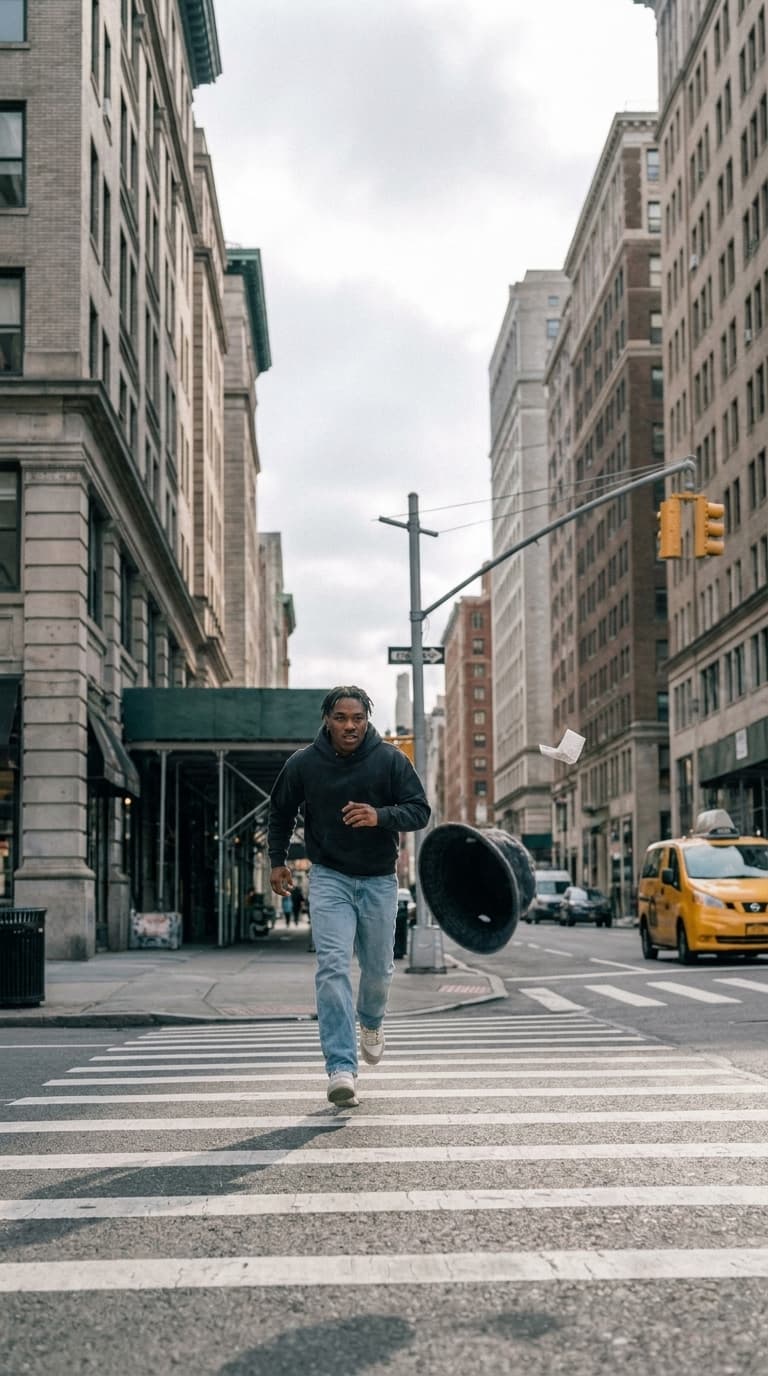
So I asked for "him and the hat further away" instead. The whole shot went wide: tall buildings on both sides, him small in the middle of the street. But the hat came out the size of his torso.
For the next frame I also swapped him for a guy in a tuxedo chasing a classic felt hat, which sets up the ending I have planned. This time I spelled out the size: the hat at real, true to life size for its distance, no larger than his head. That fixed it on the first try.
Exact prompt
Create a new photorealistic image, but in a much wider shot: the man AND the hat are both far from the camera, small in a big city frame. This is a wide establishing frame from a high-end streetwear TV commercial, shot natively on this downtown crosswalk — not a composite, not a phone photo. Editorial fashion photography, unretouched, no beauty filter, no skin smoothing. NO sun, NO lens flare, NO hard-edged shadows. THE VIBE: A premium streetwear TV commercial — polished, cinematic, graphic, cool-toned. A gust has ripped his bucket hat off and he is sprinting after it down the middle of the street; the hat is tumbling just ahead of him, out of reach. The scale of the city makes the chase feel bigger and funnier. IDENTITY LOCK: Preserve the young man with short twists, deep brown skin, thin moustache and small earring, in the washed-black oversized hoodie, baggy light-wash carpenter jeans and chunky grey-and-white sneakers, from the first reference. Do NOT source face, hair, skin or outfit from anywhere else. THE SUBJECT: Same sprint toward camera as the first reference, torso pitched forward. No makeup. THE FACE: Real, unretouched skin, mostly matte. His deep brown skin keeps its warm red-copper undertone depth, never ashy or grey. THE SETTING (LOCKED): The same downtown street as the first reference — the same brick and stone buildings on both sides, traffic signal, yellow taxi, crosswalk stripes, flying paper. Seen wider, so more of the street, the building facades and the grey sky are visible. Do NOT reimagine this environment. THE LIGHT (LOCKED): The same bright overcast sky as the first reference — the only light, a huge soft white-grey softbox overhead. Shadows beneath him and the hat are soft diffuse pools directly under them, no long hard-edged shadows. Same cool, slightly desaturated commercial grade, skin warm and rich. THE KEY DETAILS: The washed-black denim bucket hat is now SMALL and far from the camera, tumbling in mid-air about two metres ahead of him and slightly to his right, at roughly his chest height — the same distance from the camera as him, not near the lens. Clearly out of his reach. No text, no logos. THE COMPOSITION: Wide vertical frame. The man is far down the street, centred, his full figure from head to sneakers filling about 22% of the frame height — the top of his head about 45% down from the top of the frame, his feet about 67% down. The hat floats just ahead of him, small, around 50% down. A long empty stretch of crosswalk and asphalt fills the lower third between them and the camera; the buildings rise on both sides and the grey sky fills the top of the frame, the street lines converging toward him. THE CAMERA: Low angle from knee height, wide cinema lens, deep-enough focus that both he and the hat are sharp, background softening slightly with distance. Gentle edge falloff and subtle vignette, fine natural film grain across the whole frame. Not an iPhone photo. No text, no logos, no readable signage anywhere. looks like a real model filmed on location for a TV commercial, not a render.
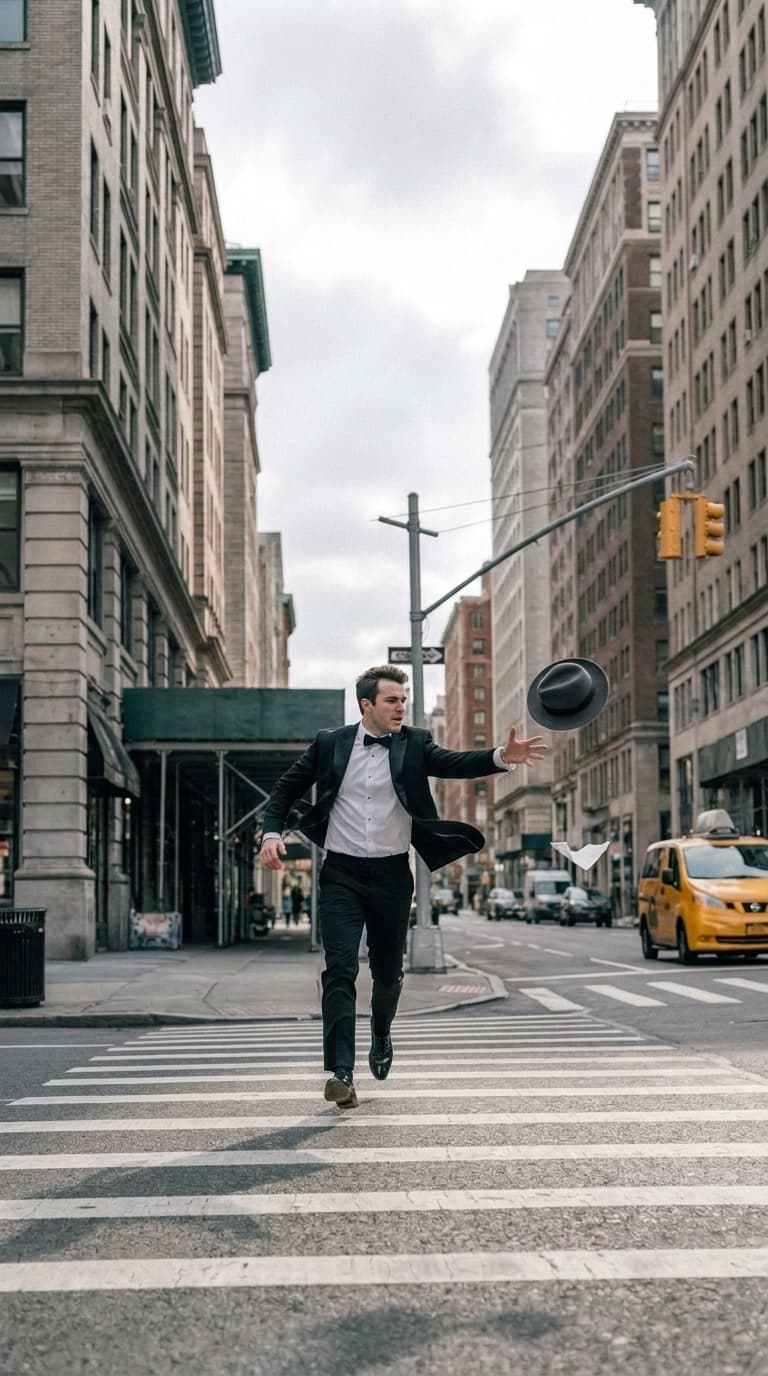
Exact prompt
Create a new photorealistic image. This is a wide frame from a high-end national TV commercial, shot natively on this downtown crosswalk from the start — not a composite, not a phone photo. Use the first reference ONLY for the street, the camera position, the wide framing and the overcast light — do NOT source the person, face, hair, skin or outfit from it. Editorial fashion photography, unretouched, no beauty filter, no skin smoothing. NO sun, NO lens flare, NO hard-edged shadows. THE VIBE: A premium TV commercial with comic momentum — a sharply dressed man in a tuxedo, clearly on his way somewhere important, is running all-out down the middle of a city street after his hat, which a gust has just stolen. Elegant and ridiculous at once; total commitment, zero dignity left. IDENTITY LOCK: The man is about 30, white, fair skin with a neutral-warm undertone, short dark-brown hair neatly side-parted but now wind-mussed, a clean-shaven defined jaw, light-blue-grey eyes, straight brows, a lean athletic build. THE SUBJECT: He is in the middle of an intense, full-speed sprint toward the camera — both feet fully off the ground at the peak of the stride, front knee driving high, back leg kicked far out behind him, torso pitched hard forward, his right arm stretched as far forward as it will go reaching for the hat, fingers splayed, his left arm flung back. Head craned forward, eyes locked on the hat, mouth open, brows up — strained, desperate effort. He wears the classic black tuxedo: a single-breasted black dinner jacket with satin peak lapels flapping open behind him, a crisp white pleated dress shirt, a black satin bow tie knocked slightly crooked, black tuxedo trousers with a satin side stripe, and polished black patent oxford shoes. A white pocket square. The jacket tails and trousers rippling with the speed. No makeup. THE FACE: Real, unretouched skin with fine visible texture, faint pores, slightly uneven natural tone, a faint natural flush on the cheeks and nose from the exertion. Mostly matte. Hair strands lifted by the wind. THE SETTING (LOCKED): The same downtown street as the first reference — the same pre-war brick and stone buildings on both sides, scaffolding shed at left, traffic signal on its pole, a yellow taxi at frame-right, the crosswalk stripes, a sheet of paper flying in the gust. All signage blank and unreadable, NO car badges or logos. THE LIGHT (LOCKED): The same bright overcast sky as the first reference — the only light, a huge soft white-grey softbox overhead. Soft even light with gentle modelling on his face and the satin lapels catching a soft grey sheen; soft diffuse shadow pooling under him and the hat. Same cool, slightly desaturated commercial grade, the yellow taxi and the white shirt as the brightest accents, the tuxedo a deep clean black. THE KEY DETAILS: The hat — a classic charcoal-grey wool felt fedora with a pinched crown and a black grosgrain band — tumbling in mid-air at REAL, true-to-life size for its distance, about two metres ahead of his outstretched fingertips toward the camera, at about his head height, clearly out of reach. It is a normal-sized hat, no larger than his head. No text, no logos. THE MOOD: The opening of a witty premium TV spot — cool grey city, black-tie elegance, slapstick urgency. THE COMPOSITION: The same wide vertical frame as the first reference. The man is far down the street, centred, his full figure from head to shoes filling about 30% of the frame height — the top of his head about 45% down from the top of the frame, his lowest point about 73% down. The small hat floats just ahead of him and above his reaching hand. The street lines converge toward him, buildings rise on both sides, grey sky fills the top. Open crosswalk in the lower frame. THE CAMERA: Low angle from knee height, wide cinema lens, focus on him and the hat, background softening slightly with distance. Gentle edge falloff and subtle vignette, fine natural film grain across the whole frame including the face. Not an iPhone photo. THE AFTER EFFECT: Slight motion blur on his flung-back arm, the flapping jacket and the paper; his face and the hat stay crisp. No text, no logos, no readable signage anywhere. looks like a real actor filmed on location for a TV commercial, not a render.
8. Put the hat in front of him
In that last frame he's reaching sideways for the hat, so there's nothing to close in on. I said "hat should be in front and he should be a bit further away".
The hat moved in front of him and came out a little bigger than his head, so you read it as closer to the camera. He came out a bit closer though, not further.
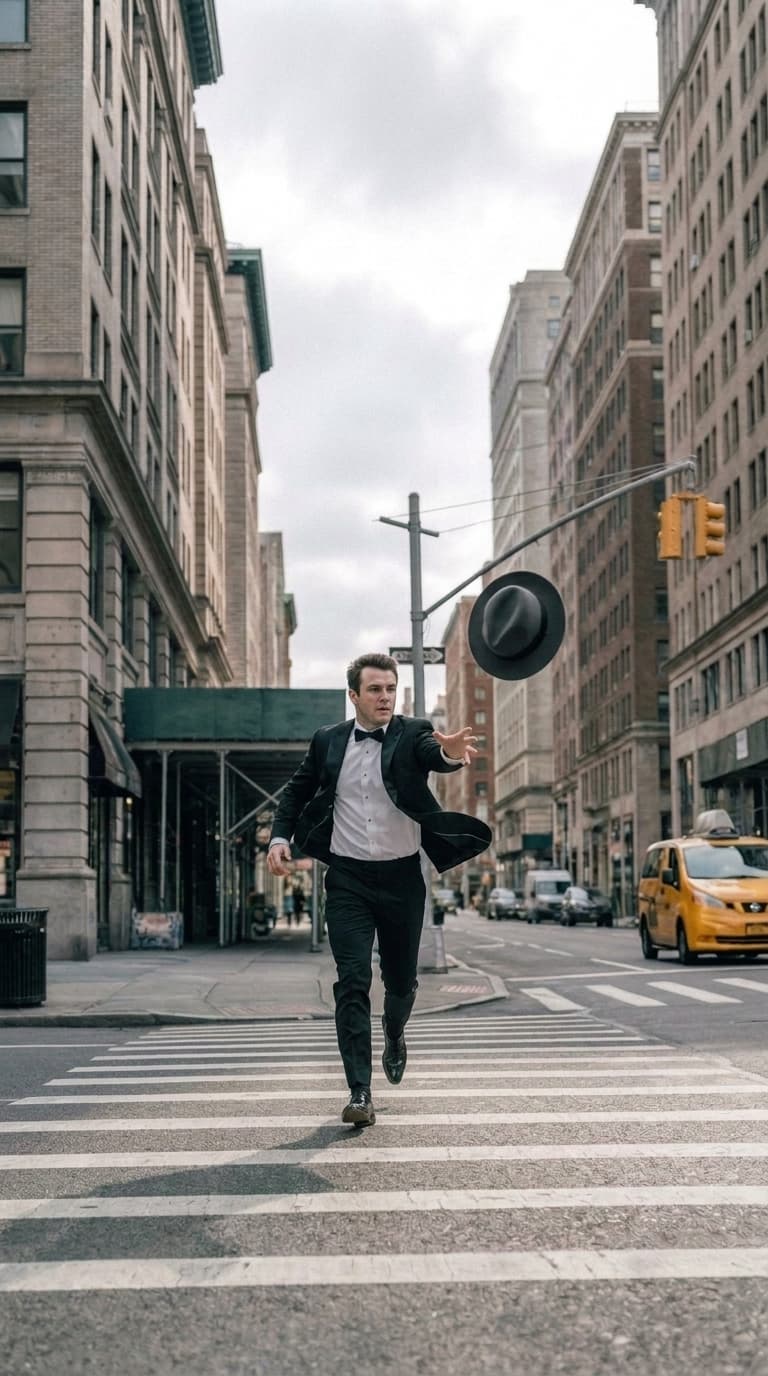
Exact prompt
Create a new photorealistic image, but the man is a bit further away down the street and the hat is now in front of him, between him and the camera. This is a wide frame from a high-end national TV commercial, shot natively on this downtown crosswalk — not a composite, not a phone photo. Editorial fashion photography, unretouched, no beauty filter, no skin smoothing. NO sun, NO lens flare, NO hard-edged shadows. THE VIBE: A premium TV commercial with comic momentum — a man in a tuxedo running down the middle of a city street after his hat, which a gust is carrying toward the camera ahead of him. Elegant and ridiculous at once. IDENTITY LOCK: Preserve the white man with short dark side-parted hair in the black tuxedo — satin peak-lapel dinner jacket flapping open, white dress shirt, black bow tie, black trousers, black patent shoes — from the first reference. Do NOT source face, hair or outfit from anywhere else. THE SUBJECT: Running toward the camera, his right arm reaching forward toward the hat ahead of him, eyes locked on it. No makeup. THE FACE: Real, unretouched skin with fine visible texture, mostly matte, a faint natural flush from the exertion. THE SETTING (LOCKED): The same downtown street as the first reference — the same brick and stone buildings, scaffolding shed at left, traffic signal, yellow taxi at frame-right, crosswalk stripes, flying paper. All signage blank and unreadable, NO car badges or logos. Do NOT reimagine this environment. THE LIGHT (LOCKED): The same bright overcast sky as the first reference — the only light, soft and even from above, soft diffuse shadow pooling under him. Same cool, slightly desaturated commercial grade. THE KEY DETAILS: The black felt fedora with a black band is now IN FRONT of him — tumbling in mid-air about two metres closer to the camera than he is, directly ahead of him on the line between him and the lens, slightly above his head height and just off-centre to frame-right so it does not cover his face. Being closer to the camera, it appears a little larger than his head — but still a normal real-life hat, never giant. Clearly out of his reach. No text, no logos. THE COMPOSITION: The same wide vertical frame as the first reference. The man is now further down the street, centred, his full figure from head to shoes filling about 24% of the frame height — the top of his head about 47% down from the top of the frame, his lowest point about 71% down. The hat floats in front of him and above, around 43% down. The street lines converge toward him, buildings rise on both sides, grey sky fills the top, open crosswalk in the lower frame. THE CAMERA: Same low angle from knee height and wide cinema lens as the first reference, focus on him and the hat, background softening slightly with distance. Gentle edge falloff and subtle vignette, fine natural film grain across the whole frame including the face. Not an iPhone photo. THE AFTER EFFECT: Slight motion blur on his trailing arm, the flapping jacket and the paper; his face and the hat stay crisp. No text, no logos, no readable signage anywhere. looks like a real actor filmed on location for a TV commercial, not a render.
9. Try a long lens (also didn't)
I liked a street style photo shot on a long lens, with the background all soft and squashed together, so I asked for that: a long telephoto lens, a muted film grade and heavy grain.
It came back almost identical to the last frame, with the same wide lens and the same sharp street. My guess is the same as in step 6: editing the previous image held onto the original camera.
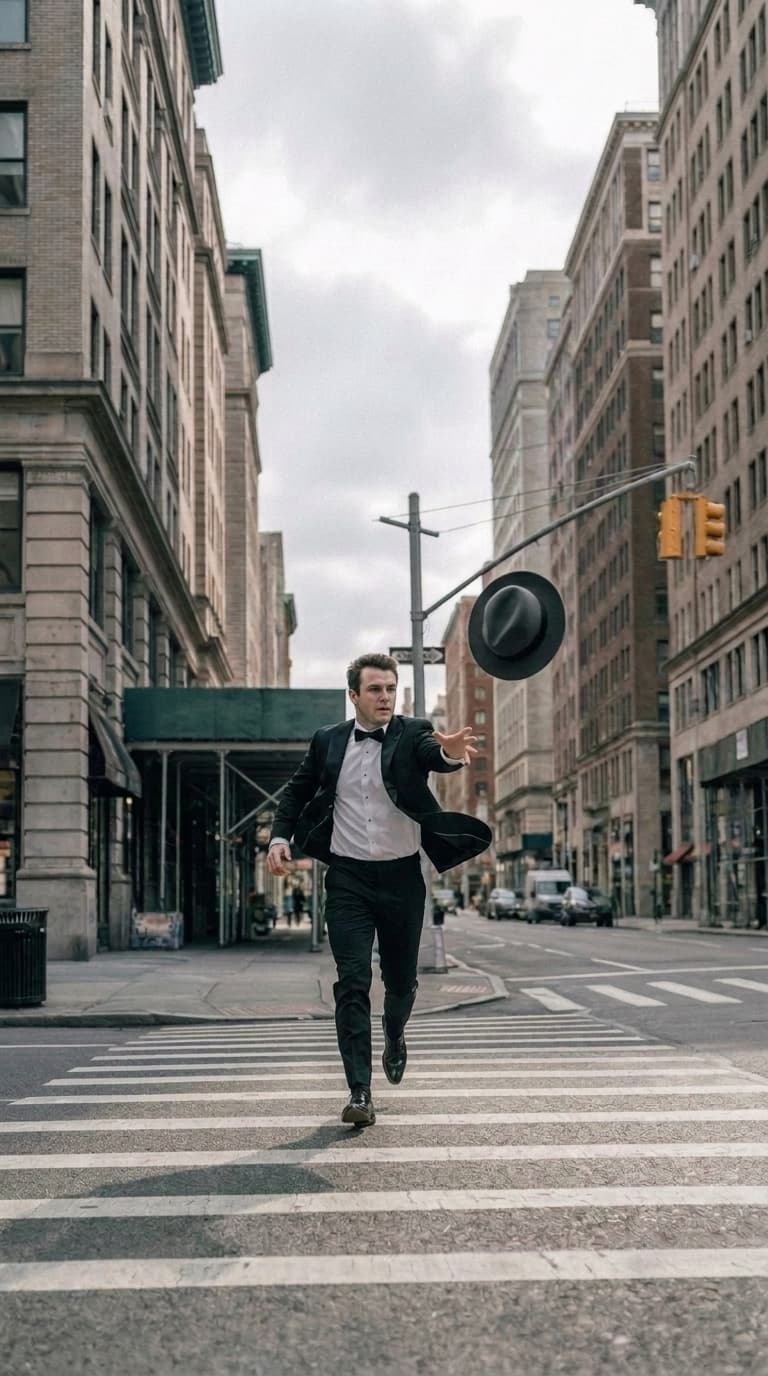
Exact prompt
Create a new photorealistic image, but re-shot with a long telephoto lens and a muted, film-like cinematic look. This is a frame from a luxury fashion commercial filmed on this city street — not a composite, not a phone photo. Editorial fashion photography, unretouched, no beauty filter, no skin smoothing. NO sun, NO lens flare, NO hard-edged shadows, NO punchy saturated colour, NO crisp digital sharpness. THE VIBE: Quiet, cool, understated luxury — the restrained, observational look of a candid long-lens street-style campaign film. Muted, soft, a little melancholic. A man in a tuxedo is running down the street after his hat, and the calm, filmic stillness of the image makes it deadpan funny. IDENTITY LOCK: Preserve the white man with short dark side-parted hair and a clean-shaven jaw, in the black tuxedo — satin peak-lapel dinner jacket, white dress shirt, black bow tie, black trousers, black patent shoes — from the first reference. Do NOT source face, hair or outfit from anywhere else. THE SUBJECT (UNCHANGED): Same position as the first reference — running toward the camera down the crosswalk, his right arm reaching forward toward the hat, eyes on it, jacket flaring open. No makeup. THE FACE: Real, unretouched skin with fine visible texture, faint pores, slightly uneven natural tone, a faint flush from running. Mostly matte. THE SETTING: The same downtown street, crosswalk and stone-and-brick buildings as the first reference — but compressed by the long lens so the buildings stack up close behind him and dissolve into soft, creamy out-of-focus shapes. No readable signage, no car badges, no logos. THE LIGHT: Flat, soft overcast daylight from a white sky — the only light. Gentle wraparound light on his face and satin lapels, soft low-contrast shadows. THE KEY DETAILS: The black felt fedora with a black band, real life-size, tumbling in the air just ahead of his reaching hand and slightly toward the camera, clearly out of reach. THE MOOD: A muted luxury fashion film — candid, restrained, cool. Colour grade: muted-desaturated, low contrast, lifted milky blacks, cool slate and stone-grey tones with a faint olive-green cast in the shadows, highlights soft and creamy, skin kept natural and warm against the cool world. THE COMPOSITION: Same framing and position of him and the hat as the first reference, keeping the top of his head below the top quarter of the frame and his shoes above the bottom fifth. THE CAMERA: Cinematic capture with a long telephoto lens (around 135mm-equivalent) from far down the street at eye level — strong background compression, very shallow depth of field: his face and the hat in focus, everything behind him melting into soft bokeh, the foreground asphalt softly out of focus. Soft, slightly diffused filmic rendering, gentle highlight halation, gentle roll-off, visible fine-to-medium film grain across the whole frame including the face. The feel of an observational long-lens fashion film, not a sharp digital still. Not an iPhone photo. THE AFTER EFFECT: Slight motion blur on his trailing hand and the flaring jacket; his face and the hat stay in focus. No text, no logos, no readable signage anywhere. looks like a real actor filmed on location for a luxury fashion commercial, not a render.
10. Let the camera move do it
At this point I stopped forcing the distance into a still and animated it instead. I asked for a 4 second clip where he sprints at the camera, the camera pulls back as he runs, and the hat tumbles toward the lens until it fills the frame.
The hat grows from small to huge across the clip and the last frame is all black felt, which gives me a clean cut into the next shot. His face drifted a bit rounder by the end though, and right before the wipe the hat reads as giant again instead of close.
Exact prompt
Create a new video where a man in a black tuxedo sprints flat-out down the middle of an overcast city street toward the viewer, chasing his black felt fedora, which a gust has torn away. The frame retreats down the street ahead of him at running pace, but the hat outruns him — tumbling end over end toward the lens, growing larger and larger until its dark felt crown fills the entire frame and blacks out the shot. Muted, soft, low-contrast luxury-commercial look, cool stone greys, fine film grain, deadpan comedy in a calm city. [SCENE 1] THE STARTING FRAME: the man mid-stride on the crosswalk, right arm reaching forward toward the fedora floating just ahead of his hand, jacket flaring open. Video animates FROM this position. He drives forward at full speed — legs pumping hard, jacket flapping, bow tie bouncing, his outstretched fingers grasping at the air just behind the hat. The view glides backward down the street at his pace, keeping him centred, the buildings sliding past on both sides. [SCENE 2] A gust lifts the fedora and it tumbles end over end toward the lens, pulling away from his fingertips. He lunges, misses, and keeps sprinting, face strained, eyes locked on it. He runs forward naturally toward the viewer, NOT backward, not sliding, not drifting. [SCENE 3] The hat rushes toward the lens, spinning, growing huge in the foreground while he shrinks behind it, still running and reaching. [SCENE 4] The fedora's dark felt crown slams right up to the lens and fills the entire frame edge to edge, the image going dark on the felt texture — a clean wipe ending the shot. The street, buildings, crosswalk and overcast light stay consistent throughout. Same man, same tuxedo, same black fedora from start to finish. No text, no logos.
Why it works
Most of these 12 tries were me fixing two things I never decided at the start: what the light is and how far he is from the camera. Once I said overcast out loud, the look clicked in one frame. The hat was the same story: it only came out normal once I wrote down its real size.
Your turn: before your next prompt, write down the time of day and how many feet your subject is from the camera.
And if you'd rather not babysit every frame like this, Emero writes the prompts for you and remembers the look you landed on for the next frame, at cost.

Get one of these every day
I test new workflows daily and send them with the exact prompts, the models and the costs
5,979 generations tested so far
More workflows
See all
GPT Image 2.5 Flare - fix one thing in an image without losing the rest
Change one detail in an AI image, like size, mood or pose, while the rest of the picture stays put
GPT Image 2.5 Flare · 2 min render

Nano Banana Pro + MiniMax H3 - a 10 second hat chase ad from a start and end frame
A man chases his runaway hat across three locations in one 10 second clip with hard cuts
Nano Banana Pro, MiniMax H3 · 23 min render
GPT Image 2.5 Flare - Gen Z slang taken literally
Turn slang like spill the tea, glazing and catfished into photos that show the words literally
GPT Image 2.5 Flare · 2 min render