Nano Banana Pro + MiniMax H3 - a 10 second hat chase ad from a start and end frame
A man chases his runaway hat across three locations in one 10 second clip with hard cuts
 Tested by Nouamane Benbrahim
Disclaimer: This is an independent creative test made with AI, for demonstration only. It isn't an ad for any brand shown or named, and isn't affiliated with, sponsored or endorsed by them. All trademarks belong to their owners
How do you get a 10 second AI clip to cut between three locations and still end exactly where you want?
I had a silly idea for an ad. A guy's hat blows off and he chases it down the street, through a park, and when he finally catches it he's down on one knee in front of a woman who thinks he's about to propose. Reels need to open on motion, so the hat had to take off in the first second. This post covers the chase. I made about 24 generations and two full 10 second runs to get there, and I'll show you what broke along the way.
Here's my exact process.
1. Make the first frame look like a TV ad
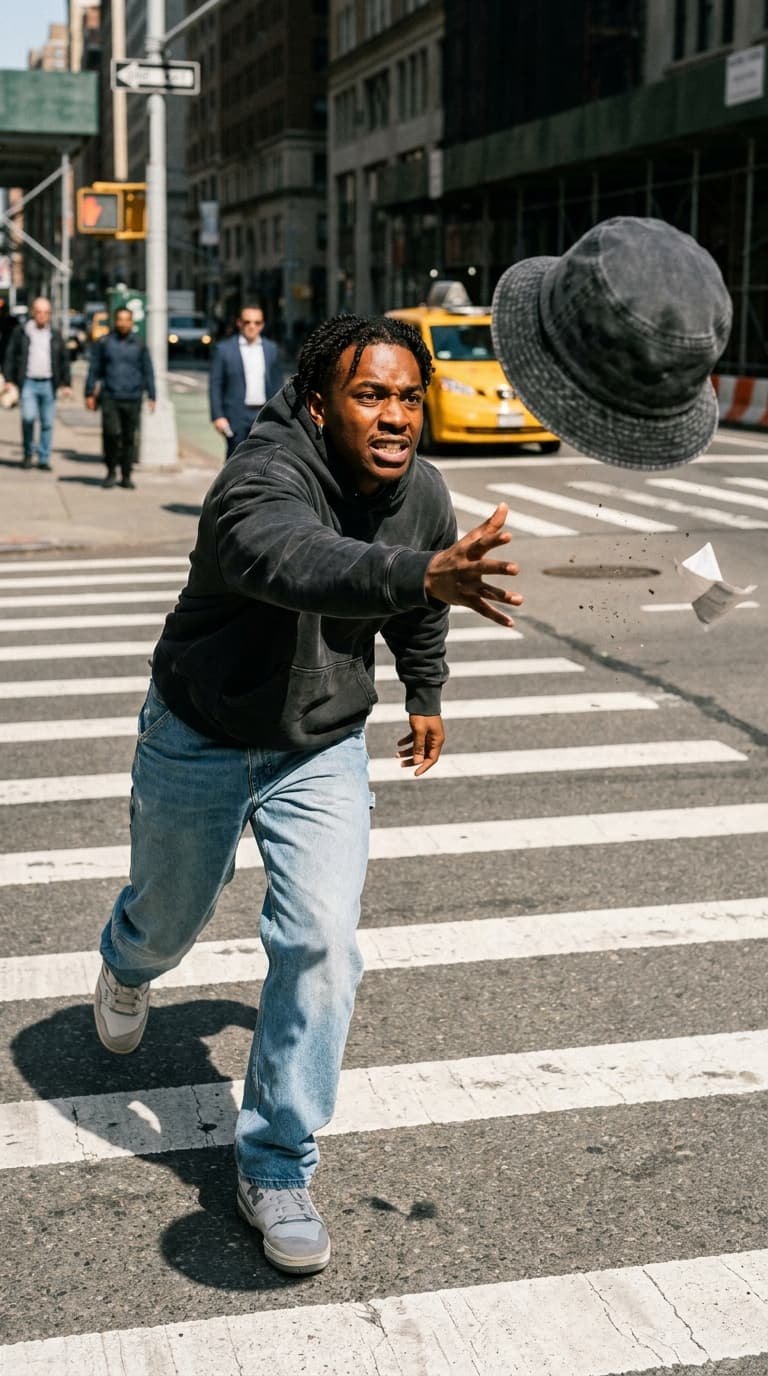
My first frame came out of a prompt alone: a guy in a hoodie and a bucket hat lunging across a crosswalk at midday.
Exact prompt
Create a new photorealistic image. This is a photograph taken on a city street crosswalk at midday from the start — a single frame caught mid-action. Editorial fashion photography, unretouched, no beauty filter, no skin smoothing. THE VIBE: A streetwear campaign shot with raw, kinetic swagger — a gust has ripped his hat off and he is flat-out sprinting after it through the street. Urgent, loud, a little ridiculous, all attitude. The hat is clearly escaping him; he is losing the race. IDENTITY LOCK: The man is about 24, deep brown skin with a warm red-copper undertone, short twists about two inches long, dark-brown eyes, a thin moustache and light chin stubble, a small silver hoop in his left ear, slim athletic build. THE SUBJECT: The man sprints hard toward camera on a diagonal from frame-left, mid-stride with his back foot fully off the ground and his front sneaker striking the asphalt, torso pitched forward, his right arm stretched out ahead toward the hat with fingers splayed, still well short of it, his left arm pumping back. His eyes are locked up and forward on the hat, never on the camera; brows pulled up, jaw clenched, mouth tight in a strained, desperate grimace of effort. He wears the oversized boxy washed-black heavyweight hoodie with no print, the baggy faded light-blue carpenter jeans stacking over his shoes, the chunky white-and-grey leather sneakers, and a thin silver chain bouncing out of the hoodie collar. No logos or text on any garment. No makeup. THE FACE: Real, unretouched skin with fine visible texture, faint pores across the nose and cheeks, slightly uneven natural tone, and a few tiny imperfections. Mostly matte — natural shine only faintly on the nose tip and centre of the forehead. His deep brown skin keeps its warm red-copper undertone depth and warmth in the shadows, never ashy or grey. THE SETTING: A gritty downtown intersection: faded, cracked white crosswalk stripes on worn dark asphalt, a steel manhole cover, a puddle-stain by the curb, a row of pre-war brick and concrete buildings with fire escapes behind, a yellow taxi-coloured car blurred at the far edge of the frame, a couple of pedestrians far back on the corner. All signage blank or unreadable. Not a clean, staged street — a real, used one. THE LIGHT: Hard direct midday sun high and to the right of camera — crisp, deep, hard-edged shadows; his shadow falls short and sharp to frame-left on the crosswalk stripes. The hat casts its own small hard shadow on the asphalt below it. Strong specular highlights on his cheekbones and the sneaker leather. The sun is the ONLY light — no studio fill; his contrast and black level match the street exactly. Punchy-saturated grade, deep inky blacks, slightly cool shadows. THE KEY DETAILS: The hat — a washed-black cotton bucket hat with no logo — spinning through the air tilted on its edge, about two metres ahead of his reaching fingertips, out toward the camera and to frame-right, unmistakably out of his reach. A loose sheet of paper and grit whipping across the street in the same gust. No text, no logos, no brand names anywhere. THE MOOD: A loud, confident streetwear lookbook-meets-campaign frame — the energy of a skate-video opener. Punchy-saturated, high contrast. THE COMPOSITION: Vertical frame. The hat is large and close to the lens in the right half of the frame, its centre about 35% down from the top and not touching the right edge. The man is in the left-centre behind it, full figure from head to sneakers filling about 55% of the frame height, the top of his head about 30% down from the top, his sneakers above the bottom 18% of the frame. The crosswalk stripes run diagonally across the lower frame as leading lines toward him. Dynamic diagonal composition built as frame 1 of a video — everything mid-motion. THE CAMERA: Cinematic streetwear capture: low angle from knee height, a wide 24mm-equivalent lens exaggerating depth so the hat looms large in the foreground and he charges up through the frame, deep focus with both hat and runner sharp, slight wide-angle distortion at the edges. Spike Jonze skate-video energy. Fine natural film grain across the whole frame, including the face and skin. THE AFTER EFFECT: Slight motion blur on his trailing arm, the hoodie hem and the flying paper; his face and the hat stay sharp. looks like a real model photographed on location, not a render.
My reaction: "camera looks like iphone. it's meant to look like a tv ad". Everything was sharp, front to back, like a phone shot.
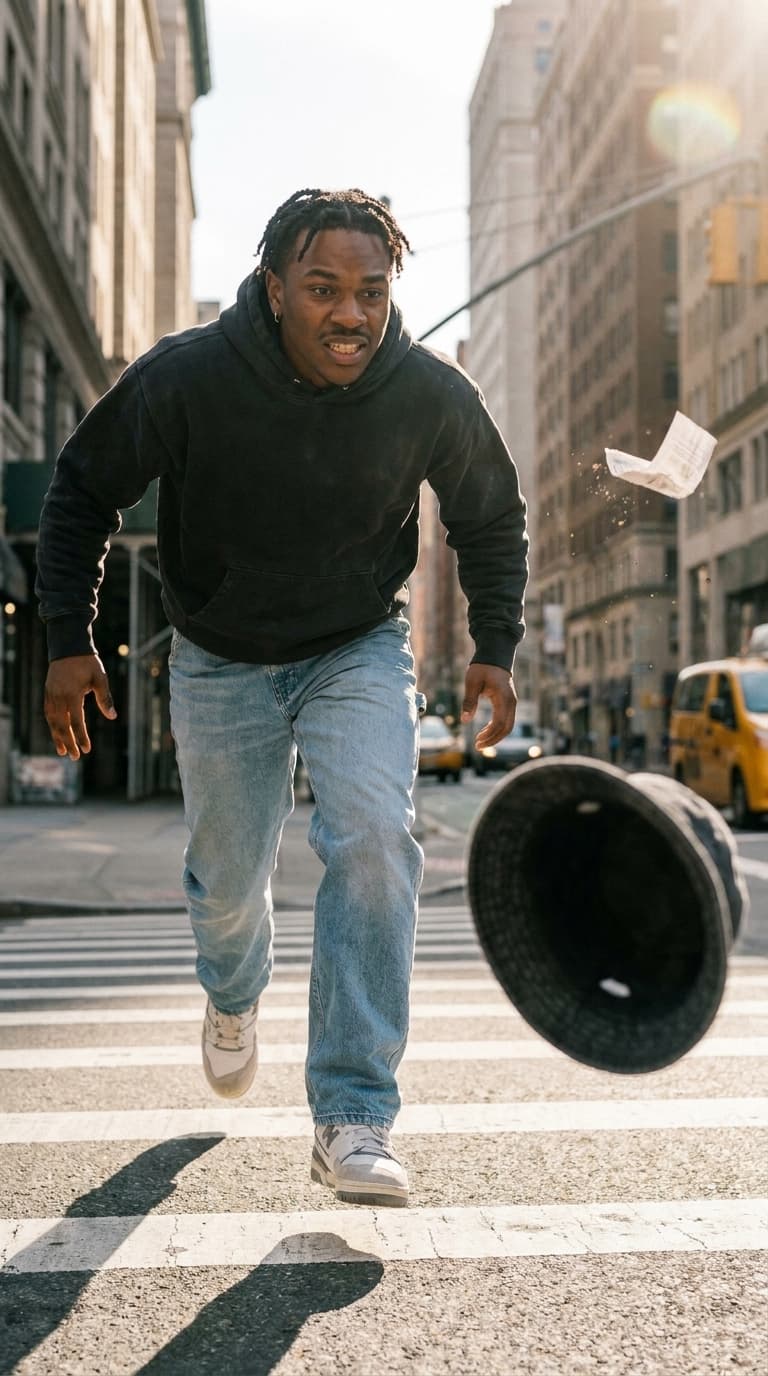
So I attached that frame to keep the guy and his outfit, and told it this is "a frame from a high-end national TV commercial", with shallow depth of field, a soft background and a bit of lens flare. I also said it straight out: "Not an iPhone photo, no deep focus, no flat phone processing."
Exact prompt
Create a new photorealistic image. This is a frame from a high-end national TV commercial, shot on a city street crosswalk from the start — not a composite, not a phone photo. Rebuild the entire scene as if shot natively here by a professional film crew, with unified lighting across subject and environment. Editorial fashion photography, unretouched, no beauty filter, no skin smoothing. THE VIBE: A big-budget streetwear brand spot — polished, cinematic, expensive-looking, but with raw kinetic swagger. A gust has ripped his bucket hat off and he is flat-out sprinting after it; the hat is escaping him. Urgent, a little ridiculous, all attitude. IDENTITY LOCK: Preserve the young man with short twists, deep brown skin and a thin moustache, from the first reference. Do NOT source face, hair or outfit from anywhere else. He wears the same washed-black oversized hoodie, baggy light-wash carpenter jeans and chunky grey-and-white sneakers, from the first reference. He is relit entirely by this scene's light. THE SUBJECT: He is in a true full-speed sprint toward camera on a diagonal from frame-left — BOTH feet off the ground at the peak of the stride, front knee driving high, back leg extended behind, torso pitched forward, right arm stretched out toward the hat with fingers splayed and still well short of it, left arm pumping back. Eyes locked up and forward on the hat, never on the camera; brows up, jaw clenched, a strained, desperate grimace. Hoodie and jeans rippling with the speed. No makeup. THE FACE: Real, unretouched skin with fine visible texture, faint pores across the nose and cheeks, slightly uneven natural tone, a few tiny imperfections. Mostly matte — natural shine only faintly on the nose tip and centre of the forehead. His deep brown skin keeps its warm red-copper undertone depth and warmth in the shadows, never ashy or grey. THE SETTING: The same gritty downtown crosswalk: worn white stripes on dark asphalt, brick and concrete buildings with fire escapes, a yellow taxi and a few pedestrians far behind — all melted into soft creamy background blur. All signage blank and unreadable, no traffic signals readable. THE LIGHT: Hard, low-ish late-afternoon sun from behind him and to frame-right: a bright warm rim carving his shoulders, twists and outstretched arm; his front lifted by soft warm bounce off the pale crosswalk; his long shadow falling toward the camera. Gentle anamorphic-style lens flare streak from the sun at the top right. The sun is the ONLY light; his contrast and black level match the scene. Polished commercial grade: rich teal shadows, warm skin and highlights, deep clean blacks, controlled highlights. THE KEY DETAILS: The hat — the washed-black denim bucket hat — spinning through the air on its edge, very close to the lens at frame-right, large in the foreground, about two metres ahead of his fingertips, unmistakably out of reach, slightly soft at its far edge. A sheet of paper and grit whipping through the frame. No text, no logos, no brand names anywhere. THE MOOD: The opening shot of a premium streetwear TV commercial — glossy, cinematic, confident. THE COMPOSITION: Vertical frame. The hat dominates the right-centre foreground, its centre about 38% down from the top, not touching the right edge. The runner is left-centre behind it, full figure from head to sneakers filling about 55% of the frame height, top of his head about 28% down from the top, his lowest foot above the bottom 20% of the frame. Crosswalk stripes converge diagonally toward him. Built as frame 1 of a moving shot. THE CAMERA: Cinematic commercial capture — low angle from knee height, a wide 24mm-equivalent cinema lens close to the hat so it looms in the foreground and he charges up through frame. Shallow depth of field: the runner tack sharp, the background buildings and cab in soft creamy bokeh, the nearest edge of the hat falling slightly soft. Gentle light falloff and subtle vignette at the frame edges, cinematic lens character, slight anamorphic flare. Spike Jonze commercial energy with the polish of a big-brand spot. Fine natural film grain across the whole frame, including the face and skin. Not an iPhone photo — no deep focus, no flat phone processing. THE AFTER EFFECT: Slight motion blur on his trailing arm, the hoodie hem and the flying paper; his face and the hat stay crisp. looks like a real model filmed on location for a TV commercial, not a render.
Way better. The background melts away and it finally looks like it cost money to shoot.
2. Pick the light yourself
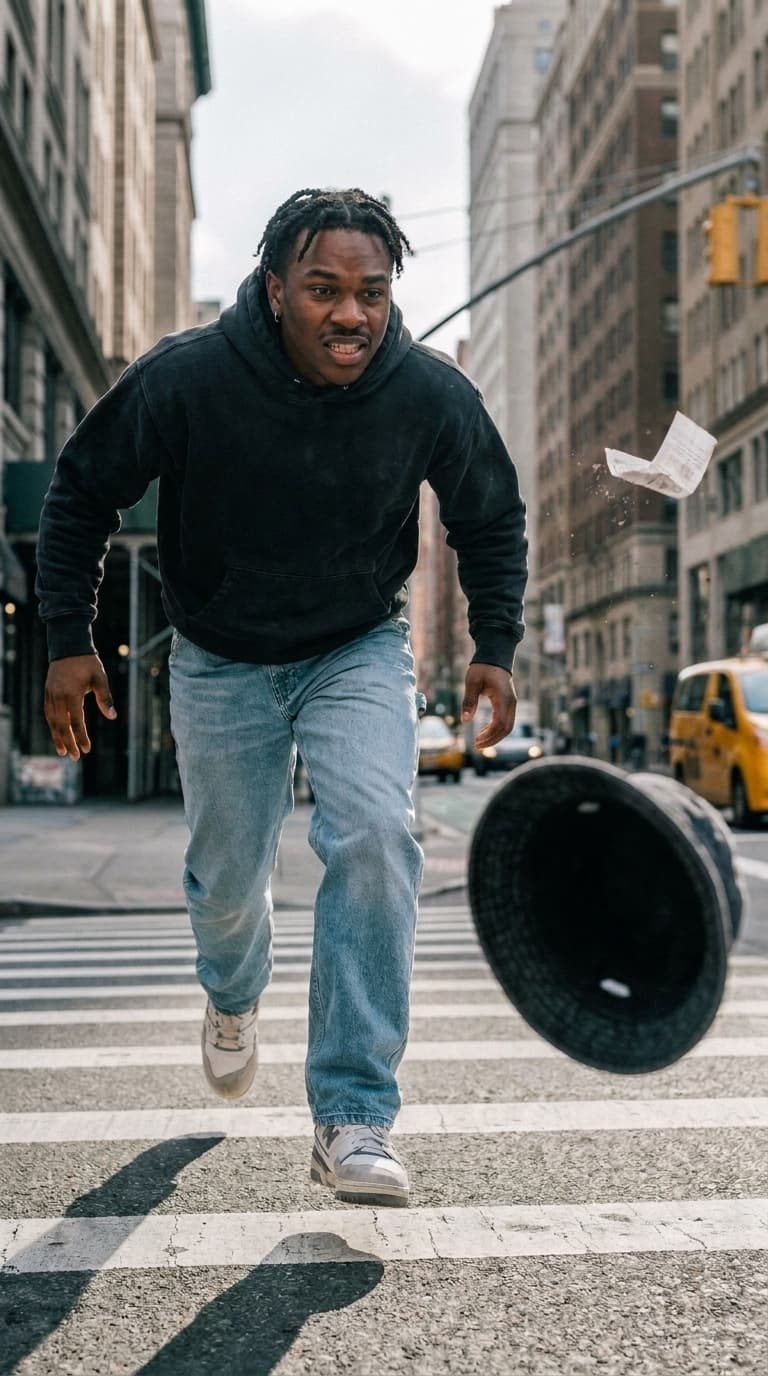
Then I noticed something. Almost every frame I made came back sunny: golden hour, then hard noon sun, then this flare. I never asked for sun once.
So I asked for "soft overcast daylight instead of sunlight", and spelled out what had to go: no sun in the frame, no lens flare, no hard shadows and no golden glow.
Exact prompt
Create a new photorealistic image, but with soft overcast daylight instead of sunlight. Preserve the young man with short twists, deep brown skin, thin moustache and small earring, his washed-black oversized hoodie, baggy light-wash carpenter jeans and chunky grey-and-white sneakers, his sprinting pose, the camera angle, framing and the street, from the first reference. Editorial fashion photography, unretouched, no beauty filter, no skin smoothing. NO sun visible, NO lens flare, NO sun rim, NO hard shadows, NO golden warm glow. THE VIBE: A premium streetwear TV commercial — polished, cinematic, graphic, cool-toned. A gust has ripped his bucket hat off and he is sprinting after it as it tumbles toward the camera. IDENTITY LOCK: Preserve the young man, from the first reference. Do NOT source face, hair, skin or outfit from anywhere else. THE SUBJECT (UNCHANGED): Same airborne sprint toward camera, same wardrobe, same position and size in frame as the first reference. No makeup. THE FACE: Real, unretouched skin with fine visible texture, faint pores across the nose and cheeks, slightly uneven natural tone, a few tiny imperfections. Mostly matte. His deep brown skin keeps its warm red-copper undertone depth and warmth in the shadows, never ashy or grey. THE SETTING (LOCKED): The same downtown crosswalk, the same brick and stone buildings, the same traffic signal, the same yellow taxi at frame-right, the same flying paper, the same washed-black bucket hat tumbling large in the right foreground. Do NOT reimagine this environment. THE LIGHT: A thick, bright overcast sky is the ONLY light — a huge soft white-grey softbox overhead. Soft, even, directional-from-above light: gentle modelling on his face and the hoodie folds, soft diffuse shadows pooling beneath him and the hat on the asphalt, no hard edges. The sky above the buildings is a flat pale grey with no sun spot. His contrast, black level and grade match the scene. Cool, slightly desaturated commercial grade: neutral-cool greys and concrete tones, the yellow taxi and the blue denim as the colour accents, his skin kept warm and rich, deep clean blacks in the hoodie. THE MOOD: A cool, confident streetwear campaign opener — graphic and moody rather than golden. THE CAMERA: Same low knee-height angle and wide cinema lens as the first reference. Cinematic commercial capture, shallow depth of field with the background buildings and cab in soft cinematic blur, gentle edge falloff and subtle vignette, fine natural film grain across the whole frame including the face. Not an iPhone photo. No text, no logos, no readable signage anywhere. looks like a real model filmed on location for a TV commercial, not a render.
The flare is gone and the sky went flat and grey. If you look at his legs though, the hard shadows stuck around. Now I always say where the light comes from in the very first prompt, so I'm not fixing it later.
3. Move him further away, and give the hat its real size
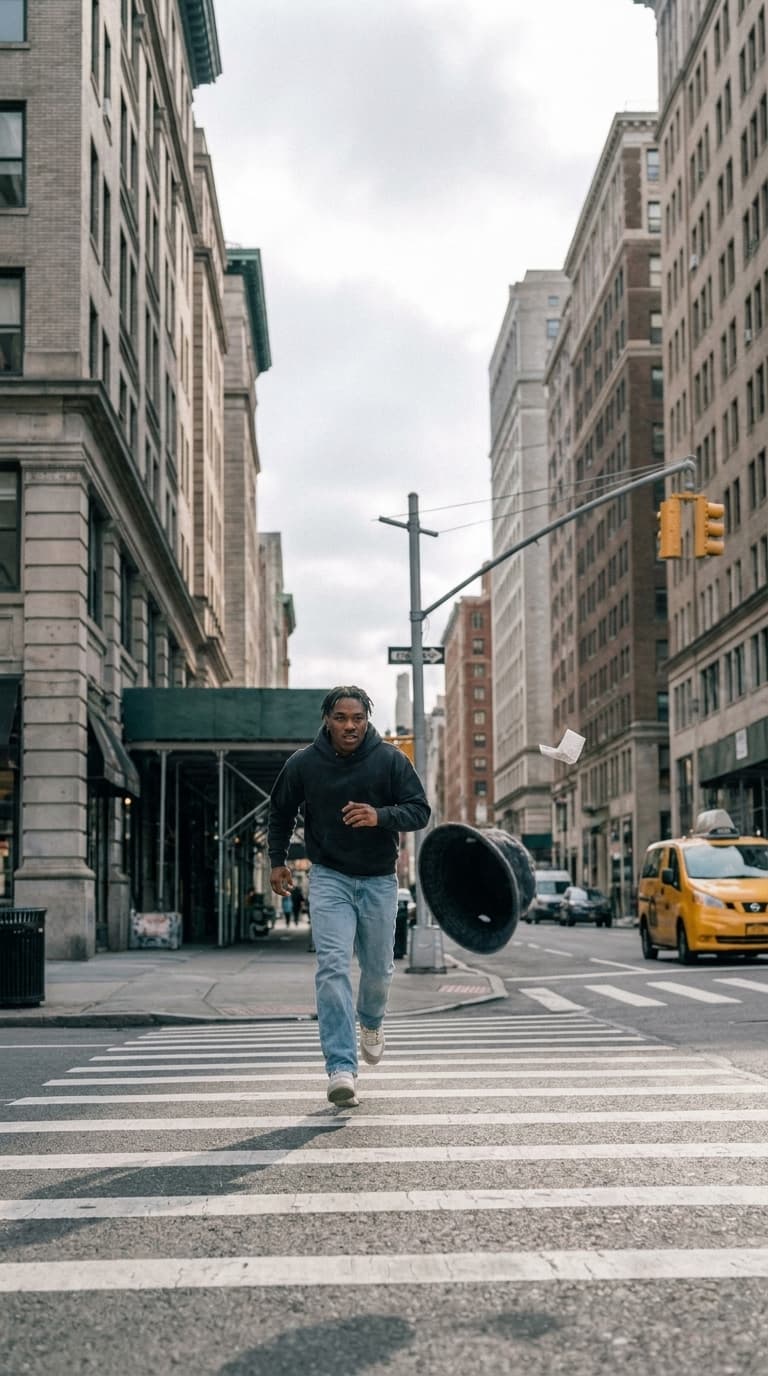
I wanted him smaller in the frame so the hat had room to fly. And listen, this one fought me. I asked for "further away" three times with the last frame attached, and he barely moved.
What finally worked was asking for "a much wider shot" where the man and the hat are both far from the camera.
Exact prompt
Create a new photorealistic image, but in a much wider shot: the man AND the hat are both far from the camera, small in a big city frame. This is a wide establishing frame from a high-end streetwear TV commercial, shot natively on this downtown crosswalk — not a composite, not a phone photo. Editorial fashion photography, unretouched, no beauty filter, no skin smoothing. NO sun, NO lens flare, NO hard-edged shadows. THE VIBE: A premium streetwear TV commercial — polished, cinematic, graphic, cool-toned. A gust has ripped his bucket hat off and he is sprinting after it down the middle of the street; the hat is tumbling just ahead of him, out of reach. The scale of the city makes the chase feel bigger and funnier. IDENTITY LOCK: Preserve the young man with short twists, deep brown skin, thin moustache and small earring, in the washed-black oversized hoodie, baggy light-wash carpenter jeans and chunky grey-and-white sneakers, from the first reference. Do NOT source face, hair, skin or outfit from anywhere else. THE SUBJECT: Same sprint toward camera as the first reference, torso pitched forward. No makeup. THE FACE: Real, unretouched skin, mostly matte. His deep brown skin keeps its warm red-copper undertone depth, never ashy or grey. THE SETTING (LOCKED): The same downtown street as the first reference — the same brick and stone buildings on both sides, traffic signal, yellow taxi, crosswalk stripes, flying paper. Seen wider, so more of the street, the building facades and the grey sky are visible. Do NOT reimagine this environment. THE LIGHT (LOCKED): The same bright overcast sky as the first reference — the only light, a huge soft white-grey softbox overhead. Shadows beneath him and the hat are soft diffuse pools directly under them, no long hard-edged shadows. Same cool, slightly desaturated commercial grade, skin warm and rich. THE KEY DETAILS: The washed-black denim bucket hat is now SMALL and far from the camera, tumbling in mid-air about two metres ahead of him and slightly to his right, at roughly his chest height — the same distance from the camera as him, not near the lens. Clearly out of his reach. No text, no logos. THE COMPOSITION: Wide vertical frame. The man is far down the street, centred, his full figure from head to sneakers filling about 22% of the frame height — the top of his head about 45% down from the top of the frame, his feet about 67% down. The hat floats just ahead of him, small, around 50% down. A long empty stretch of crosswalk and asphalt fills the lower third between them and the camera; the buildings rise on both sides and the grey sky fills the top of the frame, the street lines converging toward him. THE CAMERA: Low angle from knee height, wide cinema lens, deep-enough focus that both he and the hat are sharp, background softening slightly with distance. Gentle edge falloff and subtle vignette, fine natural film grain across the whole frame. Not an iPhone photo. No text, no logos, no readable signage anywhere. looks like a real model filmed on location for a TV commercial, not a render.
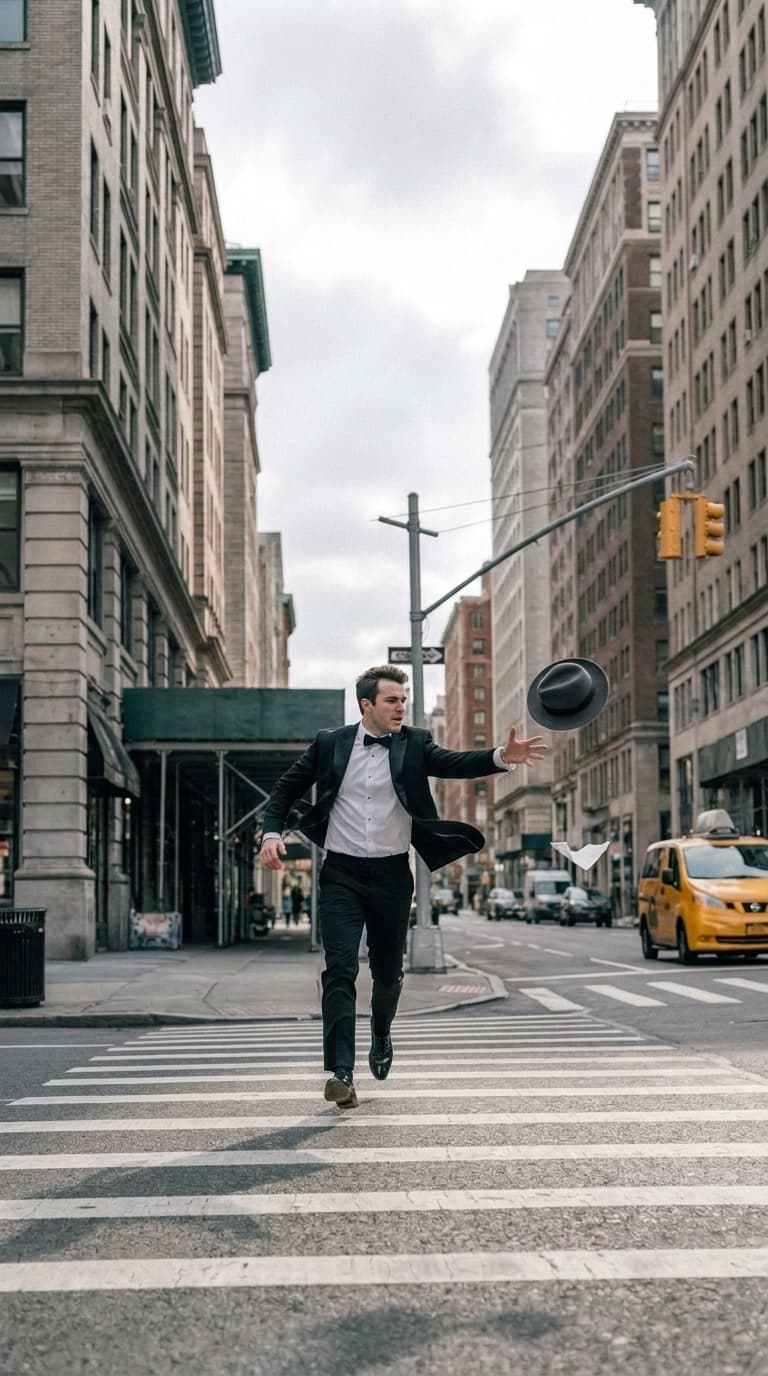
He shrank, but now the bucket hat was about the size of his whole torso. At this point I also switched him to a guy in a tux chasing a classic fedora. I kept the street and the camera from this frame, and gave the hat a real size: "a normal-sized hat, no larger than his head."
Exact prompt
Create a new photorealistic image. This is a wide frame from a high-end national TV commercial, shot natively on this downtown crosswalk from the start — not a composite, not a phone photo. Use the first reference ONLY for the street, the camera position, the wide framing and the overcast light — do NOT source the person, face, hair, skin or outfit from it. Editorial fashion photography, unretouched, no beauty filter, no skin smoothing. NO sun, NO lens flare, NO hard-edged shadows. THE VIBE: A premium TV commercial with comic momentum — a sharply dressed man in a tuxedo, clearly on his way somewhere important, is running all-out down the middle of a city street after his hat, which a gust has just stolen. Elegant and ridiculous at once; total commitment, zero dignity left. IDENTITY LOCK: The man is about 30, white, fair skin with a neutral-warm undertone, short dark-brown hair neatly side-parted but now wind-mussed, a clean-shaven defined jaw, light-blue-grey eyes, straight brows, a lean athletic build. THE SUBJECT: He is in the middle of an intense, full-speed sprint toward the camera — both feet fully off the ground at the peak of the stride, front knee driving high, back leg kicked far out behind him, torso pitched hard forward, his right arm stretched as far forward as it will go reaching for the hat, fingers splayed, his left arm flung back. Head craned forward, eyes locked on the hat, mouth open, brows up — strained, desperate effort. He wears the classic black tuxedo: a single-breasted black dinner jacket with satin peak lapels flapping open behind him, a crisp white pleated dress shirt, a black satin bow tie knocked slightly crooked, black tuxedo trousers with a satin side stripe, and polished black patent oxford shoes. A white pocket square. The jacket tails and trousers rippling with the speed. No makeup. THE FACE: Real, unretouched skin with fine visible texture, faint pores, slightly uneven natural tone, a faint natural flush on the cheeks and nose from the exertion. Mostly matte. Hair strands lifted by the wind. THE SETTING (LOCKED): The same downtown street as the first reference — the same pre-war brick and stone buildings on both sides, scaffolding shed at left, traffic signal on its pole, a yellow taxi at frame-right, the crosswalk stripes, a sheet of paper flying in the gust. All signage blank and unreadable, NO car badges or logos. THE LIGHT (LOCKED): The same bright overcast sky as the first reference — the only light, a huge soft white-grey softbox overhead. Soft even light with gentle modelling on his face and the satin lapels catching a soft grey sheen; soft diffuse shadow pooling under him and the hat. Same cool, slightly desaturated commercial grade, the yellow taxi and the white shirt as the brightest accents, the tuxedo a deep clean black. THE KEY DETAILS: The hat — a classic charcoal-grey wool felt fedora with a pinched crown and a black grosgrain band — tumbling in mid-air at REAL, true-to-life size for its distance, about two metres ahead of his outstretched fingertips toward the camera, at about his head height, clearly out of reach. It is a normal-sized hat, no larger than his head. No text, no logos. THE MOOD: The opening of a witty premium TV spot — cool grey city, black-tie elegance, slapstick urgency. THE COMPOSITION: The same wide vertical frame as the first reference. The man is far down the street, centred, his full figure from head to shoes filling about 30% of the frame height — the top of his head about 45% down from the top of the frame, his lowest point about 73% down. The small hat floats just ahead of him and above his reaching hand. The street lines converge toward him, buildings rise on both sides, grey sky fills the top. Open crosswalk in the lower frame. THE CAMERA: Low angle from knee height, wide cinema lens, focus on him and the hat, background softening slightly with distance. Gentle edge falloff and subtle vignette, fine natural film grain across the whole frame including the face. Not an iPhone photo. THE AFTER EFFECT: Slight motion blur on his flung-back arm, the flapping jacket and the paper; his face and the hat stay crisp. No text, no logos, no readable signage anywhere. looks like a real actor filmed on location for a TV commercial, not a render.
4. Build the start frame
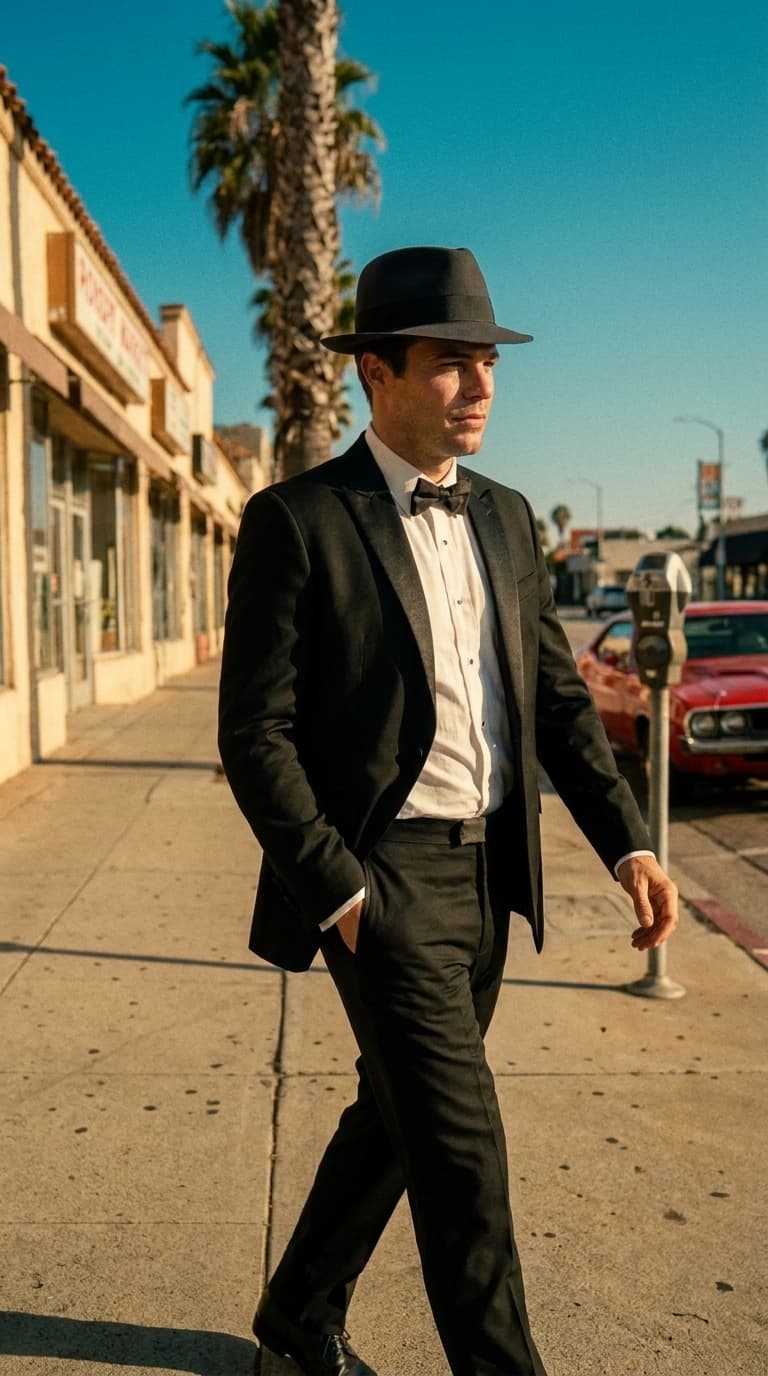
Next I wanted a 70s crime movie look, so I rebuilt the whole scene with words and only kept his face from the last frame. Then I asked for him walking down the sidewalk, caught mid-step, hand in his pocket. I left lots of open space above the hat so it has somewhere to fly.
Exact prompt
Create a new photorealistic image. This is a candid frame from a 1970s-set crime-comedy feature film, shot on a sun-baked Los Angeles sidewalk from the start — not a composite, not a phone photo. Rebuild the scene as if shot natively here on film, with unified lighting across subject and environment. Editorial fashion photography, unretouched, no beauty filter, no skin smoothing. THE VIBE: Tarantino-style cinema — cool, swaggering, sun-baked, deadpan. An ordinary moment caught mid-stride: a man in a tuxedo and fedora strolls along a hot LA sidewalk, unaware, a second before a gust steals his hat. Observed, not posed. IDENTITY LOCK: Preserve the white man with short dark hair and light stubble, in the black tuxedo with the white dress shirt and black bow tie, wearing the black felt fedora with the black band, from the first reference. Do NOT source face, hair or outfit from anywhere else. He is relit by this scene's light. THE SUBJECT: He is walking along the sidewalk toward frame-right, caught mid-step — weight on his front foot, body angled three-quarters toward the camera, one hand casually in his trouser pocket, the other arm swinging loose. His head is turned slightly, glancing off to the side at something down the street, relaxed, unaware of the camera. The fedora sits straight on his head. Jacket hanging open, lapels shifting with the walk. No makeup. THE FACE: Real, unretouched skin with fine visible texture, faint pores across the nose and cheeks, slightly uneven natural tone, a few tiny imperfections. Mostly matte — natural shine only faintly on the nose tip and centre of the forehead. Minimal natural makeup: bare skin, no foundation, no contour, no highlighter, lightly groomed brows. THE SETTING: A 1970s Los Angeles sidewalk: sun-bleached concrete paving with cracks and a few cigarette butts, a low stucco strip of shopfronts with faded striped awnings and dusty display windows behind him, a tall palm trunk at the curb, a parking meter, the cherry-red 1970s muscle car parked at the curb at the edge of frame, telephone wires overhead. A couple of passersby far behind, soft. All signs blank or unreadable, no logos, no license plates. THE LIGHT: Late-afternoon California sun, low and raking from frame-right — the ONLY light. Hard warm light across the right side of his face, the hat brim and the shirt front; the left side falls into warm-brown shadow; the brim casts a crisp shadow across his brow; his long hard shadow falls to frame-left across the sidewalk and up the stucco wall. Warm bounce off the pale concrete lifts the shadows slightly. No lens flare, no visible sun. THE KEY DETAILS: The fedora sitting on his head — the brim just catching the first lift of a breeze. A few dry palm fronds and a scrap of paper skittering along the pavement. No text, no logos. THE MOOD: A candid 1970s crime-film moment — cool, sun-drenched, deadpan. Warm, saturated retro film grade: golden-amber skin, deep cyan sky, cherry red and faded mustard accents, crushed warm blacks in the tux and hat, slightly faded highlights. THE COMPOSITION: Vertical frame, waist-up medium shot. He is left of centre, the top of the fedora crown about 25% down from the top of the frame, his face around 32% down, his waist at the bottom edge. Generous open space above and around the hat — the cyan sky, the awning and palm — so the hat has room to fly away. Nothing touching the frame edges. THE CAMERA: Cinematic feature-film capture — eye level, a long telephoto lens from across the street, compressing the shopfronts close behind him, shallow depth of field with him sharp and the background in soft warm bokeh. Observational, candid framing, as if he doesn't know he's being filmed. Real film texture: heavy visible film grain across the whole frame including the face, warm halation around bright highlights, gentle edge falloff. Tarantino-style 1970s cinema. Not an iPhone photo, not digital. No text, no logos, no readable signage anywhere. looks like a real actor in a candid frame from a 1970s feature film, not a render.
5. Make the last frame before you animate
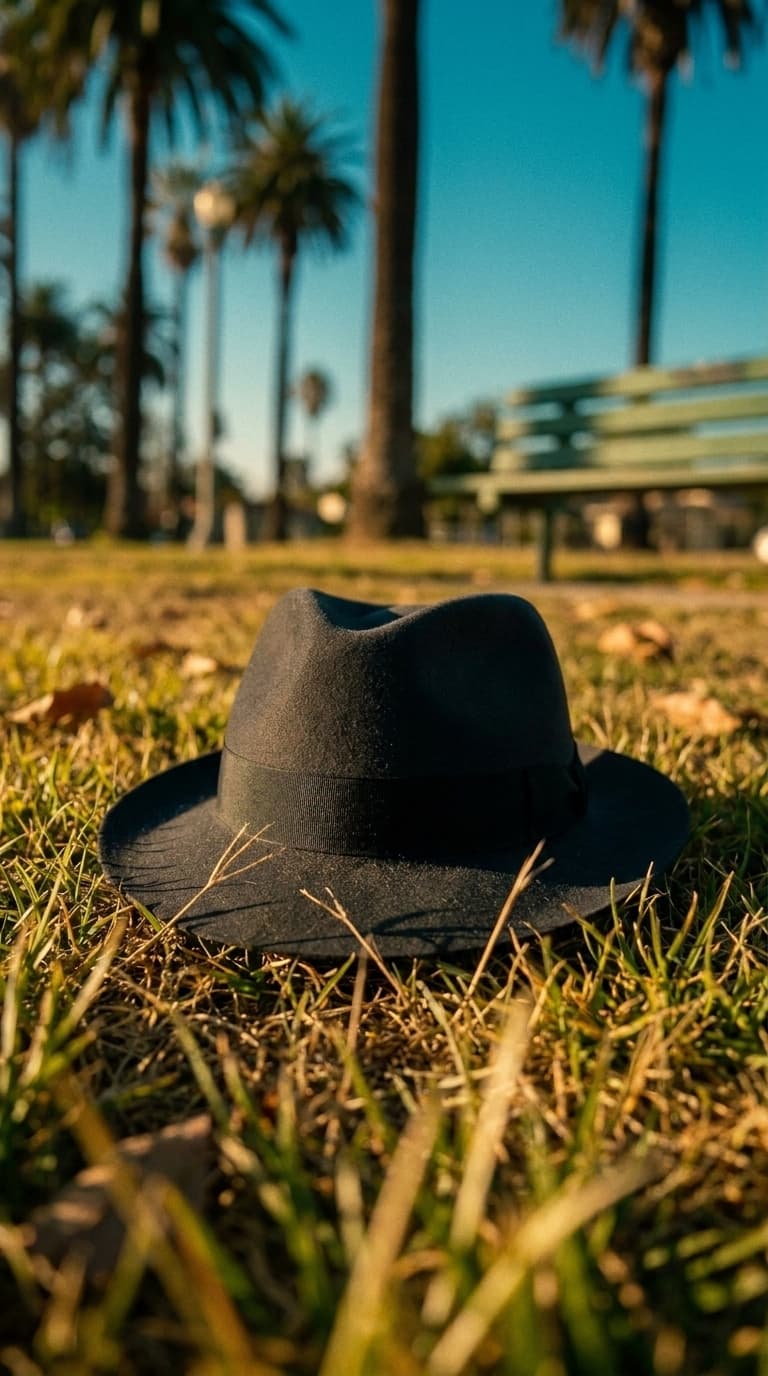
This is the step I'd tell anyone to steal. Before I wrote the video prompt, I made the final shot: a low close-up of the hat lying in the park grass. I attached the start frame and said to use just the hat from it, with no person in the shot.
Exact prompt
Create a new photorealistic image. This is a close-up frame from a 1970s-set crime-comedy feature film, shot at ground level in a Los Angeles park from the start — not a composite, not a phone photo. Rebuild the scene as if shot natively here on film, with unified lighting across the hat and the environment. THE VIBE: Tarantino-style cinema — the deadpan payoff after a long chase. The runaway fedora has finally come to rest in the grass of a sunny LA park, sitting there smugly, as if waiting. Still, quiet, slightly absurd, heroic. THE SUBJECT: The black felt fedora with the black grosgrain band, from the first reference — use ONLY the hat from the first reference; no person, no face, no tuxedo in this frame. It rests upright on its brim in the grass, tilted slightly toward the camera, the crown pinch and the band facing us at a three-quarter angle. The felt has a soft matte nap with fine fibres visible, a little dust and two blades of dry grass caught on the brim from rolling across the park; the brim edge is crisp, the band's ribbed grosgrain texture sharp. THE SETTING: A 1970s Los Angeles park in late afternoon: slightly patchy, sun-dried green-and-gold lawn, a few fallen palm fronds and dry leaves, a worn dirt path. Behind, thrown far out of focus: tall skinny palm trees, a green wooden park bench, a low hedge, and the deep cyan sky. Foreground: a few out-of-focus grass blades right in front of the lens, partly occluding the bottom edge. No people, no text, no signage, no logos. THE LIGHT: Late-afternoon California sun, low and raking from behind the hat to frame-right — the ONLY light. A warm golden rim glows along the top of the crown and the brim edge, the fibres of the felt catching the light; the front of the hat sits in soft warm shade lifted by bounce from the sunlit grass; the hat throws a long soft shadow toward the camera and to frame-left across the grass. Backlit grass blades glow translucent gold. No lens flare, no visible sun disc. THE KEY DETAILS: The texture of the felt and the band; the grass pressed down slightly under the brim where it sits; dust motes floating in the low sunlight. No text, no logos, no label. THE MOOD: The final shot of a 1970s crime-film chase — sun-drenched, mock-heroic, deadpan. Warm, saturated retro film grade: golden-amber grass and light, deep cyan sky, the hat a rich crushed warm black, slightly faded highlights. THE COMPOSITION: Vertical close-up from ground level. The hat sits in the lower-middle of the frame, centred, filling about 45% of the frame width, its crown top about 45% down from the top of the frame and its brim base about 72% down. Above it, soft blurred palms and the cyan sky; below it, out-of-focus foreground grass. Nothing touching the frame edges. THE CAMERA: Cinematic feature-film capture — the lens almost resting on the grass, looking slightly up at the hat, giving it a heroic, monumental presence. Shallow depth of field: the hat's band and brim tack sharp, the foreground grass and the park background melting into soft warm bokeh. Real film texture: heavy visible film grain across the whole frame, warm halation around the rim-lit edges, gentle edge falloff. Tarantino-style 1970s cinema. Not an iPhone photo, not digital. No text, no logos, no readable signage anywhere. Every element feels tactile and present, like a real frame from a 1970s feature film, not a render.
6. Write every cut as its own scene
I gave the video model both frames and wrote the prompt as five scenes. Scene 1 starts on the walk. Every scene after that opens with "HARD CUT to" and says exactly where we are: the middle of the boulevard with the hat rolling on its brim, the lunge and miss, the park, then the locked close-up on the hat. I also wrote that he runs forward, not backward and not sliding.
Exact prompt
Create a new video, a 1970s-style crime-comedy film sequence in three hard cuts. A man in a black tuxedo and black felt fedora strolls down a sun-baked Los Angeles sidewalk until a gust snatches his hat clean off his head and carries it out of frame. Hard cut: he sprints down the middle of the hot boulevard chasing the hat as it rolls along the asphalt on its brim like a wheel, always just out of reach. Hard cut: he chases it across the grass of a sunny palm-lined park, the hat still rolling and bouncing ahead of him. The final shot is a ground-level close-up of the hat coming to rest upright in the park grass. Warm, saturated 1970s film look throughout — golden late-afternoon sun, deep cyan sky, cherry-red and mustard accents, heavy film grain, deadpan Tarantino-style energy. Same man, same tuxedo, same black fedora in every shot. [SCENE 1] THE STARTING FRAME: the man mid-stride on the sidewalk, one hand in his pocket, glancing down the street, fedora on his head. Video animates FROM this position. He keeps strolling forward toward frame-right, relaxed. A sudden gust whips palm fronds and paper along the pavement and lifts the fedora straight off his head — it spins up and away over his shoulder and flies out of the top of the frame. His hand shoots up, too late; his face drops in disbelief. [SCENE 2] HARD CUT to a low-angle wide shot in the middle of the sun-bleached boulevard, palm trees and 1970s cars lining the street: the fedora rolls fast along the asphalt on the edge of its brim, wobbling like a runaway wheel, toward the camera. Behind it, the man in the tuxedo sprints flat-out after it, jacket flapping, bow tie crooked, arm reaching, running forward naturally — NOT backward, not sliding. The frame tracks backward low to the ground just ahead of the rolling hat. [SCENE 3] He lunges and grabs at it; the hat hits a crack in the asphalt, bounces, and keeps rolling away from his fingertips. He stumbles, recovers, keeps running. [SCENE 4] HARD CUT to a sunny 1970s LA park — sun-dried golden grass, tall palms, a green wooden bench. The hat rolls and bounces across the lawn, kicking up dry grass, the man still sprinting after it in the background, out of breath, tuxedo dishevelled. [SCENE 5] HARD CUT to a ground-level close-up: the hat rolls into frame through the grass, wobbles, slows, and settles upright on its brim in the grass, tilted slightly toward the lens. Stillness. The palms and the green bench soft in the background, dust motes in the low golden light. Hold on the hat — the frame is locked; no camera movement. The hat is the same black felt fedora with a black band throughout. No text, no logos, no readable signs, no license plates.
It hit all three locations and landed right on my end frame. But I didn't love it: "in some parts his hat basically looks like two hats". Watch the boulevard shot. The black hat and its dark shadow come apart and you get two black blobs.
7. Swap the hat, then fix the face
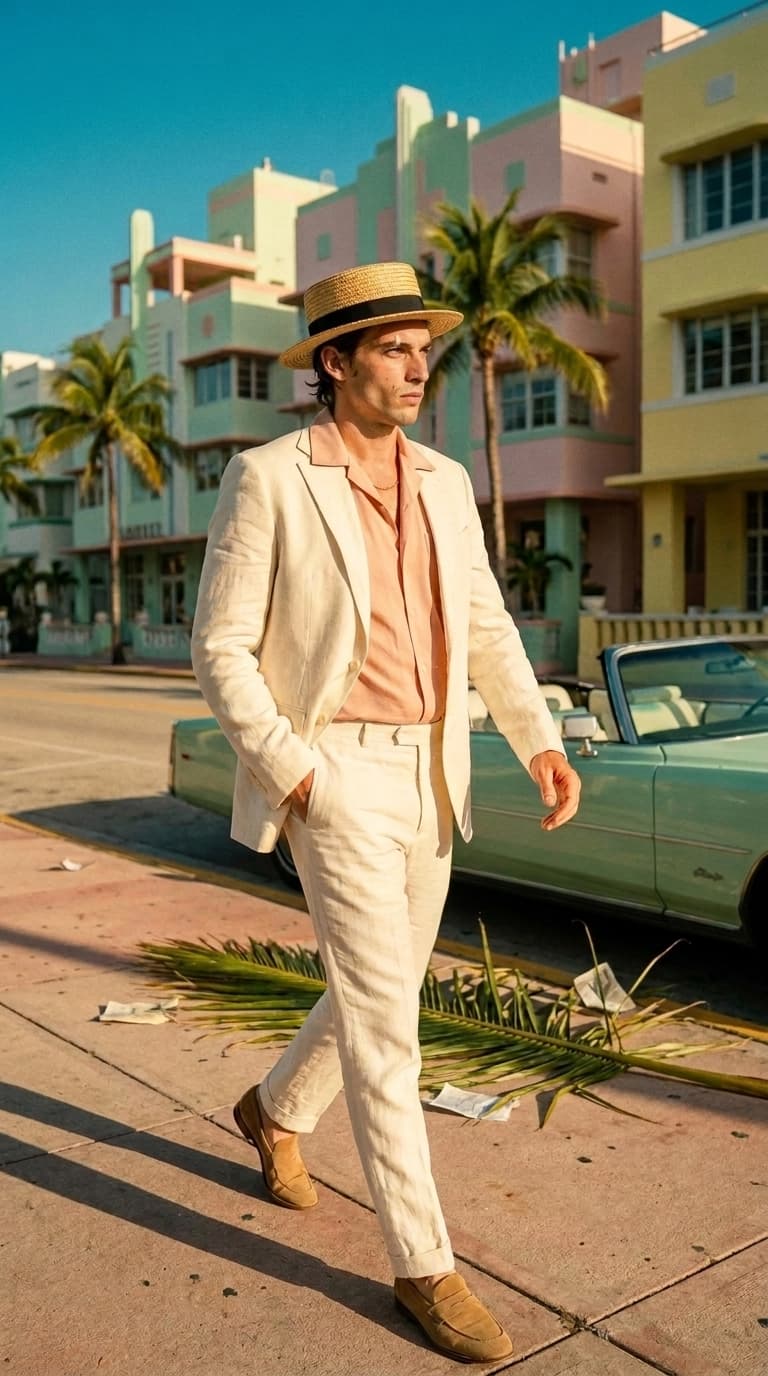
My guess was that a black hat with a black shadow is easy to misread, so I swapped the fedora for a pale, stiff straw boater with a black band. I also moved the whole thing to present-day Miami Beach with an 80s look.
The first Miami frame looked "too ai" to me, so I asked for a more editorial face: a long, lean face, high cheekbones, a slight bump on the nose, and "NOT symmetrical, NOT smooth, NOT a generic AI face."
Exact prompt
Create a new photorealistic image, but with a completely different, more distinctive editorial-model face on the man. Preserve the outfit, pose, framing, setting, light and film look of the first reference exactly. Editorial fashion photography, unretouched, no beauty filter, no skin smoothing. Do NOT keep the face from the first reference — replace the face and hair entirely with the new face described below. THE VIBE: Tarantino-style cinema in Miami — cool, swaggering, sun-drenched, deadpan. A candid frame of a striking, slightly unusual-looking man who could be a high-fashion model, strolling the deco strip a second before a gust steals his hat. THE NEW FACE (the only change): A man in his late twenties with a striking, editorial, slightly unconventional face — the kind cast for a luxury fashion campaign, not a generic handsome face. A long, lean face with high sharp cheekbones and slightly hollow cheeks beneath them; a strong angular jaw and a defined chin; a long straight nose with a slight bump on the bridge and a faint asymmetry; deep-set, slightly hooded pale grey-green eyes; thick, straight, dark untamed brows, the left one interrupted by a small pale scar; a full lower lip and a thin upper lip; a small mole on the right cheek. Dark brown hair, slightly grown out and slicked back loosely, a few strands falling forward under the brim. Light uneven stubble along the jaw. Light olive skin with a sun-tanned warmth across the nose and cheekbones. Expression: aloof, bored, faintly amused, lips closed — a model's unbothered neutral, gaze off down the street. THE FACE (finish): Real, unretouched skin with clearly visible texture — visible pores across the nose and cheeks, slightly uneven tone, faint redness at the nostrils, a few tiny blemishes and freckles from the sun, fine lines at the outer eye corners when he squints into the light. Mostly matte — natural shine only faintly on the nose tip and centre of the forehead. Minimal natural makeup: bare skin, no foundation, no contour, no highlighter. Natural, correctly proportioned features with slight real-life asymmetry — NOT symmetrical, NOT smooth, NOT a generic AI face. THE SUBJECT (UNCHANGED): The same pose as the first reference — walking toward frame-right mid-step, one hand in his trouser pocket, glancing off down the street — wearing the same straw boater with the black band, ivory linen suit, salmon-pink silk camp-collar shirt open at the neck, thin gold chain and tan suede loafers, from the first reference. THE SETTING (LOCKED): The same pastel Art Deco Miami Beach street as the first reference — mint, pink and lemon deco facades, palms, the mint-green convertible at the curb, the fallen palm frond and paper scraps on the sidewalk. Do NOT reimagine this environment. THE LIGHT (LOCKED): The same low late-afternoon sun from frame-right as the first reference — hard warm light on the right side of his face and the boater brim, the brim's crisp shadow across his brow, the left side in warm shadow. Same warm, saturated 1970s film grade. THE CAMERA: Same framing and position as the first reference. Real film texture: heavy visible film grain across the whole frame including the face and skin, warm halation around bright highlights. Not an iPhone photo, not digital. No text, no logos, no car badges, no readable signage anywhere. looks like a real fashion model photographed on location in a 1970s feature film, not a render.
Then I cleaned it up. There was a palm leaf and litter on the ground, so I added "NO palm frond on the ground. NO paper scraps, litter or debris anywhere." And instead of walking, I had him just pose there confidently. That's my new start frame.
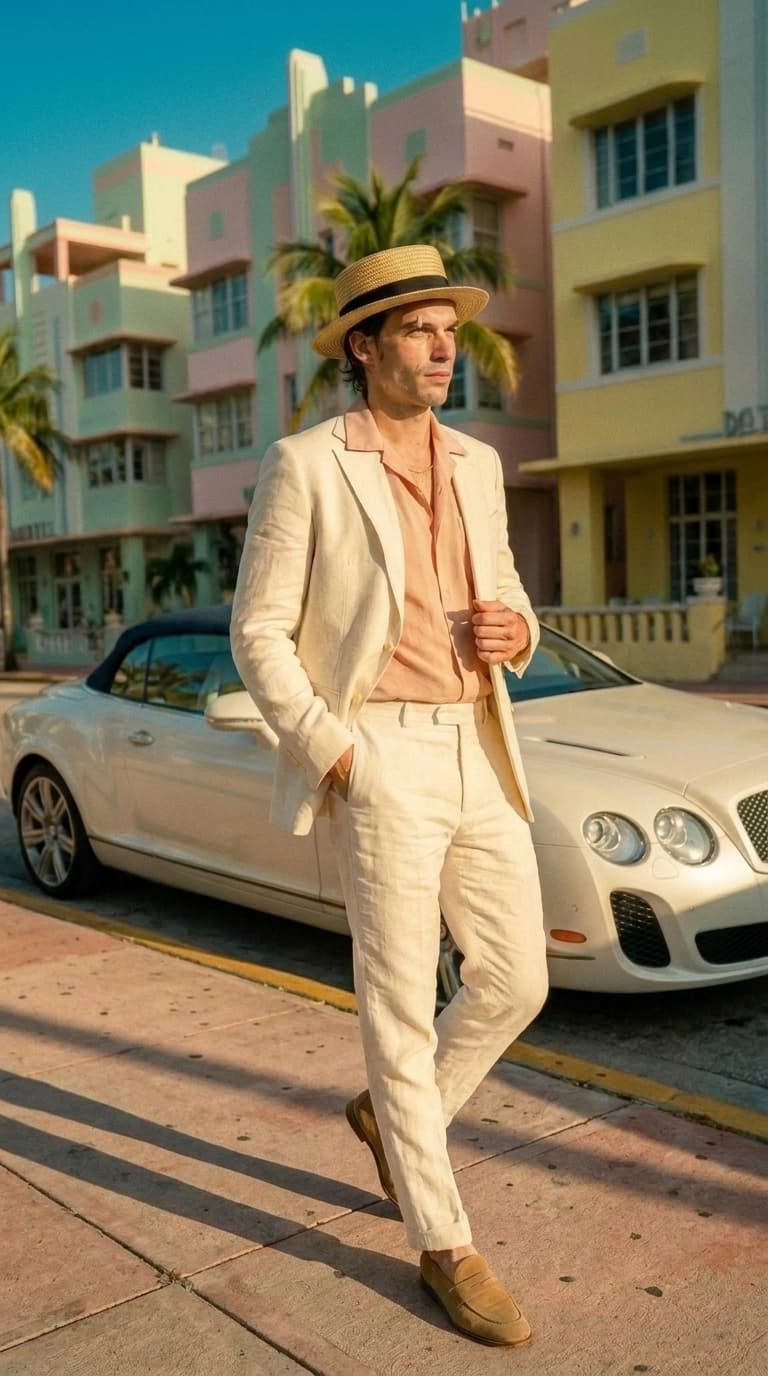
Exact prompt
Create a new photorealistic image. This is a frame from a feature film shot on this same present-day Miami Beach Art Deco sidewalk — not a composite. The man now stands still in a confident pose instead of walking; everything else is preserved from the first reference. Editorial fashion photography, unretouched, no beauty filter, no skin smoothing. THE VIBE: Tarantino-style cinema in modern-day Miami — cool, swaggering, sun-drenched, deadpan. He owns the sidewalk: utterly self-assured, a second before a gust steals his hat. IDENTITY LOCK: Preserve the man with the long lean editorial face, sharp cheekbones, dark grown-out hair falling under the brim and light stubble, from the first reference. Do NOT change his face or hair. THE SUBJECT: He stands still on the sidewalk, body angled three-quarters toward the camera, weight sunk onto his back leg with the front knee relaxed and that foot turned slightly out; hips cocked. His left hand rests in his trouser pocket, pushing the jacket open; his right hand loosely holds the lapel of his open jacket at chest height. Shoulders back, chin lifted slightly, head turned a touch to frame-right, gazing coolly off down the street with a faint, self-satisfied half-smile. He wears exactly the same outfit as the first reference: the natural golden straw boater with the black band sitting straight on his head, the ivory-white linen suit, the pale salmon-pink silk camp-collar shirt open at the neck with the thin gold chain, and the tan suede loafers with no socks. No makeup. THE FACE: Real, unretouched skin with fine visible texture, faint pores, slightly uneven natural tone, a faint sun flush. Mostly matte. Minimal natural makeup: bare skin, no foundation, no contour, no highlighter. THE SETTING (LOCKED): The same clean present-day Ocean Drive sidewalk as the first reference — the same pastel mint, pink and lemon Art Deco facades and palms, the same white modern convertible parked at the curb behind him. Clean pale concrete, no debris. Do NOT reimagine this environment. THE LIGHT (LOCKED): The same low late-afternoon sun from frame-right as the first reference — hard warm light on the right side of his face, the boater brim and the linen; the brim's crisp shadow across his brow; his long shadow falling to frame-left across the sidewalk. Same warm, saturated cinematic film grade. THE COMPOSITION: Same framing as the first reference — he stands left of centre, full figure, with the boater in the same place and open sky above and to the right of it. His feet sit above the bottom 10% of the frame. THE CAMERA: Same camera and lens as the first reference. Real film texture: heavy visible film grain across the whole frame including the face and skin, warm halation around bright highlights. Not an iPhone photo, not digital. No text, no logos, no car badges, no readable signage anywhere. looks like a real fashion model photographed on location in a feature film, not a render.
For the end frame I attached this one for the hat and my old park close-up for the composition, so the last shot frames the same way.
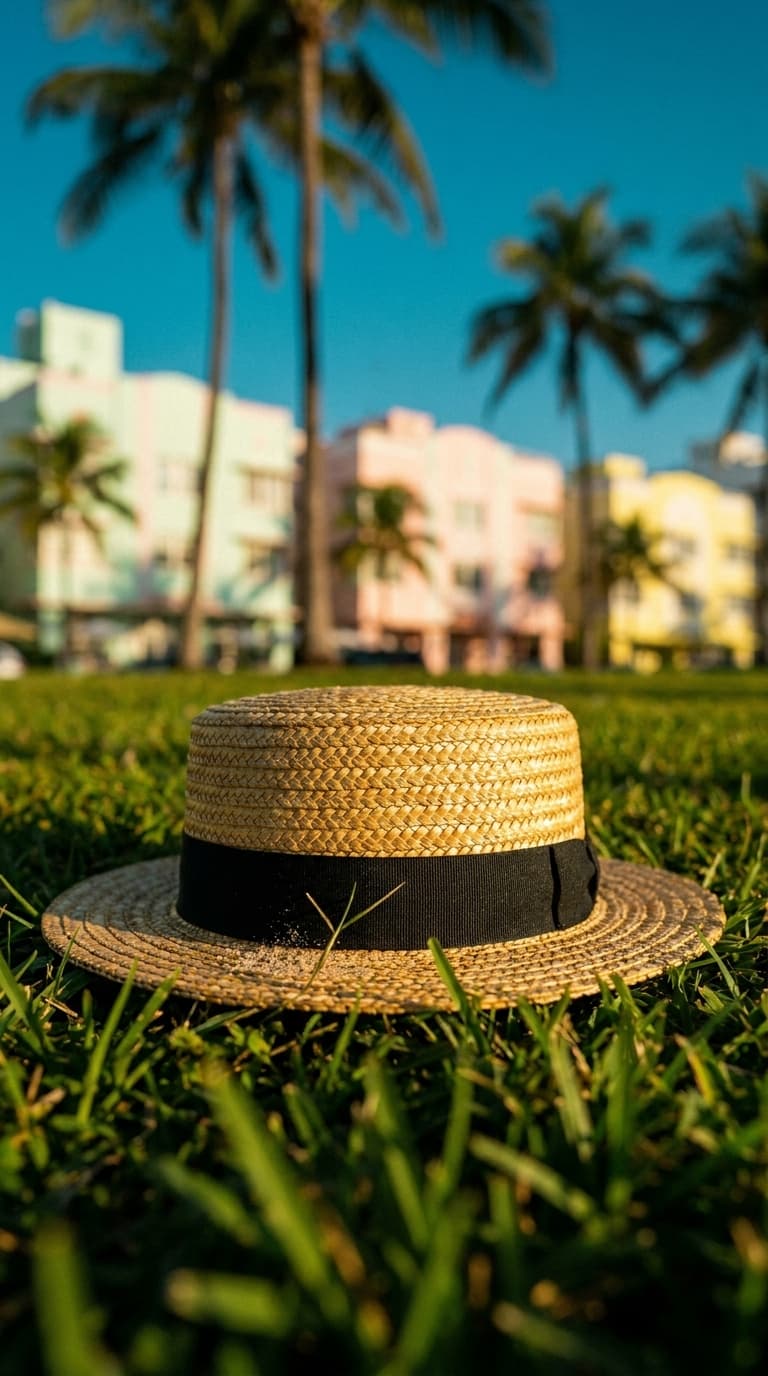
Exact prompt
Create a new photorealistic image. This is a close-up frame from a feature film, shot at ground level in a present-day Miami Beach oceanfront park from the start — not a composite, not a phone photo. Rebuild the scene as if shot natively here on film, with unified lighting across the hat and the environment. THE VIBE: Tarantino-style cinema in modern-day Miami — the deadpan payoff after a long chase. The runaway straw boater has finally come to rest in the grass, sitting there smugly, as if waiting. Still, quiet, mock-heroic. THE SUBJECT: The natural golden straw boater with the black grosgrain band, from the first reference — use ONLY the hat from the first reference; no person, no car, no street in this frame. A stiff boater: a flat round crown and a flat, perfectly round rigid brim. It rests upright, crown up, flat on its brim in the grass, tilted very slightly toward the camera, the band facing us. The woven straw is crisp and tactile, every strand of the tight weave visible, a little sand dust and two blades of grass caught on the brim from rolling across the park. THE SETTING: A present-day Miami Beach oceanfront park in late afternoon: a lush, clipped green lawn with a few fallen palm fronds' small pieces far in the background only, a sandy-white winding path. Behind, thrown far out of focus: tall slender palms, and beyond them the soft pastel shapes of Art Deco hotels — mint, flamingo pink, lemon — and the deep cyan sky. Foreground: a few out-of-focus grass blades right in front of the lens, partly occluding the bottom edge. No people, no text, no signage, no logos. THE LIGHT: Late-afternoon Florida sun, low and raking from behind the hat to frame-right — the ONLY light. A warm golden rim glows along the top edge of the crown and the brim edge, the straw strands catching and glowing where the light passes through the weave; the front of the hat in soft warm shade lifted by green-gold bounce from the sunlit grass; the hat throws a long shadow toward the camera and to frame-left across the grass. Backlit grass blades glow translucent. No lens flare, no visible sun disc. THE KEY DETAILS: The texture of the woven straw and the ribbed black band; the grass pressed down slightly under the brim; dust motes floating in the low sunlight. No text, no logos, no label. THE MOOD: The final shot of a sun-drenched crime-comedy chase — mock-heroic, deadpan. The same composition and mood as the second reference, now with the boater in a Miami park. Warm, saturated cinematic film grade: golden-amber light, deep cyan sky, candy pastels in the bokeh, the golden straw glowing. THE COMPOSITION: Vertical close-up from ground level, matching the second reference. The hat sits in the lower-middle of the frame, centred, filling about half the frame width, its crown top about 48% down from the top of the frame and its brim base about 70% down. Above it, soft blurred palms, pastel deco shapes and cyan sky; below it, out-of-focus foreground grass. Nothing touching the frame edges. THE CAMERA: Cinematic feature-film capture — the lens almost resting on the grass, looking slightly up at the hat for a heroic, monumental presence. Shallow depth of field: the hat's band and brim tack sharp, foreground grass and background melting into soft warm bokeh. Real film texture: heavy visible film grain across the whole frame, warm halation around the rim-lit edges, gentle edge falloff. Not an iPhone photo, not digital. No text, no logos, no readable signage anywhere. Every element feels tactile and present, like a real frame from a feature film, not a render.
8. Make it fast and kill the music
Last thing. I wanted "no music just sound effects" and the hat to "fly away fast not in slow motion". So the prompt says every cut plays at real-time speed with no slow motion anywhere, and the hat gets flung out of the top of the frame "in a split second". The audio line asks for sound effects only: the gust of wind, his startled breath, loafers slapping the pavement, the straw brim scraping along the asphalt, and the ocean in the background. No music, no dialogue. I also ended the prompt with "one hat, never duplicated."
Exact prompt
Create a new video, a crime-comedy film sequence in present-day Miami Beach with three hard cuts, all at real-time speed — NO slow motion anywhere. A sharply dressed man in an ivory linen suit, salmon silk shirt and a golden straw boater stands confidently on a sunny Art Deco sidewalk when a sudden, violent gust rips the boater off his head and whips it out of frame in an instant. Hard cut: he sprints down the middle of Ocean Drive chasing the boater as it rolls fast along the asphalt on the edge of its round brim like a runaway wheel, always just out of reach. Hard cut: he chases it across the grass of the palm-lined oceanfront park, the boater still rolling ahead of him. The final shot is a ground-level close-up of the boater coming to rest upright in the grass. Warm, saturated cinematic film look — golden late-afternoon sun, deep cyan sky, candy-pastel deco hotels, film grain, deadpan Tarantino-style energy. Same man, same suit, same straw boater in every shot. AUDIO: Diegetic sound effects only — absolutely NO music, no score, no soundtrack, no singing, no dialogue, no voiceover. Sounds: the sharp whoosh of a sudden gust of wind, the hat snapping off his head, his startled breath, fast footsteps of leather loafers slapping on concrete and asphalt, the rattling scrape of the straw brim rolling over asphalt, a passing car, distant seagulls and ocean surf, his heavy breathing as he runs, soft thuds of feet on grass, the hat's rustle as it settles in the grass, then quiet with gentle wind and surf. [SCENE 1] THE STARTING FRAME: the man standing on the sidewalk, one hand in his pocket, the other gripping his jacket lapel, chin up, gazing off down the street, the boater on his head. Video animates FROM this position. He holds the confident pose for a brief beat. Then, at full real-time speed, a sharp gust snaps through the street — the boater is ripped straight off his head and flung fast up and out of the top-right of the frame in a split second, no slow motion. His hair whips, his hand flies up a beat too late, his cool expression collapses into shock. [SCENE 2] HARD CUT to a low-angle shot in the middle of sunny Ocean Drive, pastel deco hotels and palms lining the street: the boater rolls fast along the asphalt on the edge of its rigid round brim like a wheel, wobbling, heading toward the lens. Behind it the man sprints flat-out after it, linen jacket flapping, arm reaching, running forward naturally — NOT backward, not sliding. The frame tracks backward low to the ground just ahead of the rolling hat. [SCENE 3] He lunges and grabs at it; the boater bounces off the curb and keeps rolling away from his fingertips. He stumbles, recovers, keeps sprinting. [SCENE 4] HARD CUT to the sunny oceanfront park — clipped green lawn, tall palms, the pastel hotels behind. The boater rolls fast across the grass on its brim, the man still sprinting after it in the background, out of breath, suit dishevelled. [SCENE 5] HARD CUT to a ground-level close-up: the boater rolls into frame through the grass, wobbles in a tight circle, and settles flat and upright on its brim in the grass. Stillness. Palms and pastel deco shapes soft in the background, golden light. Hold on the hat — the frame is locked; no camera movement. The boater is always the same pale golden straw boater with a black band — one hat, never duplicated. No text, no logos, no readable signs, no license plates, no car badges.
The hat is gone in under a second, and in the street shot you can clearly read one pale boater rolling on its brim. It's not perfect though. Once the hat comes off his hair turns into a big curly mop, he's missing from the first street shot, and in one cut he runs away from the camera when the hat was rolling toward it. And I still haven't made the proposal ending 😅
Why it works
Because I made the end frame first, both runs finished right on my close-up, even with three hard cuts in between.
Most of the other fixes came from spelling out exactly what I wanted: a frame from a TV commercial, overcast daylight, a hat no bigger than his head, and real-time speed with no slow motion.
Your turn: before you write your next video prompt, make the last frame first.
Emero keeps your start and end frames lined up for you and writes the scene-by-scene prompt, so you can spend your time on the idea. Everything's at cost.

Get one of these every day
I test new workflows daily and send them with the exact prompts, the models and the costs
5,979 generations tested so far
More workflows
See allNano Banana Pro vs GPT Image 2.5 Flare - one street ad keyframe in 12 tries
Fixing the light and the subject distance on one street ad frame across 12 tries
Nano Banana Pro, GPT Image 2.5 Flare, MiniMax H3 · 8 min render

Nano Banana Pro + MiniMax H3 - 10 second chase ad with three hard cuts
A 10 second chase ad that cuts three times, built from one start frame and one end frame
Nano Banana Pro, MiniMax H3 · 24 min render
Nano Banana Pro + GPT Image 2.5 Sunburst - a fixed cast of 8 AI models for a fashion series
Build 8 recurring AI models once, then drop them into a new outfit and scene for every post
Nano Banana Pro, GPT Image 2.5 Sunburst · 9 min render