Disclaimer: This is an independent creative test made with AI, for demonstration only. It isn't an ad for any brand shown or named, and isn't affiliated with, sponsored or endorsed by them. All trademarks belong to their owners
Nano Banana 2.1 + Seedance 2.5 - product sheets that keep a garment right on video
How I make a four-view product sheet so a garment's details hold up in an AI video
 Tested by Nouamane Benbrahim
Ever notice how a jacket's collar, buttons or lining change a little in every shot of an AI video?
What I use for this is a product sheet: one image showing the garment four ways, which I pass to the video model as a reference. I made sheets for four pieces in this series, a rose brocade coat, a yellow poncho, a black feather jacket and a long green velvet coat. Two of them broke in ways worth showing you.
Here's my exact process.
1. Pick the four views
Four tiles in a 2x2 grid on plain white: the whole garment from the front, the whole thing from the back, an extreme macro of the fabric, and a close detail of whatever makes the piece special, like the collar, a strap or the buttons. If the lining matters, I swap one tile for the inside.
2. Build it from a prompt
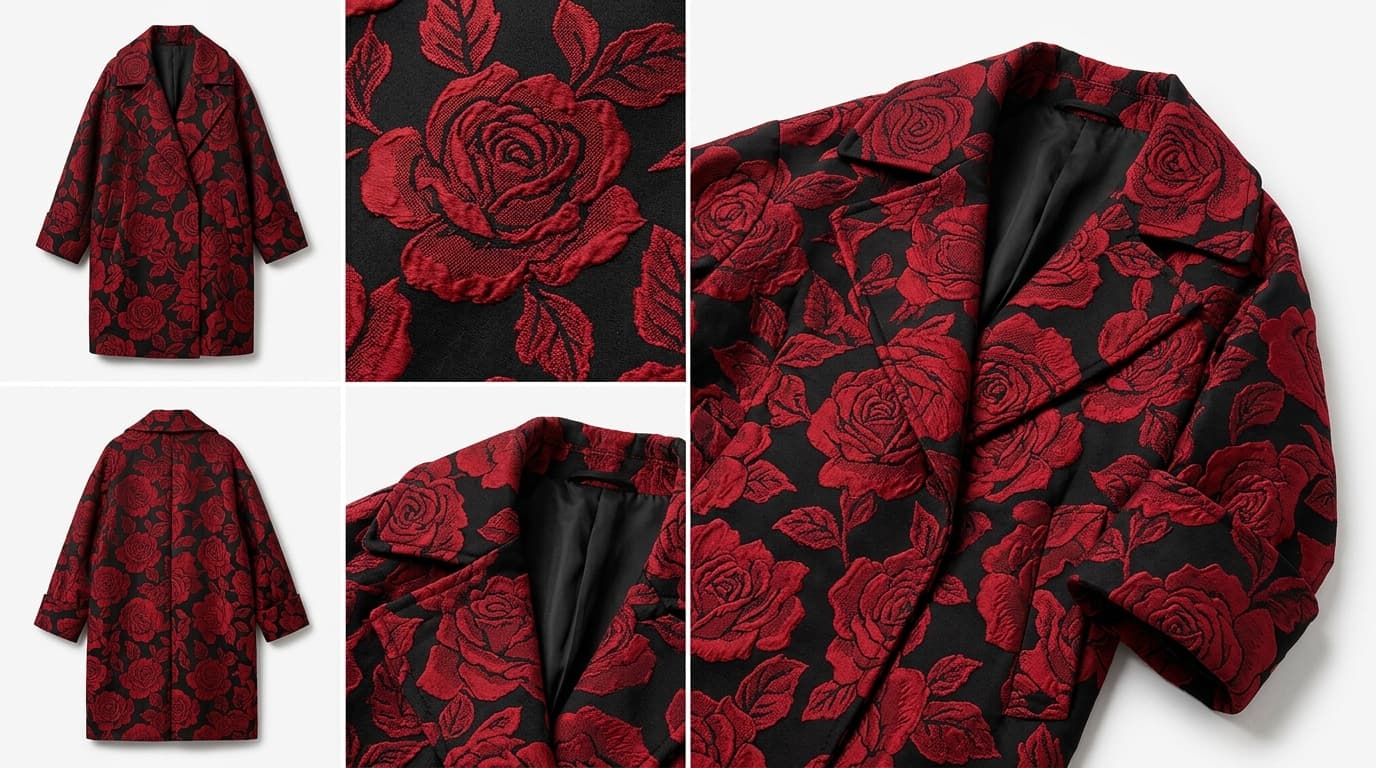
My source photos were runway looks, so I described each garment in words and built the sheet from text: the fabric, the color, the cut and every closure. Here's the rose coat.
Exact prompt
Create a new photorealistic image of a 2x2 product reference sheet: four equal tiles in a clean grid with thin white gaps, all on the same plain white seamless background, all showing the SAME single garment, ghost-mannequin style with no person, no hanger and no head. THE VIBE: A grand, theatrical evening coat in a dark rose garden palette — heavy, luxurious, a little dramatic, photographed with the calm precision of a catalogue reference sheet so every construction detail can be studied. THE SUBJECT: The one oversized knee-length coat in red-and-black rose brocade. The cloth is a jacquard-woven brocade: large-scale full-blown roses and leaves in two tones of deep crimson red on a solid black ground, the rose motifs slightly raised and embossed against the flat black, with a soft matte-satin sheen on the red threads. The coat has a wide, relaxed boxy cut with dropped shoulders, a very wide flat collar that flows into broad overlapping lapels wrapping across the chest, a hidden closure with no visible buttons, long full sleeves with deep turned-back cuffs, and a straight hem that sits at the knee. The rose pattern runs continuously across the seams. Tile one, top left: the whole coat from the front, centred and large. Tile two, top right: an extreme macro of the brocade face, showing individual rose petals as raised woven threads against the black ground, with the weave visible. Tile three, bottom left: the whole coat from the back, with the same rose pattern continuing across the back, a centre-back seam and the collar standing back from the neck. Tile four, bottom right: a close detail of the collar and one lapel edge and the turned-back cuff, with the stitched edges, the facing and a black lining visible. THE SETTING: A plain white seamless studio background, uncluttered, with a faint soft contact shadow under each view. THE LIGHT: Soft diffused studio light from above-left, with a gentle raking side light to catch the raised brocade texture and a thin rim to separate the black cloth from the white ground. The shadow side stays soft and open, with the black kept rich rather than crushed. THE KEY DETAILS: The woven raised rose motifs catching light on their threads; the crisp roll of the wide collar and lapels; the thickness and weight of the turned-back cuff; clean stitching and a black lining. THE MOOD: A couture catalogue reference page — quiet, exact, tactile. THE COMPOSITION: Four evenly sized tiles in one unified frame, each view centred in its tile with even margins, the coat large and fully visible in the front and back tiles, the two detail tiles filled with texture. THE CAMERA: Shot on an iPhone, deep focus, everything sharp, NO background blur; even studio light, straight-on and eye-level. No text, no logos, no labels, no lettering, no people, no hangers, no extra tiles, no accessories.
It came out with five panels instead of four, with an extra big view of the lapel. I could still use it, but I'd asked for four.
3. Say one view per tile
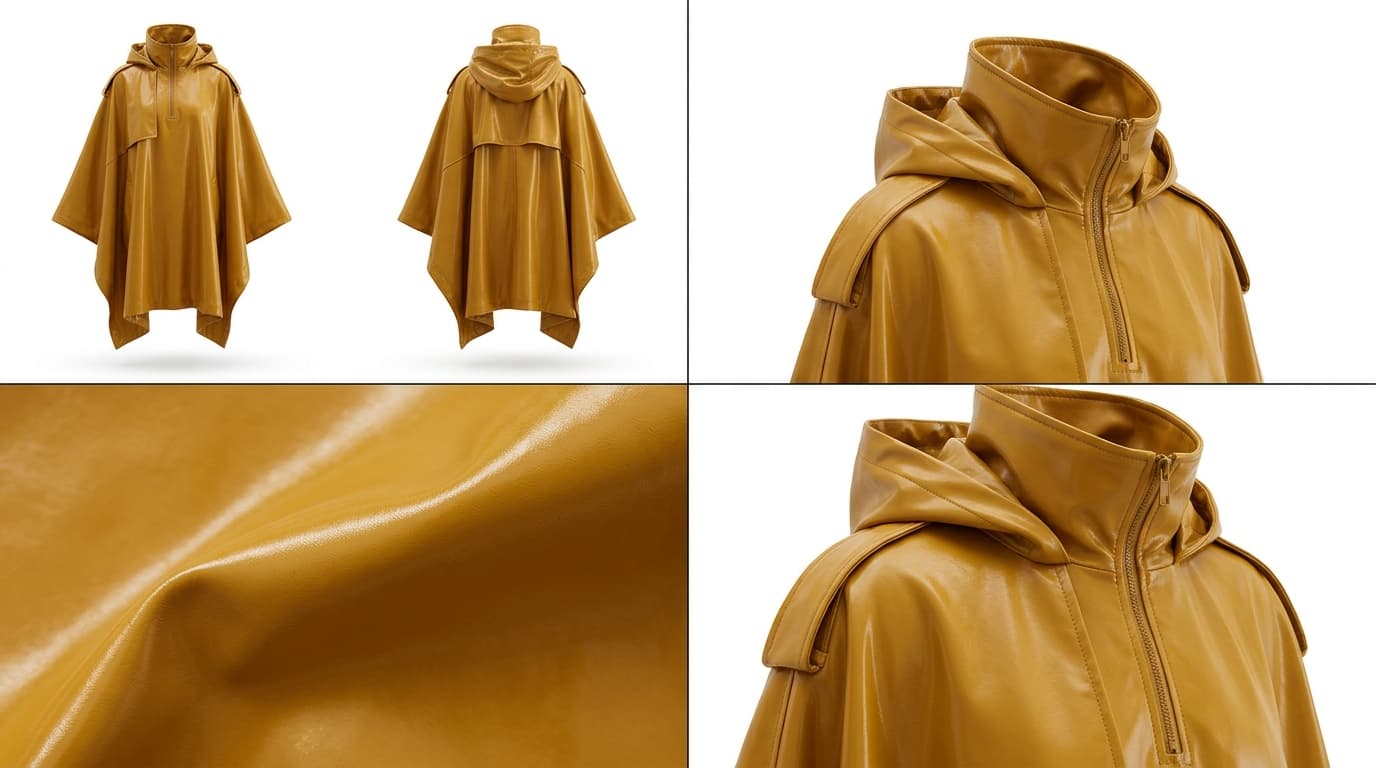
The poncho broke a different way. It squeezed the front and the back into one tile, then gave me the collar detail twice.
Exact prompt
Create a new photorealistic product reference sheet image: one single oversized poncho-cape coat shown in four equal tiles arranged in a clean 2x2 grid on a pure white seamless background, thin white gutters between the tiles, the same garment in every tile. THE VIBE: Clean, calm, tactile studio reference. The glossy yellow cloth is the star: heavy, fluid and slick, falling in broad soft folds, every view crisp enough to build the garment from. THE SUBJECT: The oversized knee-length poncho-cape coat in high-gloss mustard-yellow coated fabric, a slick lacquered ochre-yellow with a smooth wet-look finish and no print. It has a high funnel collar with a hood draped around the neck, a centre-front zip running from the collar down to mid-chest, trench-style storm flaps lying across both shoulders, and a wide cape-like body that falls straight from the shoulders with arm openings at the sides, no cuffs. The hem is long and asymmetric, dropping into soft pointed drapes at both sides. The garment is shown ghost-mannequin style, with no body, no hanger and no accessories. Tile one: the full front view, the whole garment visible. Tile two: the full back view, the whole garment visible. Tile three: an extreme macro of the glossy yellow fabric surface with a soft fold, showing the lacquered sheen, fine micro-texture and a bright specular streak along the fold. Tile four: a close detail of the high funnel collar, the draped hood, the zip pull on its placket and one shoulder storm flap. THE SETTING: A pure white seamless studio background in every tile, the garment floating on it with a soft contact-free ground shadow beneath. THE LIGHT: A large soft key from above and to the left, a raking side light along the right that rakes across the folds and drags a bright specular streak down the glossy fabric, and a thin rim light separating the yellow from the white. The shadow side stays soft, with the folds' darkest points a deep ochre, not black. THE KEY DETAILS: Specular highlights on the glossy folds, the metal zip teeth and pull catching light, the stitched edge of the storm flaps, the pointed side drapes of the hem, a fine natural crinkle where the fabric folds. THE MOOD: A precise, tactile product reference, polished and quiet. THE COMPOSITION: Four equal tiles, each filled by its subject at a large readable scale with a little margin, the whole-garment tiles on top, the macro and detail tiles below, each view clearly different from the others. THE CAMERA: Shot on an iPhone, deep focus, everything sharp, no background blur; clean studio light, straight-on and eye-level for the garment views, tight and square-on for the macro and detail tiles. No text, no logos, no labels, no people, no faces, no hangers, no mannequin body, no accessories, no extra garments.
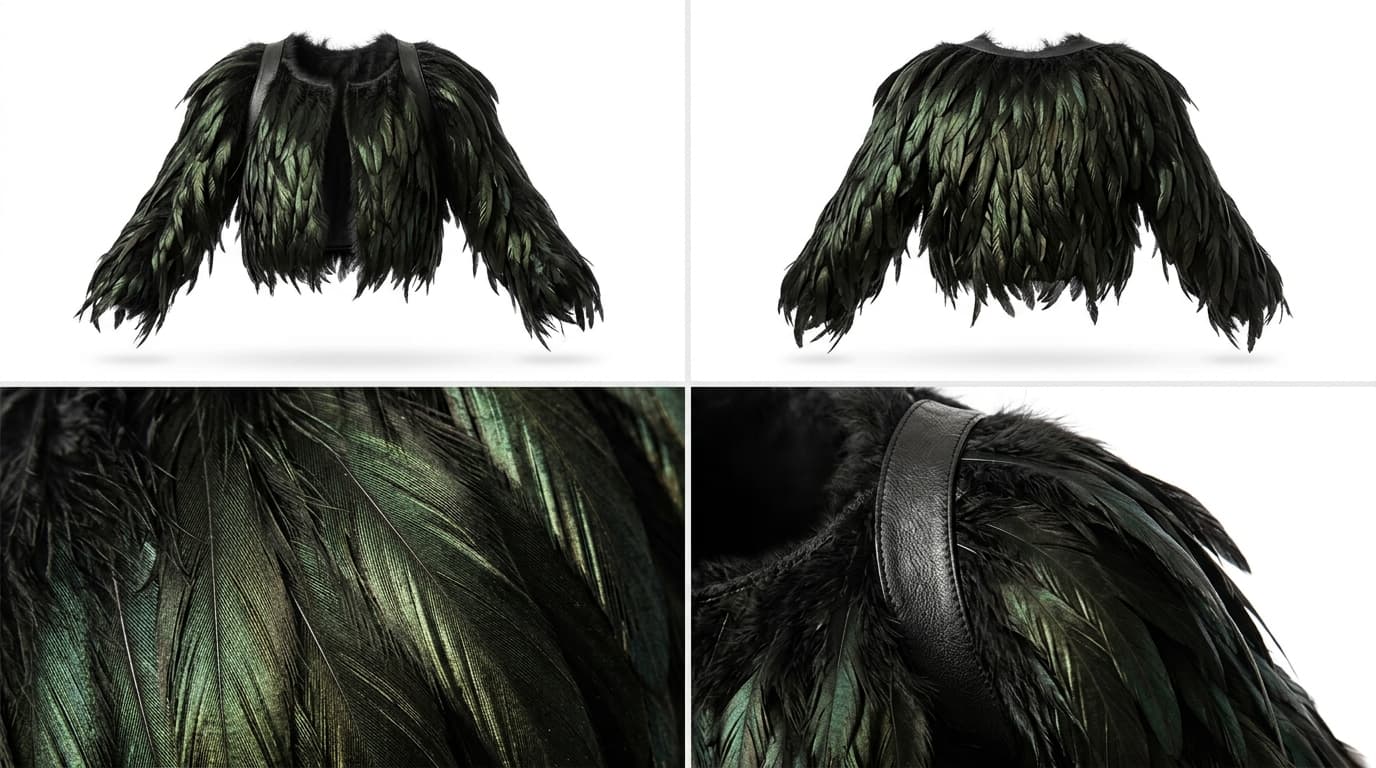
So on the next one I added "exactly one view and one garment per tile". The feather jacket came out clean on the first try.
Exact prompt
Create a new photorealistic product reference sheet image: one single cropped feather jacket shown in four equal tiles arranged in a clean 2x2 grid on a pure white seamless background, thin white gutters between the tiles, the same garment in every tile, exactly one view and one garment per tile. THE VIBE: Clean, tactile studio reference. The feathers are the star: dense, dark and alive, every tip crisp, with a green-bronze shimmer that wakes up where the light hits. THE SUBJECT: The cropped feather jacket, ending at the ribs, made entirely of long narrow black rooster-style feathers with an iridescent green-bronze sheen, laid in dense overlapping rows like roof tiles with the tips pointing downward. It has wide shoulders where the feather layers cascade down like wings, long sleeves fully covered in feathers with loose feather tips hanging over the wrists and a ragged feathered edge at the hem, an open front with no closure, a soft dark down edge around a scooped neckline, and two black leather straps lying over the shoulders. The garment is shown ghost-mannequin style, with no body, no hanger and no accessories. Tile one (top left): the full front view, the whole jacket visible, open at the front. Tile two (top right): the full back view, the whole jacket visible. Tile three (bottom left): an extreme macro of the overlapping black feathers showing individual barbs, the quill lines and the green-bronze iridescent sheen. Tile four (bottom right): a close detail of the shoulder, one leather strap and the feathered sleeve beginning below it. THE SETTING: A pure white seamless studio background in every tile, the garment floating on it with a soft contact-free ground shadow beneath. THE LIGHT: A large soft key from above and to the left, a raking side light from the right that catches the feather barbs and throws the green-bronze iridescent sheen along the layered rows, and a faint rim light along the dark edge separating the black feathers from the white. The shadow side stays soft, the feather gaps a deep warm black. THE KEY DETAILS: Individual feather barbs and quill lines, the green-bronze shimmer on the curve of each feather, loose feather tips fraying at the hem and wrists, the stitched black leather straps at the shoulders. THE MOOD: A precise, tactile product reference, dark and quietly dramatic. THE COMPOSITION: Four equal tiles, each filled by its subject at a large readable scale with a little margin, the whole-garment tiles on top, the macro and detail tiles below, each view clearly different from the others. THE CAMERA: Shot on an iPhone, deep focus, everything sharp, no background blur; clean studio light, straight-on and eye-level for the garment views, tight and square-on for the macro and detail tiles. No text, no logos, no labels, no people, no faces, no hangers, no mannequin body, no dress or other garment underneath, no accessories.
4. Use a real product photo when you have one
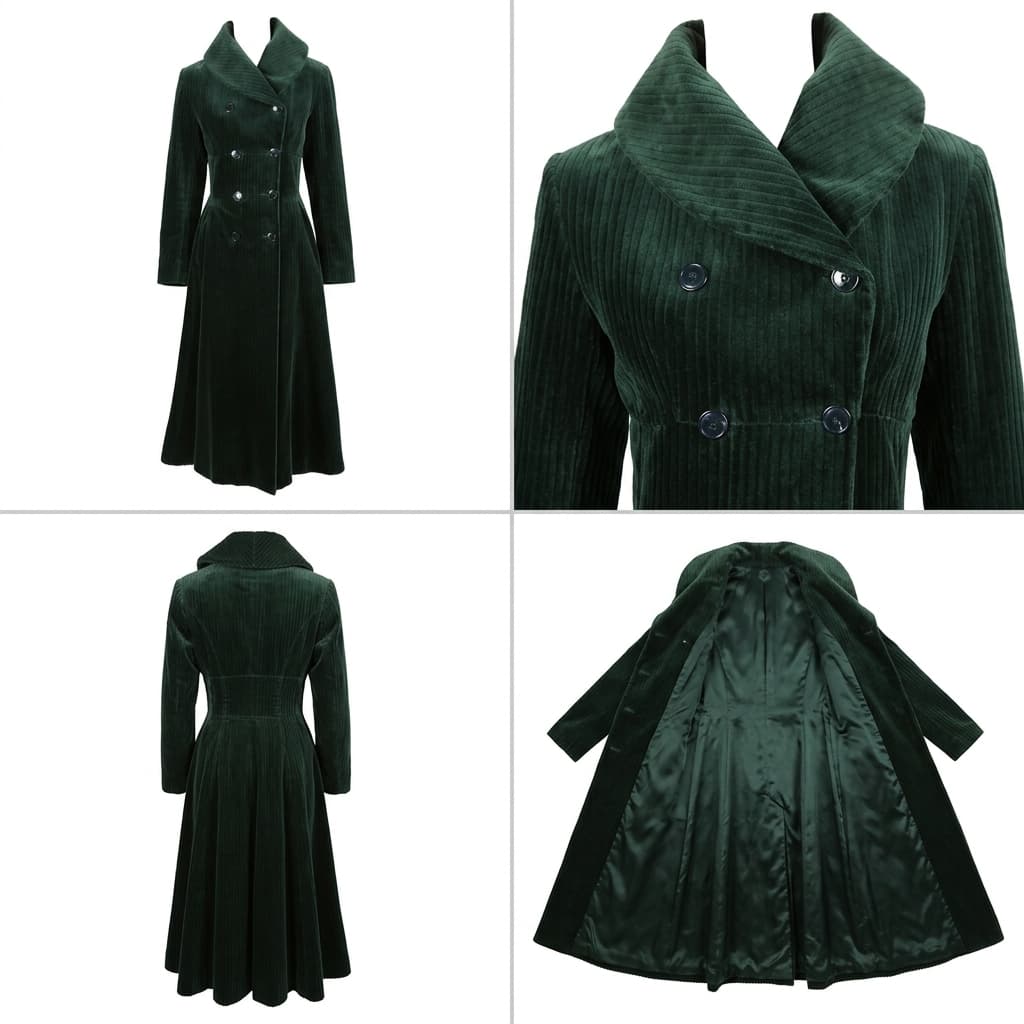
For the green velvet coat I found a clean product photo on a vintage resale listing, the coat on a form against white. A real photo is way more accurate than my description, so I gave it to the model as the source of truth and asked it to draw only the views the photo doesn't show, adding nothing new.
Exact prompt
A four-panel product reference sheet of the coat in the first reference image, laid out as a clean 2x2 grid on a plain white background, exactly one view and one coat per tile. Reproduce the coat exactly as photographed in the first reference image: deep forest-green wide-wale velvet with its vertical rib, the large rolled shawl collar, the double-breasted front with eight dark round buttons in four pairs, the fitted corseted waist with the seam under the bust, the long flared skirt to mid-calf and long fitted sleeves; the photo is the source of truth. Top left: the full front of the coat on an invisible form, as in the first reference image. Top right: a tight close-up of the shawl collar roll and the top two pairs of dark buttons on the green velvet rib, as in the first reference image. Bottom left: the full back of the coat, drawn to match the photographed coat's construction: the shawl collar rolled over at the back neck, the fitted waist seam and the flared skirt, adding nothing new. Bottom right: the coat front opened to show the inside, a smooth satin lining and the velvet facing along the front edge. For any view the photo doesn't show, draw it to match the photographed coat, adding nothing new. Even, soft studio light. No text, no labels, no logos, no people, no hands, no mannequin head.
Quick warning: the back is a guess. The listing only had a front photo, so the seams on the back and the color of the lining are the model's idea.
5. Give the hands and the room their own references
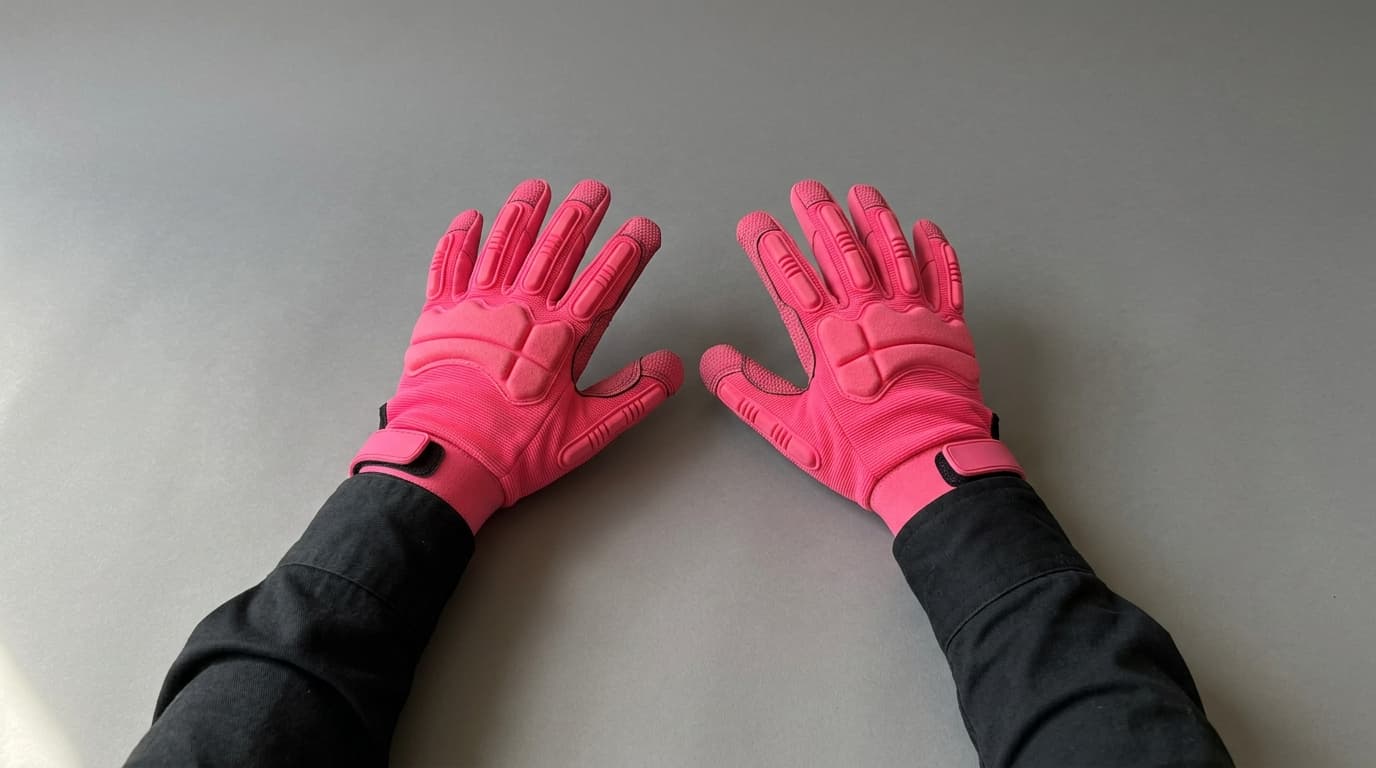
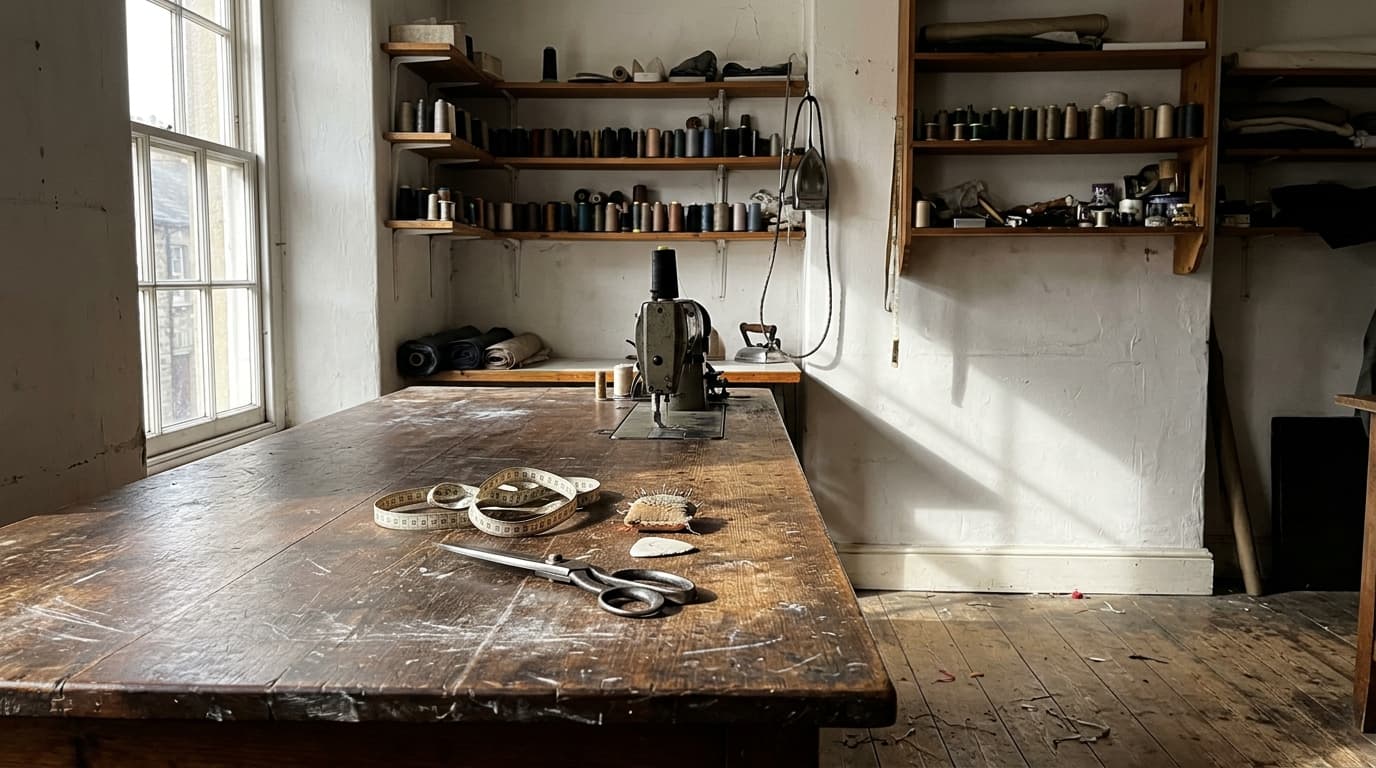
The sheet only covers the garment. So I made two more images that I reuse on every product, both from a prompt alone: the gloves on plain grey with nothing else in frame, and an empty workroom with no fabric on the table.
Exact prompt
Create a new photorealistic image of a pair of gloved hands and forearms only, on a plain background. THE VIBE: A clean, tactile hand reference for a tailor's workshop film: bold pink against dark sleeves, crisp and unfussy, the gloves the whole subject. THE SUBJECT: The two hands in bright neon-pink padded work gloves, resting open in front of the lens, fingers slightly apart, palms down, at a slight angle. The gloves have raised foam knuckle pads, a textured grip surface across the fingertips and palm, a stitched seam along each finger and a wrist strap. The dark black long sleeves of a fitted work shirt enter from the bottom of the frame and cover the forearms to the wrists. Only the gloved hands and dark-sleeved forearms are visible: no face, no body, no bare skin. THE SETTING: A plain, seamless, mid-grey studio background with nothing else in frame: no table, no cloth, no tools, no props. THE LIGHT: Soft window light from the left is the only key, with the gloves' shadow side falling softly to the right onto the grey. A faint rim of light along the knuckle pads separates the pink from the background. THE KEY DETAILS: The foam knuckle pads, the stitched finger seams, the textured grip fingertips, the wrist strap and its buckle. THE MOOD: A precise, matter-of-fact product reference. THE COMPOSITION: The two hands centred and large in the frame, the forearms rising out of the bottom edge, plenty of plain grey around them. THE CAMERA: Shot on an iPhone, deep focus, everything sharp, no background blur; soft window light, eye-level. No text, no logos, no faces, no people, no bare skin, no extra fingers, no warped hands.
Exact prompt
Create a new photorealistic image of an empty tailor's workroom, with no people. THE VIBE: A lived-in tailor's workroom just before the work begins, quiet and focused, hard light cutting across worn wood. THE SUBJECT: A long worn wooden work table with a bare, scratched, chalk-dusted top, nothing laid on it but a pair of steel tailor's shears, a roll of measuring tape, a stub of tailor's chalk and a small pincushion with pins. On the table behind them stands an industrial sewing machine with a spool of black thread on top. No cloth, no fabric, no garments, no hands, no people. THE SETTING: A tailor's workroom with whitewashed walls, wooden shelves along the back wall holding spools of thread, a few rolls of cloth tucked out of focus and a hanging steam iron, a worn plank floor, and a tall window on the left. Lived-in wear, thread ends and chalk dust on the table, not a clean showroom. THE LIGHT: Hard window light raking in from the tall window on the left is the key, laying long bright bars across the table and floor and casting sharp shadows to the right; a soft warm fill from the room lifts the shadows, and the shelves and machine fall into soft shade. Exposed for the window light, the far right of the room falls into gentle shadow. THE KEY DETAILS: Chalk dust catching the raking light, the polished steel of the shears, scratches and old stains on the tabletop, spools of thread on the shelves. THE MOOD: A quiet working studio, practical and warm. THE COMPOSITION: The table fills the lower half of the frame with the sewing machine at its far side, the shelves and window behind it, shot at table height, a wide view of the whole workroom. THE CAMERA: Shot on an iPhone, deep focus, everything sharp, no background blur; the window's own raking daylight, eye-level. No text, no logos, no people, no hands, no fabric on the table.
In the video prompt each one gets one job. The sheet is the garment: match it exactly, but not its white background or its grid. The gloves image is the hands only. The room is the table, shelves and window light only, not the cloth rolls.
6. Check the last shot
Here's the poncho video with all three references.
Exact prompt
Create a new video: a fast, rhythmic "how it's made" film of an oversized glossy mustard-yellow poncho-cape coat being made by hand, from a flat length of coated yellow cloth to the finished piece. Every shot is an extreme close-up on a tool at work, so close the tool fills the frame, and the neon-pink gloved fingertips are in every process shot. Only gloved hands and dark-sleeved forearms are ever seen; no face, no body. The work happens in a tailor's workroom: hard window light raking in from the left, soft warm fill, a worn wooden table, shelves and a sewing machine falling out of focus behind. Slick lacquered yellow cloth, chalk dust, thread, specular streaks. Fast, precise cuts on the beat, most shots well under a second, high-energy motion, with cuts matched on lines and rounds (the chalk line, the stitch line, the row of zip teeth, the curve of the hood). Every shot has one clear move with a stated speed, and the frame follows the tool along its work: it rides alongside the blades, tracks the needle, glides with the iron. Several shots are filmed from directly beneath the work, looking up through a clear glass plate at the tool coming toward us. The final scene is a held hero shot, noticeably longer than all the others. Roles, stated once: the poncho in [Image1] is the subject. Its high-gloss mustard-yellow coated cloth, high funnel collar with the draped hood, centre-front zip, trench-style storm flaps across the shoulders and long asymmetric hem with pointed side drapes must match exactly and must not change. Take only the garment from [Image1], not its white background or its tile layout. [Image2] is the hands only: padded neon-pink work gloves with dark sleeves, kept identical in every shot, taking nothing from its background or pose. [Image3] is the workroom only: take its table, shelves, sewing machine, steam iron and window light, not the cloth rolls. [SCENE 1] Two cuts. First, an extreme macro from below through glass as a gloved fingertip presses slick yellow cloth flat, slow push-in. Then a top-down macro as chalk draws the pattern line, a fast lateral track along the line. [SCENE 2] Two cuts. First, an extreme close-up from beneath the cutting line, looking up as the steel blades of the shears open over the chalk line, a strip of yellow cloth peeling away, a fast track riding along the cut. Then a tight low lateral track alongside the blades as they bite on down the line, pink gloved fingers holding the cloth. [SCENE 3] Two cuts. First, a macro push-in as fabric clips snap onto the edges of two yellow panels, pink fingertips pressing each clip down. Then a fast lateral track along the row of clips. [SCENE 4] Two cuts. First, a macro from directly below looking straight up at the needle punching down through the yellow cloth, pink fingertips either side, a held tight push-in. Then a fast lateral track along the stitch line as the needle runs, thread racing through. [SCENE 5] Two cuts. First, a close tracking tilt up as pink gloved fingers press a seam allowance flat. Then a macro from below as the finished seam runs out under the needle. [SCENE 6] Two cuts. First, a macro as a shoulder storm flap is turned right side out and pressed flat by pink fingertips. Then a fast track along its edge as the needle topstitches it close to the edge. [SCENE 7] Two cuts. First, a fast lateral track along the row of zip teeth as a pink fingertip runs the zip pull up. Then a quick push-in on the zip pull at the top of the chest placket. [SCENE 8] Two cuts. First, a low orbit around the high funnel collar as pink gloves fold the hood around it. Then a macro as the glossy cloth flexes and the specular streak slides along the curve. [SCENE 9] Two cuts. First, a fast lateral track riding with the iron as it presses the yellow cloth under a press cloth, low heat, no steam, pink glove on the handle. Then a macro from below as the press cloth lifts away from the lacquered surface. [SCENE 10] The finished poncho from [Image1] standing alone on a plain dress form in the workroom, large and centred, the whole garment fully visible with its high funnel collar, hood, zip, shoulder storm flaps and pointed side drapes, a slow push-in settling to a locked frame, window light raking across the glossy cloth. Held steady, no hand holding it. Match the poncho from [Image1] exactly: high-gloss mustard-yellow cloth, funnel collar, hood, zip, storm flaps and hem must not change in the final scene, and it must stay large and readable. Take only the hands from [Image2]. Take only the workroom and light from [Image3]. No logos, no text, no lettering, no subtitles, no watermarks, no branding anywhere. No faces, no bare skin, no extra fingers, no warped hands, no melting fabric, no headless mannequin shape.
The collar, the zip and the shoulder flaps held up. But the final shot came out small, with the poncho taking up less than half the frame height. Now I always ask for the finished piece "filling most of the frame height" in the last scene.
Why it works
One photo only shows one side of a garment. The sheet hands the video model the back, the fabric up close and the details in one image, so I'm not hoping it guesses them right in every shot.
Your turn: make a 2x2 sheet of something you're selling, and check that every tile shows exactly one view.
Emero builds sheets like these for you and remembers your products for the next video, at cost.

Get one of these every day
I test new workflows daily and send them with the exact prompts, the models and the costs
5,979 generations tested so far
More workflows
See all
GPT Image 2.5 Flare - fix one thing in an image without losing the rest
Change one detail in an AI image, like size, mood or pose, while the rest of the picture stays put
GPT Image 2.5 Flare · 2 min render
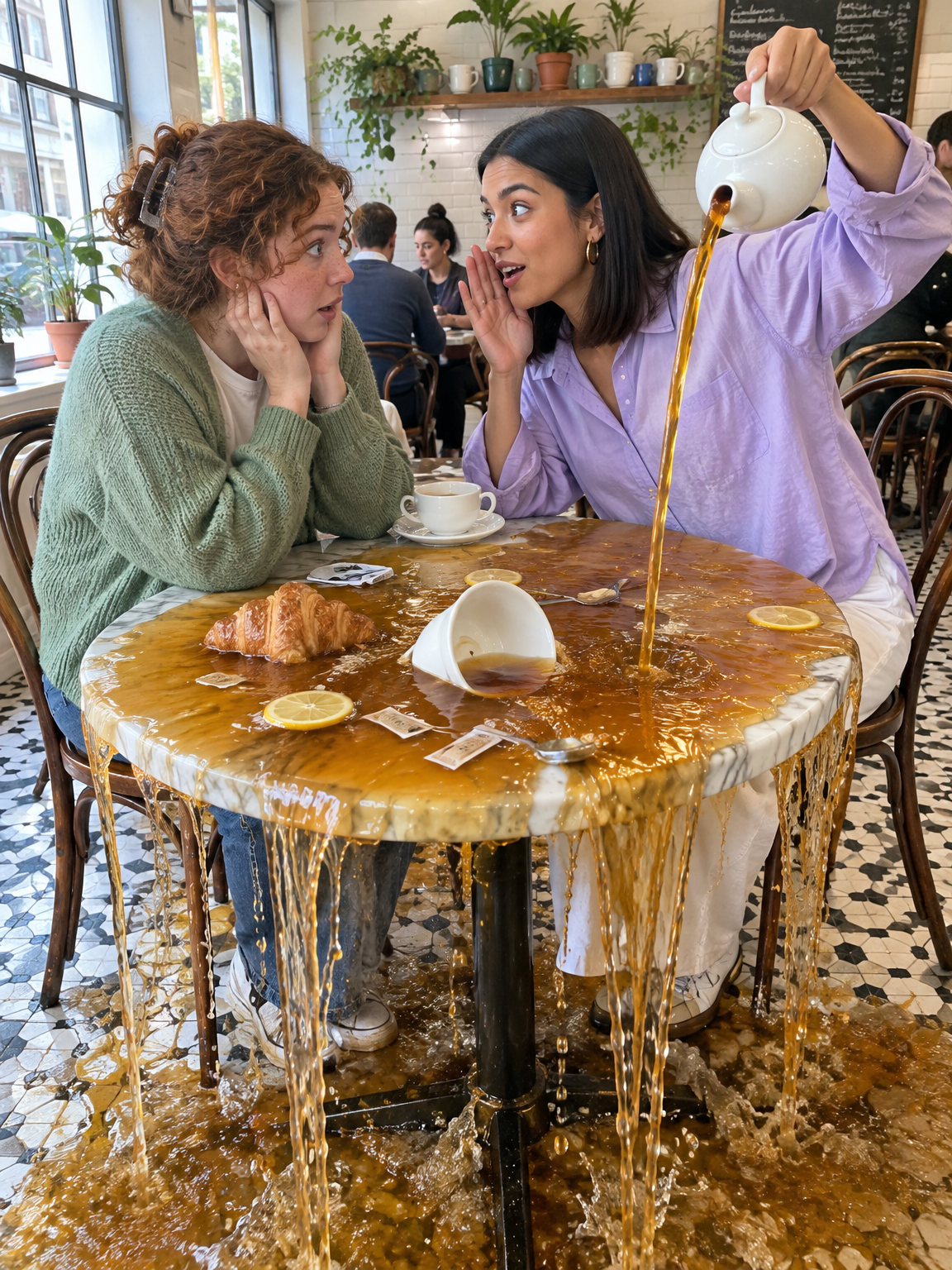
GPT Image 2.5 Flare - Gen Z slang taken literally
Turn slang like spill the tea, glazing and catfished into photos that show the words literally
GPT Image 2.5 Flare · 2 min render
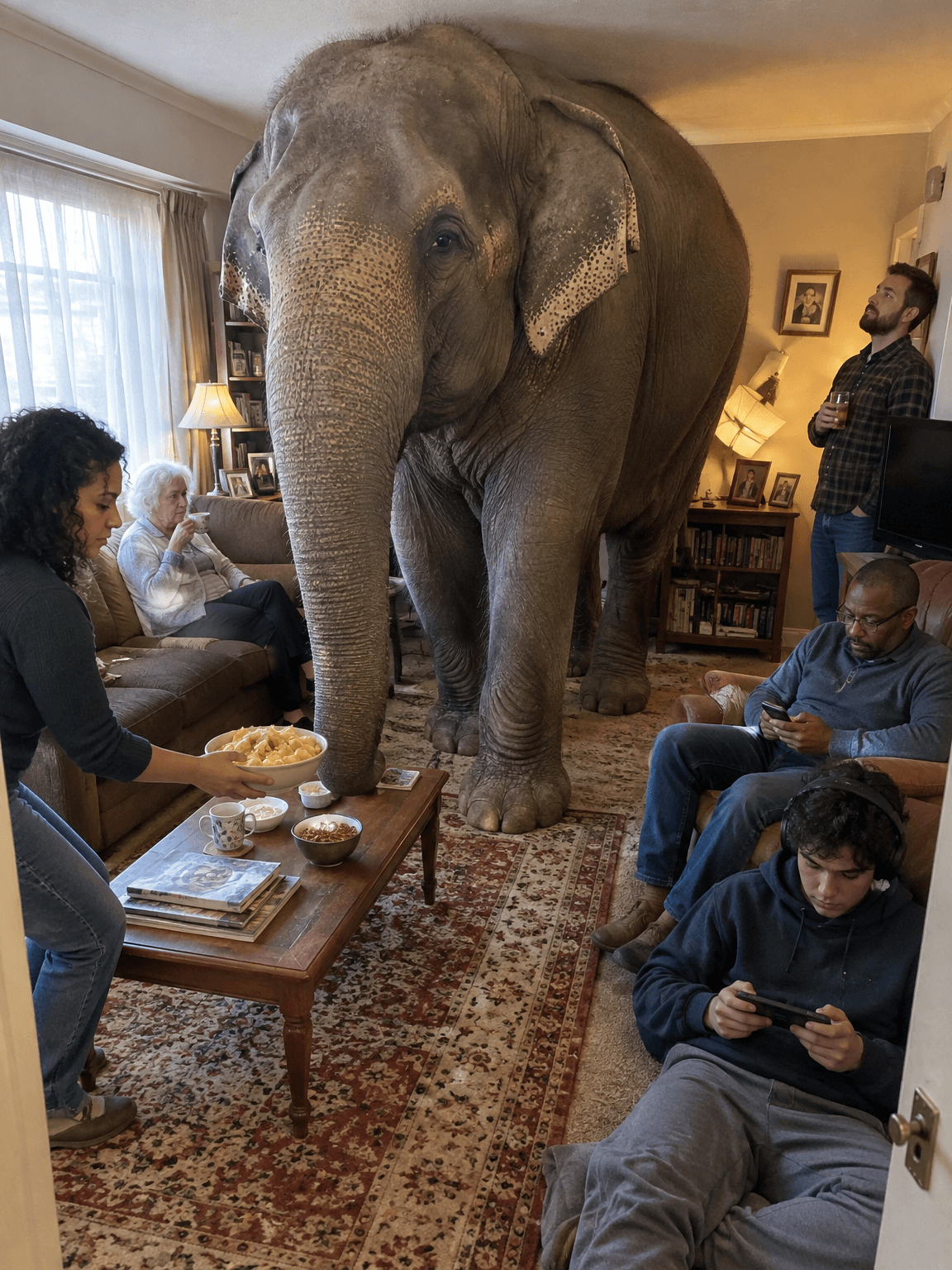
GPT Image 2.5 Flare - old sayings turned into deadpan photos
Turn everyday sayings into realistic photos where one impossible thing happens and nobody reacts
GPT Image 2.5 Flare · 1 min render