Disclaimer: This is an independent creative test made with AI, for demonstration only. It isn't an ad for any brand shown or named, and isn't affiliated with, sponsored or endorsed by them. All trademarks belong to their owners
Seedance 2.5 + Nano Banana 2 Lite - extreme close-ups for a how it's made jacket video
How I got real extreme close-ups in a how it's made video, across two jackets and seven takes
 Tested by Nouamane Benbrahim
How do you make a "how it's made" video people actually stop scrolling on?
My answer was a pair of neon pink work gloves and close-ups so tight the tools fill the frame. I put the gloves on a tailor's hands, took a black military jacket from a runway photo, and made the same video four different ways. Then I took what worked to a black feather jacket and needed three more takes to get it close enough. Neither jacket is a client, these were just tests.
Here's my exact process.
1. Turn the runway photo into a product shot
First, I need the jacket on its own. I gave the model the runway photo and asked for a clean catalogue shot with nobody in it: same black wool, same stand-up collar, same five rows of frogging with covered buttons, on white.
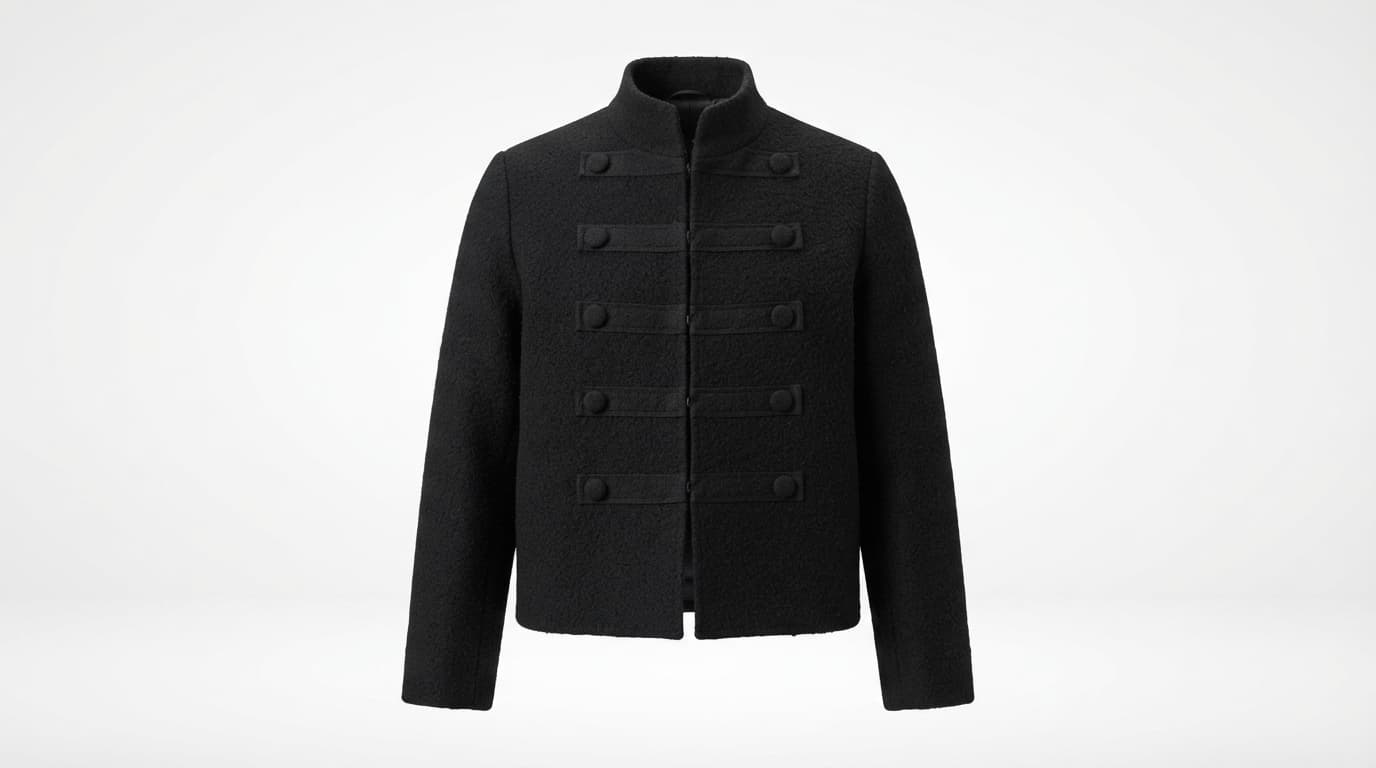
Exact prompt
Create a new photorealistic e-commerce product photograph of the jacket from the first reference, on its own with no person. Preserve the exact garment from the first reference: cropped black boiled-wool jacket with a stand-up mandarin collar, five rows of horizontal black wool-tape frogging across the chest, each row ending in a fabric-covered button on both sides, concealed hook-and-eye front closure, clean raw-looking hem, long set-in sleeves. THE VIBE: A clean, honest catalog shot of one hero jacket. Quiet, premium, nothing competing with the garment. Looks like a real studio product photo from a fashion retailer. THE SUBJECT: The jacket alone, front view, on an invisible ghost mannequin so it holds its natural shoulders and shape, fastened closed, sleeves hanging naturally at the sides slightly angled away from the body. Black wool bouclé-like textured surface with visible fibre nap, matte. The frogging tapes and covered buttons are tonal black, symmetrical, evenly spaced, exactly five rows. Collar stands upright. No person, no model, no hands, no shirt, no jeans, no sunglasses, no hanger. THE SETTING: Seamless pure white studio background, subtle soft floor-to-wall gradient, a faint soft contact shadow under the hem so it does not float. THE LIGHT: Large soft overhead-front studio softbox, even and diffuse, gentle fill from both sides, low contrast, just enough directional shaping to show the wool texture and the raised frogging. Neutral colour balance, true black without crushed detail. THE KEY DETAILS: Frogging tapes and covered buttons readable against the black wool, collar interior and shoulder seams visible, fabric texture sharp. No logos, no labels, no text, no tags. THE MOOD: Calm, clean, retail-ready. THE COMPOSITION: Jacket centred, filling about 75% of the frame height, generous white margin left and right for the 16:9 frame, straight-on and symmetrical. THE CAMERA: Product photography, 85mm equivalent, straight-on at chest height, deep focus so the whole jacket is sharp.
2. Find the gloves
Then the hands. My first idea was glossy pink latex gloves.
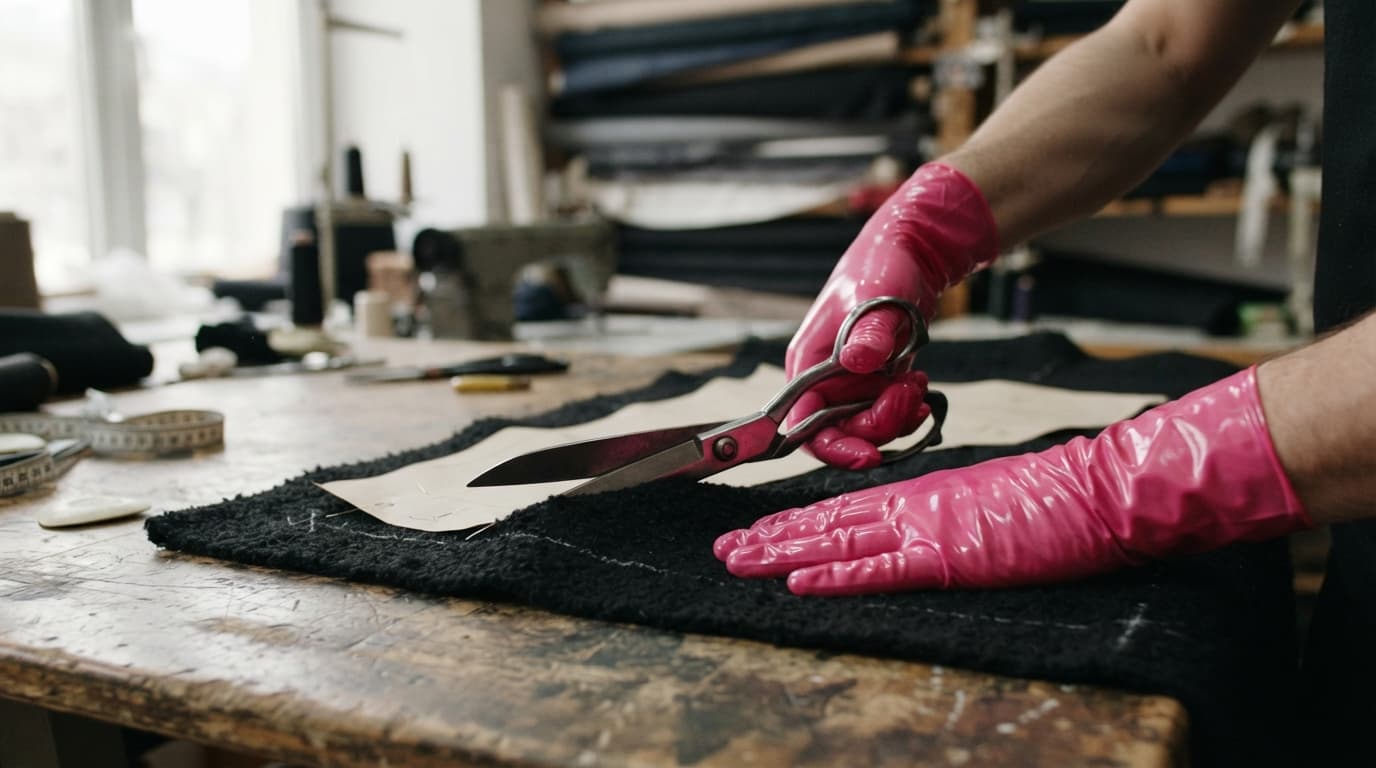
Exact prompt
Create a new photorealistic image. Commercial product-film still, unretouched, shot on location, looks like a real photograph and not a render. THE VIBE: A tailor's hands at work, made unforgettable by a single shocking colour. Black wool, steel and wood in the frame, and one pair of super bright glossy pink gloves that make you stop scrolling and ask what those gloves are. Confident, tactile, a little surreal. THE SUBJECT: Two adult hands, no face, no body visible, wearing tight-fitting glossy hot-pink latex-style gloves in a vivid saturated bubblegum-to-hot-pink (like highlighter pink), smooth and reflective with soft highlights along each finger, wrinkles at the knuckles and wrists, no logos, no text, no cuffs with branding. Exactly five fingers on each hand, natural proportions, relaxed natural grip. The right hand holds large steel tailor's shears mid-cut through a layer of black textured wool fabric; the left hand rests flat on the fabric, fingers spread, pressing it smooth. Both hands are at the centre of the frame, clearly the hero. THE SETTING: A worn wooden cutting table in a working tailoring workroom, a long sheet of black nubby wool bouclé fabric laid flat across it with a paper pattern piece chalk-marked on top, a tape measure, a piece of tailor's chalk and a few pins nearby. Softly out-of-focus background with a rack of fabric rolls and a sewing machine silhouette. No people, no signage, no brand names. THE LIGHT: Large window light from camera-left, soft and directional, with a gentle fill bounce from the table, so the pink gloves catch long soft specular highlights while the black wool stays matte and detailed. Natural warm-neutral colour, the pink slightly vivid but not neon-glowing. THE KEY DETAILS: The glossy pink gloves against matte black wool are the whole idea. The shears' steel edge visible mid-cut, fabric nap and weave texture sharp, chalk lines on the paper pattern, no readable text anywhere. THE MOOD: Playful craftsmanship, bold, eye-catching, premium. THE COMPOSITION: 16:9 landscape, hands slightly right of centre, filling roughly 45% of the frame, fabric sweeping diagonally from lower-left, shallow depth of field with the gloves in crisp focus. THE CAMERA: Shot like a real photograph, 50mm lens at a slightly raised three-quarter angle looking down on the table, natural grain.
They looked like dish gloves, and you could see bare arms. So I tried huge puffy insulated ones.
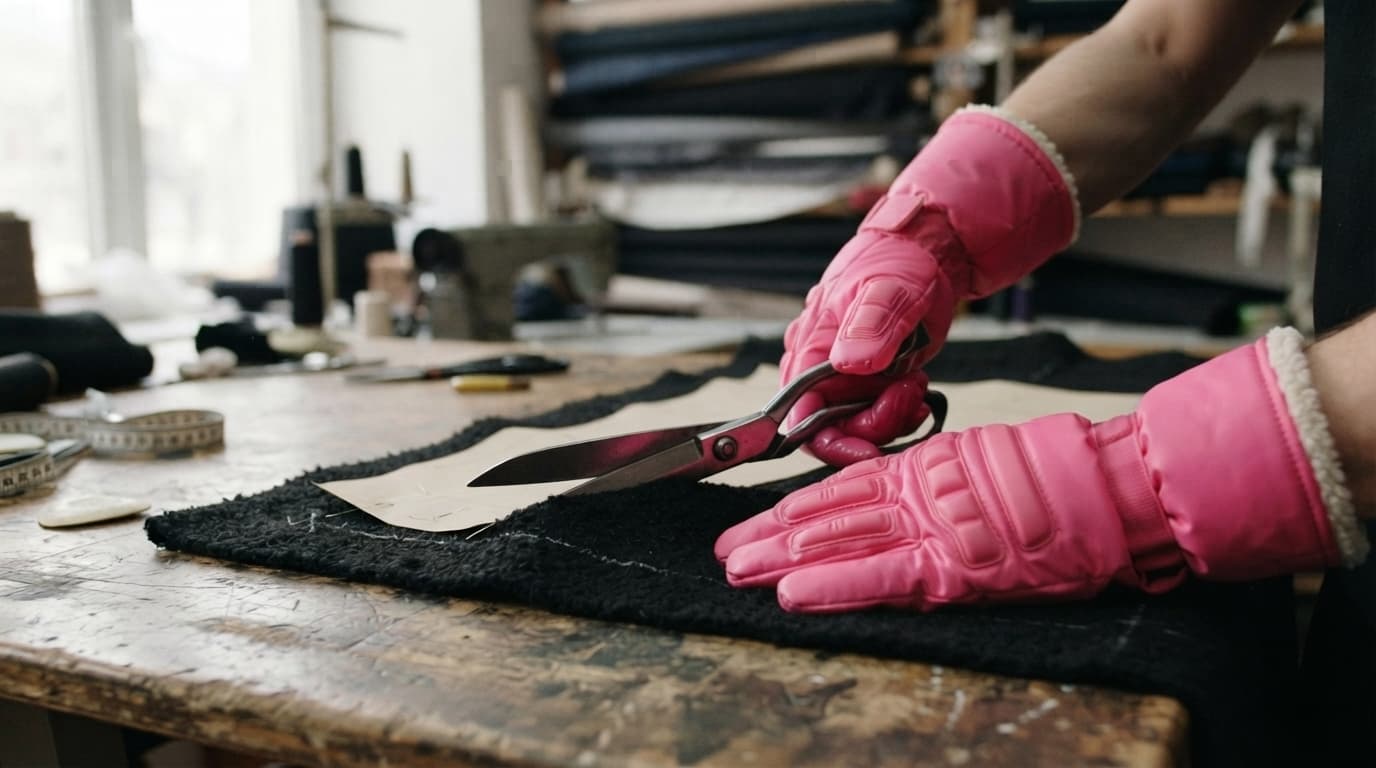
Exact prompt
Create a new photorealistic image. Take the whole scene from the first reference: the tailor's workroom, the worn wooden cutting table, the black bouclé wool with the chalk-marked paper pattern, the tape measure and chalk, the soft window light from the left and the same camera angle and framing. Keep the steel tailor's shears cutting through the pattern in the right hand and the left hand pressing the fabric flat. Change only the gloves. Editorial photography, unretouched, looks like a real photograph and not a render. THE VIBE: The same craft moment, but the hands now wear huge, chunky, heavy insulated work gloves in super bright hot pink. They are comically bulky next to the delicate tailoring work, which makes people stop and ask what those gloves are. THE SUBJECT: Two hands, no face, wearing very bulky padded insulated work gloves in a vivid saturated highlighter hot pink, bright bubblegum pink leaning to neon, clearly brighter than a raspberry. The gloves are thick like cold-weather insulated work gloves: heavily padded puffy fingers like sausages, a thick shell with quilted stitched panels, thick padded palms, molded rubber-style knuckle guards on the back of each hand, a chunky extended gauntlet cuff with a cinch strap and a hint of fluffy cream sherpa lining visible at the cuff opening. Material is a tough matte-satin coated fabric with soft highlights, no logos and no text. The gloves are clearly much bigger and puffier than normal gloves, with fingers about twice normal thickness. Exactly five fingers on each hand, natural proportions despite the bulk. The right hand clumsily but firmly grips the large steel tailor's shears mid-cut through the paper pattern; the left hand rests flat on the black wool, thick fingers spread. THE SETTING: Same as the first reference: worn wooden table with scars, black nubby wool bouclé with a chalk-marked brown paper pattern, tape measure and tailor's chalk on the left, a blurred shelf of dark fabric rolls and a vintage sewing machine in the background. Both arms are short in frame and covered by the thick gauntlet cuffs to the wrist, with dark sleeves above. No faces, no brand names, no readable text. THE LIGHT: Soft directional window light from the left as in the first reference, with natural warm-neutral colour. The pink gloves catch broad soft highlights across the padded fingers and knuckle guards, the black wool stays matte. THE KEY DETAILS: Super bright pink bulky gloves with quilted padding and knuckle guards against the matte black wool, steel shears mid-cut, chalk lines on the pattern. THE MOOD: Playful, bold, eye-catching craftsmanship with a visual joke. THE COMPOSITION: 16:9 landscape, same framing as the first reference, hands slightly right of centre filling about 50% of the frame, shallow depth of field with the gloves and shears in crisp focus. THE CAMERA: Shot like a real photograph, 50mm lens at a slightly raised three-quarter angle looking down on the table, natural grain.
Funny, but still bare arms. The one I kept is a padded mechanic-style work glove in neon pink. I used a photo of a real glove for the design, told the model to strip every logo and label off it, and covered the wrists with dark sleeves so there's no skin anywhere.
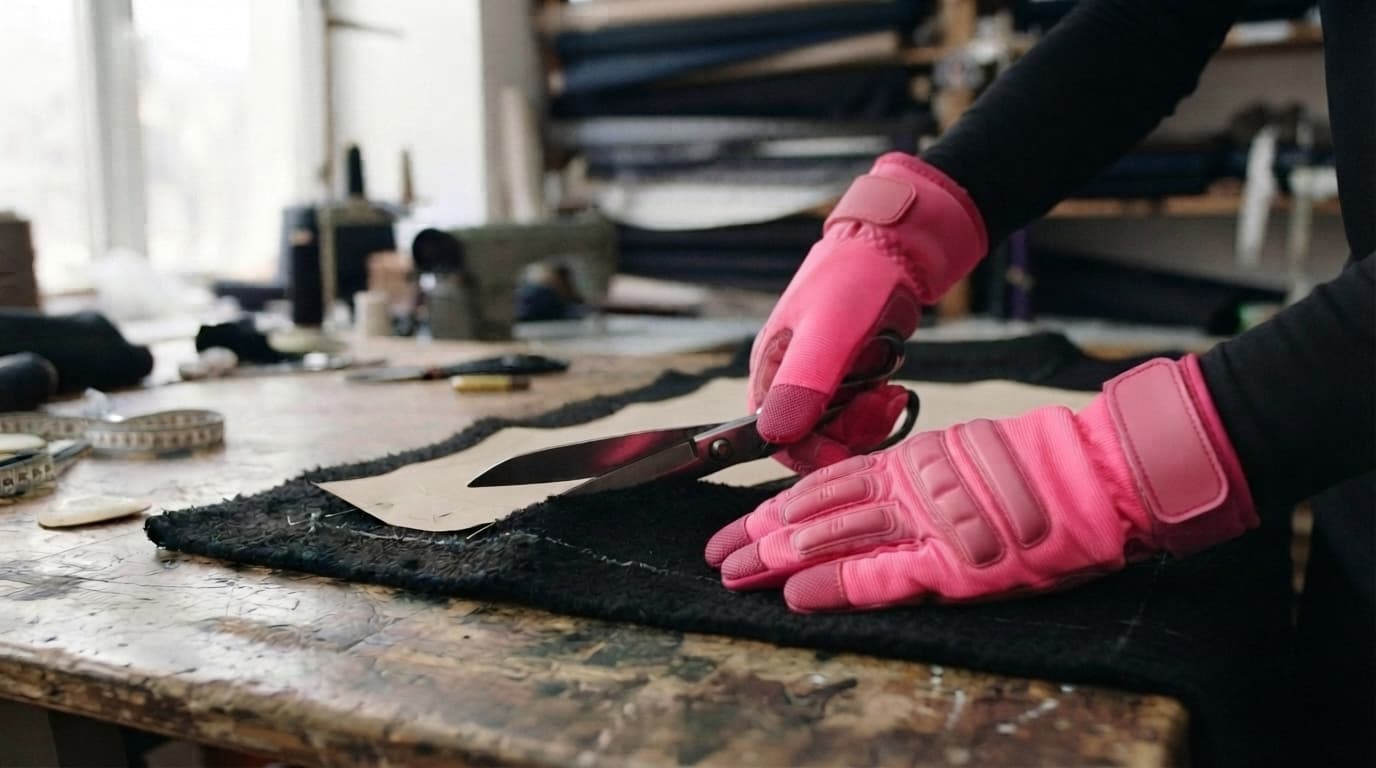
Exact prompt
Create a new photorealistic image. Use the second reference as the scene: the tailor's workroom table, the black nubby bouclé wool with the chalk-marked paper pattern, the tape measure and chalk on the left, blurred shelves and sewing machine behind, soft window light from the left, the steel shears mid-cut in the right hand, the left hand pressing the wool flat, and the dark sleeves at the wrists. Keep the same camera angle and tight framing. Replace the gloves entirely with the glove from the first reference. Editorial photography, unretouched, looks like a real photograph and not a render. THE VIBE: The same craft moment, but the hands wear the exact cold-weather work gloves from the first reference, recolored in a shockingly bright neon pink. People should stop and ask what those gloves are. THE SUBJECT: Two hands, no face, wearing the glove from the first reference. Copy its exact design and proportions: the tight-knit stretch fabric back, the thick padded panel across the knuckles with stitched seams, the contrasting flexible gusset panels between the fingers, thick padded fingers with reinforced textured fingertip patches, and the wide hook-and-loop wrist strap with a rubberized pull tab. Recolor it in a vivid neon highlighter pink, fluorescent hot pink, clearly brighter than raspberry or salmon. The stretch-knit back and knuckle panel are in neon pink, the finger gussets and fingertip patches in a deeper hot pink, the palm panels in a darker pink synthetic suede with white contrast topstitching. Remove every logo, brand patch, label, printed text and tag from the glove: the cuff tab and back-of-hand patch are blank plain pink rubber, no letters anywhere. Natural proportions, exactly five fingers on each hand. The right hand grips the steel tailor's shears mid-cut through the paper pattern with the fingers wrapped naturally around the handle and the thumb visible through the other handle loop. The left hand rests flat on the black wool with the fingers slightly spread. THE SETTING: As in the second reference. The wrists disappear into plain dark long sleeves, no bare skin and no torso or apron in frame. THE LIGHT: Soft directional window light from the left with natural neutral colour. The neon pink keeps its saturation without clipping, soft highlights on the padded knuckles, and the wool stays matte black. THE KEY DETAILS: Neon pink padded work gloves with stitched knuckle padding, white topstitching and blank straps, steel shears mid-cut, chalk lines on the pattern, black bouclé wool. THE MOOD: Playful, bold, eye-catching craft with a visual joke. THE COMPOSITION: 16:9 landscape, same tight framing as the second reference, the two gloved hands and shears filling about 65% of the frame, shallow depth of field with the gloves and shears in crisp focus. THE CAMERA: Shot like a real photograph, 50mm lens at a slightly raised three-quarter angle looking down on the table, natural grain.
3. Pull the room out of the same photo
Now I need the workroom. Instead of making a new room from scratch, I took that glove still and asked for the whole room, pulled back, with the hands and shears removed. That way the table, the window light and the shelves match the close-ups.
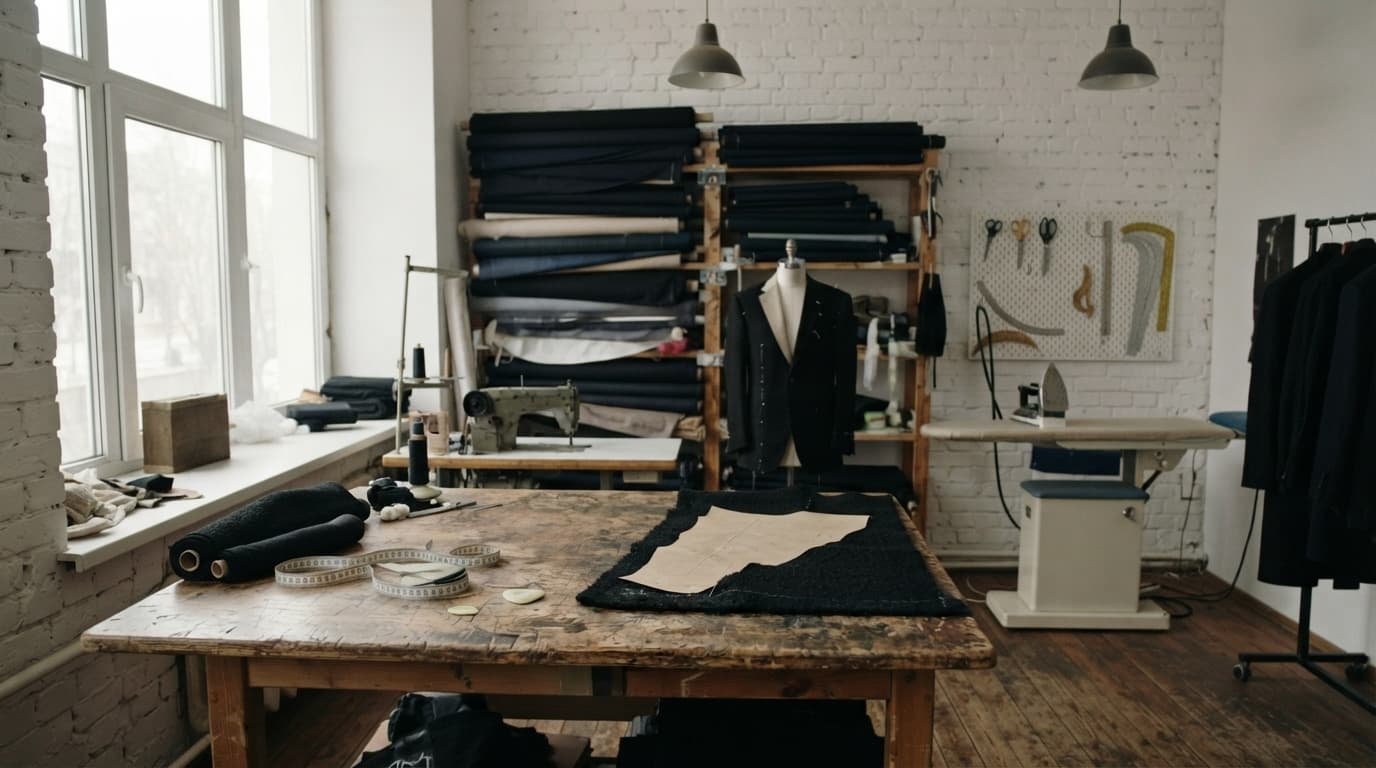
Exact prompt
Create a new photorealistic image. Unretouched architectural interior photograph of a working tailoring workroom, no people at all. Take the room, the worn wooden cutting table, the window light and the overall feel from the first reference, and pull the view back so the whole workroom is visible. Remove the hands, gloves, arms, shears and any person completely; nobody is in the room. THE VIBE: A quiet, lived-in tailor's workroom just before the work begins. Warm, tactile, authentic, with craft tools everywhere and no one in frame. Looks like a real location photograph, not a render. THE SUBJECT: The worn wooden cutting table from the first reference, a long scarred butcher-block style table with tape measure, tailor's chalk and pins on it, now empty of hands. A length of black nubby bouclé wool fabric lies flat across the table with a chalk-marked brown paper pattern piece on top, exactly as in the first reference. No scissors in the frame, no gloves, no hands, no people. THE SETTING: A wide view of the whole workroom. Tall windows along the left wall letting in daylight, floor-to-ceiling shelving on the back wall stacked with rolls of dark wool, navy and charcoal fabric, an industrial straight-stitch sewing machine on its own sewing table at the back left, a tailor's dress form with a half-finished black jacket pinned on it, spools of thread, a steam iron on a pressing table with a padded ironing board, a pegboard of shears, rulers and curves, a clothing rail with finished dark garments. Wooden floorboards, white-painted brick walls, a few pendant lamps. Lived-in but tidy. No signage, no brand names, no readable text. THE LIGHT: Soft daylight from the tall windows on the left, directional and gently diffused, falling across the cutting table in the centre and fading into the room. Warm-neutral colour balance, natural contrast, no neon, no spotlights. THE KEY DETAILS: The cutting table with the black wool and chalk-marked pattern clearly in the middle of the frame, the sewing machine, the dress form and the pressing table readable in the same room so the stations are visible, wooden surfaces with realistic wear. THE MOOD: Calm, craft, premium workshop. THE COMPOSITION: Wide establishing shot, 16:9 landscape, camera pulled back so the cutting table sits in the lower centre and the room fills the rest of the frame, shelves and windows on the sides, depth stretching to the back wall. Everything in the room reasonably sharp. THE CAMERA: Shot like a real photograph, 24mm wide-angle lens at eye level slightly above table height, deep focus, natural grain.
4. Version one: four slow shots
With those three images as references, I tried four hard cuts, each one locked onto a tool: the shears, the needle, the iron, then the jacket on a dress form.
Exact prompt
Create a new video: a cinematic "how it's made" film of a black wool military-style jacket coming together in a tailor's workroom, told in four hard-cut shots. Each shot locks onto a tool and follows it with smooth, steady tracking movement. Soft window light from the left, warm and overcast, shallow focus, tactile craftsmanship mood. Match the jacket from [Image1] exactly: black wool, stand-up collar, five rows of tonal tape frogging with covered buttons, hook-and-eye front; it must not change. The only hands in frame are the neon-pink padded work gloves from [Image2], matched exactly, with dark sleeves; take only the gloves and their grip from [Image2], not its framing. The workroom and black bouclé wool from [Image3] are the setting. [SCENE 1] Low, tight on the table. The steel shears bite into the chalk line on the black wool and the frame glides right alongside the blades, riding the cut line as they advance, a clean strip of wool peeling away behind them. Gloved left hand holds the cloth flat. [SCENE 2] Hard cut. Close on the sewing machine needle punching down through tonal tape frogging, pink gloves guiding the tape. The frame tracks along the stitch line at the pace of the fabric, keeping the needle and stitching sharp. [SCENE 3] Hard cut. A steam iron presses the wool under a press cloth. The frame glides with the iron through its full pass, steam rising and catching the window light, the pink glove steady on the handle. [SCENE 4] Hard cut. The finished jacket from [Image1] stands alone on a plain dress form. A slow push-in settles into a locked hero frame, the whole jacket large and centred, collar and frogging clearly readable, a long still hold. No hand holding it. No logos, no text, no lettering, no labels anywhere. No faces, no bare skin, no extra fingers, no warped hands, no melting fabric, no headless mannequin shape.
It came out slow. Most shots sit far enough back that you see the whole glove and the table, so it never feels like a close-up film.
5. Version two: one long glide
Then I tried the opposite, one unbroken move gliding along the bench from station to station.
Exact prompt
Create a new video: one unbroken, gliding "how it's made" shot following a black wool military-style jacket as it comes together along a single long tailor's workbench, station by station, ending on the finished jacket. Soft window light from the left, warm and overcast, quiet craftsmanship mood, shallow focus, fine natural texture, unhurried and tactile. Match the jacket from [Image1] exactly: black wool, stand-up collar, five rows of tonal tape frogging with covered buttons, hook-and-eye front; it must not change. The only hands in frame are the neon-pink padded work gloves from [Image2], matched exactly, with dark sleeves and no faces and no bare skin; take only the gloves and their grip from [Image2], not its framing. The workroom, table and wool from [Image3] are the setting; keep its shelves and sewing machine softly out of focus behind. [SCENE 1] A single continuous lateral tracking move, gliding slowly along the workbench at table height and never cutting: it opens on black bouclé wool laid flat with a chalk-marked paper pattern, a pink-gloved hand smoothing the cloth while the other draws steel shears through the chalk line, a clean strip of wool peeling away. The glide drifts on to the right, past the cut panels, where pink-gloved hands guide rows of tonal tape frogging under a sewing machine needle, the stitch line running straight and even. Still drifting, it reaches a covered button being pressed into place, then a steaming iron gliding over the wool under a press cloth, steam rising softly into the window light. The glide ends by easing around to the finished jacket from [Image1] standing alone at the end of the bench on a plain dress form, frogging and stand-up collar fully visible, the move slowing to a gentle push-in and settling to a still hold. The jacket alone, no hand holding it, the whole garment large and centred in the final moments. No logos, no text, no lettering, no labels anywhere. No faces, no bare arms, no extra fingers, no warped hands, no melting fabric, no headless mannequin shape.
It drifts slowly past each station on the bench, so it ends up feeling like a tour of the workshop.
6. Version three: two-cut bursts
Next I split it into 10 scenes, each one a burst of two quick cuts, in the real build order: smooth the wool, chalk, cut, stitch, lay the tape, stitch the frogging, cover the buttons, hook and eye, shape the collar, press. Then a held shot of the jacket at the end, noticeably longer than the rest.
Exact prompt
Create a new video: a fast, rhythmic "how it's made" film of a black wool military-style jacket with tonal tape frogging being made by hand, from a flat length of black bouclé wool to the finished piece. Only a worker's gloved hands and dark-sleeved forearms are ever seen; no face, no body. The work happens in a tailor's workroom: hard window light raking in from the left, soft warm fill, a long worn wooden table, shelves and a sewing machine falling out of focus behind. Black wool, chalk dust, thread, steam. Fast, precise cuts on the beat, most shots well under a second, high-energy motion, with cuts matched on lines and rounds (the chalk line, the stitch line, the row of frogging, the round covered button). Every shot has one clear camera move with a stated speed, riding along with the tool rather than cutting away from it. The final scene is a held hero shot, noticeably longer than all the others. Roles, stated once: the jacket in [Image1] is the subject. Its black wool, stand-up collar, five rows of tonal tape frogging with covered buttons and hook-and-eye front must match exactly and must not change. [Image2] is the hands only: padded neon-pink work gloves with dark sleeves, kept identical in every shot, taking nothing from its table, wool or pose. [Image3] is the workroom only: take its table, shelves, sewing machine and window light, not the wool laid out on it. [SCENE 1] Two cuts. First, a low macro as gloved hands smooth black wool flat across the table, a fast lateral track. Then a top-down push-in as chalk draws the pattern line across the cloth. [SCENE 2] Two cuts. First, a tight low lateral track riding alongside the steel shears as they bite along the chalk line, a clean strip of wool peeling away. Then a quick top-down as the cut panel is lifted clear. [SCENE 3] Two cuts. First, a macro push-in on the sewing machine needle punching down through the seam. Then a fast track along the stitch line, the thread running straight. [SCENE 4] Two cuts. First, a close tracking tilt up as gloved hands lay tonal tape across the chest in rows. Then a top-down as pins hold the first row in place. [SCENE 5] Two cuts. First, a fast track along the needle as it stitches the frogging tape down. Then a macro on the finished loops lying in a neat row. [SCENE 6] Two cuts. First, a macro push-in as a scrap of wool is wrapped over a button and pressed in the button machine. Then a quick low track as the round covered buttons drop into a tray. [SCENE 7] Two cuts. First, a close side profile as gloved hands stitch a hook and eye into the front edge. Then a fast push-in on the covered button sewn tight to the frogging. [SCENE 8] Two cuts. First, a low orbit around the stand-up collar as it is shaped over a pressing ham. Then a macro as steam rolls off the wool. [SCENE 9] Two cuts. First, a fast lateral track riding with the iron as it presses the wool under a press cloth, steam catching the window light. Then a top-down as the press cloth is lifted away. [SCENE 10] The finished jacket from [Image1] standing alone on a plain dress form in the workroom, large and centred, the whole garment fully visible with its stand-up collar and rows of frogging, a slow push-in settling to a locked frame, window light raking across the wool. Held steady, no hand holding it. Match the jacket from [Image1] exactly: black wool, collar, frogging and buttons must not change in the final scene, and it must stay large and readable. Take only the hands from [Image2]. Take only the workroom and light from [Image3]. No logos, no text, no lettering, no subtitles, no watermarks, no branding anywhere. No faces, no bare skin, no extra fingers, no warped hands, no melting fabric, no headless mannequin shape.
Way better pace. But a few cuts still sat back at medium distance.
7. Version four: the tool fills the frame
For the next version I kept the same 10 bursts and added three lines to the opening paragraph:
- Every shot is an extreme close-up on a tool at work, so close the tool fills the frame.
- The frame follows the tool: it rides alongside the blades, tracks the needle, glides with the iron.
- Several shots are filmed from directly beneath the work, looking up through a clear glass plate.
I also changed the opening shot to the weirdest one I could think of: a pink fingertip pressing the wool flat against a sheet of glass.
Exact prompt
Create a new video: a fast, rhythmic "how it's made" film of a black wool military-style jacket with tonal tape frogging being made by hand, from a flat length of black bouclé wool to the finished piece. Every shot is an extreme close-up on a tool at work, so close the tool fills the frame, and the neon-pink gloved fingertips are in every process shot. Only gloved hands and dark-sleeved forearms are ever seen; no face, no body. The work happens in a tailor's workroom: hard window light raking in from the left, soft warm fill, a worn wooden table, shelves and a sewing machine falling out of focus behind. Black wool, chalk dust, thread, steam. Fast, precise cuts on the beat, most shots well under a second, high-energy motion, with cuts matched on lines and rounds (the chalk line, the needle line, the row of frogging, the round covered button). Every shot has one clear camera move with a stated speed, and the frame follows the tool along its work: it rides alongside the blades, tracks the needle, glides with the iron. Several shots are filmed from directly beneath the work, looking up through a clear glass plate at the tool coming toward us. The final scene is a held hero shot, noticeably longer than all the others. Roles, stated once: the jacket in [Image1] is the subject. Its black wool, stand-up collar, five rows of tonal tape frogging with covered buttons and hook-and-eye front must match exactly and must not change. [Image2] is the hands only: padded neon-pink work gloves with dark sleeves, kept identical in every shot, taking nothing from its table, wool or pose. [Image3] is the workroom only: take its table, shelves, sewing machine and window light, not the wool laid out on it. [SCENE 1] Two cuts. First, an extreme macro from below through glass as a gloved fingertip presses black wool flat, slow push-in. Then a top-down macro as chalk draws the pattern line, a fast lateral track along the line. [SCENE 2] Two cuts. First, an extreme close-up from beneath the cutting line, looking up as the steel blades of the shears open over the chalk line, wool strip peeling away, a fast track riding along the cut. Then a tight low lateral track alongside the blades as they bite on down the line, pink gloved fingers holding the cloth. [SCENE 3] Two cuts. First, a macro from directly below looking straight up at the needle punching down through the wool, pink fingertips either side, a held tight push-in. Then a fast lateral track along the stitch line as the needle runs, thread racing through. [SCENE 4] Two cuts. First, a close tracking tilt up as pink gloved hands lay tonal tape in rows. Then a macro from below as the presser foot pins the tape flat under the needle. [SCENE 5] Two cuts. First, a fast track along the needle stitching the frogging tape down, extreme close. Then a macro on the finished loops lying in a neat row, a pink fingertip tracing along them. [SCENE 6] Two cuts. First, a macro push-in as a scrap of wool is wrapped over a button and pressed in the button machine. Then a quick low track as the round covered buttons drop into a tray, pink fingers sweeping them. [SCENE 7] Two cuts. First, a close side profile as pink gloved fingers push the needle and thread through a hook and eye at the front edge. Then a fast push-in on the covered button sewn tight to the frogging. [SCENE 8] Two cuts. First, a low orbit around the stand-up collar as it is shaped over a pressing ham by pink gloves. Then a macro as steam rolls off the wool. [SCENE 9] Two cuts. First, a fast lateral track riding with the iron as it presses the wool under a press cloth, steam catching the window light, pink glove on the handle. Then a macro from below as the press cloth lifts away from the wool. [SCENE 10] The finished jacket from [Image1] standing alone on a plain dress form in the workroom, large and centred, the whole garment fully visible with its stand-up collar and rows of frogging, a slow push-in settling to a locked frame, window light raking across the wool. Held steady, no hand holding it. Match the jacket from [Image1] exactly: black wool, collar, frogging and buttons must not change in the final scene, and it must stay large and readable. Take only the hands from [Image2]. Take only the workroom and light from [Image3]. No logos, no text, no lettering, no subtitles, no watermarks, no branding anywhere. No faces, no bare skin, no extra fingers, no warped hands, no melting fabric, no headless mannequin shape.
This is the one I kept. It opens on that glass shot, the needle tip comes straight at you, and there's a tool in almost every cut. And listen, it's not perfect. The tonal frogging came out tan in a few shots and on the final jacket. But it became my template.
8. Research the next jacket before you write it
Then I tried the template on a cropped black feather jacket. I had no idea how feather garments get made, so I had Claude look it up first. A few things came back from featherwork pages: feathers get sorted by size, steamed to bring back their volume, picked up with fine tweezers, and laid in overlapping rows like roof tiles. One method lays the feathers on a strip of tissue, machine-sews across the base, then tears the tissue away to leave a fringe.
Those steps became my scenes, in that order. Anything the sources didn't cover, like how the leather shoulder straps go on, I treated as a guess. For references I used a four-view product sheet of the jacket, the pink gloves on plain grey, and an empty workroom, all made from prompts.
9. Write the gloves into every scene
My first feather take had bare fingers in two shots. One of them was the opening shot, a bare fingertip pressing the feathers on glass.
Exact prompt
Create a new video: a fast, rhythmic "how it's made" film of a cropped black feather jacket being made by hand, from loose black feathers to the finished piece. Every shot is an extreme close-up on a tool at work, so close the tool fills the frame, and the neon-pink gloved fingertips are in every process shot. Only gloved hands and dark-sleeved forearms are ever seen; no face, no body. The work happens in a tailor's workroom: hard window light raking in from the left, soft warm fill, a worn wooden table, shelves and a sewing machine falling out of focus behind. Long black feathers with a green-bronze shimmer, steam, thread, loose barbs drifting. Fast, precise cuts on the beat, most shots well under a second, high-energy motion, with cuts matched on lines and rounds (the straight row of feathers, the stitch line, the curve of a quill, the round of the sleeve). Every shot has one clear move with a stated speed, and the frame follows the tool along its work: it rides alongside the tweezers, tracks the needle, glides along the feather row. Several shots are filmed from directly beneath the work, looking up through a clear glass plate at the tool coming toward us. The final scene is a held hero shot, noticeably longer than all the others. Roles, stated once: the jacket in [Image1] is the subject. Its long narrow black feathers with the iridescent green-bronze sheen laid in dense overlapping rows, its cropped length, wide shoulders with cascading feather layers, long feathered sleeves with loose feather tips, open front, ragged feathered hem, downy scooped neckline and two black leather shoulder straps must match exactly and must not change. Take only the jacket from [Image1], not its white background or its tile layout. [Image2] is the hands only: padded neon-pink work gloves with dark sleeves, kept identical in every shot, taking nothing from its background or pose. [Image3] is the workroom only: take its table, shelves, sewing machine and window light, not the cloth rolls. [SCENE 1] Two cuts. First, an extreme macro from below through glass as a gloved fingertip presses a layer of black feathers flat, the green sheen blooming, slow push-in. Then a top-down macro as pink fingertips sort a row of long feathers by size, a fast lateral track along the row. [SCENE 2] Two cuts. First, an extreme close-up from beneath as a steamer bursts steam through a batch of feathers, the barbs lifting and fluffing up full, a fast track riding along the steam. Then a tight low track as pink fingertips brush the fronds flat so they all lie in one direction. [SCENE 3] Two cuts. First, a macro push-in as feather tweezers held in pink fingertips lift a single feather from the batch. Then a fast lateral track along a straight row of feathers laid on a strip of tissue. [SCENE 4] Two cuts. First, a macro from directly below looking straight up at the needle punching down across the base of the feathers, pink fingertips either side, a held tight push-in. Then a fast lateral track along the stitch line as the needle runs, thread racing through. [SCENE 5] Two cuts. First, a close macro as the tissue strip is torn away from the stitched feather fringe. Then a quick tilt up as the fringe is lifted and the feathers hang loose. [SCENE 6] Two cuts. First, a fast top-down track as pink fingertips lay a new row of feathers overlapping the last like roof tiles. Then a macro push-in on the green-bronze sheen catching the raking window light. [SCENE 7] Two cuts. First, a macro riding along with the needle as a row of feathers is stitched in place on the black base. Then a quick low track along the finished edge of the layered feathers. [SCENE 8] Two cuts. First, a close side profile as a black leather strap is laid across a shoulder and tacked down by pink gloved fingers. Then a macro on the stitched strap against the feathers. [SCENE 9] Two cuts. First, a low orbit around a feathered sleeve as a pink glove smooths the feathers down toward the wrist. Then a macro as the loose feather tips settle. [SCENE 10] The finished jacket from [Image1] standing alone on a plain dress form in the workroom, filling most of the frame height, large and centred, the whole jacket fully visible with its cascading shoulders, feathered sleeves and ragged hem, a slow push-in settling to a locked frame, window light raking across the feathers so the green-bronze sheen shows. Held steady, no hand holding it. Match the jacket from [Image1] exactly: black feathers with green-bronze sheen, cropped cut, shoulders, sleeves, straps and hem must not change in the final scene, and it must stay large and readable. Take only the hands from [Image2]. Take only the workroom and light from [Image3]. No logos, no text, no lettering, no subtitles, no watermarks, no branding anywhere. No faces, no bare skin, no extra fingers, no warped hands, no melting fabric, no headless mannequin shape.
When I went back to the prompt, the opening scene said "a gloved fingertip" but never said pink. The other bare shot came from a scene that only named the needle, with no hand in it at all, and the model added one anyway. So I wrote "pink-gloved" inside every scene that has a hand, and "no hand in frame" on the shots that are just the steamer or the machine.
Exact prompt
Create a new video: a fast, rhythmic "how it's made" film of a cropped black feather jacket made by hand, from loose black feathers to the finished piece. Every shot is an extreme close-up on a tool at work, so close the tool fills the frame. Whenever a hand appears it is a neon-pink padded work glove with a dark sleeve, never a bare hand; shots of the machine or the steamer alone show no hand at all. Only gloved hands and dark-sleeved forearms are ever seen; no face, no body, no bare skin. The work happens in a tailor's workroom: hard window light raking in from the left, soft warm fill, a worn wooden table, shelves and a sewing machine out of focus behind. Long black feathers with a green-bronze shimmer, steam, thread, loose barbs. Fast cuts on the beat, most shots well under a second, with cuts matched on lines and rounds (the straight row of feathers, the stitch line, the curve of a quill, the round of the sleeve). Every shot has one clear move with a stated speed, and the frame follows the tool: riding alongside the tweezers, tracking the needle, gliding along the feather row. Several shots are filmed from directly beneath the work, looking up through a clear glass plate. The final scene is a held hero shot, noticeably longer than all the others. Roles, stated once: [Image1] is the jacket, the subject: long narrow black feathers with an iridescent green-bronze sheen in dense overlapping rows, cropped length, wide shoulders with cascading feather layers, long feathered sleeves with loose tips, open front, ragged feathered hem, downy scooped neckline, two black leather shoulder straps. Match it exactly, not its white background or tile layout. [Image2] is the hands only: padded neon-pink work gloves with dark sleeves, identical in every shot, taking nothing from its background or pose. [Image3] is the workroom only: table, shelves, sewing machine and window light, not the cloth. [SCENE 1] Two cuts. First, an extreme macro from directly beneath through a clear glass plate as a pink-gloved fingertip presses a bed of black feathers flat, a slow push-in. Then a fast lateral track as pink-gloved fingers sort a row of feathers by size. [SCENE 2] Two cuts. First, a steamer bursting steam through a batch of feathers, no hand in frame, a quick push-in. Then a close track as a pink-gloved fingertip brushes the fronds flat in one direction. [SCENE 3] Two cuts. First, feather tweezers held in a pink-gloved hand lifting a single feather, riding alongside the tweezers. Then a fast glide along a straight row of feathers laid on a strip of tissue by pink-gloved fingers. [SCENE 4] Two cuts. First, looking up from directly beneath through the glass as the needle of the sewing machine runs across the feather base, no hand in frame. Then a fast track along the stitch line with a pink-gloved fingertip guiding the tissue. [SCENE 5] Two cuts. First, pink-gloved fingers tearing the tissue strip away from the stitched base. Then a quick lift as the pink-gloved hand raises the finished fringe. [SCENE 6] Two cuts. First, a pink-gloved hand layering a new row over the last like roof tiles, tracking along the row. Then a slow glide as the raking light catches the green-bronze sheen on the overlapping feathers, no hand in frame. [SCENE 7] Two cuts. First, the sewing machine needle stitching a row onto the black base, tracking the needle, no hand in frame. Then a tight shot of the finished edge with a pink-gloved fingertip smoothing it. [SCENE 8] Two cuts. First, a pink-gloved hand laying a black leather strap across the shoulder and tacking it. Then a quick push-in on the stitched strap. [SCENE 9] Two cuts. First, a low orbit around a feathered sleeve as a pink-gloved hand smooths it toward the wrist. Then the loose feather tips settling, no hand in frame. [SCENE 10] The finished jacket from [Image1] standing alone on a plain dress form in the workroom, filling most of the frame height, large and centred, a slow push-in settling to a locked frame, window light raking so the green-bronze sheen shows. Held steady, no hand holding it. Match the jacket from [Image1] exactly: black iridescent feathers, wide cascading shoulders, long feathered sleeves, open front and leather shoulder straps must not change in the final scene, and it must stay large and readable. Take only the hands from [Image2], always gloved in neon pink. Take only the workroom and light from [Image3]. No logos, no text, no lettering, no subtitles, no watermarks, no branding anywhere. No faces, no bare skin, no bare fingers, no bare hands, no extra fingers, no warped hands, no melting fabric, no headless mannequin shape.
Every hand came out gloved. But in my words: "the closeups weren't extreme enough to give personality to the video". Whole gloves filled a lot of the frames.
10. Make the tool the subject of every cut
So I compared it line by line with version four of the military jacket. Three things stood out:
- Version four names the shot size in almost every cut. "An extreme macro from below", "a top-down macro", "a tight low lateral track". My feather prompt only said it once at the top.
- The tool is the subject of the sentence. "The needle punching down", "the steel blades of the shears open". After my glove fix, most of my feather lines started with "a pink-gloved hand", and my guess is that pulled the framing out to fit the whole hand.
- Every beat has a tool in it. My feather prompt had beats like "smooth the sleeve" and "tear the tissue" with nothing small to fill the frame.
So every cut now opens with "extreme close-up" or "extreme macro". The subject is always a tool: the tweezer tips, the steam nozzle, the machine needle, the presser foot, a hand needle, a curved needle going through the leather strap. And the gloves are just a pink-gloved fingertip at the edge of the frame.
Exact prompt
Create a new video: a fast, rhythmic "how it's made" film of a cropped black feather jacket being made by hand, from loose black feathers to the finished piece. Every shot is an extreme close-up on a tool at work, so close the tool fills the frame, and neon-pink gloved fingertips are at the edge of every process shot; never a bare hand. Only gloved fingertips and dark-sleeved forearms are ever seen; no face, no body. The work happens in a tailor's workroom: hard window light raking in from the left, soft warm fill, a worn wooden table, shelves and a sewing machine falling out of focus behind. Long black feathers with a green-bronze shimmer, single barbs, steam, thread, fine wire. Fast, precise cuts on the beat, most shots well under a second, high-energy motion, with cuts matched on lines and rounds (the quill line, the needle line, the row of feathers, the curl of a feather tip). Every shot has one clear move with a stated speed, and the frame follows the tool along its work: it rides alongside the tweezers, tracks the needle, glides with the steam nozzle. Several shots are filmed from directly beneath the work, looking up through a clear glass plate at the tool coming toward us. The final scene is a held hero shot, noticeably longer than all the others. Roles, stated once: the jacket in [Image1] is the subject. Its long narrow black feathers with green-bronze sheen in dense overlapping rows, cropped length, wide cascading shoulders, long feathered sleeves with loose tips, open front and two black leather shoulder straps must match exactly and must not change; not its white background or tile layout. [Image2] is the hands only: padded neon-pink work gloves with dark sleeves, kept identical in every shot, taking nothing from its table or pose. [Image3] is the workroom only: take its table, shelves, sewing machine and window light, not the cloth laid out on it. [SCENE 1] Two cuts. First, an extreme macro from below through glass as a pink gloved fingertip presses a black feather flat against the glass, barbs splaying, slow push-in. Then an extreme close-up top-down on the steel tips of feather tweezers lifting a single feather by its quill, a fast lateral track along the quill. [SCENE 2] Two cuts. First, an extreme close-up on the brass nozzle of a steamer as a burst of steam rolls over a feather, the barbs lifting and fluffing, a fast push-in. Then an extreme macro on the feather barbs springing open in the steam, pink fingertip at the edge of frame. [SCENE 3] Two cuts. First, an extreme close-up from beneath the glass, looking up as the tweezers tips set a feather quill down in a straight row on a strip of tissue, a fast track riding along the row. Then a tight low lateral track alongside the row of quills, a pink gloved fingertip nudging the last one level. [SCENE 4] Two cuts. First, an extreme macro from directly below looking straight up at the sewing machine needle punching down through the quills and tissue, a held tight push-in. Then a fast lateral track along the stitch line as the needle runs, thread racing through. [SCENE 5] Two cuts. First, an extreme close-up on the presser foot pinning the feather strip flat as it feeds under the needle, pink fingertips either side. Then an extreme macro as the tissue tears away along the perforated stitch line, a quick track following the tear. [SCENE 6] Two cuts. First, an extreme close-up on a hand needle drawing black thread through the quill base of a feather row onto the black base, a fast push-in. Then an extreme macro from below through glass as a new row lands overlapping the last like roof tiles. [SCENE 7] Two cuts. First, an extreme close-up on fine black wire being twisted into a tiny knot around a quill with the tweezers, a held tight push-in. Then an extreme macro gliding across the overlapping feathers as the raking window light catches the green-bronze sheen. [SCENE 8] Two cuts. First, an extreme close-up on a curved needle pulling thread through the black leather shoulder strap, pink fingertip pressing the strap down, a fast track along the stitches. Then an extreme macro from below through glass on the finished stitched strap edge. [SCENE 9] Two cuts. First, an extreme close-up low orbit around the loose feather tips at the end of a sleeve as the steam nozzle passes over them, tips curling. Then an extreme macro on a single feather tip settling still, pink fingertip lifting away. [SCENE 10] The finished jacket from [Image1] standing alone on a plain dress form in the workroom, filling most of the frame height, large and centred, the whole garment fully visible with its wide cascading feather shoulders and long feathered sleeves, a slow push-in settling to a locked frame, window light raking across the feathers so the green-bronze sheen shows. Held steady, no hand holding it. Match the jacket from [Image1] exactly: black feathers, green-bronze sheen, wide shoulders, sleeves and leather straps must not change in the final scene, and it must stay large and readable. Take only the hands from [Image2], always neon-pink gloved. Take only the workroom and light from [Image3]. No logos, no text, no lettering, no subtitles, no watermarks, no branding anywhere. No faces, no bare skin, no bare fingers, no bare hands, no extra fingers, no warped hands, no melting fabric, no headless mannequin shape.
This one is way tighter: the tweezer tips on a single quill, the brass steam nozzle over the feather tips. It's still not perfect. A couple of beats still had whole gloves in them, and the shot from under the glass never really showed up.
Why it works
The gloves give every shot one thing you recognize, so a lot of fast cuts still feel like one video. And writing "extreme close-up" once at the top never got me there on its own. The shots got close when I wrote it into every cut and made a small tool the subject of each sentence.
Your turn: read your scene lines and circle the subject of each sentence. If it's a hand, swap in the tool.
Or let Emero write the prompts. It remembers your gloves, your room and your rules, like gloves in every shot, so you don't have to explain them again every chat, and everything's at cost.

Get one of these every day
I test new workflows daily and send them with the exact prompts, the models and the costs
5,979 generations tested so far
More workflows
See all
GPT Image 2.5 Flare - fix one thing in an image without losing the rest
Change one detail in an AI image, like size, mood or pose, while the rest of the picture stays put
GPT Image 2.5 Flare · 2 min render
GPT Image 2.5 Flare - Gen Z slang taken literally
Turn slang like spill the tea, glazing and catfished into photos that show the words literally
GPT Image 2.5 Flare · 2 min render
GPT Image 2.5 Flare - old sayings turned into deadpan photos
Turn everyday sayings into realistic photos where one impossible thing happens and nobody reacts
GPT Image 2.5 Flare · 1 min render