Disclaimer: This is an independent creative test made with AI, for demonstration only. It isn't an ad for any brand shown or named, and isn't affiliated with, sponsored or endorsed by them. All trademarks belong to their owners
Seedance 2.5 + GPT Image 2.5 Sunburst - showpiece shots in a tailoring film
How I add one showpiece shot to a tailoring video: an eye reflection, a tablecloth pull, a flip
 Tested by Nouamane Benbrahim
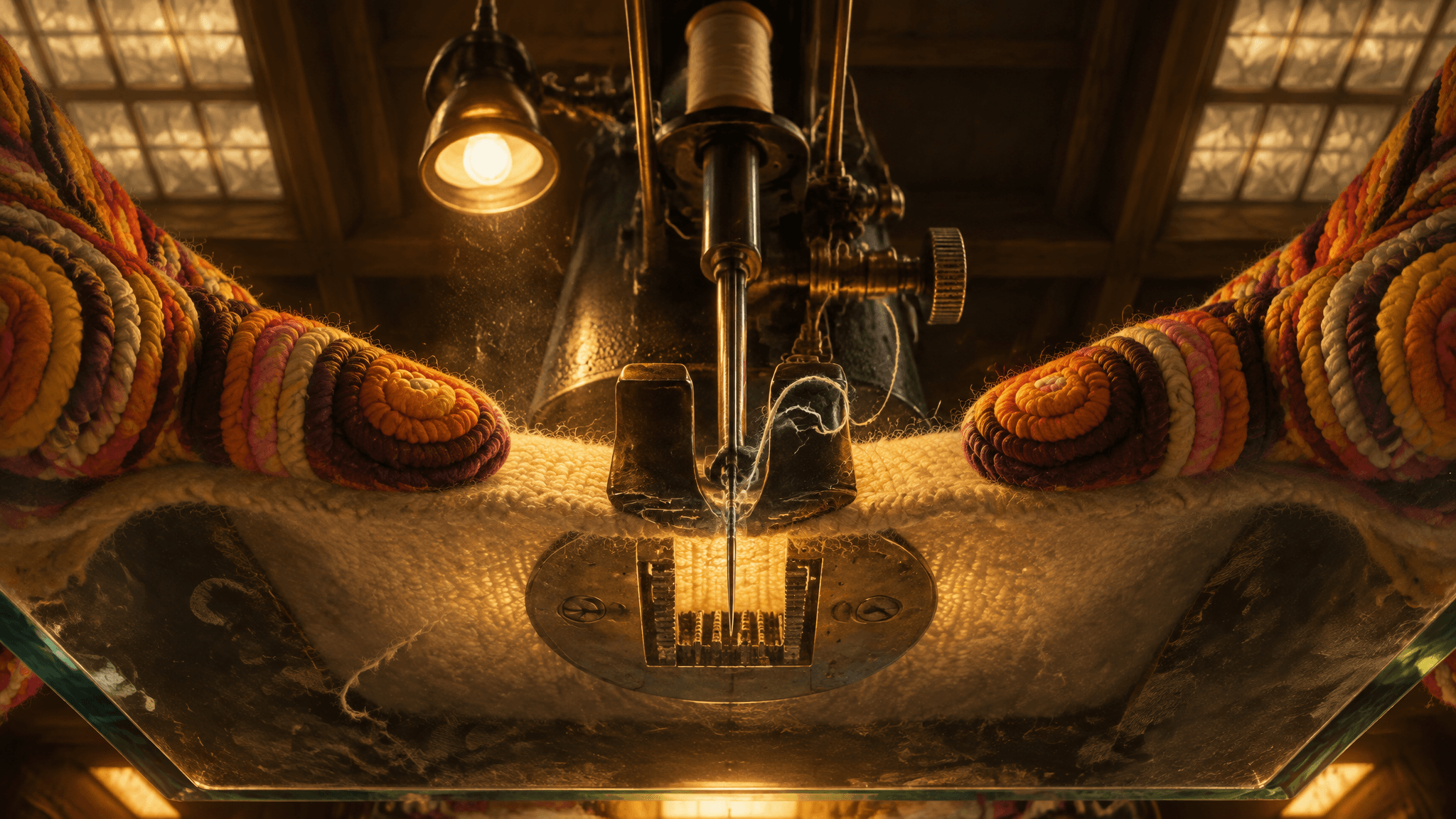
What makes someone rewatch a 10 second "how it's made" video?
For me it's usually one weird shot I didn't see coming. So on two jackets, an ivory peplum jacket and a black jacket with gold cord across the chest, I added a showpiece beat and kept the rest of the video normal. Both are runway looks I recreated as a test, not clients.
Here's my exact process.
1. Build the jacket and the gloves from text
First, I made a product sheet of the ivory jacket from a prompt alone: the whole jacket, the buttons up close, the back, and the inside with the black lining.
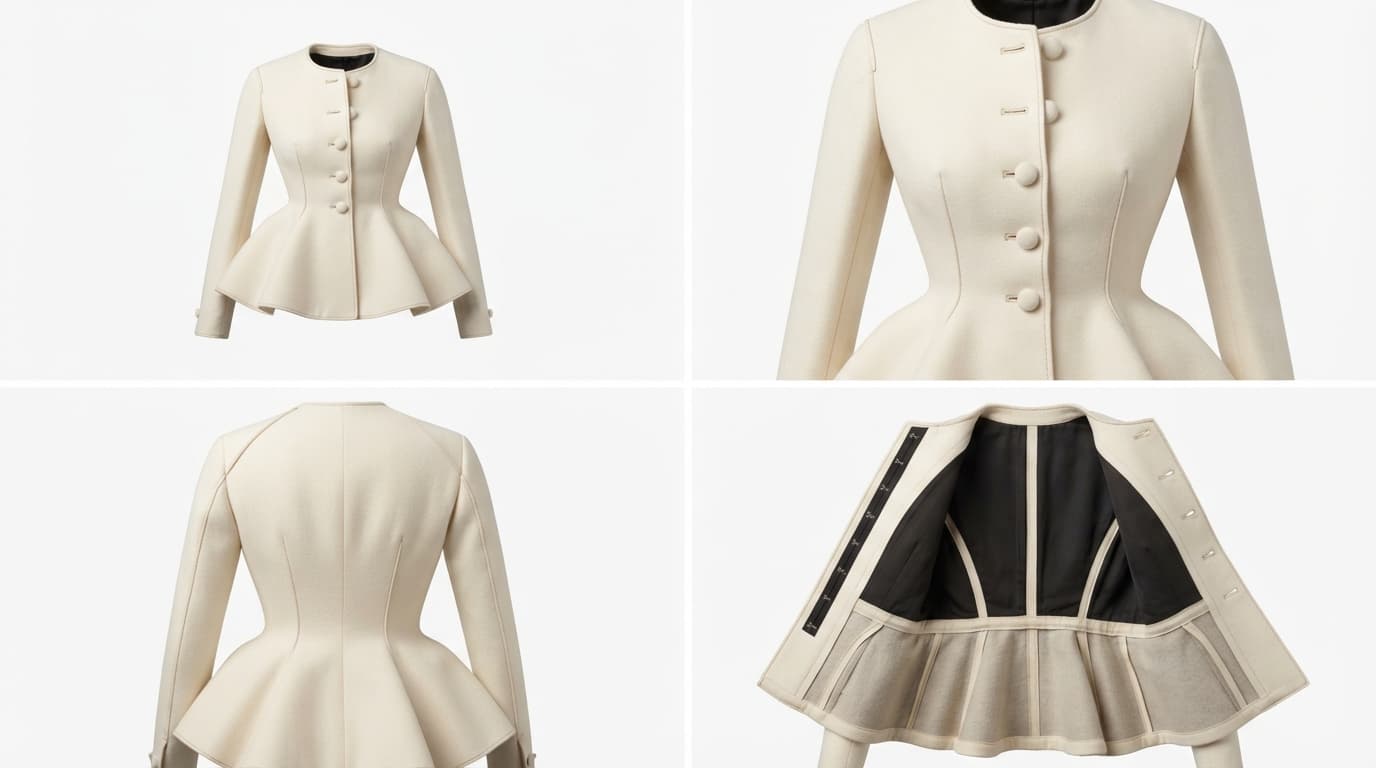
Exact prompt
A photorealistic product sheet on a pure plain white seamless background, one landscape frame split into four equal rectangular panels in a 2 by 2 grid separated by thin white gutters. The same original garment appears in every panel: a sculptural shrunken cropped jacket in heavy warm ivory wool crepe, with narrow softly sloped shoulders, a rounded collarless neckline, a tightly nipped waist and an exaggerated stiff peplum flaring out from the waist into a wide, rounded, standing-away skirt that ends at the hip, a row of large fabric-covered buttons down the front, long slim sleeves with small buttoned cuffs, and precise raw-edge topstitching along the seams. No person, no mannequin, no body parts, no neck, no face: the jacket is shown as an invisible ghost-mannequin form with the neckline opening empty. Top left panel: far shot, the whole jacket from neckline to peplum hem, centered, about 80 percent of the panel height, plenty of white space around it, straight-on. Top right panel: front close-up of the chest, neckline, buttons and nipped waist where the peplum begins to flare, showing the wool crepe texture, the covered buttons and buttonholes and the seam topstitching. Bottom left panel: back close-up of the upper back, shoulder seams and the back of the waist where the peplum flares, seen from directly behind. Bottom right panel: close-up of the jacket with the front opened, showing the inside of the garment: the dark inner lining, the hair canvas interlining, the hook-and-eye tape along the front edge, the inside waist seam and the stiff structure under the peplum. Light: isolated product studio, soft key from front left with gentle fill, pure white background in every panel, no shadows on the background. No logos, text, labels, tags or panel captions. Camera: iPhone default, deep focus, eye-level.
For this one I wanted a crazier glove, so I made heavy work gloves covered in hand-coiled colored cord.
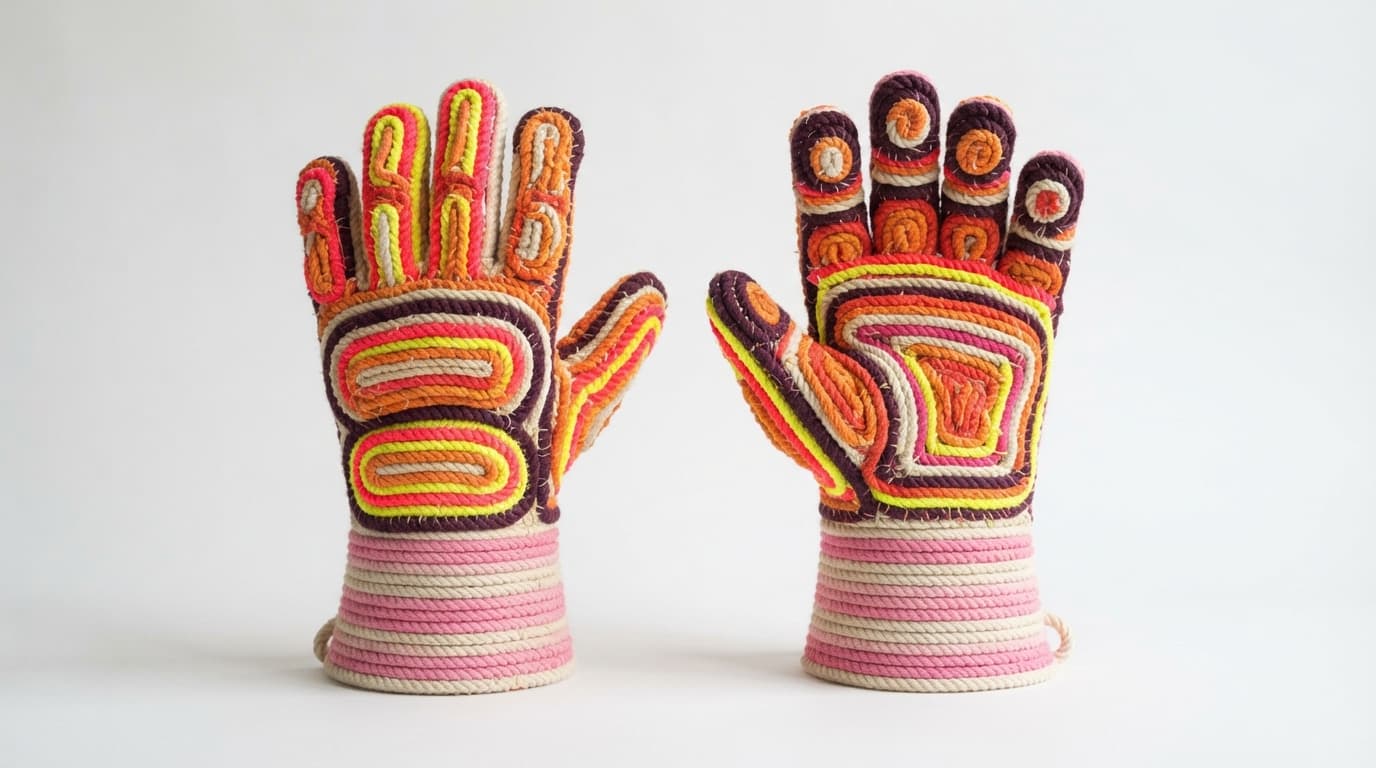
Exact prompt
A photorealistic product photo of a pair of heavy-duty work gloves on a pure plain white seamless background, one glove shown back of hand up and the other palm up, side by side with a little space between them, each standing as if filled with an invisible hand. No hand, no person, no body. The gloves are built like real industrial work gloves: thick padding, a reinforced knuckle guard, reinforced double-layer fingertips, a wide gauntlet cuff and chunky stitched seams. Every surface is covered in thick colorful braided cord hand-coiled and stitched in tight concentric nested loops that follow the outline of the palm, the fingers and the knuckle guard, like tactile handmade textile art. The cord bands are neon red, hot yellow, bright orange, cream white and deep plum, with dense visible stitching between the coils. The wide cuff is made of stripes of bubblegum pink and cream cord with a small cord loop at the top edge. Light: soft diffused studio light from front left, gentle shadow under the gloves on the white surface. No logos, text or labels. Camera: iPhone default, deep focus, eye-level, slightly above, straight-on.
2. Build two rooms in the same world
Then a dark walnut workroom with a glowing glass-block ceiling and one big walnut table.
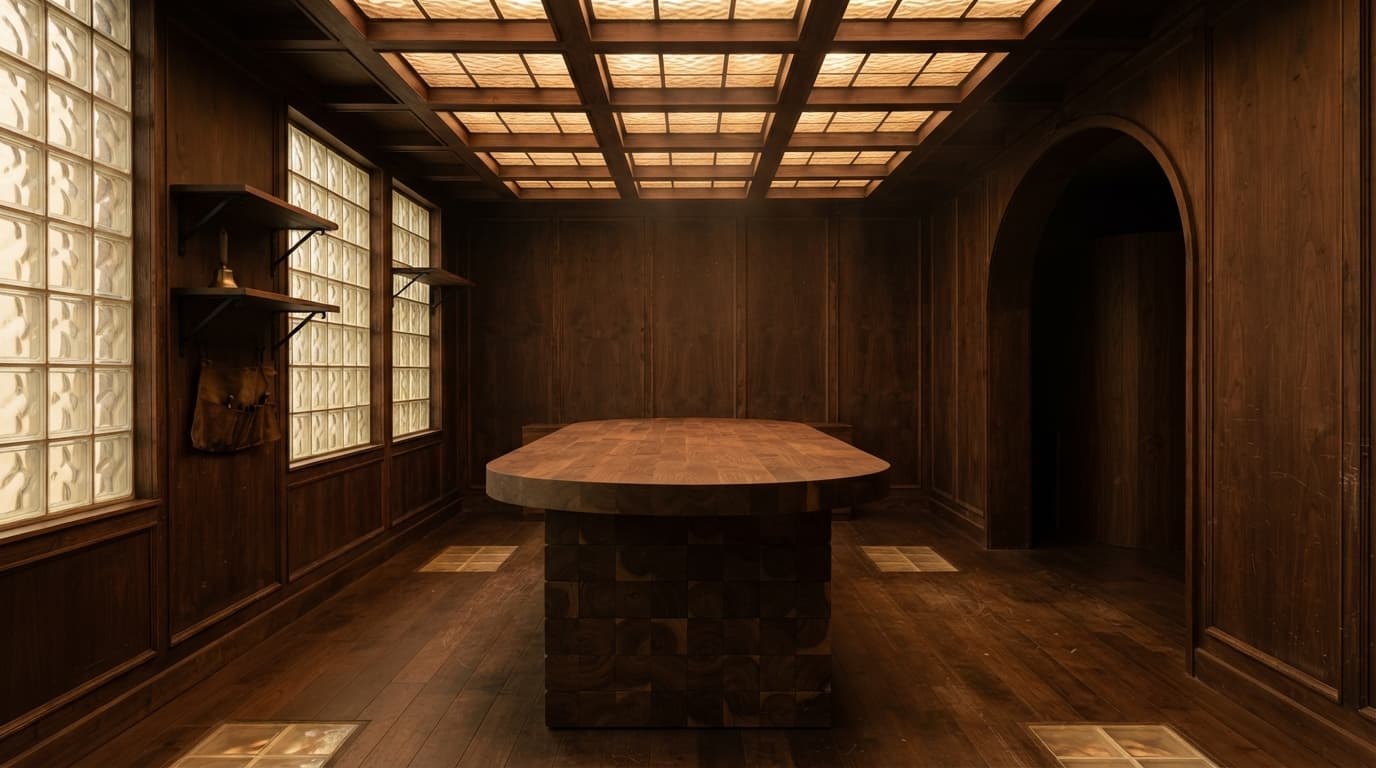
Exact prompt
Create a new photorealistic image of an empty interior, a photograph of a real room. THE VIBE: A craftsman's workroom that feels hushed and warm, like the inside of a polished wooden jewel box lit from within. Old-world workshop patience meets quiet luxury, a place where one beautiful thing gets made slowly. THE SETTING: The empty tailoring workroom is entirely clad in dark walnut: vertical walnut plank wall panelling, a deep walnut-framed coffered ceiling, and a wide walnut parquet floor worn pale along a walking path. The ceiling is a grid of chunky dark timber beams, each square coffer filled with thick rippled glass blocks that glow evenly like frosted lanterns. The long wall at frame-left is a wall of glowing glass-block windows set in walnut frames, the blocks thick, wavy and cloudy. Rectangular insets of glass block are set into the wooden floor, faintly lit from beneath. Frame-right, a tall rounded arched opening in the walnut panelling leads into a dim back room with a curved wooden wall and a deep shadowed corner. A few dark iron-bracket wall shelves with bare walnut boards stand empty against the window wall. Lived-in, not a showroom: faint scuffs and cup rings on the wood, tiny thread ends and chalk dust on the floor near the table, a worn leather tool roll hanging from an iron hook, a small brass hand bell on a shelf. No people, no garments, no products, no bags, no plants. THE LIGHT: Lit entirely by the room's own glass-block sources: the glowing ceiling coffers are the main key, soft, warm and overhead, the glass-block window wall at frame-left adds a cooler pale-cream side light, and a faint warm glow pools from the floor insets. The arched back room beyond is nearly black, about three stops under. Everything between these sources falls into deep walnut shadow, blacks gentle but real. Warm amber bounces off the polished wood into the shadows; soft shadows from the table fall away from the window wall toward frame-right. Light catches the grain of the walnut and the ripples in the glass. THE KEY DETAILS: In the centre of the floor stands one massive oval worktable, its top and pedestal built from thick stacked blocks of walnut with visible end-grain and soft rounded edges, the top bare, clear and empty so it is ready for work. Fine dust motes hang in the light from the ceiling coffers. The glass blocks show real thickness, bubbles and uneven ripples. No logos, no text, no signage, no brand marks anywhere. THE MOOD: Warm, hushed, tactile, timeless, a quiet atelier at the end of the day. Colour grade warm and rich: amber walnut browns, pale cream glass glow, deep black shadows. THE COMPOSITION: Wide establishing view of the room, eye-level and angled slightly into the corner, the oval worktable centred in the lower half with generous clear floor around it, the glass-block window wall receding at frame-left, the arched dark opening at frame-right, the glowing coffered ceiling filling the top third. Table top clearly visible and uncluttered for a product to sit on later. THE CAMERA: Shot on an iPhone, deep focus, everything sharp, NO background blur; the room's own available light, steady eye-level.
And a second room for the ending: same walnut and glass blocks, built around one glass display case with an empty plinth. I told the model to take only the materials and the mood from the first room and build a different room.
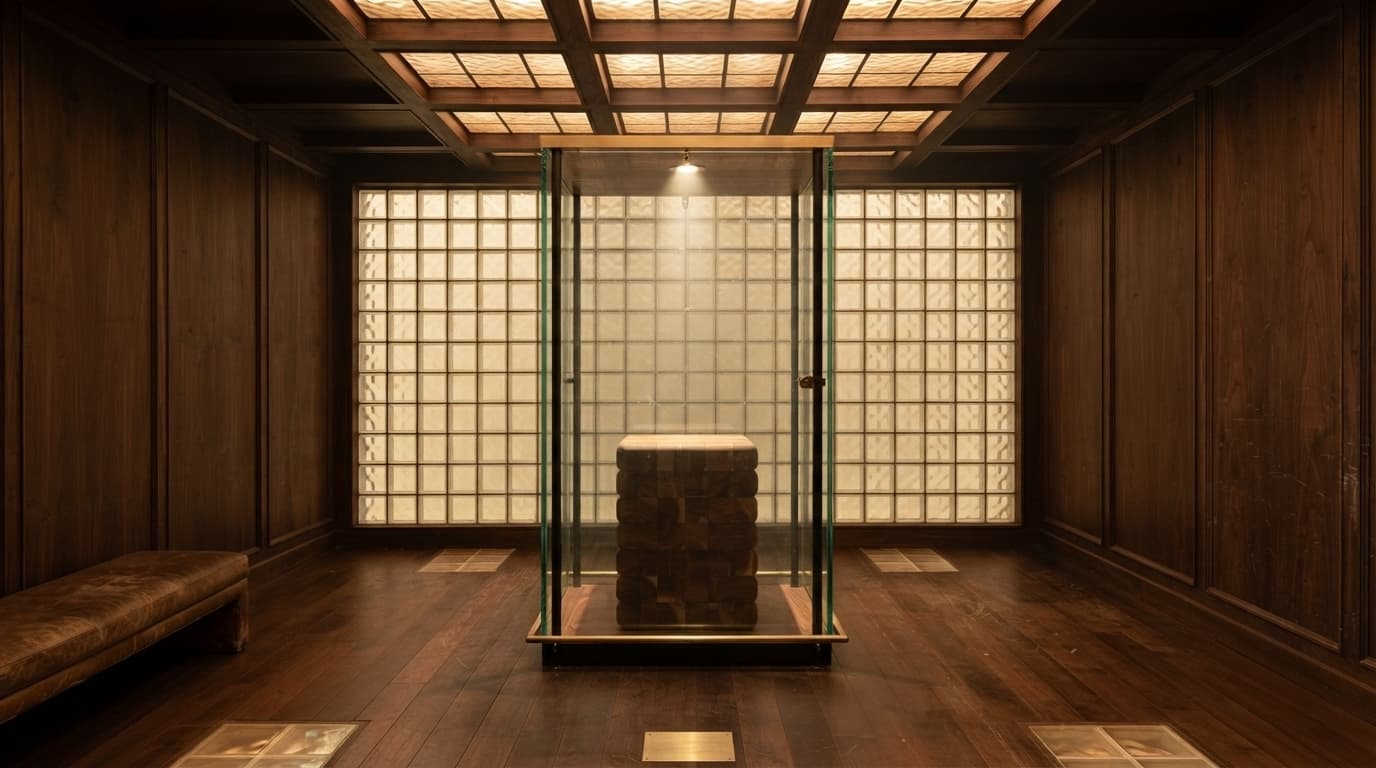
Exact prompt
Create a new photorealistic image of an empty interior, a photograph of a real room. It is a second room in the same world as the first reference: take only the material language, the glass-block glow and the quiet warm mood from the first reference (dark walnut panelling, rippled glass blocks lit from within, polished wood floor), and build a different room, not a copy of it. THE VIBE: A private gallery room built for a single object, hushed and reverent, like a jewel box with the lights turned on. Everything in the room points at the glass case, and the case glows like the only thing awake. THE SETTING: A square display room clad in dark walnut vertical panelling, with a low coffered ceiling of walnut beams and glowing rippled glass-block coffers, as in the first reference. The back wall is a full wall of backlit glass blocks, pale cream and softly luminous, framed in walnut. The floor is polished dark walnut parquet with large rectangular glass-block insets glowing faintly from beneath, and the case and ceiling are mirrored in the polished wood. Lived-in, not a showroom: faint scuffs on the floor, a few fingerprints on the glass, a small brass floor plaque with no writing, a worn leather bench against one side wall. No people, no garments, no bags, no plants. THE SUBJECT: In the centre of the room stands one large glass display case, a tall rectangular vitrine of thick clear low-iron glass with visible green-tinted edge thickness, held in slim blackened-steel corner posts with a polished brass base rail and a brass top frame. Inside it stands one bare walnut plinth made of stacked end-grain wood blocks with soft rounded edges, its top empty and clean, ready for one hero object. The case door is closed with a small brass lock, glass panes clean but with a few faint fingerprints and soft reflections of the room. THE LIGHT: The case is the key source: a concealed warm spotlight in the top frame throws a clean downward cone of light onto the empty plinth, and the glass edges catch bright cream rim lines. The glowing glass-block back wall adds a soft pale-cream backlight that silhouettes the case edges, and the glowing glass-block floor insets add a low warm uplight. The corners of the room and the ceiling between the coffers fall into deep walnut shadow, about two stops under. Warm amber reflections bounce off the brass into the glass and onto the floor; the case casts a soft shadow and a glowing reflection forward across the polished floor toward the camera. THE KEY DETAILS: Real glass behaviour: refraction along the thick edges, a faint green tint at the edge, crisp reflections of the ceiling coffers, a few dust motes in the spotlight cone. Raised end-grain texture on the plinth catching the light. No logos, no text, no signage, no brand marks anywhere. THE MOOD: Reverent, warm, expensive, quietly dramatic. Colour grade warm amber and cream against deep walnut browns, with the glass as the brightest thing in the frame. THE COMPOSITION: Wide establishing view, eye-level and slightly off-centre to the right, so the room's corner is visible. The vitrine stands in the centre third of the frame and fills about two-thirds of the frame height, with clear polished floor below it and the glowing glass-block wall rising behind it, the plinth top clearly visible at mid-height with open space around it for a hero object. THE CAMERA: Shot on an iPhone, deep focus, everything sharp, NO background blur; the room's own available light, steady eye-level.
3. Get the shot from under the needle
I wanted one shot from a place nobody looks from: straight up at the needle, from underneath the cloth. This took me four tries. The first three came out as low angles looking up at the machine, not straight up the needle.
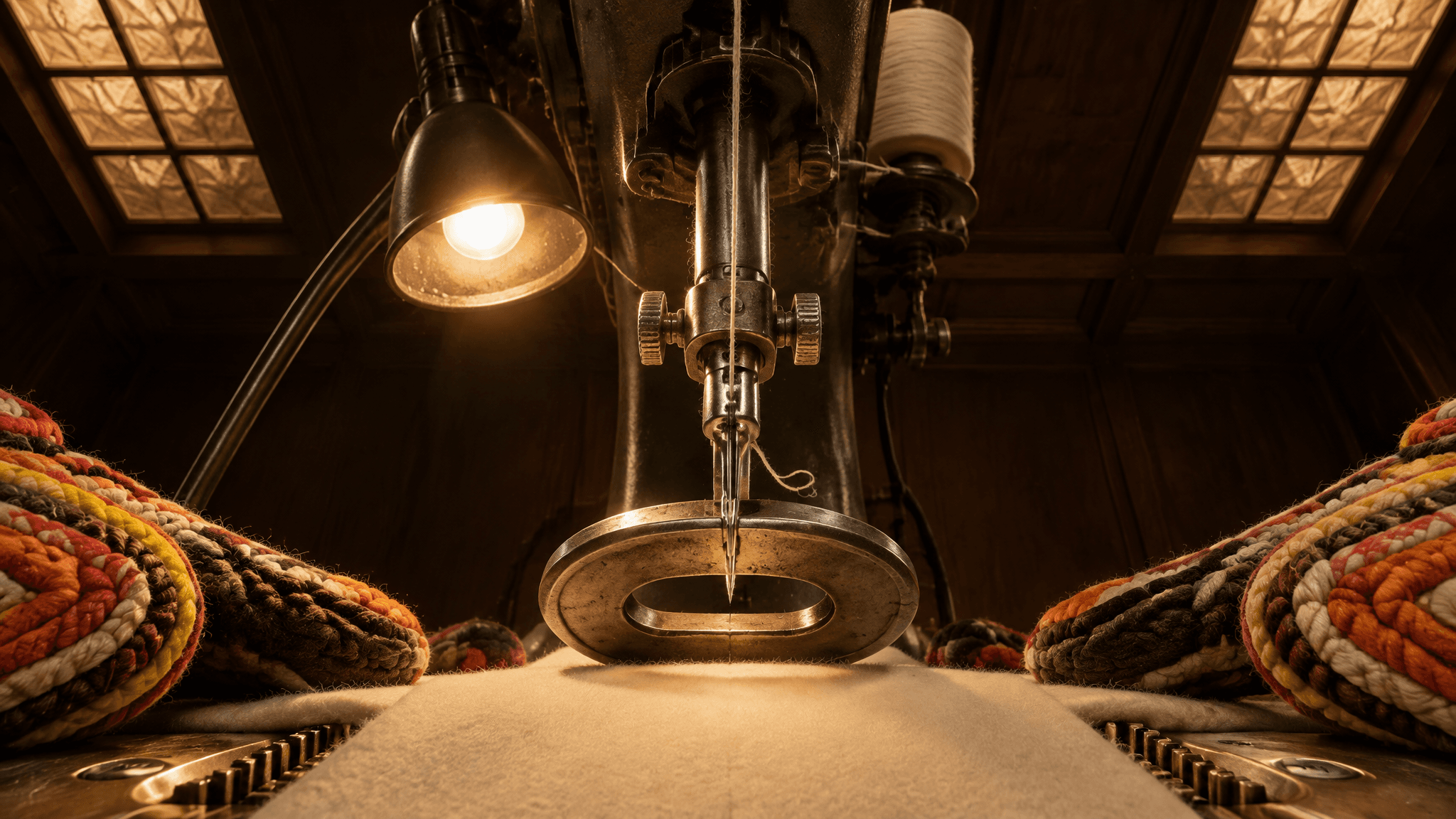
Exact prompt
Create a new photorealistic image. This is a photograph taken in a dark walnut workroom, with the lens sitting flat on the worktable top in the throat opening of the stitch plate, pointing straight up at the sewing machine needle directly above it, from the start — not a composite. Rebuild the entire scene as if shot natively here, with unified lighting across subject and environment. The gloves are relit entirely by this scene's light; the reference's studio lighting is discarded. THE VIBE: A hushed old atelier after hours, one lamp working over the machine, the room dark and warm around it. Intimate, precise, a little reverent. THE SUBJECT: A true straight-up view with no horizon. The steel needle is the nearest thing to the lens, a few centimetres away, pointing straight down the lens axis, so it reads as a bright steel point at the exact centre of the frame with a short thread running through its eye and a small loose thread loop beside it. Around the needle sits the flat circular presser foot seen from underneath as a worn steel ring with an oval slot. Above it the machine head and arm recede upward in steep converging perspective: a vertical shaft, a brass-and-steel mechanism, a spool of ivory thread far overhead, and a small work lamp clamped to the arm. A ring of brass feed teeth surrounds the lens position at the bottom edge and corners of the frame. The ivory cloth lies flat on the table around the lens and runs up under the presser foot, its clean cut edge running toward the needle. Two cord-coiled heavy-duty work gloves, glove design from the first reference only, rest small in the lower-left and lower-right corners with their fingertips pressing the cloth either side of the foot, each no wider than about a fifth of the frame, their cuffs leaving the frame edge. No faces, no people. THE SETTING: Only the material language from the second reference: the dark walnut table edge and end-grain at the bottom corners, the glass-block coffered ceiling glowing faintly far above in the top corners. Lint, snipped threads and oil smudges on the brass. Not a clean showroom machine — a real, used, lived-in workbench. THE LIGHT: Three sources only. The small work lamp on the arm throws a warm amber pool down onto the presser foot, the needle and the glove tips. The cool cream glow of the glass-block ceiling touches the top corners far overhead. A faint amber floor-insert glow rims the bottom edge. Exposed for the lamp; the machine head sits about two stops under, everything between the sources falls into dark, blacks crushed. The amber bleeds onto the steel, the cord coils and the cloth where it reaches; the foot casts a soft shadow onto the cloth. THE KEY DETAILS: The cloth is the same fabric as the third reference — smooth, dense, matte felted wool in warm ivory, no visible weave, loops or knit stitches, a soft even surface, with clean sharply cut edges and a gentle rounded dent under the presser foot. Take only the fabric material from the third reference, not the garment, its panels or its layout. Raised steel edges catch the lamp. THE MOOD: A how-it's-made film still — focused craft, quiet tension at the needle's tip. THE COMPOSITION: Radial and symmetrical, the needle tip at the centre of the frame, the presser foot ring and needle together filling about half the frame height, the machine arm converging toward the top of the frame, the gloves small and low in the corners, open dark space around. THE CAMERA: Shot on an iPhone ultra-wide, deep focus, everything sharp, NO background blur, shot straight upward from the table surface. No text, no logos.
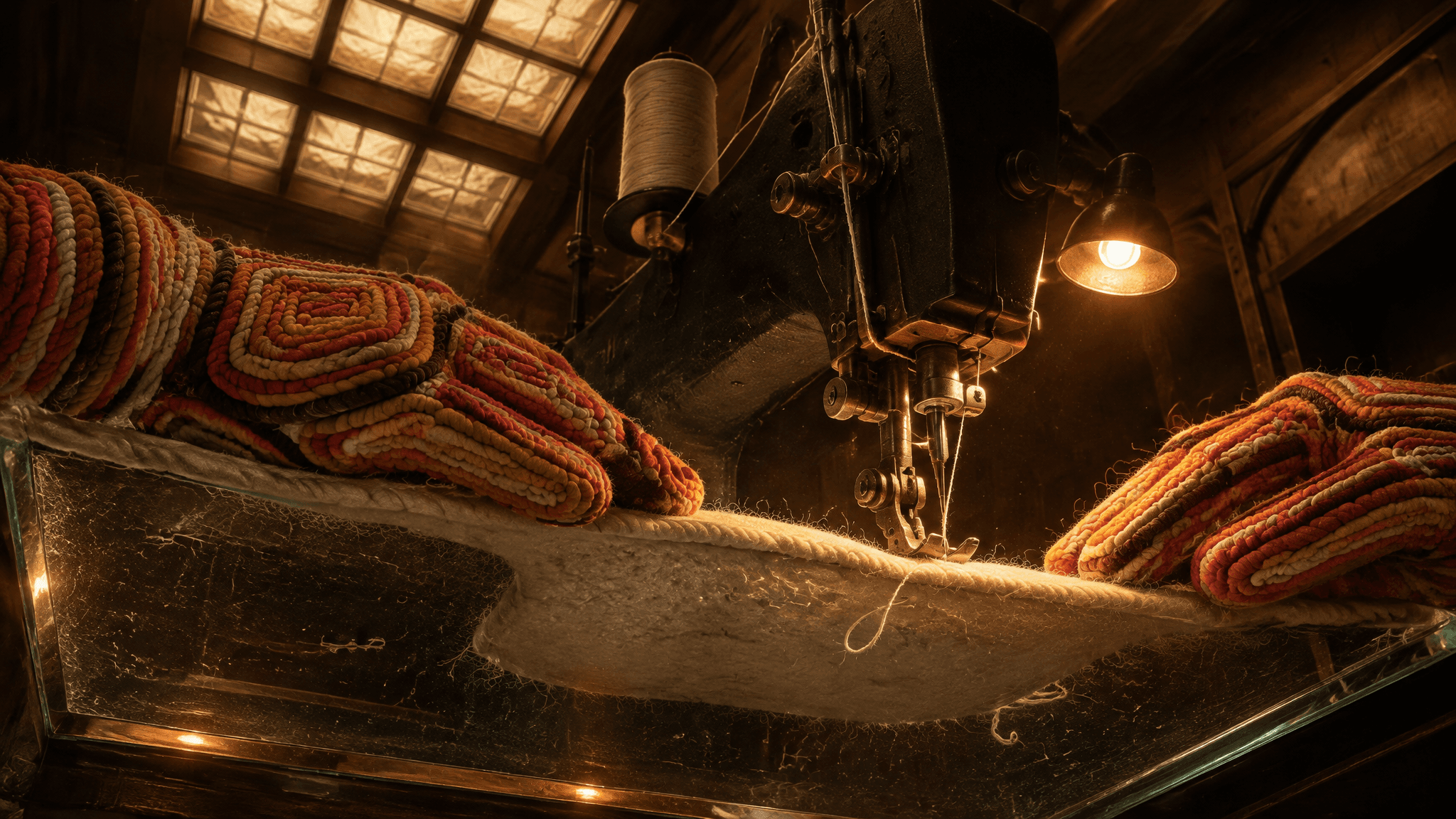
Exact prompt
Create a new photorealistic image. This is a photograph taken from beneath a thick glass worktable, looking up through the glass, from the start — not a composite. Rebuild the entire scene as if shot natively here, with unified lighting across the gloves, the machine and the room. THE VIBE: A hushed, jewel-dark atelier where one machine is working. Intimate, mechanical, tactile — the quiet instant a needle meets cloth, seen from a place nobody normally gets to look from. THE SUBJECT: A heavy industrial sewing machine seen from below through the glass worktable. Its blackened-steel body and brass thread guides loom above the glass in dark silhouette; a spool of ivory thread sits on top and the thread runs down a brass guide path, through the take-up lever, into the eye of the needle. The needle tip has just pierced a layer of ivory wool laid flat against the top of the glass, so the underside of the cloth, its soft woven texture and the thread loop forming beneath the needle all face the camera through the glass. The steel presser foot presses the cloth beside the needle. Two work gloves guide the cloth, one on each side of the needle, only the gloved hands and wrists in frame — each is a heavy-duty work glove wrapped in coiled cord, with the pink, yellow, orange and purple geometric coil patterns, from the first reference. Do NOT source the glove design from any other reference. The gloves are relit entirely by this scene's light; the reference's white-studio lighting is discarded. No faces, no people beyond the gloved hands and wrists. THE SETTING: Taking only the material language and mood from the second reference — dark walnut, blackened steel, brass, glowing glass blocks. The thick low-iron glass worktable, its green-tinted edge visible at the frame edge; beyond the machine, the far room falls to black with the faint outline of a glass-block coffered ceiling glowing high above. Not a clean showroom — a used, working glass: fingerprints, a faint oil smudge, specks of lint and wool fibre on the underside of the glass, a few snipped threads. THE LIGHT: Three sources only. A small warm work lamp on the machine arm throws a tight amber pool onto the needle, the ivory cloth and the fingertips of the gloves. The glowing glass-block ceiling far above is a cool cream wash that backlights the machine into silhouette and glows through the thick glass. A faint amber floor insert near the camera rims the lower edge of the glass. Exposed for the needle area; the machine body sits about two stops under, the rest of the room black between the sources. The amber bleeds onto the glove cord, the brass and the cloth; the thick glass edge picks up green and a thin specular line. THE KEY DETAILS: The needle eye with the ivory thread through it; the thread loop forming under the cloth; individual coiled cord ridges on the gloves catching amber light; brass guides with worn edges; lint and fingerprints on the glass; no text, labels or logos anywhere. THE MOOD: A luxury atelier film still — precise, warm, quietly hypnotic. THE COMPOSITION: Looking straight up through the glass, low angle from below. The needle and the pierced cloth sit slightly right of centre and fill about half the frame height, the two gloves entering from the left and lower right frame edges, the machine body rising toward the top of the frame in silhouette, dark glass-block glow high at the top left. THE CAMERA: Shot on an iPhone, deep focus, everything sharp, NO background blur; the scene's own available light, shot upward from beneath the glass.
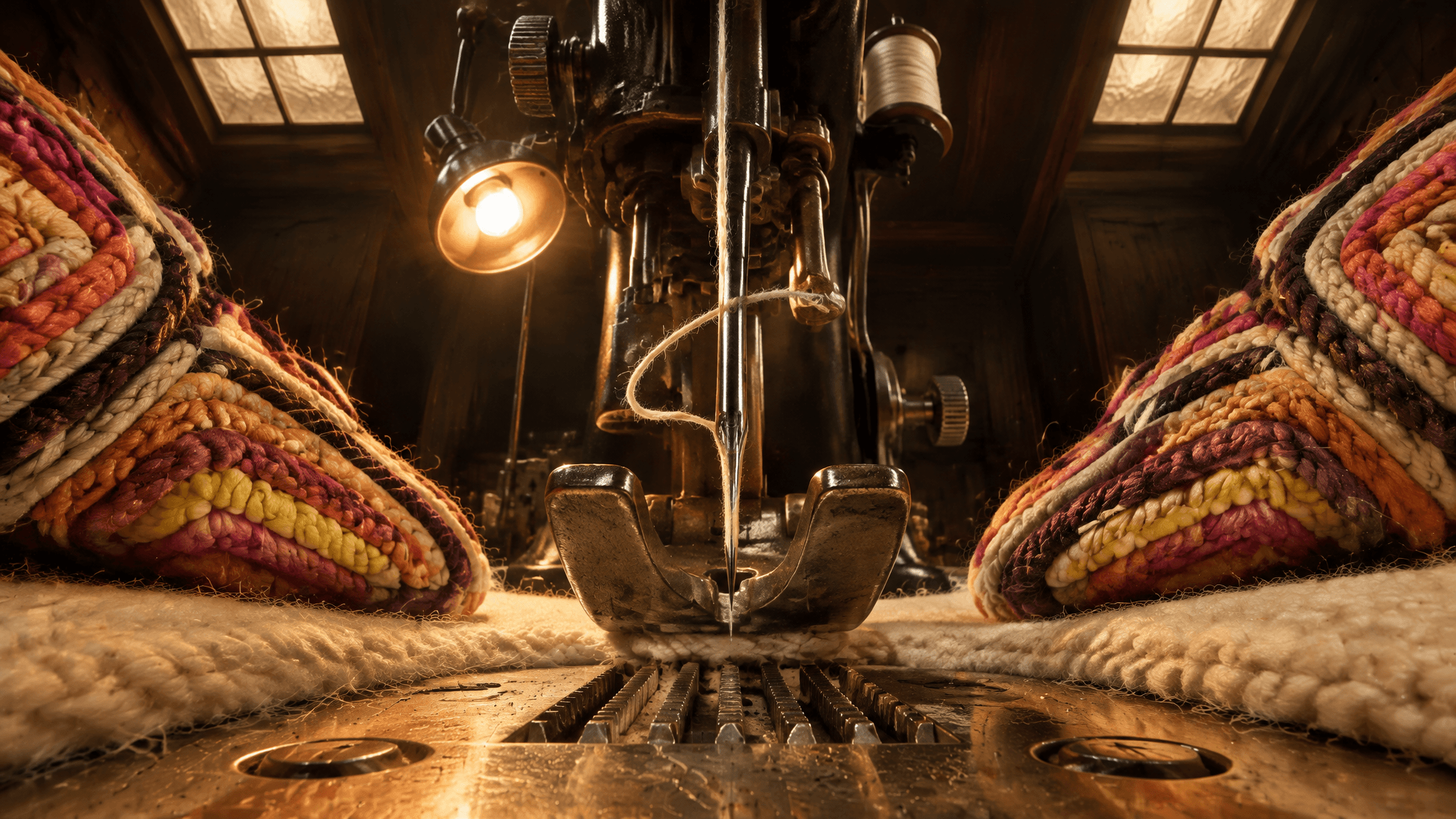
Exact prompt
Create a new photorealistic image. This is a photograph taken with the lens resting on the worktable top, directly beneath a sewing machine needle, pointing straight up at it, from the start — not a composite. The camera sits exactly under the needle on its vertical axis, a true nadir view: the needle tip points at the lens and its shaft is foreshortened, not seen from the side, and there is no horizon. Rebuild the entire scene as if shot natively here, with unified lighting across the gloves, the machine and the room. THE VIBE: A hushed, jewel-dark atelier at the instant a needle meets cloth, seen from the one place nobody normally looks from: right at the stitch plate, looking up into the machine. Intimate, mechanical, hypnotic. THE SUBJECT: Looking straight up, the sharp steel needle tip is nearest the lens, centred, pointing at the camera, with the ivory thread running through its eye and a small thread loop beside it. The underside of the steel presser foot surrounds the needle as a flat circle with a slot, directly above the lens. Beyond it, the machine's blackened-steel head and brass thread guides rise away overhead in strong perspective toward the top of the frame, a small ivory thread spool far above and a small work lamp on the machine arm. The brass stitch plate with its feed teeth fills the bottom edge of the frame around the lens, with ivory wool laid flat across it at the bottom-left and bottom-right corners, wool fibres in sharp detail. Two work gloves reach in from the left and right frame edges and press the ivory wool down on each side of the needle, only gloved hands and wrists, each a heavy-duty work glove wrapped in coiled cord with pink, yellow, orange and purple geometric coil patterns, from the first reference. Do NOT source the glove design from any other reference. The gloves are relit entirely by this scene's light; the reference's white-studio lighting is discarded. No faces, no people beyond the gloved hands and wrists. THE SETTING: Taking only the material language and mood from the second reference — dark walnut, blackened steel, brass, glowing glass blocks. The worktable is dark walnut end-grain, its edge just visible at the bottom corners. Far above the machine, at the top corners of the frame, the glass-block coffered ceiling glows as a faint cream wash against dark timber beams. A used working space: oil smudges on the brass, wool lint and snipped threads on the table, a few specks of dust in the lamp beam. Not a clean showroom. THE LIGHT: Three sources only. The small warm work lamp on the machine arm throws a tight amber pool down onto the needle, the presser foot, the cloth and the glove fingertips. The glowing glass-block ceiling far above gives a cool cream backlight at the top corners. A faint amber glow comes from a floor insert behind the table at the bottom edge. Exposed for the needle area; the machine head sits about two stops under, the rest black between the sources. The amber bleeds onto the glove cord, the brass and the steel needle, and the needle shows a thin specular streak. THE KEY DETAILS: The needle eye with the ivory thread through it; the thread loop beside it; individual coiled cord ridges of the gloves catching amber light; brass guides with worn edges; feed teeth on the stitch plate; no text, labels or logos anywhere. THE MOOD: A luxury atelier film still — precise, warm, quietly hypnotic. THE COMPOSITION: Looking straight up the needle axis, symmetrical and radial. The needle tip and presser foot sit at the exact centre and fill about half the frame height, the machine head and arm recede overhead in perspective toward the top, the two gloves enter from the left and right frame edges at lower-mid height pressing the cloth, the glass-block glow in the top corners. THE CAMERA: Shot on an iPhone ultra-wide, deep focus, everything sharp, NO background blur; the scene's own available light, shot straight upward from the table surface.
What finally got it was putting a thick glass plate under the cloth and saying the lens sits exactly under the needle on the vertical axis, a true straight-up view, not angled and not from the side.
Exact prompt
Create a new photorealistic image. This is a photograph taken from directly underneath a thick clear glass plate, with the lens pointing straight up at the sewing needle, from the start — not a composite. The camera sits exactly under the needle on the vertical axis, a true nadir view, not angled and not from the side. Rebuild the entire scene as if shot natively here, with unified lighting across the gloves, the machine and the room. THE VIBE: A hushed, jewel-dark atelier at the instant a needle meets cloth, seen from the one place nobody normally looks from. Intimate, mechanical, hypnotic. THE SUBJECT: Looking straight up through the glass plate, the sharp steel needle tip is directly above the lens, centred, just emerging through a layer of ivory wool that lies flat on the other side of the glass. The ivory wool fills the frame as a pale, softly woven ceiling, its underside weave and fuzz in sharp detail, glowing warm where lamp light passes through it. A thread loop forms right beside the needle tip. Around the needle, the underside of the steel presser foot is a circle with a small slot, and the stitch plate with its feed teeth surrounds it. Beyond that, the machine's blackened-steel body and brass thread guides rise away overhead in strong perspective, a thread spool tiny and far at the very top. Two work gloves press and guide the cloth, one entering from the left frame edge and one from the right, fingertips and cord-coiled backs pressing the ivory wool down on each side of the needle; only gloved hands and wrists, each a heavy-duty work glove wrapped in coiled cord with pink, yellow, orange and purple geometric coil patterns, from the first reference. Do NOT source the glove design from any other reference. The gloves are relit entirely by this scene's light; the reference's white-studio lighting is discarded. No faces, no people beyond the gloved hands and wrists. THE SETTING: Taking only the material language and mood from the second reference — dark walnut, blackened steel, brass, glowing glass blocks. The clear glass plate has a green-tinted thick edge visible at the frame corners. Far above the machine, out at the top corners of the frame, the glass-block coffered ceiling glows as a faint cream wash against dark timber beams. The glass is a used working surface: fingerprints, a faint oil smudge, wool lint and a few snipped threads stuck to its underside, near the lens. Not a clean showroom. THE LIGHT: Three sources only. A small warm work lamp on the machine arm shines down onto the ivory wool, which glows amber from within where the light passes through it, and throws a tight amber pool around the needle. The glowing glass-block ceiling far above gives a faint cool cream backlight at the top corners. A dim amber floor insert near the camera rims the lower glass edge. Exposed for the needle and the glowing cloth; the machine body sits about two stops under, the rest black between the sources. The amber bleeds onto the glove cord, the brass and the steel needle. THE KEY DETAILS: The needle eye with the ivory thread through it; the thread loop beside it; individual coiled cord ridges of the gloves catching amber light; brass guides with worn edges; lint and fingerprints on the glass in the foreground; no text, labels or logos anywhere. THE MOOD: A luxury atelier film still — precise, warm, quietly hypnotic. THE COMPOSITION: Looking straight up the needle axis, symmetrical and radial. The needle tip and presser foot sit at the exact centre and fill about half the frame height, the glowing ivory wool fills the rest of the middle, the two gloves enter from the left and right frame edges at mid-height, the machine rises away in perspective toward the top, dark glass-block glow at the top corners. THE CAMERA: Shot on an iPhone, deep focus, everything sharp, NO background blur; the scene's own available light, shot straight upward from beneath the glass.
4. Write the showpiece beats in plain steps
Now the video. Along with the normal steps, I added two weird beats. One is an extreme macro of the maker's eye with the finished jacket reflected in it. The other is the old tablecloth trick: the gloves yank the wool off the table and the shears, the spool and the buttons stay standing.
Exact prompt
Create a new video: a fast, rhythmic "how it's made" film of an ivory felted-wool peplum jacket being made by hand in a dark walnut workroom, from raw cloth and chalk to the finished jacket shown in a glass case. Only gloved hands and one close eye are ever seen; no face, no body. Warm amber lamp pools, a cool cream glow from glass-block panels, everything between them dark. Smooth dense matte ivory wool, steel, brass, black lining, lint and loose thread. Fast, precise cuts on the beat, most shots well under a second, high-energy motion, with cuts matched on circles (the needle ring, the spool, the button, the eye, the hook's loop). Every shot has one clear move with a stated speed. The final scene is a held hero shot, noticeably longer than all the others. Roles, stated once: the jacket in [Image1] is the subject. Its ivory felted wool, round collarless neck, covered buttons, flared peplum, black lining and cream piping must match exactly and must not change; take only the garment, not its white background, panel layout or form. [Image2] is the gloves only: the cord-coiled work gloves, identical in every process shot, taking nothing from its background. [Image3] is the room only: dark walnut walls, glass-block ceiling and window, the oval end-grain walnut worktable. [Image4] is the look of the threading machine for scene 3 only: the needle, presser foot, lamp and low angle. [Image5] is the display room only: the glass case with brass frame and steel posts, for the last scene. The maker is described in text: a woman in her forties, olive skin, dark brown eyes with a hazel ring, thick dark brows, fine lines at the outer corner of the eye; only her right eye is ever seen, and her hands always wear the gloves. [SCENE 1] Two cuts. First, an extreme close-up, low angle: gloved hands smoothing ivory wool flat across the worktable, a fast lateral track. Then a top-down push-in as a chalk line is drawn across the cloth. [SCENE 2] Two cuts. First, a macro of steel shears biting into the wool along the chalk line, riding along with the blade. Then a low side track as the cut edge falls away, clean and unfrayed. [SCENE 3] Two cuts. First, looking up from table level at the needle and presser foot as in [Image4], a slow push-in on the needle. Then a macro of thread pulling through the needle's eye as the needle drops into the wool. [SCENE 4] Two cuts. First, an extreme macro of the maker's eye in warm lamp light, lashes, iris and pupil, held steady. Then a slow lateral track across the eye, ending on the iris and pupil with a tiny reflection of the finished ivory jacket. [SCENE 5] Two cuts. First, gloved hands grip the edge of the ivory wool laid over the worktable, shears, a spool of thread and a stack of covered buttons standing on it. Then a rapid snapping pull whips the wool off the table and out of frame in one motion, the shears, spool and buttons staying standing. [SCENE 6] Two cuts. First, a macro of black lining and hair canvas pressed into the open jacket panel. Then a top-down along the cream piping tracing the seam. [SCENE 7] Two cuts. First, a macro of a wool-covered button pulled tight over its form. Then a tight push-in as it is stitched onto the front. [SCENE 8] Two cuts. First, a macro of hook-and-eye tape laid along the lining edge. Then a quick top-down as a hook clasps into its eye. [SCENE 9] Two cuts. First, gloved hands press the flared peplum under a steam iron, steam rising, a low slow track. Then a pull back as the peplum is lifted and settles round and full. [SCENE 10] In the glass case from [Image5]: a slow push-in on the empty plinth as a spotlight snaps on, then a held, locked-off shot of the finished jacket from [Image1], upright inside the case on an unseen form, the whole jacket fully visible, large and centred, peplum flared, rim light tracing its curve, no hand holding it. Held steady. Match the jacket from [Image1] exactly in the final scene; it must stay large and readable. Take only the room from [Image3] and the case from [Image5]. No logos, no text, no lettering, no subtitles, no watermarks. No face except the single eye, no extra fingers, no warped hands, no melting fabric, no headless mannequin shape.
Both of them landed, which honestly surprised me. For the tablecloth beat I named every object that stays standing, and the shears and the spool are still standing after the pull. The ending puts the jacket in that glass case.
And listen, I didn't love the low light version overall. So I moved the same jacket into a bright workshop.
5. One still can carry the gloves, the cloth and the room
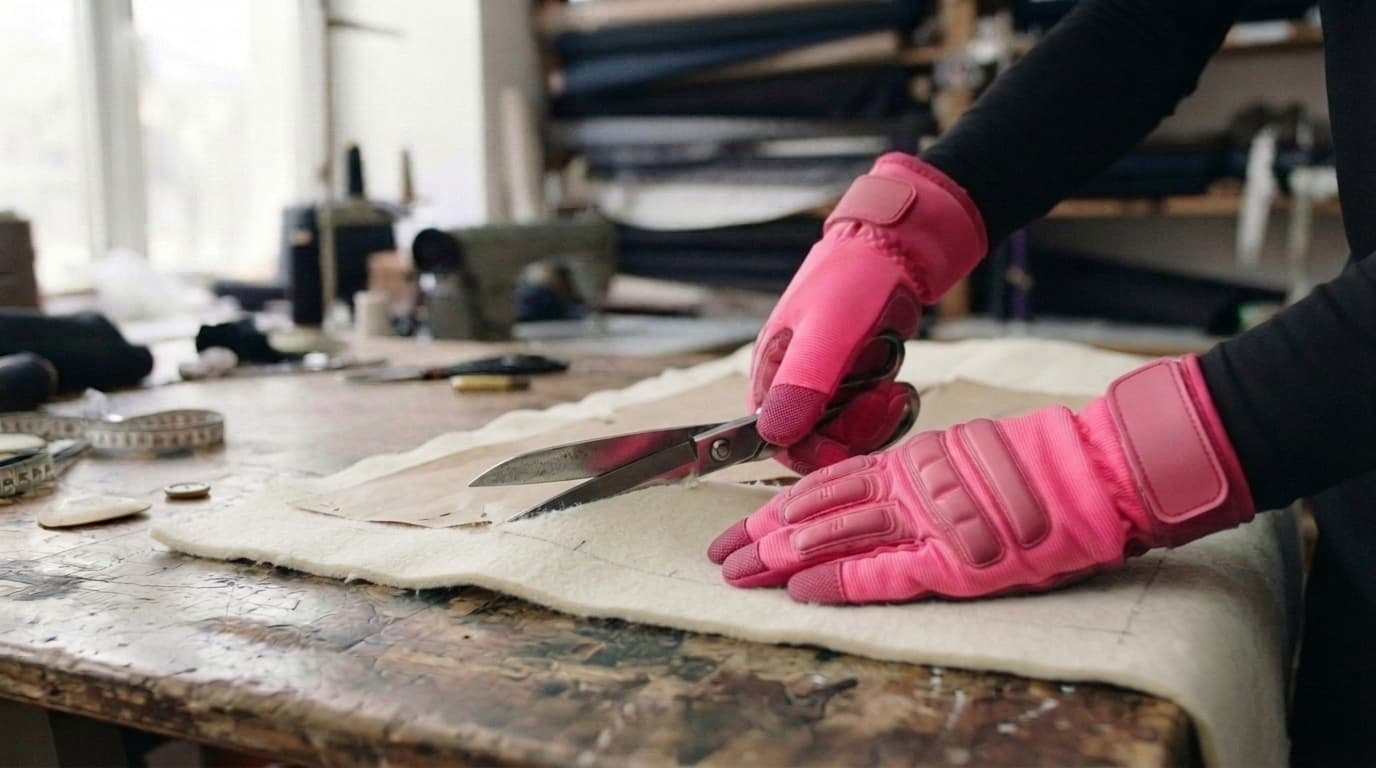
For the bright version I made one still: the pink gloves cutting ivory cloth on a worn bench in daylight.
Exact prompt
Create a new photorealistic image, but with the dark cloth replaced by ivory cloth. Preserve the pink padded work gloves, the hands and black sleeves, the shears, the paper pattern, the wooden workbench and the tailor's workshop, from the first reference. THE VIBE: A busy tailor's workshop in soft grey daylight, the quiet focus of the first cut into a fine cloth. Bright and tactile, a pink-gloved craft moment with real work-worn character. THE SUBJECT: Only the two hands and forearms are seen; no face, no body. The pink padded work gloves with their padded knuckle bars and wrist straps, from the first reference, cut with the long steel shears along the edge of the brown paper pattern. The left glove rests flat on the cloth holding it down, the right glove holds the shears mid-cut at the pattern edge. The cloth under the pattern is the thick ivory felted wool, from the second reference: its cream-white colour, dense matte felted surface, soft brushed nap and clean cut edge. Take only the cloth colour and texture from the second reference, not its jacket shape, white background or panel layout. THE SETTING (UNCHANGED): Preserve the same worn wooden workbench with paint stains and scratches, the measuring tape coiled at left, the chalk and button on the bench, the sewing machine and spools softly behind, the shelves of folded cloth rolls at the back and the tall window at left. Do NOT redesign the workshop. THE LIGHT: Soft overcast window light from the left is the ONLY key, falling across the bench and lighting the ivory cloth and the pink gloves; the right side falls into gentle shade. The cloth bounces a clean cool-white light up under the gloves and shears. Shadows from the gloves and shears fall softly to the right onto the cream cloth. THE KEY DETAILS: Pencil notch marks and a faint chalk line along the pattern edge on the ivory wool; a few cream wool fibres lifting at the fresh cut edge; the shears' steel blade catching the window light; the ivory cloth reads clearly as the same fabric as a cream felted wool jacket. THE MOOD: A brand-film still: bright, tactile, handmade. THE COMPOSITION: Low three-quarter angle at bench height, as in the first reference. The gloved hands and shears sit in the lower right of centre, the ivory cloth fills the middle foreground, the workshop falls soft behind. The ivory cloth and pink gloves are the clear focal pair. THE CAMERA: Shot on an iPhone, shallow background softness from the close bench-height distance, the room's own window light, eye-level candid. No text, no logos, no brand names on props, no face, no extra fingers, no warped hands.
Then I used just two references, the product sheet and that still. The still covered the gloves, the cloth and the workshop all at once.
Exact prompt
Create a new video: a fast, rhythmic "how it's made" film of an ivory felted-wool peplum jacket being made by hand in a bright tailor's workshop, from raw ivory cloth and chalk to the finished jacket. Only pink padded work gloves and black sleeves are ever seen; no face, no body. Soft overcast window light from the left is the only key, falling across a worn wooden workbench, with cool clean-white bounce off the ivory cloth and the right side of the room in gentle shade. Fast, precise cuts on the beat, most shots well under a second, high-energy motion, with cuts matched on shapes (the curve of the shears, the round button, the arc of the peplum). Every shot has one clear move with a stated speed. The final scene is a held hero shot, noticeably longer than all the others. Roles, stated once: the jacket in [Image1] is the subject. Its ivory colour, matte felted wool, fitted waist, flared peplum, round covered buttons and black lining must match exactly and must not change. Take only the jacket from [Image1], not its white background or panel layout. [Image2] is the gloves, the ivory cloth and the workshop look only: the same bright pink padded work gloves with padded knuckle bars and wrist straps, kept identical in every shot, the same ivory felted cloth, and the same worn workbench, shears and workshop shelves, taking nothing else from its framing. [SCENE 1] Two cuts. First, a low three-quarter view at bench height as the pink gloves smooth a length of ivory felted wool flat across the bench, a fast lateral track. Then a top-down snap as tailor's chalk draws a line along the brown paper pattern edge. [SCENE 2] Two cuts. First, a macro riding along the long steel shears as they cut the wool along the pattern, cream fibres lifting at the fresh edge. Then a quick push-in on a small notch snipped into the cut edge. [SCENE 3] Two cuts. First, a top-down view as the gloves lay a cut jacket panel over a second panel and pin the layers. Then a tight macro of a pin sliding through the wool. [SCENE 4] Two cuts. First, a close side view as the gloves feed the ivory wool under the needle of a sewing machine, a seam racing past. Then a macro riding with the needle as the stitch line runs forward. [SCENE 5] Two cuts. First, the gloves lay a pale hair-canvas interfacing over the inside of a panel. Then a quick top-down as the black lining is turned into the jacket. [SCENE 6] Two cuts. First, a macro of the gloves winding fabric around a small round button form to cover it in ivory wool. Then a tight view as the covered button is pressed into place. [SCENE 7] Two cuts. First, a close view of the gloves sewing a small metal hook and eye pair at the front opening, hook and bar only, no button. Then a quick top-down on the row of covered buttons being fastened down the front. [SCENE 8] Two cuts. First, steam bursts as a pressing iron presses the flared peplum skirt of the jacket flat on the pressing table, the flare curving round. Then a low track along the curved peplum hem. [SCENE 9] The gloves lift the finished jacket by its shoulders and lower it onto a wooden hanger on a rail by the window, a fast lift settling to a hang. [SCENE 10] The finished jacket from [Image1], hanging alone on the wooden hanger by the tall window, held large and centred, the whole jacket fully visible with its fitted waist and flared peplum, a slow push-in settling to a locked frame, soft window light tracing the wool. No hand touches it. Held steady. Match the jacket from [Image1] exactly: ivory colour, felted wool, fitted waist, flared peplum, covered buttons must not change in the final scene, and it must stay large and readable. Take only the gloves, cloth and workshop from [Image2]. No logos, no text, no lettering, no subtitles, no watermarks, no branding anywhere. No face, no extra fingers, no warped hands, no melting fabric, no headless mannequin shape.
This version is simpler, with no showpiece at all, and it ends on the jacket hanging by the window.
6. The flip
On the next jacket I told Claude "replace one machine scene with one where the maker flips the cloth". First, a product sheet of the jacket from a prompt alone.
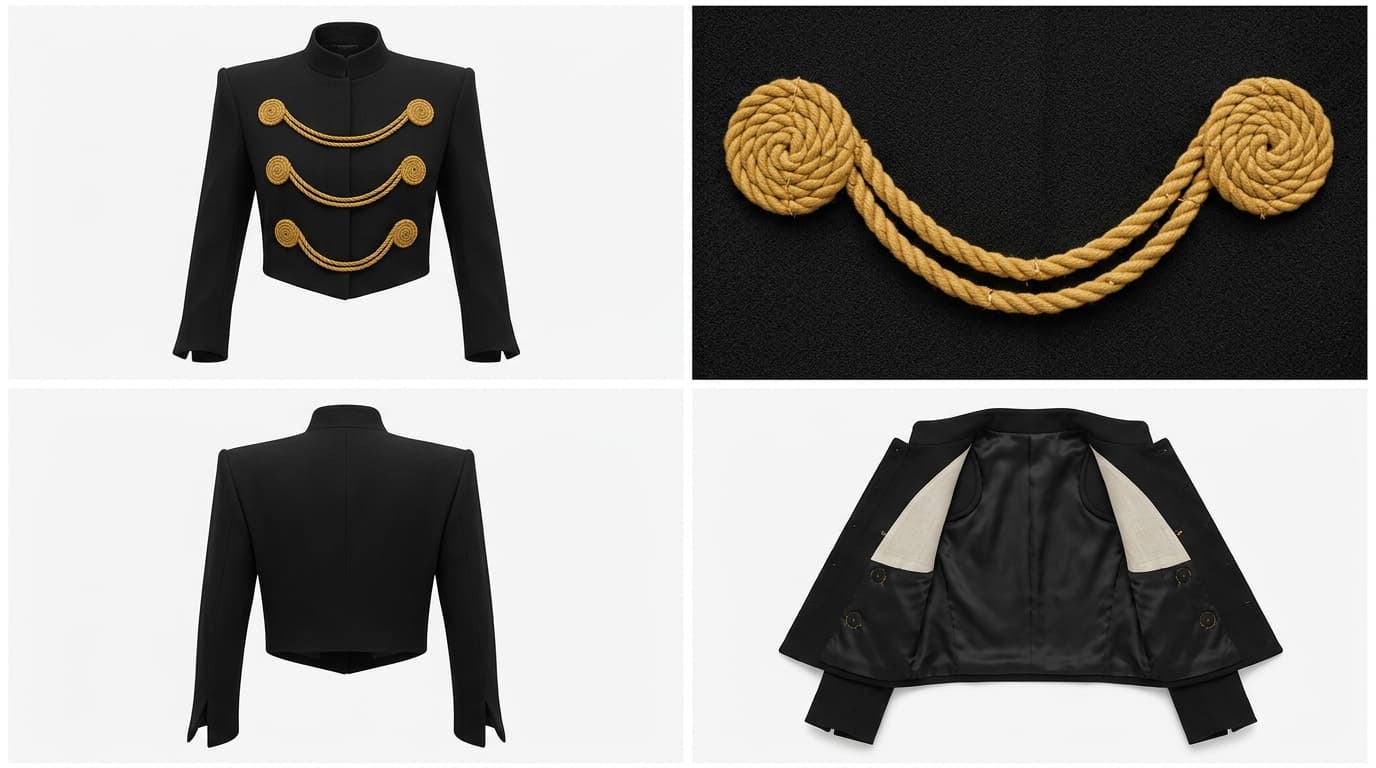
Exact prompt
Create a new photorealistic product reference sheet: exactly four equal tiles in a clean two-by-two grid with thin white gaps, every tile showing the same single black cropped military jacket on a plain white seamless background, e-commerce ghost-mannequin style with no person, no head and no hands. THE VIBE: Quiet, sharp, ceremonial tailoring made modern: a black wool jacket with an almost theatrical band of gold cord across the chest. Precise, clean, a garment laid out for study. THE SUBJECT: The jacket is the cropped black wool-crepe military jacket with a mandarin stand collar, hard wide structured shoulders with sharp square shoulder points, long fitted sleeves ending in slightly flared cuffs that fall long over the hands, and a short cropped hem ending at the waist with a gently shaped point at the centre front. The front closes through a smooth hidden placket with no visible buttons. Across the chest are three swags of mustard-gold twisted two-ply cord, one above the other, each swag curving in a shallow U between two flat coiled spiral rosettes of the same cord, one rosette near each end; the cord is matte, soft and rope-like, not shiny metal. Tile one, top left: the full jacket from the front, centred, showing the stand collar, square shoulders, the three gold cord swags with their six spiral rosettes, the hidden placket and the cropped hem. Tile two, top right: a close-up of one gold cord swag and its coiled spiral rosette on the black wool, showing the two-ply twist of the cord, the hand-stitched tacking points and the dense wool-crepe weave around it. Tile three, bottom left: the full jacket from the back, centred, plain black with no cord, showing the clean centre-back seam, the sharp structured shoulders, the stand collar from behind and the long sleeves. Tile four, bottom right: the jacket opened flat to show the inside: the black lining, the hidden front placket with its fastenings, the shoulder pads and the pale hair-canvas interlining at the chest, and the underside of the cord rosettes tacked through to the wool. THE SETTING: Plain white seamless studio background in all four tiles, a pure white ground with a faint soft shadow beneath each garment. No room, no props. THE LIGHT: Soft diffused studio light from above and slightly to the left is the key, with a low raking side light that catches the wool-crepe grain and the twist of the gold cord; a thin clean rim along the garment edges separates the black jacket from the white ground, and the same lighting in every tile. THE KEY DETAILS: The matte mustard-gold cord twist and coiled rosettes; the dense matte black wool surface; the sharp seams and crisp edges of the shoulders and stand collar; the black lining and pale hair canvas inside. Every tile is the same jacket in identical colours. THE MOOD: A tailoring reference sheet for a fashion brand: clean, exact, ready to hand to a maker. THE COMPOSITION: Four equal tiles of identical size in a two-by-two grid, each garment centred and large in its tile with even white margin, the close-up detail tile filling its tile edge to edge with the cord. Exactly four tiles, no more. THE CAMERA: Sharp, deep focus, everything crisp, neutral white balance, straight-on at chest height for the front and back tiles, a macro close-up for the detail tile. No text, no labels, no logos, no brand names, no people, no faces, no hangers, no extra tiles.
Then the flip got its own scene in the middle: the gloves grab a black wool panel by the edges, flick it up, it flips once in the air and lands lining side up, with the frame gliding along so it stays in shot.
Exact prompt
Create a new video: a fast, rhythmic "how it's made" film of a cropped black wool military jacket with gold twisted-cord swags being made entirely by hand, from a length of raw black wool to the finished jacket. Only a pair of bright pink padded work gloves and forearms are ever seen; no face, no body. The work happens in a bright tailor's workshop: soft daylight from a tall window on the left, clean and even, a worn wooden bench, tailor's tape, chalk, shears and pins, a sewing machine in the background. Fast, precise cuts on the beat, most shots well under a second, high-energy motion, with one showpiece beat where the gloved hands flip the cloth through the air. Every shot has one clear move with a stated speed. The final scene is a held hero shot, noticeably longer than all the others. Roles, stated once: the jacket in [Image1] is the subject. Its black colour, stand collar, wide square structured shoulders, short cropped hem and the three swags of gold twisted cord, each ending in flat coiled rosettes, must match exactly and must not change. Take only the jacket from [Image1], not its white background or its four-panel layout. [Image2] is the gloves and workshop look only: take the bright pink padded gloves, the worn bench and the soft daylit tailor's workshop, and nothing else from it; the cloth being worked is black wool, not the off-white cloth in [Image2]. The gloves look identical in every shot. [SCENE 1] Two quick cuts. First, a close top-down snap as the pink gloves shake out a length of black wool and smooth it flat across the bench. Then a fast lateral track as a piece of tailor's chalk draws a long line along the cloth. [SCENE 2] Two quick cuts. First, a macro as shears bite into the black wool and cut a clean curve, a fast track following the blades. Then a top-down as a cut panel is lifted away from the offcut. [SCENE 3] Two quick cuts. First, a close push-in as pins are pressed along the edge of two black panels. Then a low angle as the gloves square the panels together. [SCENE 4] The flip. The pink gloves grip the black wool panel by its edges and flick it up, and the cloth flips over once in the air, unfurling and snapping open, the view gliding with it so it stays framed, then it lands flat on the bench with its lining side now up. Fast, confident, one smooth motion, the gloves staying in frame throughout. [SCENE 5] Two quick cuts. First, an overhead as pale hair canvas is laid onto the black wool and pressed with the flats of the gloves. Then a tight macro as a shoulder pad is seated into the wide square shoulder point. [SCENE 6] Two quick cuts. First, a close side-on view as the gloves lay a length of matte gold twisted cord in a U-shaped swag across the black chest of the jacket. Then a macro on a needle taking small hand stitches through the cord to tack it down. [SCENE 7] Two quick cuts. First, a top-down as the end of the gold cord is wound flat into a tight coiled spiral rosette. Then a macro riding along with the needle as the rosette is stitched in place on the black wool. [SCENE 8] Two quick cuts. First, a low track as the gloves smooth the stand collar around its curve. Then a fast push-in on the gloves pressing the sharp point of the shoulder. [SCENE 9] Two quick cuts. First, the gloves lift the finished jacket by its shoulders and the sleeves fall open. Then a top-down as the gloves lay it down on the bench and smooth the sleeves straight, then pull away out of frame. [SCENE 10] The finished jacket from [Image1], laid flat on the bench, seen from above, large and centred, the whole jacket fully visible with its square shoulders, stand collar and three gold cord swags with their rosettes, no hands touching it, a slow push-in settling to a locked frame in the soft daylight. Held steady. Match the jacket from [Image1] exactly: black wool, stand collar, structured shoulders and three gold cord swags with rosettes must not change in the final scene, and it must stay large and readable. Take only the gloves and workshop look from [Image2]. No logos, no text, no lettering, no subtitles, no watermarks, no branding anywhere. No faces, no hanger, no mannequin, no headless shape, no extra fingers, no warped hands, no melting fabric.
The flip comes out as a fast blur of cloth, which is pretty much what a real flip looks like. What broke was the ending. I asked for the jacket laid flat on the bench, seen from above, and it came out standing upright on the bench like there's an invisible body inside it.
Why it works
Most of a "how it's made" video is stuff you expect to see. I add one beat you'd never see in a real workshop video, keep everything around it normal, and write it out step by step: who grabs what, what moves, what stays still and where it lands.
Your turn: pick one impossible moment for your product and write it as three plain steps.
If you want a showpiece beat without writing it all out, Emero writes the prompt and remembers what you've already locked in. All at cost.

Get one of these every day
I test new workflows daily and send them with the exact prompts, the models and the costs
5,979 generations tested so far
More workflows
See all
GPT Image 2.5 Flare - fix one thing in an image without losing the rest
Change one detail in an AI image, like size, mood or pose, while the rest of the picture stays put
GPT Image 2.5 Flare · 2 min render
GPT Image 2.5 Flare - Gen Z slang taken literally
Turn slang like spill the tea, glazing and catfished into photos that show the words literally
GPT Image 2.5 Flare · 2 min render
GPT Image 2.5 Flare - old sayings turned into deadpan photos
Turn everyday sayings into realistic photos where one impossible thing happens and nobody reacts
GPT Image 2.5 Flare · 1 min render